
👉Fitness After 40: Why It Feels Different (And What To Do)
- MOH Singapore. Nutri-Grade Requirements for Key Sources of Sodium and Saturated Fat Intake to Take Effect from Mid-2027. April 2025. moh.gov.sg
- HPB Singapore. Measures for Nutri-Grade. hpb.gov.sg
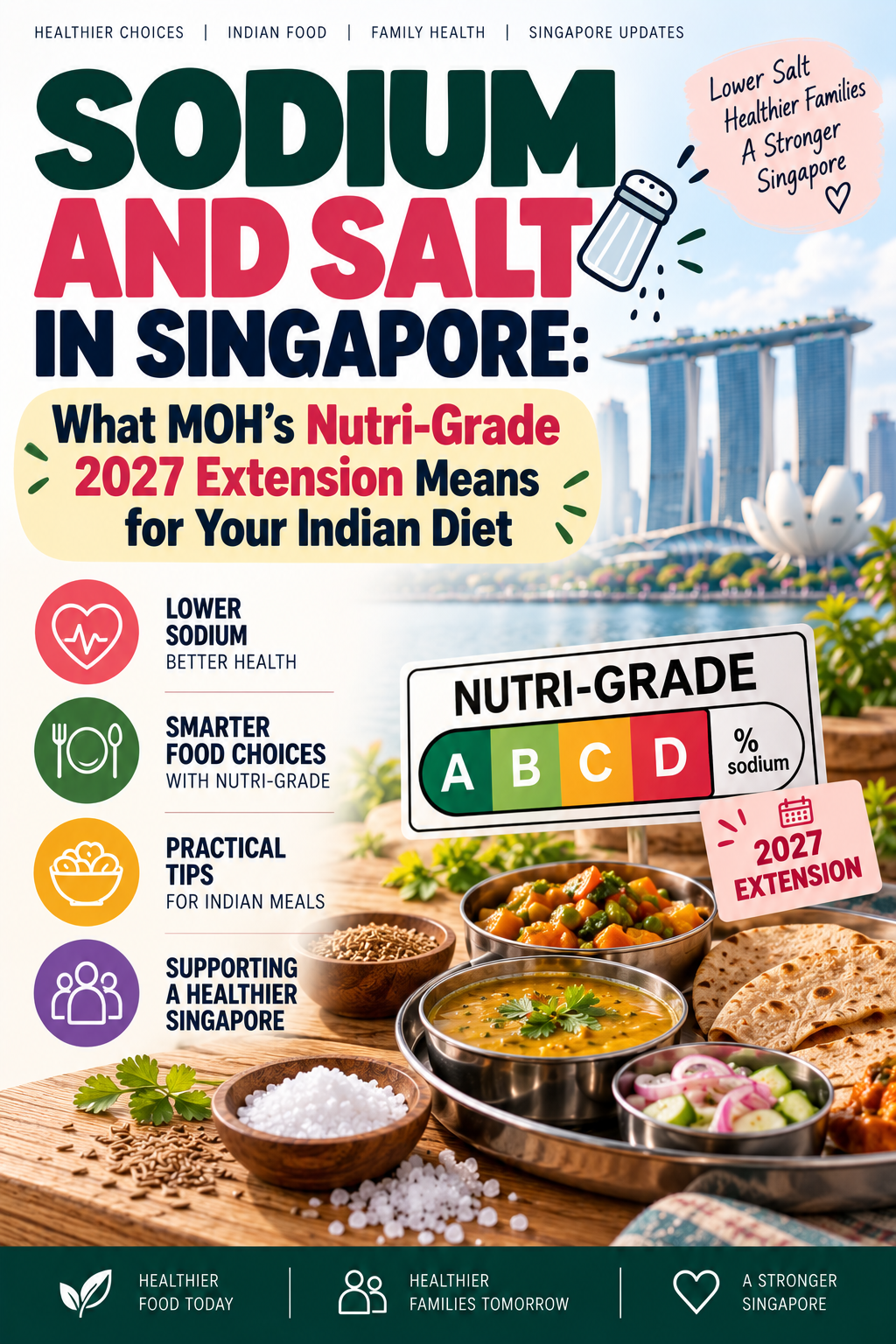
What Is the Nutri-Grade System — and What Is Changing in 2027?
Current Nutri-Grade (Since December 2022)
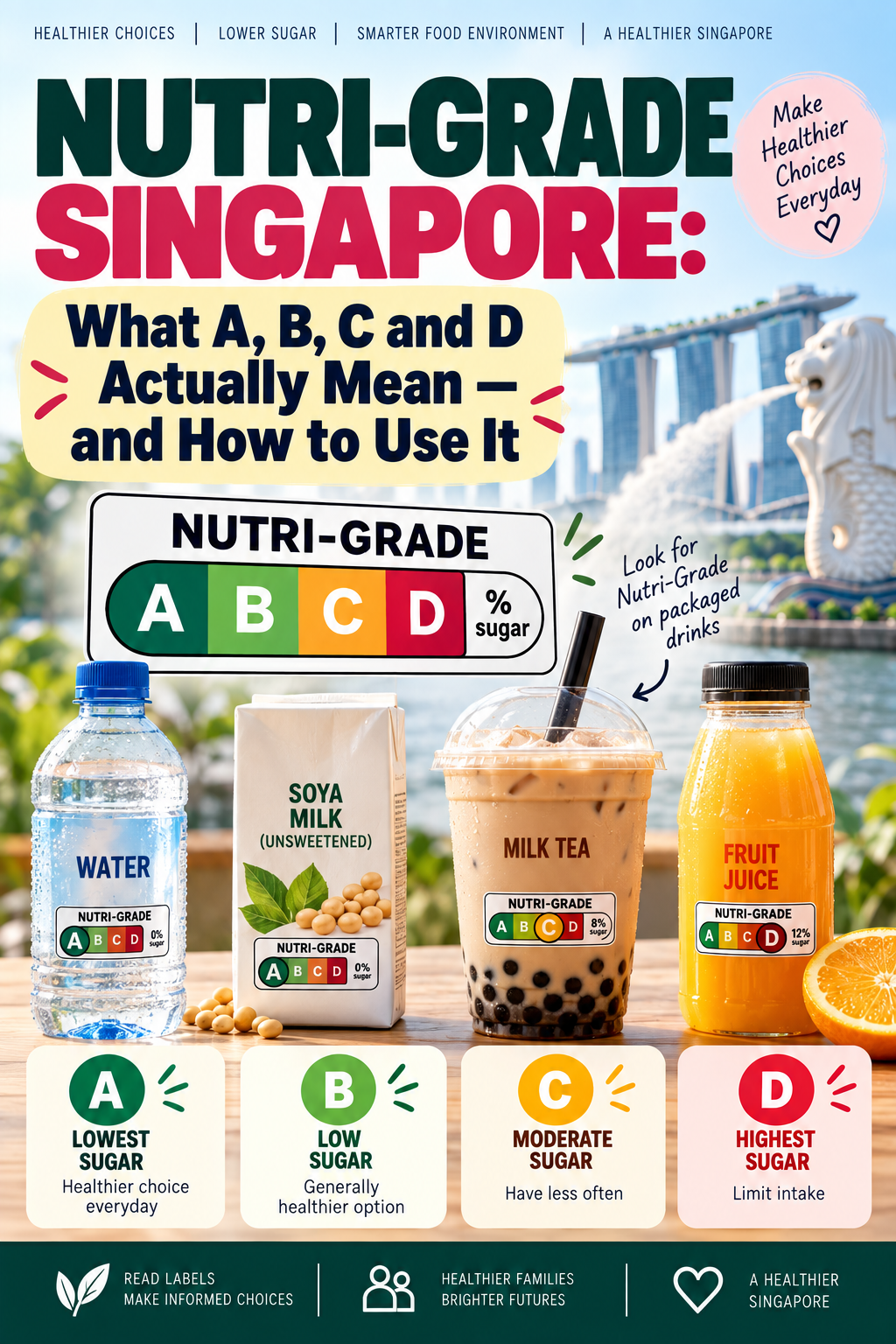
The existing Nutri-Grade system grades beverages on a colour-coded A–D scale based on sugar and saturated fat content — Grade A (dark green) being healthiest, Grade D (red) being least healthy. Since December 2022, all prepacked beverages must display their grade, and since December 2023, freshly prepared drinks at food establishments (hawker centres, cafes, restaurants) must also display grades. Grade C and D drinks face advertising restrictions.
The system has produced measurable results: the median sugar level of prepacked Nutri-Grade drinks fell from 7.1% in 2017 to 4.6% in September 2023, a 35% reduction directly attributable to the grading pressure on manufacturers. Approximately six in ten beverage outlets are now offering less sweet choices by default.
What Changes from Mid-2027
From mid-2027, the Nutri-Grade system will be extended to 23 sub-categories of SSSIO products in retail settings, introducing sodium as a key nutrient of concern alongside saturated fat. The categories covered include:
- Prepacked salt products
- Soy sauce, oyster sauce, fish sauce, and other sauces
- Pastes, seasonings, and spice mixes
- Soups, broths, and stock cubes
- Instant noodles (including Maggi, Indomie, and other brands widely consumed in Singapore)
- Cooking oils (graded on saturated fat)
The Nutri-Grade for these products will use the same A–D grading system, with Grade A representing the lowest sodium/saturated fat and Grade D representing the highest, encouraging reformulation by manufacturers and helping consumers compare products on the shelf. Grade D products will face advertising prohibitions across all platforms.
No grace period will be provided after mid-2027 implementation.
👉Nutri-Grade Singapore — the complete A/B/C/D explanation for beverages and the 2027 extension
👉Healthier SG Singapore — blood pressure and sodium status are monitored through the programme
Why This Matters for Indian Women in Singapore: Your Hidden Sodium Sources
The Nutri-Grade 2027 extension will make visible, for the first time, clearly and systematically, the sodium load in the sauces, seasonings, and condiments that form the backbone of both Indian and broader Singapore cooking. For Indian women managing hypertension, blood pressure, kidney health, or metabolic syndrome, the categories being labelled map directly onto the highest-sodium elements of the Indian kitchen in Singapore.
The Indian Kitchen’s Hidden Sodium Load
| Product (Singapore retail) | Typical Sodium Content | Daily Limit Context |
|---|---|---|
| Mango pickle/lime pickle (1 tablespoon) | 400–600 mg | 20–30% of daily limit in one tablespoon |
| Commercial curry paste (1 serving) | 800–1,200 mg | 40–60% of daily limit per curry made |
| Soy sauce (1 tablespoon) | 900–1,100 mg | 45–55% of daily limit |
| Fish sauce (1 tablespoon) | 1,200–1,500 mg | 60–75% of daily limit |
| Instant noodle packet (1 serving, all seasoning) | 1,500–2,000 mg | 75–100% of daily limit in one meal |
| Stock cube (1 cube) | 900–1,100 mg | 45–55% per cube used in cooking |
| Papad/poppadom (1 piece) | 200–350 mg | 10–17% per piece |
| Iodised table salt (1 teaspoon) | 2,300 mg | 115% of daily limit in one teaspoon |
An Indian woman cooking a standard curry using a commercial curry paste + soy sauce + fish sauce (common in Singapore’s Indian-Malay fusion cooking) + a stock cube + a teaspoon of salt at the table can easily exceed 4,000–5,000 mg of sodium in a single meal, two to two-and-a-half times the recommended daily limit before accounting for any other meal.
👉High Uric Acid Diet Singapore — sodium worsens uric acid excretion and urate crystal formation
👉Metabolic Syndrome in South Asian Women — hypertension as part of the broader metabolic cluster
How to Read the Nutri-Grade Labels From 2027
When the 2027 extension takes effect, products in the SSSIO categories at NTUC FairPrice, Cold Storage, Mustafa Centre, and all Singapore supermarkets will display the Nutri-Grade mark. Here is how to use it:
- Grade A (dark green): Lowest sodium; actively choose these products. The grading thresholds are set per subcategory, encouraging within-category comparison. A Grade A soy sauce is the lowest-sodium option within the soy sauce category.
- Grade B (light green): Better than average; reasonable choice when Grade A is unavailable
- Grade C (orange): Higher sodium; use sparingly; Grade C products must display the Nutri-Grade label on all advertising
- Grade D (red): Highest sodium in the category; limit significantly; advertising prohibited
The practical behaviour change MOH is engineering: when consumers see a red Grade D label on an instant noodle seasoning packet at NTUC, many will switch to a Grade B or A alternative, exactly what the beverage Nutri-Grade achieved with sugar in drinks.
What to Do Now — Before 2027
The Nutri-Grade labels for SSSIO do not arrive until mid-2027, but the sodium problem and its health consequences exist now. The strategies below address the highest-sodium components of the Indian Singapore kitchen immediately:
1. Switch Cooking Method — From Paste to Fresh Spice
Commercial curry pastes and spice mixes are convenient but sodium-dense. A curry made from fresh spices like cumin, coriander, turmeric, chilli, garlic, ginger, and onion, with salt added at the end in a measured amount, contains a fraction of the sodium of the same curry made from a commercial paste. The flavour of fresh-spice cooking is also superior. Available at Tekka Market, Geylang Serai, and all Singapore wet markets at modest cost.
2. The Sodium Budget Approach
With a 2,000 mg daily sodium budget, allocate it deliberately:
- Cooking salt: maximum ¼ teaspoon per meal (575 mg)
- Condiments combined: maximum 500 mg (approximately 1 teaspoon soy sauce OR ½ tablespoon fish sauce; not both)
- Preserved foods (pickle, papad): maximum 1 small serving, maximum 3 times weekly, not daily
- Processed/packaged foods: check label; target below 600 mg sodium per serving
3. The Low-Sodium Swap List for Indian Cooking in Singapore
| High-Sodium Item | Lower-Sodium Alternative | Where to Buy in Singapore |
|---|---|---|
| Regular soy sauce | Reduced-sodium soy sauce (Kikkoman Less Salt) | NTUC FairPrice, Cold Storage |
| Commercial curry paste | Homemade spice blend or Baba’s individual spice powders | Mustafa, Indian grocery stores in Little India |
| Stock cube/powder | Homemade bone broth or low-sodium stock (Massel brand) | Cold Storage, iHerb Singapore |
| Table salt (unrestricted) | Himalayan salt or iodised sea salt used in ¼ teaspoon measures | NTUC FairPrice; note: all salts have similar sodium content; measure, not type, is what matters |
| Instant noodles with full seasoning packet | Plain noodles + homemade spice or use ½ seasoning packet only | NTUC, Cold Storage |
| Packaged sambar/rasam powder | Homemade sambar powder (no added salt) | Indian spice stores in Little India, Mustafa |
| Mango pickle (daily) | Maximum 1 teaspoon, maximum 3× per week; replace daily habit with lime wedge | Reduce quantity at Mustafa; lime from any wet market |
4. Add Potassium to Counter Sodium’s Blood Pressure Effect
Potassium directly antagonises sodium’s blood-pressure-raising effects through the RAAS pathway. The most practical daily potassium additions for Indian women in Singapore: one banana daily (360 mg potassium), rajma weekly (600 mg per 100g cooked; highest Indian food potassium source), coconut water as a hydration choice (600 mg per cup, at any Singapore supermarket), and palak regularly (558 mg per 100g cooked).
5. Use HPB’s Healthier Choice Symbol Now
The HPB Healthier Choice Symbol (HCS) already identifies lower-sodium products in categories where it applies; look for it on soy sauce, curry pastes, and instant noodles at NTUC and Cold Storage now, before the Nutri-Grade extension formalises the grading system across the full SSSIO range.
👉Kidney Stones Prevention Diet in Singapore: The Indian Food Guide That Actually Works
Metabolic Health · Singapore
Managing high blood pressure or metabolic health in Singapore? Sodium is the most impactful dietary lever.
I work with women in Singapore to build personalised low-sodium nutrition plans that work with Indian food culture, not against it, and that fit Singapore’s hawker and supermarket environment practically.
👉 Book a FREE 20-Minute Metabolic Health Audit Call
Dr Akanksha Sharma · MBBS MD · Singapore & worldwide via Zoom
The Hawker Centre Sodium Picture
The Nutri-Grade 2027 extension covers prepacked SSSIO products sold at retail; it does not directly regulate freshly prepared hawker centre food. This is important context: even with the most sodium-savvy supermarket shopping, Indian women in Singapore who eat at hawker centres regularly are consuming significant hidden sodium from gravies, sauces, and cooking seasonings used in bulk restaurant preparation.
Practical hawker centre sodium reduction that applies now:
- Request less gravy: The gravy is where most hawker sodium lives; asking for “less gravy” or “gravy on the side” at economy rice, curry, and noodle stalls can reduce sodium intake by 30–40% from a single meal
- Avoid drinking hawker soups: Hawker broths- laksa, bak kut teh, prawn noodle soup- contain 800–1,500 mg of sodium per bowl of soup consumed. Eat the solid ingredients and leave the broth.
- Choose HPB Healthier Hawker stalls: HPB’s Healthier Hawker Program identifies stalls using lower-sodium ingredients and preparation methods. Look for the Healthier Choice logo at hawker centres across Singapore.
- At Indian hawker stalls: Choose plain thosai with sambar (lower sodium than gravy-heavy preparations), rasam (thin and lower sodium), and request roti without excess salt if buying from a mamak stall
📥 Download the Healthy Hawker Food Cheat Sheet (Doctor-Approved)
Frequently Asked Questions
Pink Himalayan salt is marketed as healthier than regular salt. Is it lower in sodium?
No, and this is one of the most persistent nutritional myths among Indian women in Singapore. Pink Himalayan salt contains approximately the same sodium content as regular table salt, approximately 2,300 mg of sodium per teaspoon. It is not lower in sodium, does not have clinically meaningful mineral advantages over iodised table salt at the quantities consumed in cooking, and critically, unlike iodised table salt, does not provide iodine, which is an essential mineral particularly important for thyroid function. Using pink Himalayan salt instead of iodised salt while cutting out dairy and seafood is a pathway to iodine deficiency. If you prefer to use Himalayan salt for its flavour, continue, but measure it the same way, and ensure your iodine comes from other sources (iodised salt at the table, dairy, or eggs).
I cook Indian food daily. How do I realistically reduce sodium when so many authentic recipes require salt-heavy condiments?
The most practical approach is ingredient substitution rather than recipe reduction. Swap commercial curry pastes for fresh spices (which contain negligible sodium). Replace stock cubes with Massel low-sodium stock or homemade broth. Reduce (not eliminate) salt in cooking to ¼ teaspoon per pot rather than ½–1 teaspoon. Use tamarind, lime, and kokum (sour flavours) and fresh chilli (heat) to compensate for the flavour contribution of reduced salt; these enhance perceived flavour without adding sodium. The palate adapts to lower-sodium cooking within 2–4 weeks; food that initially tastes “bland” relative to the previous sodium level becomes the new normal.
Will the Nutri-Grade 2027 extension apply to food sold at Mustafa Centre and Indian grocery stores?
The Nutri-Grade 2027 extension applies to prepacked SSSIO products sold at all retail settings in Singapore, including Mustafa Centre, Indian grocery stores in Little India, and all supermarkets. This means the pickles, curry pastes, spice mixes, and sauces sold at Mustafa will also require grading, making this one of the most relevant policy changes for the Indian community’s food purchasing specifically. Watch for Nutri-Grade labels on your Aachi, MDH, and Everest spice packets from mid-2027.
The Bottom Line
Singapore’s Nutri-Grade 2027 extension to salt, sauces, seasonings, and instant noodles is the most significant food labelling policy change since the original beverage grading in 2022, and it is directly relevant to the Indian kitchen in Singapore, where commercial curry pastes, sauces, pickles, and seasonings represent the single largest hidden sodium source in an otherwise nutritious diet. From mid-2027, Grade A–D labels will appear on these products at NTUC FairPrice, Cold Storage, and Mustafa Centre, making sodium comparison at the shelf systematic. Act before 2027: switch to fresh spices, measure salt in ¼ teaspoon increments, request less gravy at hawker centres, reduce daily pickle from tablespoon to teaspoon, and look for the existing HPB Healthier Choice Symbol on sauces and condiments now. The 37% Singapore hypertension rate was built one sauce-heavy curry at a time. It can be reduced the same way.
Sodium & Metabolic Health · Singapore
The Labels Are Coming in 2027. Your Health Cannot Wait Until Then.
A personalised nutrition plan that addresses sodium reduction through Indian cooking, without asking you to abandon your food culture, is the most practical next step for managing blood pressure and cardiovascular risk in Singapore.
Not sure where to start? Let’s talk: 20 minutes, your numbers, your kitchen, a clear plan. 👉 Book a FREE 20-Minute Metabolic Health Audit Call Dr Akanksha Sharma · MBBS MD · Preventive Medicine Physician · Singapore & worldwide via Zoom |
Disclaimer: This article is for educational purposes only. Management of hypertension requires medical assessment and guidance from your physician.
References:
- MOH Singapore. Nutri-Grade Requirements for Sodium and Saturated Fat to Take Effect Mid-2027. April 2025. moh.gov.sg
- HPB Singapore. Measures for Nutri-Grade. hpb.gov.sg
- MOH Singapore. NPHS 2022 — 9 in 10 Singapore residents exceed sodium intake; hypertension prevalence 37.0%. moh.gov.sg
- Lexology. Extension of Nutri-Grade labelling to sodium and saturated fat from mid-2027. April 2025. lexology.com

Akanksha Sharma
Dr Akanksha Sharma (MBBS, MD) is a physician and women’s health nutrition specialist, and the founder of IYSA Nutrition. She provides evidence-based, doctor-led nutrition guidance for pregnancy, postpartum recovery, PCOS, child nutrition, and family health, helping women make calm, informed decisions about their health and their children’s well-being.

Leave a Reply