👉Perimenopause Nutrition Singapore
What Is Seed Cycling? The Protocol Explained
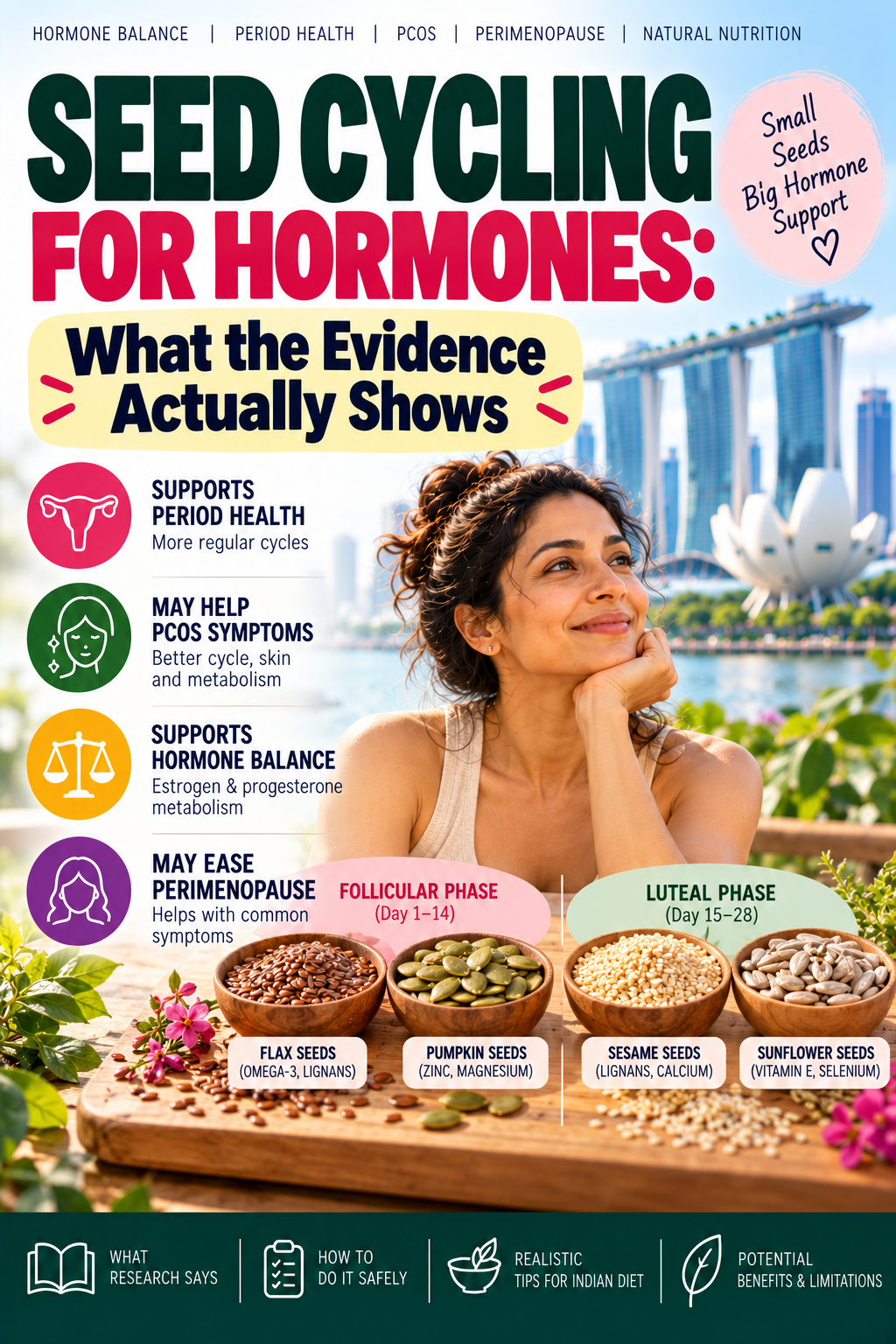
Seed cycling rotates four seeds across the two main phases of the menstrual cycle:
| Phase | Days | Seeds | Dose | Claimed Mechanism |
|---|---|---|---|---|
| Follicular phase | Day 1–14 | Ground flaxseed + pumpkin seeds | 1 tablespoon each daily | Support oestrogen production and metabolism; flaxseed lignans modulate oestrogen; pumpkin seed zinc supports FSH and LH |
| Luteal phase | Day 15–28 | Sesame seeds + sunflower seeds | 1 tablespoon each daily | Support progesterone production; sesame lignans balance luteal oestrogen; sunflower seed Vitamin E supports progesterone synthesis |
The biological rationale that specific seed nutrients influence the hormonal environment of each cycle phase has a plausible mechanistic basis, even if the formalised cycling protocol has not been directly tested in clinical trials with rigorous design.
👉 Perimenopause & Hormone Support Guide
What the Systematic Review Evidence Actually Shows
A 2025 systematic review specifically examining the efficacy of seed cycling as an integrative therapy for PMS and PCOS in reproductive-aged women was published in Cureus. This review searched PubMed and Scopus for studies from 2015 to 2025 on seed cycling or its components in women aged 15–49 with PMS or PCOS diagnosed using standardised criteria.
What the 2025 systematic review found:
- Seed cycling as a formalised protocol (cycling all four seeds across menstrual phases) remains under-researched, with no large, high-quality RCTs directly testing the complete protocol
- The studies that exist on the individual seeds, flaxseed specifically, and combined seed interventions show promising results for PCOS and PMS outcomes, including cycle regularity, hormonal parameters, and symptom burden
- Flaxseed lignans may affect sex hormone-binding globulin (SHBG) levels and improve androgen metabolism; sesame seed phytoestrogens may support luteal-phase oestrogen balance; pumpkin seed zinc supports FSH and LH signalling
- One included study (Kour, 2024) found substantial improvements in anthropometric, biochemical, and hormonal profiles of PCOS women following seed cycling therapy combined with dietary modifications
- The reviewers concluded that seed cycling shows “promising results” but requires larger, standardised RCTs to confirm efficacy
A separate 2023 systematic review specifically on flaxseed supplementation and sex hormone profiles in adults (cited in multiple reviews including the MedicalNewsToday 2025 evidence summary) found that flaxseed supplementation had no significant effect on sex hormones in adults broadly, but this meta-analysis included both men and women of all ages for conditions other than PCOS, not specifically the reproductive-age women with hormonal imbalance who are the primary seed cycling population.
👉Menopause Nutrition Singapore — phytoestrogen strategy including seeds, tofu, and edamame
What the Individual Seeds Actually Do: The Evidence-Based Breakdown
Here is where the evidence is more solid, not for the cycling protocol specifically, but for the nutritional properties of the individual seeds and their documented effects on hormonal and metabolic parameters.
Flaxseed (Ground) — Follicular Phase
Flaxseed is the most studied of the four seeds for hormonal effects. The relevant properties:
- Lignans (the main active compound): Plant polyphenols that act as phytoestrogens, binding weakly to oestrogen receptors and modulating oestrogen activity. Flaxseed contains the highest lignan content of any food (~800 times more than most other foods). The 2024 single-blind placebo-controlled study found that 10g of daily ground flaxseed powder over three months produced a 47% decline in perimenopausal symptom scores on the modified Kupperman’s Index, a clinically meaningful result.
- SHBG elevation: Flaxseed supplementation has been shown to increase SHBG in several studies; higher SHBG binds free testosterone, directly reducing androgen excess symptoms (acne, hirsutism, hair thinning) in women with PCOS or hyperandrogenism.
- ALA omega-3: Flaxseed provides ALA, the short-chain omega-3 precursor. This converts poorly to DHA (0–4% efficiency), but ALA has independent anti-inflammatory properties relevant to hormonal health.
- Luteal phase lengthening: A small but notable study in the Journal of Clinical Endocrinology and Metabolism found flaxseed supplementation increased luteal phase length and improved the progesterone-to-oestrogen ratio in regularly cycling women. This is one of the more directly relevant findings for the seed cycling biological rationale.
Pumpkin Seeds — Follicular Phase
- Zinc (highest plant zinc source per gram): Required for FSH synthesis, LH pulsatility, and ovulation. Zinc deficiency impairs follicular development and oocyte maturation. In PCOS, zinc also inhibits 5-alpha reductase, reducing the conversion of testosterone to the more potent DHT that drives acne and hair thinning.
- Magnesium: Magnesium is a cofactor for insulin signalling and HPA-axis regulation, both directly relevant to PCOS and perimenopausal hormonal health.
- Iron: Relevant for the iron losses of menstruation in the follicular phase when iron repletion is most needed.
Sesame Seeds (Til) — Luteal Phase
- Lignans (sesamin and sesamolin): Different lignans from flaxseed but with similar phytoestrogenic properties, may support oestrogen metabolism during the luteal phase when progesterone should predominate and oestrogen should decline appropriately.
- Zinc and selenium: Support thyroid function (selenium is required for T4→T3 conversion) and immune regulation. India’s food tradition of til laddoo, til chutney, and til in khichdi makes sesame one of the most naturally compatible additions to an Indian diet.
- Calcium: At 975 mg per 100g (one of the highest plant calcium sources), sesame seeds in tablespoon quantities contribute meaningfully to the daily calcium target, particularly relevant for luteal-phase bone turnover.
Sunflower Seeds — Luteal Phase
- Vitamin E (highest food source per gram): Vitamin E has documented evidence for PMS symptom reduction, particularly breast tenderness and mood symptoms. Several RCTs have found Vitamin E supplementation at doses of 400 IU reduces PMS severity; the seed cycling dose of 1 tablespoon sunflower seeds provides approximately 10 IU, which is a meaningful dietary contribution, though less than therapeutic supplemental doses.
- Selenium: As with sesame seeds, thyroid function support and antioxidant protection.
- Omega-6 (linoleic acid): Precursor to prostaglandin E1, which has anti-inflammatory effects relevant to PMS; the balance between omega-6 and omega-3 in the seed cycling protocol is relevant (flaxseed in the follicular phase provides omega-3; sunflower in the luteal phase provides omega-6, an interesting balance that the protocol advocates have noted).
👉PCOS and Hormonal Acne Singapore — pumpkin seed zinc reduces DHT-driven acne and hair thinning
Hormonal Health · Singapore
Seeds are a worthwhile addition to hormonal health nutrition, but they are one piece of a larger picture.
I work with women in Singapore to build the complete hormonal nutrition strategy, addressing insulin resistance, nutrient deficiencies, inflammatory load, and gut health, that seeds alone cannot cover.
👉 Book a FREE 20-Minute Hormonal Health Call
Dr Akanksha Sharma · MBBS MD · Singapore & worldwide via Zoom
The Honest Evidence Assessment
Here is the direct, evidence-calibrated verdict:
| Claim | Evidence Status | Appropriate Response |
|---|---|---|
| “Seed cycling balances oestrogen and progesterone” | Not proven as a cycling protocol in rigorous RCTs | Do not treat as established medical intervention |
| “Flaxseed improves perimenopausal symptoms” | Supported; a 2024 RCT found 47% symptom score reduction with 10g daily | Include ground flaxseed daily regardless of cycling phase |
| “Seed cycling may help PCOS cycle regularity” | Promising but limited; 2025 SR found encouraging data, inadequate RCT evidence for definitive conclusions | Worth trying alongside evidence-based PCOS interventions |
| “Individual seeds have real hormonal nutritional value” | Well-supported; zinc, lignans, Vitamin E, magnesium, selenium all have documented hormonal relevance | Include all four seeds regularly in diet, regardless of cycling structure |
| “Seed cycling is safe” | Yes, all four seeds are whole foods with excellent safety profiles at the recommended doses | No reason not to try; minimal downside risk |
👉A Doctor’s Natural Approaches for Perimenopause Symptom Relief
👉Navigating Perimenopause: Signs, Symptoms, and Strategies
The Practical Recommendation: Seeds Yes, Strict Cycling Optional
My clinical recommendation for Indian women in Singapore interested in seed cycling:
- Include all four seeds regularly in your diet: the nutritional value is real regardless of whether the cycling structure adds additional hormonal benefit beyond daily consumption
- Prioritise ground flaxseed daily (1 tablespoon): The most evidence-backed of the four, with specific perimenopausal, PCOS, and anti-inflammatory benefits. Must be ground (not whole) for bioavailability. In dahi, smoothie, porridge, or mixed into dal or sabzi.
- Include pumpkin seeds and sesame seeds most days: Both are traditional Indian foods (til laddoo, pumpkin seeds as a snack) — the cultural integration is natural and easy in Singapore’s Indian community
- Try the cycling structure if you find it motivating: If the structured protocol helps you maintain consistency with the seeds, the cycling framework is worthwhile even if the phase-specific mechanism is not proven, because the nutritional benefits of the seeds themselves are real
- Do not rely on seed cycling as a substitute for evidence-based hormonal management: For PCOS, seed cycling is an adjunct to the insulin resistance management strategy, not a replacement. For perimenopause, it is an adjunct to the hormonal nutritional strategy, not a sufficient standalone intervention.
Indian Kitchen Integration — Singapore Practical Guide
- Flaxseed: Ground fresh (coffee grinder, Decathlon or Mustafa available) and stored in the fridge; add 1 tablespoon to morning dahi, smoothie, or ragi porridge daily. Purchased pre-ground at NTUC FairPrice health foods aisle or iHerb Singapore.
- Pumpkin seeds: Roast lightly with salt and turmeric as a snack; add to trail mix; sprinkle over dal or sabzi. Available at NTUC FairPrice, Cold Storage, Mustafa, and health food stores.
- Sesame seeds: Til laddoo (traditional Indian preparation, jaggery + sesame, makes this a culturally natural daily habit); til chutney with dosa or idli; sprinkle over rice or stir-fry. Available at all supermarkets and Indian grocery stores.
- Sunflower seeds: Least traditional in Indian cooking but easily incorporated as a salad topping, added to trail mix, or eaten as an afternoon snack. Available at NTUC FairPrice and Cold Storage.
Frequently Asked Questions
My cycles are irregular. Should I try seed cycling?
Irregular cycles have multiple causes: PCOS, thyroid dysfunction, hypothalamic amenorrhoea (under-eating or over-exercising), perimenopause, and hyperprolactinaemia, each of which has a different treatment pathway. Seed cycling is a low-risk, nutritionally valuable addition regardless of cause, and may contribute to cycle regularity, particularly in PCOS where the zinc, magnesium, and phytoestrogen properties are most relevant. However, the most important first step for irregular cycles is a clinical assessment: TSH, FSH, LH, prolactin, testosterone, and a pelvic ultrasound, to identify the cause before relying on dietary intervention alone. Request this from your gynaecologist at KKH, NUH, or a private clinic.
I have PCOS. Will seed cycling help more than myo-inositol?
Myo-inositol has a substantially stronger and more consistent evidence base for PCOS-specific outcomes than seed cycling. The 2024 systematic review informing international PCOS guidelines documented significant improvements in metabolic markers, hormonal parameters, and cycle regularity from inositol supplementation at 2–4 g daily. Seed cycling does not have equivalent evidence for PCOS specifically. The most rational approach: myo-inositol as the primary evidence-based intervention, with daily seeds as a nutritionally worthwhile addition rather than a replacement.
Can I do seed cycling if I don’t have regular periods (PCOS, postmenopause, on the pill)?
Yes, women without regular menstrual cycles can follow the seed cycling protocol by cycling on a 28-day calendar schedule (days 1–14 follicular seeds, days 15–28 luteal seeds) rather than tracking actual menstrual phases. For postmenopausal women, the phytoestrogen benefit of flaxseed is the most relevant; daily ground flaxseed at 1 tablespoon is the most evidence-backed inclusion from the seed cycling protocol in this group, regardless of cycling structure.
The Bottom Line
Seed cycling as a formalised protocol, specific seeds at specific cycle phases, has promising but limited clinical evidence: the 2025 systematic review found encouraging data for PCOS and PMS outcomes but no large, rigorous RCTs testing the complete protocol. What is well-evidenced is that the four individual seeds contain genuinely valuable hormonal nutritional properties: flaxseed lignans that modulate oestrogen and SHBG (with a 2024 RCT showing 47% reduction in perimenopausal symptoms), pumpkin seed zinc that supports FSH, ovulation, and androgen metabolism, sesame seed calcium and selenium for thyroid and bone health, and sunflower seed Vitamin E for PMS symptom relief. The honest recommendation: include all four seeds in your diet consistently, prioritise daily ground flaxseed as the most evidence-backed addition, try the cycling structure if the framework helps you maintain the habit, and treat seeds as a worthwhile nutritional addition to an evidence-based hormonal health strategy, not as a substitute for one.
Hormonal Nutrition · Singapore
Seeds Are a Piece of the Hormonal Puzzle.
Let’s Build the Whole Picture.
A personalised hormonal nutrition plan, addressing insulin resistance, inflammatory load, gut health, nutritional deficiencies, and yes, seeds, tailored for your diet and Singapore lifestyle.
Managing hormonal symptoms and not sure where seeds fit in your overall strategy? Let’s talk — 20 minutes, your symptoms, your diet, a clear plan. 👉 Book a FREE 20-Minute Hormonal Health Call Dr Akanksha Sharma · MBBS MD · Preventive Medicine Physician · Singapore & worldwide via Zoom |
Disclaimer: This article is for educational purposes only. Hormonal conditions including PCOS, irregular cycles, and perimenopause require medical assessment before relying on dietary intervention alone.
References:
- Efficacy of Seed Cycling as Integrative Therapy for PMS and PCOS: Systematic Review. Cureus. 2025. PMC12461132
- Effectiveness of combined seeds as adjacent therapy for PCOS. Food Sci Nutr. 2023. PMC10261760
- Effects of flaxseed on perimenopausal symptoms: single-blind RCT. 2024. [47% decline in Kupperman Index symptom scores]
- Seed cycling for hormonal balance through menopause — evidence review. Menopause Centre Australia. 2025. Full Text
- MedicalNewsToday. Seed cycling for hormonal balance: what the research says. 2025. Full Text

Akanksha Sharma
Dr Akanksha Sharma (MBBS, MD) is a physician and women’s health nutrition specialist, and the founder of IYSA Nutrition. She provides evidence-based, doctor-led nutrition guidance for pregnancy, postpartum recovery, PCOS, child nutrition, and family health, helping women make calm, informed decisions about their health and their children’s well-being.
Leave a Reply