
Related reading:
👉Fitness After 40: Why It Feels Different (And What To Do)
What Is Nutri-Grade and Why Was It Introduced?
Nutri-Grade is a mandatory nutrition labelling and advertising restriction system introduced by Singapore’s MOH and HPB. It was launched in December 2022 for prepacked beverages and extended in December 2023 to freshly prepared drinks at food establishments.
The primary purpose was to address diabetes and obesity. Singapore has one of the highest rates of diabetes in developed Asia — 9.5% of Singapore residents have diabetes, and one in three will develop it in their lifetime. Sugar-sweetened beverages were identified as a major modifiable dietary driver of this risk. By making the sugar and saturated fat content of every drink visible, comparable, and subject to advertising restrictions at the worst end, MOH aimed to shift both consumer behaviour and manufacturer formulation simultaneously.
The results have been measurable: the median sugar level of prepacked Nutri-Grade beverages fell from 7.1% in 2017 to 4.6% in September 2023 — a 35% reduction. Approximately six in ten freshly prepared beverage outlets now offer lower-sugar choices by default.
References:
- HPB Singapore. Measures for Nutri-Grade. hpb.gov.sg
- MOH Singapore. Nutri-Grade extension to sodium and saturated fat. April 2025. moh.gov.sg
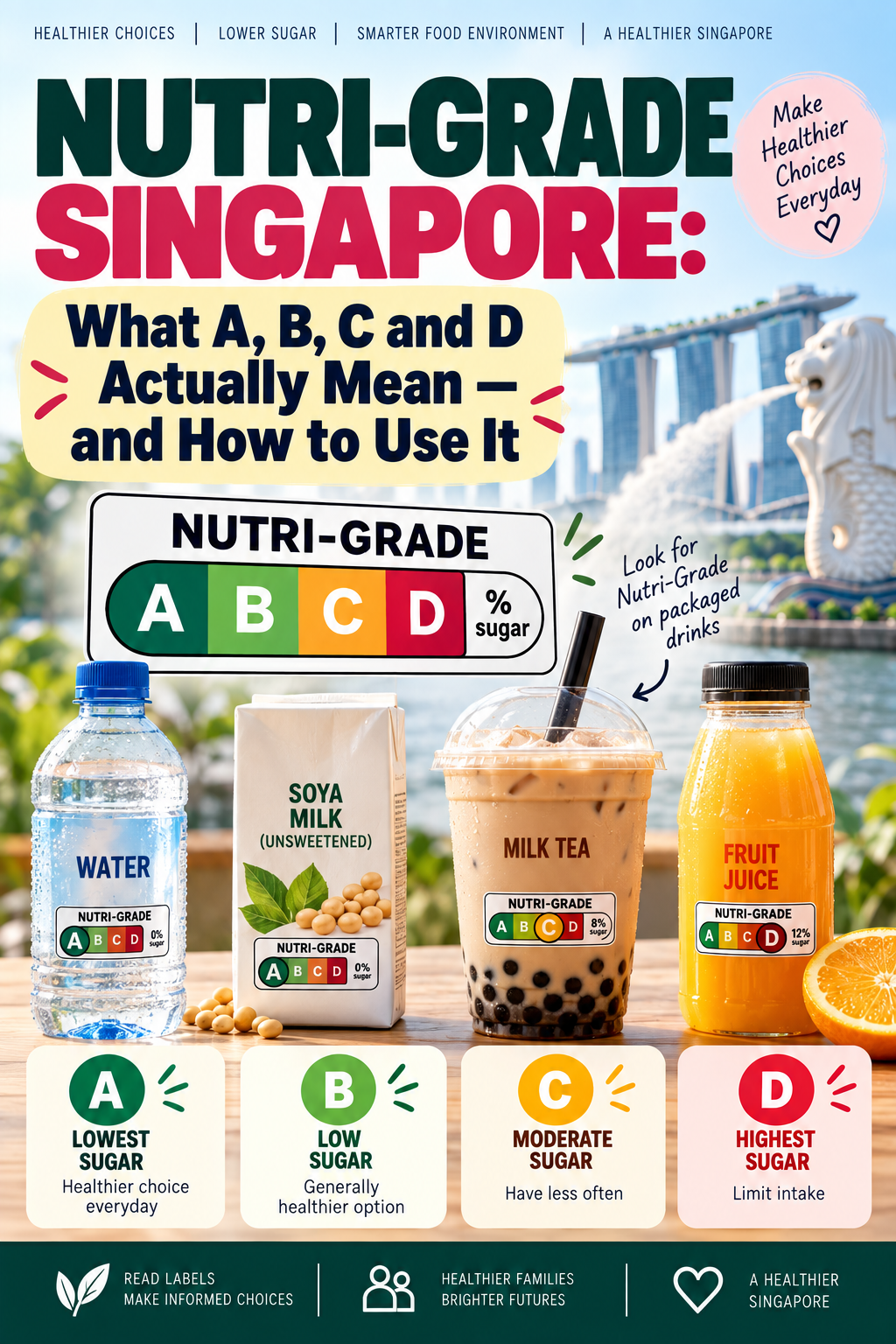
The Current Nutri-Grade System for Beverages: A, B, C, D Explained
The current beverage Nutri-Grade grades drinks on two nutrients of concern: sugar and saturated fat. The grading thresholds for each are defined per 100ml of product:
| Grade | Colour | Sugar (per 100 ml) | Saturated Fat (per 100 ml) | What This Means in Practice |
|---|---|---|---|---|
| A | Dark green | ≤1 g | ≤0.7 g | Lowest sugar and fat: unsweetened drinks, plain water alternatives |
| B | Light green | 1–5 g | 0.7–1.2 g | Low sugar: many reformulated drinks, unsweetened teas |
| C | Orange | 5–10 g | 1.2–2.0 g | Moderate sugar: must display Nutri-Grade mark on all advertising |
| D | Red | >10 g | >2.0 g | Highest sugar: advertising prohibited; must display mark prominently |
Important nuances:
- Grade A and B drinks are not required to display the Nutri-Grade mark (though many manufacturers do voluntarily to signal healthiness). Grade C and D drinks must display it on packaging and in all advertising.
- The grading is based on the drink as prepared for consumption, not per 100g of dry powder. A full-cream milk heated and served is graded differently from skim milk.
- 100% pure fruit juices without added sugar receive a Grade C or D based on their natural sugar content; this is intentional and important. “No added sugar” does not mean low sugar; natural fruit sugar contributes to the grade.
What Nutri-Grade Means for Common Drinks Indian Women Consume in Singapore
This is where the grading system becomes most practically useful — seeing where familiar drinks actually sit:
| Drink | Typical Grade | Clinical Implication |
|---|---|---|
| Plain water, sparkling water (unsweetened) | A | Zero nutritional concern, the ideal daily drink |
| Unsweetened green tea, oolong, black tea | A or B | Excellent daily choice; antioxidant benefit |
| Teh O Kosong (plain black tea, no milk, no sugar) | A or B | Good choice; ask specifically for “no sugar” |
| Unsweetened almond/soy milk | A or B | Reasonable dairy alternative when fortified |
| Milo (standard preparation, hawker centre) | C or D | 3–4 teaspoons of Milo powder + condensed milk = Grade D; significant daily sugar contribution |
| Teh Tarik (standard preparation) | C or D | Condensed milk + sugar = high sugar, high saturated fat; regular consumption drives insulin resistance in Indian women |
| Packaged fruit juice (100%, no added sugar) | C or D | Natural fructose still grades C or D; fructose directly drives uric acid and insulin production |
| Bubble tea (standard, with pearls) | D | 30–40 g sugar per drink; one of the highest-sugar regular beverages consumed in Singapore |
| Sugarcane juice (hawker centre) | D equivalent | Not yet Nutri-Grade labelled as freshly prepared; extremely high fructose content |
| Plain coconut water (unsweetened, packaged) | B or C | Natural sugars from coconut; reasonable electrolyte choice in moderation |
| Plain full-cream milk (200 ml) | B or C | Natural fat from dairy; nutritionally justified for calcium and protein despite B or C grade |
What Nutri-Grade Does Not Mean: Important Caveats
The Nutri-Grade system grades on sugar and saturated fat (for beverages); these are the two nutrients of greatest public health concern in beverages. But this means the grade does not capture everything nutritionally relevant:
- A Grade A drink is not necessarily the healthiest drink for you: A diet soda with artificial sweetener may receive a Grade A (no sugar, no saturated fat) while full-cream milk receives a Grade C. The milk is nutritionally superior in protein, calcium, and B12; the soda provides nothing of nutritional value. Grade A reflects the graded nutrients, not overall nutritional value.
- Sodium is not currently included in beverage grading: Until the 2027 extension, sodium content is not part of the Nutri-Grade calculation for beverages. A high-sodium sports drink may receive a favourable grade despite its sodium content.
- Caffeine, alcohol, and artificial additives are not graded: The Nutri-Grade system does not address caffeine content, alcohol, or artificial sweeteners, all of which may be relevant depending on individual health status.
- Portion size matters: The grade is calculated per 100 ml, but actual consumption varies widely. A 500 ml Grade B drink delivers five times the sugar and fat of 100ml; portion context is essential alongside the grade.
The 2027 Extension: Nutri-Grade for SSSIO Products
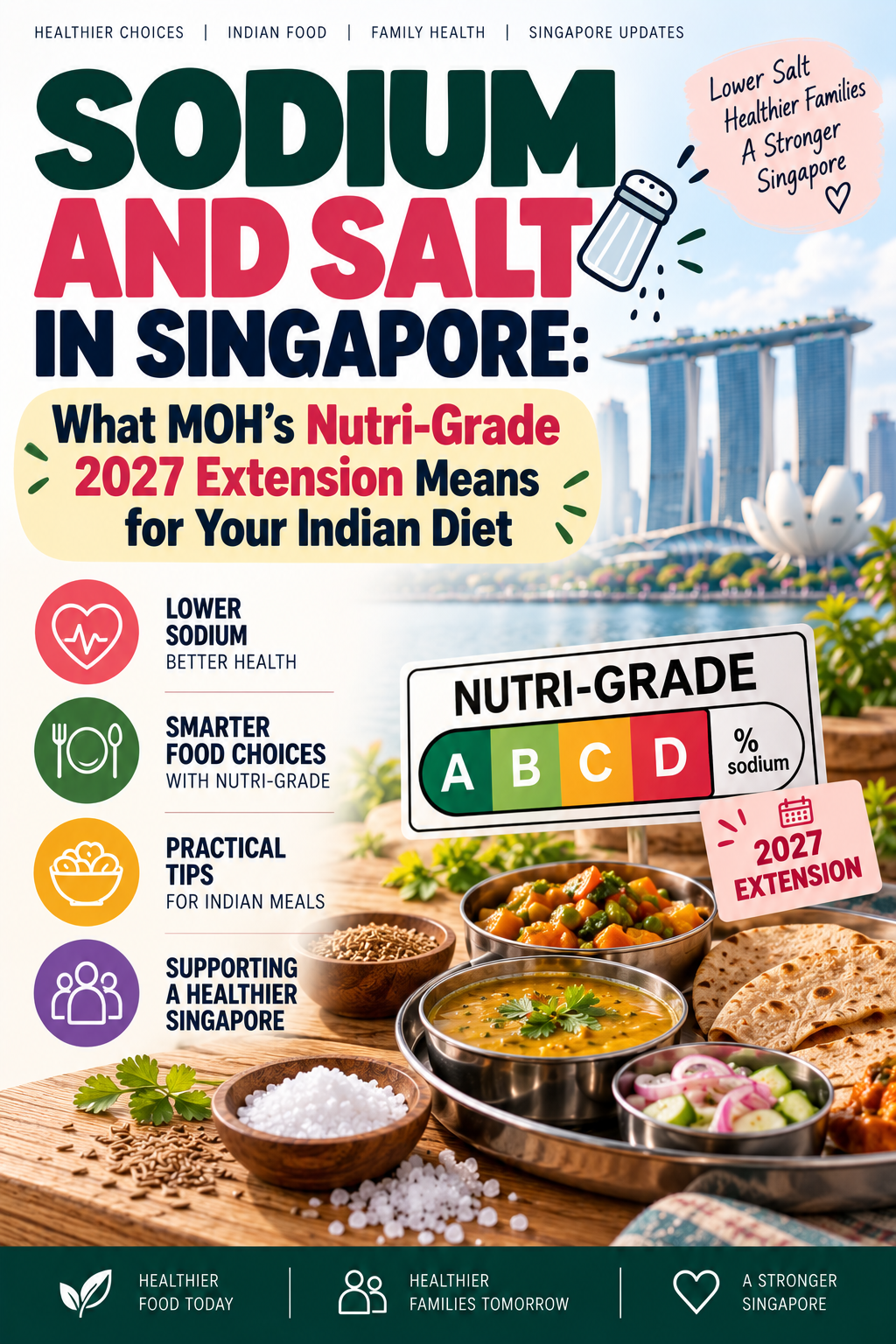
From mid-2027, the Nutri-Grade grading system extends to 23 sub-categories of prepacked salt, sauces, seasonings, instant noodles, and cooking oils (SSSIO) sold at retail in Singapore. For these products, sodium becomes the primary nutrient of concern (for salt, sauces, seasonings, and instant noodles) and saturated fat for cooking oils.
Key features of the 2027 extension as announced by MOH and HPB:
- Products will be graded A–D within each subcategory; the thresholds are set relative to the category rather than an absolute universal threshold, allowing within-category comparison
- Grade D products in the SSSIO categories will be prohibited from advertising across all physical and online platforms
- The grade will appear on product packaging, enabling systematic comparison at the supermarket shelf for the first time
- MOH and HPB have consulted with industry on the draft regulations; final provisions will be gazetted before the mid-2027 implementation
What This Means for Your Shopping at NTUC FairPrice, Cold Storage, and Mustafa
From mid-2027, look for the Nutri-Grade label on:
- Every bottle of soy sauce, fish sauce, oyster sauce, and sambal
- Every packet of instant noodles (Maggi, Indomie, Nissin)
- Every commercial curry paste (Baba’s, Mdh, Aachi, Prima Taste Singapore)
- Every salt product on the shelf
- Every cooking oil, graded on saturated fat content
The practical shopping rule from 2027: within any category, choose the highest grade (closest to A) when two products serve the same cooking purpose; lower-sodium soy sauce over standard soy sauce; Healthier Choice Symbol cooking oil over standard oil; reduced-sodium instant noodle seasoning over regular.
👉Sodium and Salt Singapore — the Nutri-Grade 2027 extension and what it means for Indian cooking
Nutrition Literacy · Singapore
Understanding food labels is one thing. Building a nutrition strategy around them is another.
I work with women in Singapore to translate Singapore’s food labelling system into a personalised, practical daily nutrition plan, one that accounts for Indian food culture, Singapore’s food environment, and your individual health goals.
👉 Book a FREE 20-Minute Nutrition Strategy Call
Dr Akanksha Sharma · MBBS MD · Singapore & worldwide via Zoom
How to Use Nutri-Grade Practically: A Singapore Indian Woman’s Daily Guide
At the Hawker Centre
- Look for the Nutri-Grade mark on the drinks display; Grade A or B drinks are the goal
- If the drinks stall only offers Grade C or D: ask for less sugar (“siu dai”: less sweet) or request a separate cup of hot water to dilute the prepared drink
- The best hawker centre drink choice that will always be available: plain water from a jug or the water cooler. No Nutri-Grade needed; it is always Grade A.
At NTUC FairPrice, Cold Storage, or Mustafa
- For bottled drinks: Look for Grade A or B: unsweetened teas, plain sparkling water, reduced-sugar variants of familiar drinks. Many brands have reformulated; a lower-grade version of a familiar drink often tastes nearly identical to the original after a short adjustment period.
- From 2027, for SSSIO products: Compare within categories and choose the higher grade (closer to A). When two curry pastes serve the same culinary purpose, the Grade A or B option achieves the same flavour outcome with less sodium.
- HPB Healthier Choice Symbol now: Use the existing HCS logo for sodium guidance on sauces and condiments before the 2027 Nutri-Grade extension is formalised.
For Your Family’s Daily Drinks
- Replace Grade D daily drinks with Grade A/B alternatives: Sweetened Milo (Grade D) → Milo Gao Siu Dai (less sweet, Grade C) → plain warm milk with 1 teaspoon cocoa and minimal honey (homemade equivalent, Grade B) → plain milk or unsweetened soy milk (Grade A/B)
- Practical transition for children: Reduce sweetness gradually over 2–4 weeks rather than eliminating immediately; the palate adjusts, and a gradual transition maintains acceptance while reducing sugar load
Frequently Asked Questions
My daily teh tarik is Grade D. Do I have to give it up completely?
Not completely, but the daily habit creates a meaningful cumulative sugar and saturated fat load that contributes directly to insulin resistance, particularly for Indian women with the thin-fat phenotype. The practical approach: make it weekly rather than daily. On daily working days, replace it with teh O kosong (black tea, no sugar) or teh O siu dai (less sweet): Grade B or C. Save the full teh tarik for a weekend treat. This single change reduces your weekly sugar intake from daily teh tarik by approximately 70–80% without eliminating the cultural and social enjoyment entirely.
If 100% fruit juice is Grade C or D, should I stop giving it to my children?
Yes, and this is an important message for Indian parents in Singapore who give fruit juice as a “healthy” daily drink. The Nutri-Grade system correctly grades fruit juice at C or D because the fructose content, even from natural fruit, is nutritionally concerning in the liquid, fibre-free form. Fructose in juice is absorbed rapidly, drives uric acid and insulin production, and provides no satiety. The entire fruit (with its fibre and physical structure) is nutritionally superior in every way. Replace packaged fruit juice with whole fruit and plain water. One guava provides more Vitamin C than a glass of orange juice, plus fibre, lower glycaemic response, and satiety.
I see some drinks labelled “no added sugar”, but they are still Grade C or D. How?
The grade reflects total sugar content, both naturally occurring and added. “No added sugar” on a label indicates no additional sugar was added during manufacturing, but the product’s natural sugar content can still be high enough to earn a Grade C or D. Fresh sugarcane juice, pure fruit juice, and flavoured milk with natural lactose all demonstrate this; the “no added sugar” claim is accurate while the grade still reflects the total sugar load your body receives.
The Bottom Line
The Nutri-Grade system is one of Singapore’s most effective and most accessible public health tools; it puts nutritional information at the point of purchase in a simple, colour-coded format that requires no nutritional education to use. For Indian women in Singapore, the most immediately actionable changes are: choose Grade A or B drinks at hawker centres and supermarkets, transition daily teh tarik from a Grade D daily habit to a weekly treat, replace packaged fruit juice with whole fruit, and prepare for the 2027 extension that will make sodium content visible on the sauces and seasonings that form the Indian kitchen’s hidden sodium load. The system works, the 35% reduction in beverage sugar content since 2022 demonstrates it. Use it.
Nutrition Strategy · Singapore
Singapore’s Food Labels Tell You What’s in the Food.
I Tell You What It Means for Your Health.
A personalised nutrition plan translates Singapore’s food labelling system: Nutri-Grade, Healthier Choice Symbol, and the 2027 extension, into a practical daily strategy for your Indian diet, your metabolic health, and your Singapore lifestyle.
Not sure where to start? Let’s talk — 20 minutes, your daily diet, a clear plan. 👉 Book a FREE 20-Minute Nutrition Strategy Call Dr Akanksha Sharma · MBBS MD · Preventive Medicine Physician · Singapore & worldwide via Zoom |
Disclaimer: This article is for educational purposes only. Nutri-Grade grades reflect two specific nutrients and should be considered alongside overall dietary patterns, not in isolation.
References:
- HPB Singapore. Measures for Nutri-Grade. hpb.gov.sg
- MOH Singapore. Nutri-Grade Requirements for Sodium and Saturated Fat — Mid-2027. April 2025. moh.gov.sg
- TEL Expert Solutions. Nutri-Grade Labelling Guide Singapore (updated January 2026). telexpertsolutions.com
- FoodNavigator-Asia. Singapore to enforce stricter sodium and fat labelling by 2027. June 2025. foodnavigator-asia.com

Akanksha Sharma
Dr Akanksha Sharma (MBBS, MD) is a physician and women’s health nutrition specialist, and the founder of IYSA Nutrition. She provides evidence-based, doctor-led nutrition guidance for pregnancy, postpartum recovery, PCOS, child nutrition, and family health, helping women make calm, informed decisions about their health and their children’s well-being.

Leave a Reply