
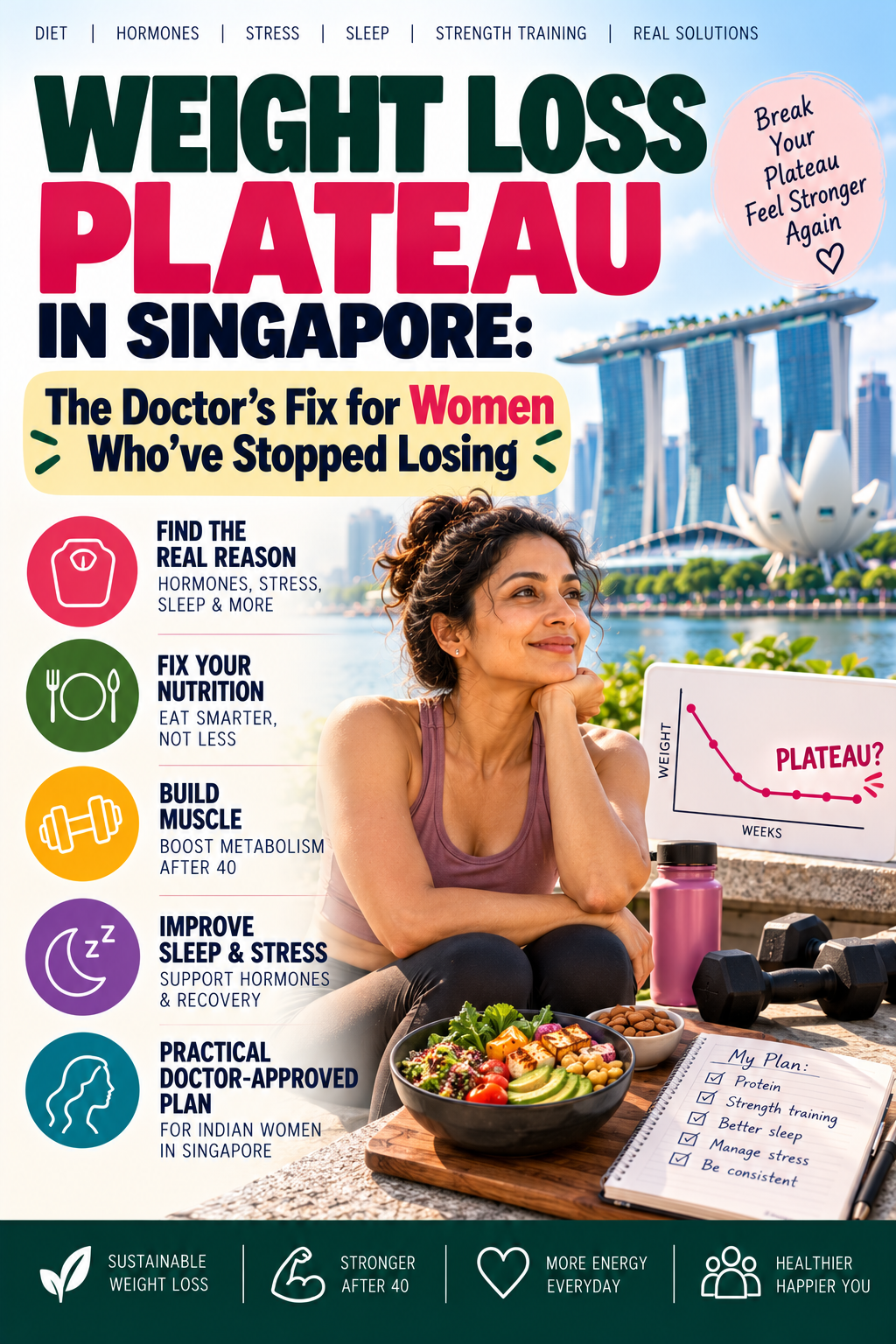
This post gives you the evidence-based explanation of the weight loss plateau and the five specific interventions most likely to restart progress for Indian women in Singapore.
👉Singapore’s Healthier SG Program: How Women Can Use It to Prevent Disease
👉Fitness After 40: Why It Feels Different (And What To Do)
The Physiology of the Weight Loss Plateau: Why Your Body Fights Back
A weight loss plateau is not the absence of effort; it is the presence of biology. The body’s primary evolutionary priority is survival, and it interprets calorie restriction as a threat to survival. Its response is both predictable and well-documented.
A 2026 narrative review published in Health Science Reports , synthesising the evidence on weight loss plateau reasons, challenges, and solutions, identified the core mechanisms:
1. Metabolic Adaptation (Adaptive Thermogenesis)
The most important and most underappreciated mechanism. As body weight decreases, resting energy expenditure (REE) falls, not just because you are smaller (which would be expected), but by more than your reduced body mass predicts. This additional reduction in metabolic rate, adaptive thermogenesis, is the body’s active defence against continued energy deficit. The StatPearls review on weight loss plateau management (NCBI Bookshelf) defines adaptive thermogenesis as “the primary physiological adaptation that contributes to weight loss plateaus, slowing or halting weight loss as the body’s REE decreases to match the lower caloric intake.”
What this means practically: the calorie deficit that produced weight loss in week one no longer exists in week twelve, because your body has reduced its energy expenditure to match your reduced intake. You are eating the same amount, but your body is now burning less than it was when you started.
2. Increased Appetite — The Neurohormonal Hunger Surge
Calorie restriction increases neuropeptide Y (NPY), a potent appetite-stimulating neurotransmitter. Simultaneously, leptin (the satiety hormone) falls and ghrelin (the hunger hormone) rises in response to weight loss. The result: the body is simultaneously burning less and making you want to eat more. Most people interpret this hunger surge as personal weakness; it is a neurohormonal response that occurs in everyone who loses weight, regardless of motivation or discipline.
3. Reduced NEAT (Non-Exercise Activity Thermogenesis)
NEAT is the energy burned through all movement that is not formal exercise- fidgeting, walking between rooms, posture maintenance, & spontaneous movement. NEAT is surprisingly large (200–800 kcal per day in active individuals) and falls significantly during calorie restriction as the body unconsciously reduces all spontaneous activity to conserve energy. You may not notice this reduction, but your Apple Watch or Fitbit step count often tells the story: the person who walked 8,000 steps daily before dieting finds themselves walking 5,500 steps daily at plateau, not because they made a conscious choice, but because the body reduced incidental movement automatically.
4. Reduced Body Mass = Reduced Calorie Cost of Movement
A smaller body burns fewer calories doing the same exercise. The 5 km run that burned 350 kcal at 70 kg burns 300 kcal at 63 kg. As weight decreases, the calorie cost of every movement decreases proportionally, narrowing the deficit further at the same effort level.
👉Strength Training: Your Secret to a Healthier, Longer Life
👉Understanding the Body’s Mechanism to Maintain Weight
References:
- Ashtary-Larky D et al. Weight Loss Plateau: Reasons, Challenges, and Solutions: A Narrative Review. Health Sci Rep. 2026. Wiley Full Text | PubMed PMID 42466371
- Musharbash et al. Overcoming Weight Loss Plateaus: Evidence-Based Nutritional and Behavioral Strategies. J Food Innov Nutr Sci. 2025;2(2):81-97. Full Text
- Management of Weight Loss Plateau. StatPearls — NCBI Bookshelf. Full Text
- Hall K. Physiology of the weight-loss plateau in response to diet restriction, GLP-1 receptor agonism, and bariatric surgery. Obesity. 2024;32(6):1163-1168. PubMed PMID 38644683
Diagnosing Your Specific Plateau: Which Type Are You In?
Before reaching for the fixes, identifying which mechanism is dominant in your plateau determines which strategy is most relevant. Three questions:
- Are you still in a genuine caloric deficit? Most plateaus involve what researchers call “dietary drift”, gradual unconscious increases in food intake that erode the original deficit. Portion sizes expand. Olive oil pours more freely. Weekend meals become larger. An honest two-week food log (MyFitnessPal, or a handwritten record) typically reveals 200–400 more calories daily than the person believes they are consuming.
- Has your movement level decreased? Check your step count now versus eight weeks ago. NEAT reduction is automatic and unconscious; you may not have noticed.
- Are uncorrected nutritional or hormonal factors amplifying the plateau? Thyroid dysfunction (TSH elevation), insulin resistance worsening, ferritin depletion, Vitamin D deficiency, and perimenopausal hormonal shifts all impair the metabolic environment independently of calorie balance. These are correctable contributors that many Indian women in Singapore have not had tested.
The Five Evidence-Based Plateau Breakers
Strategy 1: Increase Protein — The Single Most Impactful Dietary Adjustment
Protein has three distinct advantages at a weight loss plateau:
- The thermic effect of protein (20–30% of protein calories are burned in digestion) is the highest of any macronutrient; increasing protein proportion increases the metabolic “cost” of eating
- Protein is the most satiating macronutrient; it blunts the NPY-driven hunger surge that accompanies calorie restriction more effectively than carbohydrate or fat
- Protein is required for muscle protein synthesis; adequate protein during a plateau preserves lean mass, preventing the muscle loss that would further reduce REE
The 2026 narrative review specifically identified high-protein diets as a key plateau management strategy. The target: 1.4–1.6 g protein per kg body weight at a plateau, higher than the maintenance recommendation of 1.2 g/kg, to compensate for the muscle-preserving demands of ongoing calorie restriction.
For Indian women in Singapore: two eggs at breakfast + masoor dal at lunch + paneer or fish at dinner + plain dahi at afternoon snack reliably delivers 70–90g of protein daily for a 58–65 kg woman, a meaningful increase over the typical Indian vegetarian baseline.
For Chinese or Malay Singaporean women: steamed fish or tofu at two main meals, a bowl of plain douhua (tofu pudding, unsweetened) or low-sugar tau huay as a snack, eggs at breakfast, and a chicken- or fish-based soup for dinner provide a comparable protein total through familiar local foods. At hawker centres, economy rice with two protein dishes (steamed fish fillet + egg tofu, for example) over a smaller rice portion achieves the protein-first meal structure without requiring any cooking at home.
👉Protein for Menopause: Are You Eating Enough?
Strategy 2: Deliberately Increase NEAT
Because NEAT falls automatically during calorie restriction, deliberately counteracting this through structured incidental activity increases is one of the most evidence-grounded plateau strategies. The 2026 review specifically cited NEAT as a key target for overcoming metabolic adaptation.
Practical Singapore NEAT strategies:
- Set a step target of 1,000 more steps daily than your current average, not 10,000 as a fixed goal, but your current baseline plus 1,000, every week, as a moving target
- Walk to the MRT rather than bus/taxi for one additional commute leg daily
- Take the stairs at HDB lifts and office buildings consistently; this is the most accessible NEAT addition in Singapore’s built environment
- Stand during phone calls and Zoom meetings; a standing desk pad (available at Ikea and online) makes this structural rather than effortful
- Evening walk after dinner: a 20-minute post-dinner walk in Singapore’s cooled evening air (park connectors, void decks, neighbourhood loops) that also improves post-meal glucose disposal
Strategy 3: A Structured Diet Break — The Evidence-Based Refeed
A “diet break”, a planned period of returning to maintenance calories for 1–2 weeks before resuming the deficit, is one of the most evidence-supported and least used plateau strategies. The 2026 narrative review and the 2025 JFINES paper both cite intermittent energy restriction (alternating deficit and maintenance periods) as a mechanism for partially reversing metabolic adaptation, allowing REE to recover before the next round of deficit.
This is not “falling off the diet.” It is a structured, intentional physiological reset. During the diet break: eat to your estimated maintenance level (TDEE), continue resistance training, and maintain protein intake. After 1–2 weeks, return to the calorie deficit. Most women find that weight loss restarts within 2–4 weeks of resuming the deficit after a properly executed break.
The psychological benefit is also real: the relief of eating to satiety for two weeks reduces the behavioural fatigue that accumulates during prolonged restriction, making adherence on return to deficit substantially easier.
Strategy 4: Add or Intensify Resistance Training
Resistance training is the most effective intervention for reversing the muscle loss that accompanies weight loss and amplifies metabolic rate decline. Muscle mass is the primary determinant of resting metabolic rate. Adding or intensifying resistance training at a plateau rebuilds the REE that calorie restriction has eroded.
For women who have been doing cardio only: introducing two resistance training sessions weekly frequently restarts weight loss within 3–4 weeks, not because resistance training burns enormous calories in the session, but because the muscle built over time raises the baseline metabolic rate at which all subsequent calories are burned.
Strategy 5: Investigate and Correct Underlying Metabolic Blockers
For Indian women in Singapore whose plateau is genuinely resistant despite consistent implementation of all the above, the cause is frequently not the diet or the exercise. It is an underlying metabolic condition impeding fat loss independently of calorie balance:
- Subclinical or overt hypothyroidism: Reduces REE, increases water retention, reduces mitochondrial energy efficiency, impairs fat oxidation. TSH elevation even within “normal” lab range (TSH above 3.0 mIU/L with symptoms) can meaningfully impair weight loss. Request TSH + FT3, not TSH alone.
- Insulin resistance: Impairs fat mobilisation from adipose tissue. Fasting insulin and HOMA-IR, not fasting glucose alone, assess this accurately. High fasting insulin can block fat-burning even in a calorie deficit by keeping adipocytes in storage mode. The dietary fix is specifically low-glycaemic, protein-first eating.
- Perimenopausal hormonal shifts: Declining oestrogen directly increases insulin resistance and drives visceral fat accumulation through mechanisms that are largely independent of calorie balance. A woman entering perimenopause may find that the calorie-counting approach that previously worked simply stops working, because the metabolic environment has fundamentally changed. This requires a perimenopause-specific nutritional response, not just further calorie reduction.
- Cortisol elevation: Chronic stress, and Singapore’s working mother population carries significant chronic stress, elevates cortisol, which directly inhibits fat oxidation, drives visceral fat accumulation, and increases appetite specifically for high-calorie foods. Addressing sleep, stress management, and the evening eating patterns that worsen the cortisol cycle is a legitimate part of plateau management.
- Ferritin and Vitamin D deficiency: Both impair energy metabolism and exercise tolerance; a woman who is too fatigued to exercise effectively due to low ferritin or Vitamin D will not generate the NEAT and exercise calorie burn that plateau-breaking requires. Test and correct before assuming the plateau is purely dietary.
Weight Management · Singapore
Doing everything right and still not losing? The plateau has a cause. Let’s find it.
I work with women in Singapore to identify the specific mechanism behind their plateau: metabolic adaptation, thyroid, insulin resistance, hormonal shift, or dietary drift and build the strategy that addresses the actual cause rather than “eat less and move more” for the tenth time.
👉 Book a FREE 20-Minute Weight Loss Review Call
Dr Akanksha Sharma · MBBS MD · Singapore & worldwide via Zoom
What Not to Do at a Plateau
The most common plateau responses that make the situation worse:
- Cut calories further: Severe calorie restriction worsens metabolic adaptation; it widens the adaptation gap while further accelerating muscle loss and driving NPY-mediated hunger even higher. Cutting to 1,000 kcal or below is not a plateau solution; it is a metabolic adaptation accelerant.
- Add more cardio: Additional cardiovascular exercise without additional protein and without resistance training increases lean mass catabolism (the body breaks down muscle for fuel), reducing REE further and worsening the conditions that caused the plateau.
- Weigh yourself daily and interpret minor fluctuations as failure: Day-to-day scale fluctuations of 1–2 kg reflect water retention, gut content, and hormonal fluid shifts, not fat loss or gain. Weekly averages are the meaningful metric. A woman whose scale shows the same number for three weeks may still be losing visceral fat and improving body composition if she is resistance training adequately.
Frequently Asked Questions
I have lost 6kg and then stopped. I have been at the same weight for six weeks. How long do plateaus last?
The duration of a plateau before natural spontaneous breakthrough (without active intervention) varies; most people on a consistent plan see the scale begin moving again within 4–8 weeks as the body completes its adaptive adjustment. The interventions in this post- diet break, protein increase, NEAT increase, resistance training addition- typically shorten this to 2–3 weeks. The key diagnostic question is whether a genuine deficit still exists: six weeks of no scale movement with consistent eating and exercise often reflects dietary drift (300–400 kcal daily creep over six weeks) rather than a true metabolic plateau. A two-week food log typically answers this definitively.
Will my metabolism be permanently damaged from dieting?
No, “metabolic damage” is not a clinically accurate term. Adaptive thermogenesis is a reversible physiological adaptation. REE returns toward its pre-diet baseline with restoration of calorie intake (though this process takes months, not days, which is why post-diet weight regain is so common when people return to old eating patterns rapidly). The most effective strategy for preventing permanent REE suppression is preserving muscle mass through the weight loss period via adequate protein and resistance training, which prevents the lean mass loss that would represent a genuine, longer-lasting metabolic rate reduction.
My friend lost 15 kg, and I have only lost 6kg in the same time. Why is my weight loss slower?
Weight loss rate is highly individual, driven by starting body composition, metabolic rate, the specific hormonal and thyroid environment, dietary adherence precision, exercise intensity, sleep quality, and stress levels. Comparing your rate to someone else’s is comparing two different physiological systems facing two different environments. What matters is that your trajectory is moving in the right direction over time, not that it matches another person’s. For Indian women specifically, the thin-fat phenotype and higher baseline insulin resistance mean that initial weight loss from calorie restriction alone is often slower than for matched Western women, even at identical caloric deficits.
The Bottom Line
A weight loss plateau is not a personal failure; it is a predictable physiological consequence of sustained calorie restriction, driven by adaptive thermogenesis, increased appetite, and reduced NEAT. The evidence-based responses are specific: increase protein to 1.4–1.6g/kg daily; deliberately increase NEAT by 1,000 steps above current baseline; take a structured 1–2 week diet break at maintenance calories; add resistance training to rebuild REE-supporting lean mass; and investigate the underlying metabolic blockers- thyroid, insulin resistance, perimenopausal hormonal shifts, cortisol, ferritin, & Vitamin D that may be structurally preventing fat loss independently of calorie balance. For Indian women in Singapore who have been told to “eat less and move more” at every plateau, the evidence suggests this advice is both insufficient and, in the case of further calorie restriction without protein adequacy, potentially counterproductive. The plateau has a specific cause. Identify it and address it directly.
Weight Management · Singapore
Past a Plateau Is Not Further Restriction.
It Is a Smarter Strategy.
A personalised weight management plan that identifies your specific plateau mechanism and builds the nutritional, metabolic, and lifestyle strategy to break through it, without starving or overtraining.
Stuck and not sure why? Let’s talk for 20 minutes and figure out why. 👉 Book a FREE 20-Minute Weight Loss Review Call Dr Akanksha Sharma · MBBS MD · Preventive Medicine Physician · Singapore & worldwide via Zoom |
Disclaimer: This article is for educational purposes only. Significant unexplained weight loss resistance warrants medical assessment to exclude thyroid dysfunction, hormonal conditions, and other medical causes.
References:
- Ashtary-Larky D et al. Weight Loss Plateau: Reasons, Challenges, and Solutions. Health Sci Rep. 2026. PubMed PMID 42466371
- Musharbash et al. Overcoming Weight Loss Plateaus: Evidence-Based Nutritional and Behavioral Strategies. J Food Innov Nutr Sci. 2025. Full Text
- Management of Weight Loss Plateau. StatPearls — NCBI Bookshelf. Full Text
- Hall K. Physiology of the weight-loss plateau in response to diet restriction, GLP-1 agonism, and bariatric surgery. Obesity. 2024;32(6):1163-1168. PubMed PMID 38644683

Akanksha Sharma
Dr Akanksha Sharma (MBBS, MD) is a physician and women’s health nutrition specialist, and the founder of IYSA Nutrition. She provides evidence-based, doctor-led nutrition guidance for pregnancy, postpartum recovery, PCOS, child nutrition, and family health, helping women make calm, informed decisions about their health and their children’s well-being.



Leave a Reply