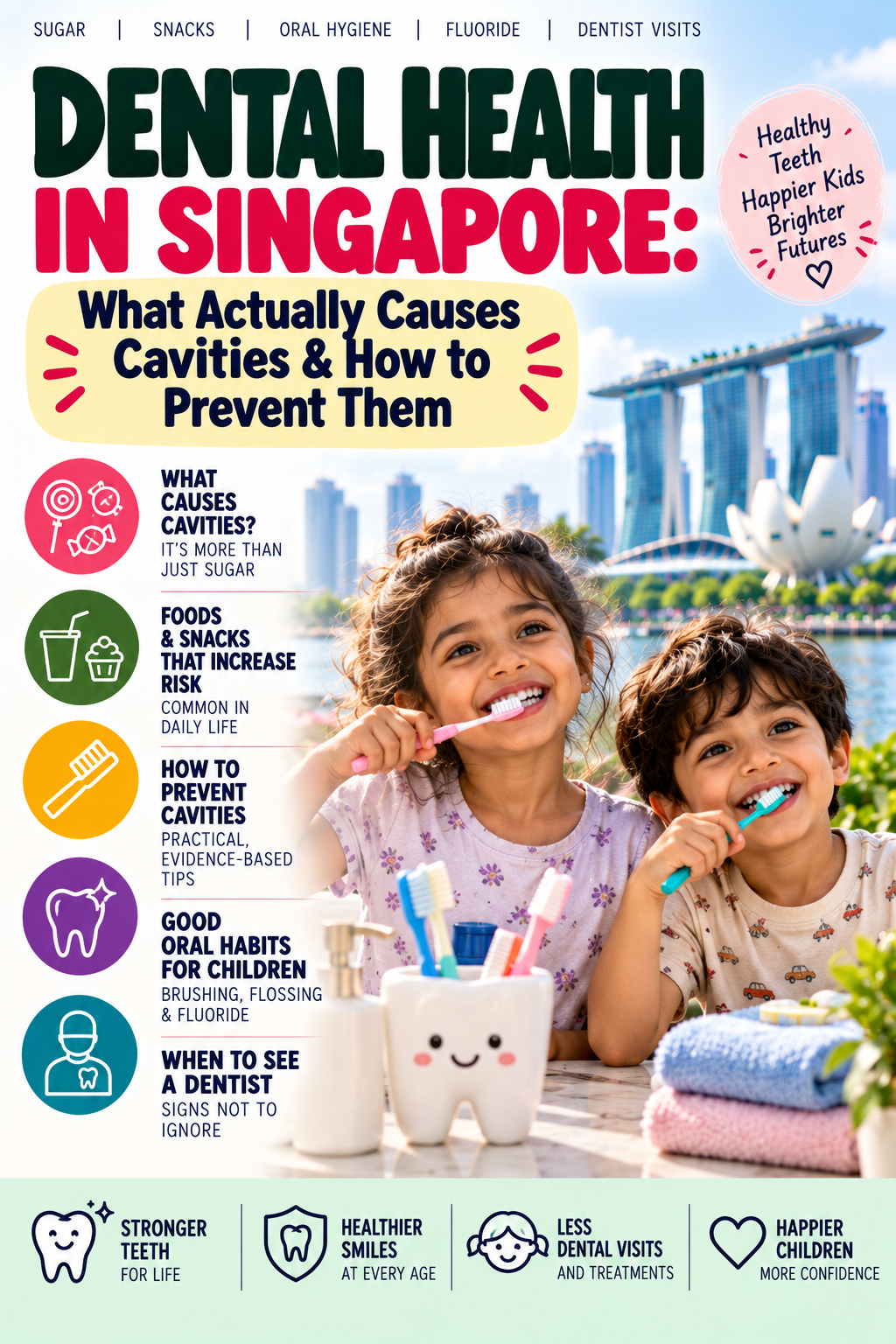
For Indian families in Singapore, there are specific dietary and cultural patterns that compound this risk: sweetened chai given to toddlers, condensed milk in drinks, jaggery-based snacks as daily treats, and the deep cultural norm around mithai at celebrations. Understanding what actually drives dental caries, and which interventions have the strongest evidence, is the starting point.
📌Children Are Not Mini Adults: Stop “Healthy” Food Trends From Harming Your Child
How Dental Caries Develops: The Biology in Brief
Dental caries is not simply caused by sugar. It results from the interaction of four factors: teeth, bacteria, fermentable carbohydrates (sugar), and time. Cariogenic bacteria in the mouth, primarily Streptococcus mutans, ferment dietary sugars and produce acids that demineralise tooth enamel. Repeated acid attacks, when remineralisation between attacks is insufficient, produce cavities.
The key insight that changes the practical guidance: it is the frequency of sugar exposure, not just the total quantity, that drives caries risk. A child who sips a sweetened drink continuously over two hours creates a two-hour acid attack. A child who drinks the same quantity in five minutes creates a 20-minute acid attack followed by remineralisation. Frequency and duration of sugar contact matter more than total sugar consumed in a day.
Singapore’s Dental Reality: What the Numbers Show
- 40–50% of Singapore children under 6 have early childhood caries (ECC), among the highest rates in developed Asia
- 90% of those caries were untreated in a 2009 NDCS study: the gap between prevalence and dental attendance is wide
- Only 8% of Singapore children aged 3–6 attend the dentist regularly
- The National Dental Research Institute Singapore (NDRIS) was established in 2019 specifically to address this burden
- The HPB School Dental Service screens children at primary schools, but the caries found at Primary 1 were established in the pre-school years, at home. The prevention window is the first five years.
The Highest-Risk Dietary Habits in Indian Singapore Homes
1. Sweetened Drinks — the Primary Modifiable Driver
The 2021 systematic review of longitudinal studies (Mahboobi et al.) and the IAPD 2022 evidence-based guidelines both confirm: free sugar in drinks is the primary modifiable dietary driver of dental caries in children. For Indian children in Singapore, the specific high-risk drinks:
- Sweetened condensed milk in hot drinks: A common Indian household practice. Condensed milk is approximately 55% sugar and coats teeth directly. Even a small quantity, added to infant drinks or toddler “milky tea,” creates concentrated sugar contact with erupting teeth.
- Packaged fruit juices: Perceived as healthy, but fruit juice is both acidic (pH 3.5–4.0, well below the enamel dissolution threshold of pH 5.5) and high in free fructose. Apple, grape, and packaged orange juice are among the most cariogenic children’s drinks available. The American Academy of Paediatrics recommends no fruit juice for children under 1 year, and no more than 120 ml daily for ages 1–3.
- Flavoured milk drinks (Milo, Ovaltine, sweetened soy milk): The added sugar in standard preparations makes these a significant contributor when given multiple times daily, especially if sipped slowly or provided at bedtime without subsequent brushing.
- Bedtime feeds without brushing: Any sweetened liquid, or even breast milk and formula, given after the last tooth-brush of the night creates an extended acid contact window during sleep, when saliva flow (the natural remineralisation mechanism) is at its lowest. Pooling of liquid around teeth at night is a primary cause of the characteristic pattern of early childhood caries seen across the upper front teeth.
2. Sticky, High-Frequency Sweet Snacks
The systematic review confirmed that frequency of free sugar exposure, more than total quantity, predicts caries development. Sticky Indian snacks, mithai, laddoo, jaggery-based sweets, dates (very high fructose despite being “natural”), chewable sweet toffees, and chakli dipped in sugar adhere to tooth surfaces and extend acid contact time beyond the eating event. The cultural normalisation of sweet foods as daily rewards and snacks in many Indian Singapore households creates a high-frequency exposure pattern from an early age. Diwali mithai once a year is not the problem. Daily jaggery-based snacks every afternoon are.
3. Acidic Foods and Drinks (Separate from Sugar)
Acidic foods and drinks lower oral pH independently of sugar: tamarind-based snacks, carbonated drinks, frequent lemon water, vinegar-based chutneys given regularly to young children. Repeated acid exposure erodes enamel even without bacterial fermentation, and is additive to cariogenic sugar exposure. Carbonated water, often perceived as a healthy alternative to soft drinks, is mildly acidic and over time contributes to enamel erosion in children who drink it frequently.
📌 MOH’s Grow Well SG Health Plan
📌Why Zinc Deficiency is common in Indian Kids (And How to Fix It)
The Protective Foods: What the Evidence Supports
Dairy — the Most Caries-Protective Food Group
A 2024 scoping review of 38 studies examining milk and dairy products in children and adolescents (published in Children, PMC10887650) found consistently that dairy products, particularly plain cheese and milk, have non-cariogenic and actively protective properties against dental caries. The mechanisms are multiple:
- Calcium and phosphate in milk and cheese directly remineralise enamel after acid attacks
- Casein (milk protein) forms a protective film on tooth surfaces that reduces acid penetration
- Cheese raises salivary pH above 5.5 within minutes of eating — effectively ending the post-meal acid attack
- Plain milk does not lower oral pH, unlike fruit juices and sweetened drinks
The traditional Indian practice of ending a meal with plain dahi or chaas (buttermilk) has genuine dental protective benefit; the calcium and casein in dahi contribute to post-meal remineralisation. A small piece of plain cheddar after lunch and dinner is an evidence-backed post-meal dental habit. Both are available at every Singapore supermarket.
Raw, Fibrous Vegetables and Whole Fruits
Raw fibrous vegetables (cucumber sticks, carrot sticks) and whole fruits (apple slices, pear, guava) stimulate saliva production and mechanically clean tooth surfaces. They are also lower in free sugar than juices and dried fruits. Including raw vegetables as part of school tiffin snacks directly contributes to dental protection alongside the other nutritional benefits.
Plain Water — Singapore’s Most Underused Dental Tool
Singapore tap water is fluoridated at 0.7 ppm. Drinking plain tap water throughout the day provides continuous low-level fluoride exposure and dilutes oral acid after eating. The single highest-yield habit change for most Indian Singapore families: replace all sweetened drinks with plain water as the default, served in a reusable bottle the child drinks from consistently through the school day. This is free, immediately available, and supported by the strongest evidence in preventive dentistry.
📌Healthy School Tiffin for Indian Kids in Singapore (HPB-Aligned)
📌Iron Deficiency in Indian Children
|
Doctor-Led Children’s Nutrition · Singapore Dental health and overall nutrition share the same dietary drivers. Fixing one tends to fix the other.I work with Indian families in Singapore to build complete children’s nutrition plans, covering growth, immunity, brain development, and dental-protective dietary habits, through one evidence-based, culturally grounded strategy. 👉 Book a FREE 20-Minute Children’s Nutrition Call Dr Akanksha Sharma · MBBS MD · Singapore & worldwide via Zoom |
The Fluoride Strategy: Getting It Right
Singapore’s water fluoridation provides a baseline protective effect, but the data show it is insufficient alone. The fluoride strategy needs supplementing at the individual level:
- Fluoride toothpaste — 1000 ppm minimum: The 2020 Singapore evidence review recommends 1000 ppm or greater fluoride toothpaste based on moderate-to-high evidence for caries prevention in children. All adult fluoride toothpastes in Singapore contain ≥1000 ppm. Many children’s toothpastes in Singapore supermarkets use low-fluoride formulations marketed as “gentle”; check the label. Children who can reliably spit (typically age 5–6) can use standard adult fluoride toothpaste in an age-appropriate amount.
- The bedtime brush is the highest-priority daily habit: After the final brush before bed, no food or sweetened drink should pass the child’s lips until morning. Saliva flow decreases during sleep; the overnight period is when acid and bacteria work most undisturbed. The morning brush removes plaque before the day begins; the bedtime brush is what actually protects the teeth through the night. Both matter; if only one is done consistently, it should be the bedtime brush.
- For children under 3 who cannot spit: Use a smear (rice-grain-sized amount) of 1000 ppm fluoride toothpaste. The tiny amount incidentally swallowed at this quantity does not present a fluorosis risk at Singapore’s fluoridated water level. Colgate and Darlie standard adult formulations, both widely available at NTUC, Guardian, and Watsons, are appropriate choices.
- Fluoride varnish from the dentist: High-caries-risk children benefit from professional fluoride varnish application, not available at home but the reason early dental attendance matters. The HPB School Dental Service provides free dental checks for primary school children. The NDCS recommends a child’s first dental visit when the first tooth appears, typically at 6 months, and no later than age 1, to establish risk-based care from the beginning.
📌Omega-3 for Children’s Brain Development Singapore
The Celebration Food Problem: A Practical Framework
Diwali, Eid, birthdays, weddings, Indian cultural celebrations in Singapore involve abundant sweets. The dental framework for navigating this:
- Concentrated sweet eating at one sitting is significantly less cariogenic than grazing on sweets continuously throughout the day. The acid attack from one sitting, followed by brushing and remineralisation, is less damaging than repeated small doses of sugar across the whole day.
- Brush teeth within 30–45 minutes after a celebration meal. This removes the sugar substrate before bacteria ferment it into acid.
- Drink plain water after sweets to dilute the oral acid environment before brushing.
- The problem is not Diwali mithai once a year. It is the daily sweetened drink, the daily sugary snack, and the bedtime feed without brushing. Address the daily habits; the celebrations become manageable.
Where to Get Dental Care in Singapore
- HPB School Dental Service: Free dental screenings and basic treatment for all primary school children in government and government-aided schools. Children are screened annually from Primary 1.
- NDCS Paediatric Dentistry (KKH campus): Specialist paediatric dental care for children with complex or significant caries burden; referral through the school dental service or GP.
- Polyclinic dental services: Subsidised dental care for children at all Singapore polyclinics; no referral required.
- First dental visit: Both HPB and NDCS recommend the first visit when the first tooth appears, around 6 months, and no later than age 1. Most Singapore Indian families bring children to the dentist far later; establishing early contact allows risk-based fluoride varnish and dietary guidance before caries become established.
Frequently Asked Questions
My child has baby teeth. Does it matter if they get cavities — they’ll fall out anyway?
Yes, significantly. Untreated caries in primary teeth causes pain, difficulty eating (which directly affects nutrition and growth), disruption to sleep, and most critically affects the positioning and health of the permanent teeth developing beneath. Severe early childhood caries can require general anaesthesia for dental treatment in young children, a completely preventable intervention. Primary teeth hold space for permanent teeth; premature loss from untreated caries causes alignment problems in the permanent dentition. Milk teeth matter as much as adult teeth.
I give my toddler fruit juice because I think it is healthier than soft drinks. Is this a dental concern?
Yes. Fruit juice, including freshly squeezed, 100% fruit, no added sugar, is both acidic (pH 3.5–4.0, well below the enamel dissolution threshold of pH 5.5) and high in free fructose. It is one of the most cariogenic drinks for young children, despite its healthy perception. Replace fruit juice with whole fruit (fibre intact) and plain water. If juice is given, limit it to a small amount with a meal rather than sipping throughout the day, and rinse with water afterwards.
Is jaggery safer than sugar for teeth?
No. Jaggery is sucrose with trace minerals. Its cariogenic potential is equivalent to refined sugar; the bacteria in the mouth ferment jaggery into acid at the same rate. “Natural,” “unrefined,” or “traditional” sweeteners do not reduce caries risk. The relevant variable is fermentable carbohydrate contact with teeth, regardless of the source.
The Bottom Line
Nearly half of Singapore children have dental caries by age six, not because Singapore lacks fluoridated water, but because the daily dietary patterns in the pre-school years at home are driving repeated high-frequency sugar exposure that fluoride alone cannot overcome. The primary drivers are sweetened drinks given throughout the day, sticky sweet snacks as daily habits, bedtime feeds without brushing, and the high-frequency sweet exposure pattern normalised in many Indian households. The protection strategy is specific and evidence-based: plain water as the default drink from the earliest age, plain dairy (dahi, milk, a piece of cheese after meals) daily, fibrous raw vegetables as snacks, the bedtime brush as the non-negotiable daily dental habit, 1000 ppm fluoride toothpaste, and a first dental visit before age 1. Dental health in children is nutritional health. The habits that protect teeth protect everything else too.
|
Children’s Health · Singapore Your Child’s Teeth Are Built from What They Eat.
|
|
||
|
| 👉 Not Sure Which Programme? Book a FREE 20-Minute Call
Dr Akanksha Sharma · MBBS MD · Preventive Medicine Physician · Singapore & worldwide via Zoom |
References
- Recommending 1000 ppm fluoride toothpaste for caries prevention in Singapore children. Proc Singapore Healthcare. 2020. Full Text
- Mahboobi Z et al. Dietary free sugar and dental caries in children: systematic review on longitudinal studies. Health Promot Perspect. 2021;11(3):271–280. PMC8501477
- Non-Cariogenic Effect of Milk and Dairy Products on Oral Health in Children: Scoping Review. Children. 2024;11(2):149. PMC10887650
- International Association of Paediatric Dentistry (IAPD). Diet and Dental Caries: Evidence-based recommendations, Global Agreement Evaluation 2022. iapdworld.org
- Clinical efficacy of a two-year oral health programme for infants and toddlers in Singapore. Singapore Med J. 2018;59(2):87–93. PMC6119743
- Sadegh-Zadeh SA et al. Decoding children dental health risks: a machine learning approach. Front Artif Intell. 2024. PMC11215085
Disclaimer: This article is for educational and informational purposes only. Dental treatment for children should be sought from a qualified dentist. Singapore residents can access subsidised dental care through polyclinics and the HPB School Dental Service.

Akanksha Sharma
Dr Akanksha Sharma (MBBS, MD) is a physician and women’s health nutrition specialist, and the founder of IYSA Nutrition. She provides evidence-based, doctor-led nutrition guidance for pregnancy, postpartum recovery, PCOS, child nutrition, and family health, helping women make calm, informed decisions about their health and their children’s well-being.
Leave a Reply