Written & reviewed by Dr Akanksha Sharma, MBBS, MD (Preventive & Community Medicine) | Founder, IYSA Nutrition, Singapore
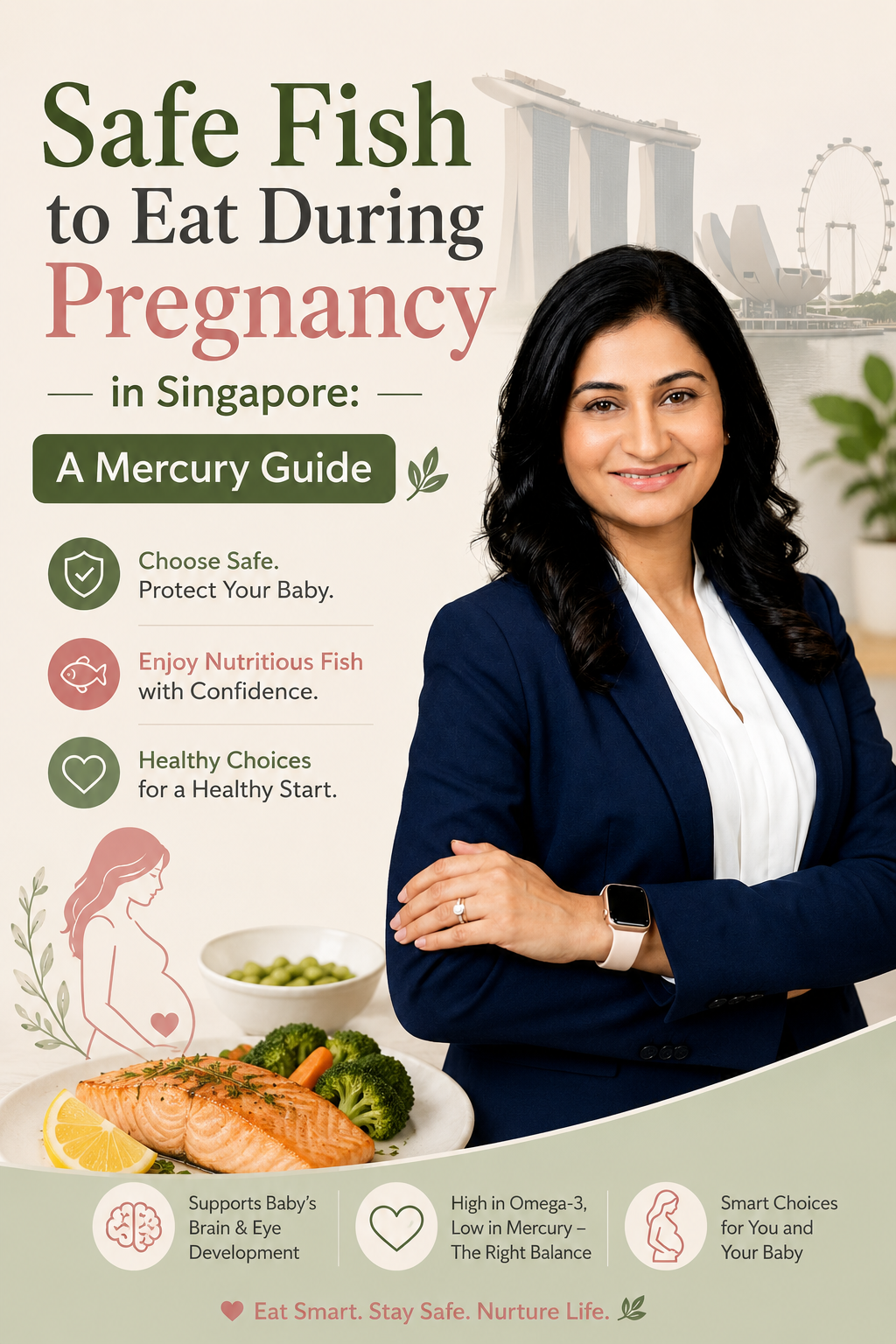
Fish is one of the most nutritionally valuable foods a pregnant woman can eat, and one of the most anxiety-inducing, because of mercury. The result is that many Indian women in Singapore either avoid fish entirely during pregnancy (losing significant DHA, iodine, protein, and selenium benefits) or eat it without any awareness of which species carry mercury risk. Both extremes are problematic.
The truth is more nuanced and more reassuring than either: the vast majority of fish commonly eaten in Singapore are low in mercury and safe during pregnancy. A small number of large predatory fish carry a meaningful mercury risk and should be avoided. And for Indian women who prefer vegetarian eating, there is a clear, evidence-based alternative to fish-sourced DHA.
This post gives you the complete, Singapore-specific, pregnancy fish guide, with the mercury data, the safe species list, the practical wet market and supermarket guidance, and the evidence on why eating the right fish is strongly recommended, not just permitted, during pregnancy.
Related reading:
👉 10 Foods Pregnant Woman Should Eat for a Healthy Pregnancy
👉Second Trimester Nutrition: Step by step guide
Why Fish Matters So Much During Pregnancy
Before discussing mercury, it is worth understanding what fish provides in pregnancy, because the fear of mercury has led many women to under-eat a food that pregnancy nutrition guidelines actively recommend.
DHA — The Brain-Building Omega-3
DHA (docosahexaenoic acid) is the primary structural fat in the foetal brain and retina. The foetal brain incorporates approximately 67 mg of DHA per day in the third trimester. Fish, particularly fatty fish, are the most direct, bioavailable dietary source of preformed DHA. Plant sources provide only ALA, which converts to DHA at 2–5% efficiency. For non-vegetarian pregnant women, eating fatty fish 2–3 times per week is the most effective way to meet foetal DHA requirements.
Iodine — The Thyroid and Brain Nutrient
Fish and seafood are naturally rich in iodine, a nutrient that is critical for foetal thyroid development and brain function, and one that is consistently insufficient in Indian diets that rely on non-iodised salts. The iodine benefit of fish consumption is a meaningful additional argument for including it during pregnancy.
High-Quality Protein, Selenium, Vitamin D
Fish provides complete protein (all essential amino acids in optimal ratios for foetal growth), selenium (required for thyroid function and antioxidant protection), and Vitamin D (of which very few foods are good sources). These combined nutritional benefits make fish genuinely irreplaceable in the pregnancy diet for non-vegetarian women.
The Harvard Evidence
A 2016 analysis published in the American Journal of Clinical Nutrition by Hibbeln et al., using data from 26,000 pregnancies in the ALSPAC study, found that children of mothers who ate more fish during pregnancy had higher IQ scores, better verbal ability, and better social development than children of mothers who ate less fish, despite the fish consumption including species with some mercury content. The researchers concluded that the DHA benefit of fish consumption during pregnancy significantly outweighs the mercury risk at normal dietary quantities of low-to-moderate mercury fish.
Both the WHO and the US FDA recommend pregnant women eat 2–3 servings of low-mercury fish per week, not to avoid fish, because the neurodevelopmental benefit of DHA is lost when fish is eliminated.
👉Foods to Avoid During Pregnancy & Why
Understanding Mercury in Fish
How Mercury Gets Into Fish
Mercury enters aquatic environments through industrial emissions, then converts to methylmercury, the organic form that is absorbed by marine organisms. Small fish absorb small amounts. Large predatory fish that eat many smaller fish bioaccumulate methylmercury across the food chain. By the time a large predatory fish at the top of the food chain, such as a shark, swordfish, or king mackerel, is eaten, its mercury concentration may be 1–2 million times higher than the surrounding water. Tuna accumulates intermediate levels depending on species and size.
Methylmercury is a neurotoxin. In pregnancy, it crosses the placenta and accumulates in foetal tissue, including the developing brain. High maternal methylmercury exposure is associated with impaired cognitive development, reduced IQ, and neurological deficits in children. This is the genuine risk that makes fish selection important during pregnancy.
The critical point: mercury risk is species-specific, not fish-specific. A sardine and a shark are both “fish”, but their mercury levels differ by a factor of several hundred.
Mercury Levels in Fish: The Singapore-Relevant Species Guide
Category 1: Safe — Eat 2–3 Times Per Week (Low Mercury)
These are the fish that pregnant women in Singapore should actively eat, regularly, confidently, and without concern about mercury accumulation:
- Pomfret (silver pomfret / white pomfret / bawal): One of the most beloved fish in Indian and Chinese cooking in Singapore. Low mercury, excellent DHA content. Available fresh at all wet markets. Pomfret steamed with ginger and soy, or in Indian curry, is an ideal pregnancy meal. Eat freely, 2–3 times per week.
- Sardines (ikan bilis / small sardines / tarli): Extremely low mercury (bottom of the food chain), very high DHA (500–800 mg per 100g serving), rich in calcium (eaten with bones), Vitamin D, and selenium. Sardines are arguably the single most nutritionally valuable fish for pregnancy in terms of the DHA-to-mercury ratio. Available canned at all supermarkets and fresh at wet markets. Use in Indian curry, dry fry, or in tamarind-based preparations.
- Mackerel — Atlantic or Indian mackerel (bangda): Low mercury, very high DHA. The Indian mackerel (Rastrelliger kanagurta), sold widely at Singapore wet markets, is an excellent pregnancy fish, affordable, available, and nutritionally dense. Important: this applies to Atlantic and Indian mackerel. King mackerel (a different, much larger species) is a Category 3 fish that should be avoided. When buying mackerel at a Singapore wet market, you will almost always be buying the safe Indian or Atlantic variety unless specifically purchasing “king mackerel.”
- Salmon: Low mercury, very high DHA (1500–2000 mg per 100g). Available at Cold Storage, FairPrice Finest, and most wet markets in Singapore. Choose fresh or frozen Atlantic or Pacific salmon. Norwegian salmon, available widely in Singapore, is consistently low in mercury and high in DHA.
- Anchovies (ikan bilis): Very small, very low mercury, reasonable DHA. The ikan bilis used in nasi lemak and as a sambal base, though typically eaten in small quantities as a condiment, contributes meaningful calcium and omega-3.
- Tilapia: Very low mercury. A mild, affordable, widely available freshwater fish in Singapore. Lower DHA than fatty fish but a safe, versatile protein source. Common in Chinese and Indian preparations.
- Catfish (ikan keli): Low mercury; sold widely at Singapore wet markets. Good protein source; lower in omega-3 than fatty marine fish.
- Squid and prawns: Low mercury. Prawns are a good source of iodine and protein. Limit deep-frying; steamed, stir-fried, or in curry preparations are preferable.
- Clams and mussels: Very low mercury; good iron, zinc, and iodine sources. Ensure that it is fully cooked, as raw shellfish carry a bacterial risk in pregnancy.
Category 2: Eat Occasionally — Maximum 1 Serving Per Week (Moderate Mercury)
- Canned tuna (light tuna — skipjack): Light canned tuna (the most common type) has moderate mercury levels, lower than albacore but higher than sardines or pomfret. The US FDA and Singapore HPB recommend limiting light canned tuna to no more than 2–3 servings per week in pregnancy. One serving is approximately 85–100g. Use occasionally in sandwiches, rice dishes, or salads, not as a daily pregnancy staple.
- Albacore (white) canned tuna: Higher mercury than light tuna. Limit to 1 serving (approximately 170g) per week maximum in pregnancy. Some guidelines recommend avoiding albacore entirely in pregnancy — check your local health authority’s current guidance.
- Yellowfin tuna (fresh/steak): Moderate to moderately high mercury. Limit to 1 serving per week. Not a regular pregnancy fish.
- Snapper (red snapper, ang sai): Moderate mercury. Available fresh at Singapore wet markets. Safe in moderation, one serving per week. A popular Indian-style preparation; fine to eat occasionally during pregnancy.
- Grouper (kerapu): Moderate mercury. Available at many Singapore wet markets. One serving per week is the recommended limit for pregnancy.
Category 3: Avoid Completely During Pregnancy (High Mercury)
These fish bioaccumulate mercury to levels that pose a genuine neurodevelopmental risk with regular consumption during pregnancy. Avoid entirely, including in restaurants where these may be prepared as fish head curry, soups, or other preparations:
- Shark (any species): Very high mercury. Shark is commonly consumed in Singapore as shark fin (in soups and dishes), shark meat, and various preparations. Avoid shark fin soup and all shark-based products during pregnancy. Sharks can accumulate mercury at concentrations hundreds of times higher than safe levels in fish.
- Swordfish: Very high mercury. Less commonly consumed in Singapore but sometimes available at restaurants and speciality fishmongers.
- King mackerel (ikan tenggiri — the large variety): Very high mercury. Important distinction: the large king mackerel (Scomberomorus species) sold whole and as steaks has very high mercury content. This is different from the small Indian mackerel (bangda) that is safe. When buying “tenggiri” at a wet market, clarify the size; small tenggiri (Indian mackerel) is safe; large king mackerel is not.
- Tilefish: Very high mercury. Not commonly available in Singapore but sometimes seen in speciality stores.
- Bigeye tuna (fresh): High mercury, higher than skipjack. If ordering tuna sashimi or tuna steak at restaurants, the species is often bigeye or bluefin, both high in mercury. Best to avoid raw or fresh tuna in restaurants during pregnancy.
- Orange roughy: High mercury. A deep-sea fish occasionally seen in Singapore supermarkets.
Practical Singapore Wet Market and Supermarket Guide
At the Wet Market (Pasar Basah)
Singapore’s wet markets- Tekka, Geylang Serai, Ghim Moh, Tiong Bahru, and neighbourhood markets- are excellent for fresh, affordable, low-mercury pregnancy fish. When shopping:
-
- Ask for: bawal putih (white/silver pomfret), sardin (sardines), bangda (small Indian mackerel), ikan merah kecil (small red snapper, moderate mercury — occasional)
- Choose fresh fish with:** clear eyes (not cloudy), red gills, firm flesh that springs back when pressed, and mild sea smell (not strong or ammoniacal)
- When in doubt about species: Ask the fishmonger explicitly. Most Singapore wet market fishmongers are helpful and knowledgeable about species names in Malay, Chinese, and English.
At Supermarkets
- FairPrice: Good selection of frozen sardines (canned and fresh-frozen), Atlantic salmon, pomfret, and tilapia. Check the label for species name when buying any “mackerel” — the packaging should specify Atlantic or Indian mackerel, not king mackerel.
- Cold Storage / FairPrice Finest / Marketplace: Fresh and frozen Norwegian salmon, pomfret, sardines. Also stocks canned sardines in various preparations. Norwegian salmon from these retailers is consistently tested and safe.
- Canned fish selection: Look for sardines in water or olive oil (John West, King Oscar, or local brands), light canned tuna for occasional use, and canned mackerel. Always check the species on the label.
👉Third Trimester Nutrition: Preparing Your Body for Labour
How Much Fish Per Week During Pregnancy?
Both the WHO and Singapore HPB recommend:
- 2–3 servings per week of low-mercury fish (Category 1 above)
- One serving = approximately 100–150g of cooked fish
- Maximum 1 serving per week of moderate-mercury fish (Category 2)
- Zero servings of high-mercury fish (Category 3)
For Indian women who traditionally eat fish curry, this translates to: pomfret or sardine curry twice a week, with a third serving of salmon or bangda curry, and occasional prawn preparations for variety. This provides approximately 700–1200 mg of combined DHA+EPA per week — meaningfully contributing to the recommended 200–300 mg/day target.
👉 Pregnancy & Postpartum Nutrition: A Doctor-Reviewed Guide
👉First Trimester Nutrition: A Week-by-Week Food Guide for Indian Mums
If you are a woman struggling with optimising your diet during pregnancy:
👉 Join my program Nourish Nine: Doctor-Led Pregnancy Nutrition & Care Program (Trimester-Wise, 3 months)
📥 Want a Printable Food & Nausea Tracker?
🎁 Download my FREE “Anti-Nausea Food List + Tracker” to keep by your bedside or fridge
👉 Click here to download
For Vegetarian Indian Women: The DHA Alternative
If you are a vegetarian and do not eat fish during pregnancy, the solution is not to worry; it is to supplement deliberately with algae-based DHA. Read my complete guide on omega-3 for vegetarian pregnant women. The key points:
- Algae-based DHA (200–300 mg/day) is equivalent in bioavailability to fish oil-derived DHA
- It contains zero mercury by nature; algae do not bioaccumulate mercury
- Available at Guardian, Watsons, and iHerb Singapore under brands including Testa, Nordic Naturals Algae Omega, and Ovega-3
- Combine with ground flaxseed (1 tablespoon daily) and walnuts (daily handful) for ALA omega-3, alongside the algae DHA
👉Safe Supplements During Pregnancy
Raw Fish and Sushi During Pregnancy: The Bacterial Risk
Mercury is not the only fish safety concern during pregnancy. Raw fish, in sushi, sashimi, ceviche, or undercooked preparations, carries the risk of Listeria monocytogenes, Salmonella, and Vibrio infections, all of which can cause serious complications in pregnancy, including miscarriage, preterm birth, and foetal infection.
Avoid during pregnancy:
- All raw fish sushi and sashimi (including salmon sashimi, tuna sashimi, prawn sashimi)
- Smoked salmon (cold-smoked, not hot-smoked, which is fully cooked)
- Raw oysters and clams
- Any fish eaten rare or undercooked
Safe alternatives at Japanese restaurants: fully cooked fish preparations (baked, grilled, or fully cooked rolls), vegetable sushi, tamago (cooked egg), and clearly cooked prawn dishes.
Frequently Asked Questions
I ate shark fin soup before I knew I was pregnant. Should I be worried?
One or two exposures to high-mercury fish before pregnancy awareness is not cause for significant concern; foetal mercury harm is associated with chronic, regular high-mercury fish consumption, not a single or a few incidents. If you have eaten shark or swordfish a handful of times before knowing you were pregnant, discuss this with your obstetrician. For reassurance, a maternal blood mercury level can be tested, but in most cases of infrequent prior exposure, this is not necessary.
Is canned sardines as nutritious as fresh sardines?
Yes, canned sardines in olive oil or water retain essentially all of their DHA, protein, selenium, and iodine content. The canning process actually increases calcium bioavailability because the bones soften and become edible. Canned sardines are one of the most nutritionally efficient and cost-effective pregnancy foods available in Singapore. A can at approximately SGD 2–3 provides 500–800 mg of DHA and significant amounts of calcium, Vitamin D, and selenium. They are a practical and excellent pregnancy staple.
The fish at my favourite restaurant — how do I know if it is safe?
When dining out in Singapore, the safest approach is to choose pomfret, salmon, sardine (ikan bilis dishes), tilapia, or prawn (fully cooked) preparations. Avoid shark fin in any form, large fish head curry (fish heads tend to be from larger species that accumulate more mercury), and any preparation with uncertain species. Indian restaurant fish curry made with pomfret or sardine is completely safe. Chinese steamed fish with ginger is typically very safe, the species is usually grouper or tilapia. Ask staff if you are uncertain about the species.
My Indian family says to avoid seafood during pregnancy. Is this traditional advice correct?
Traditional Indian dietary restrictions around pregnancy vary significantly by region and community; some communities restrict all seafood, others restrict specific types, and others have no restriction. From a clinical nutrition perspective, the evidence strongly supports eating low-mercury fish during pregnancy for DHA, iodine, and protein benefits. The restrictions that have a scientific basis are species-specific (high mercury fish) and preparation-specific (raw fish). A blanket avoidance of all seafood during pregnancy is not evidence-based and results in unnecessary DHA and iodine deficiency. If cultural or family pressure to avoid fish is strong, supplement with algae-based DHA and ensure iodine adequacy through iodised salt and dairy.
How should I cook fish to make it safe during pregnancy?
Cook all fish to an internal temperature of 63°C (145°F), the flesh should be opaque and flake easily. For Indian-style fish curry, full cooking in the curry sauce achieves this reliably. Grilled, baked, steamed, and fried fish are all safe when fully cooked. Avoid medium-rare fish preparations, undercooked fish in quick stir-fries, and any raw preparations. Marinated raw fish (like ceviche) should also be avoided — the acid marinade does not kill all pregnancy-relevant pathogens.
The Bottom Line
Fish is not a food to fear during pregnancy; it is a food to choose wisely. The pomfret curry and sardine fish fry that have been staples of Indian coastal cuisine for centuries are not just culturally delicious; they are nutritionally ideal pregnancy foods, providing DHA, iodine, protein, selenium, and Vitamin D in a low-mercury package that benefits rather than harms the foetal brain.
The rule is simple: eat the small ones and the ones close to the bottom of the food chain (sardines, pomfret, mackerel, salmon) two to three times a week. Avoid the large ones at the top of the food chain (shark, swordfish, king mackerel) entirely. And enjoy your fish curry, knowing the evidence overwhelmingly supports it.
If you are a woman struggling with optimising your diet during pregnancy:
👉 Join my program Nourish Nine: Doctor-Led Pregnancy Nutrition & Care Program (Trimester-Wise, 3 months),
customised for Indian diets and Singapore lifestyles.
👉Book a consultation call (FREE) to discuss your concerns
🔗 You May Also Find These Readings Helpful:
- [10 Superfoods for Pregnant Women: A Blend of Science and Ayurveda]
- [Balanced Pregnancy Diet at 6 Months]
- [Top 7 Anti-Bloating Foods During Pregnancy (With Recipes!)]
Disclaimer: This article is for educational purposes only. Fish safety guidelines during pregnancy may be updated — always check the current recommendations from Singapore HPB and your obstetrician.
References:
- Hibbeln JR et al. Maternal seafood consumption in pregnancy and neurodevelopmental outcomes in childhood. Lancet. 2007;369(9561):578-585. PubMed
- US FDA / EPA. Advice about eating fish for those who might become or are pregnant, breastfeeding, or children. 2024. fda.gov
- Health Promotion Board Singapore. Eating during pregnancy. healthhub.sg
- WHO. Fish and shellfish safety during pregnancy. who.int

Akanksha Sharma
Dr Akanksha Sharma (MBBS, MD) is a physician and women’s health nutrition specialist, and the founder of IYSA Nutrition. She provides evidence-based, doctor-led nutrition guidance for pregnancy, postpartum recovery, PCOS, child nutrition, and family health, helping women make calm, informed decisions about their health and their children’s well-being.