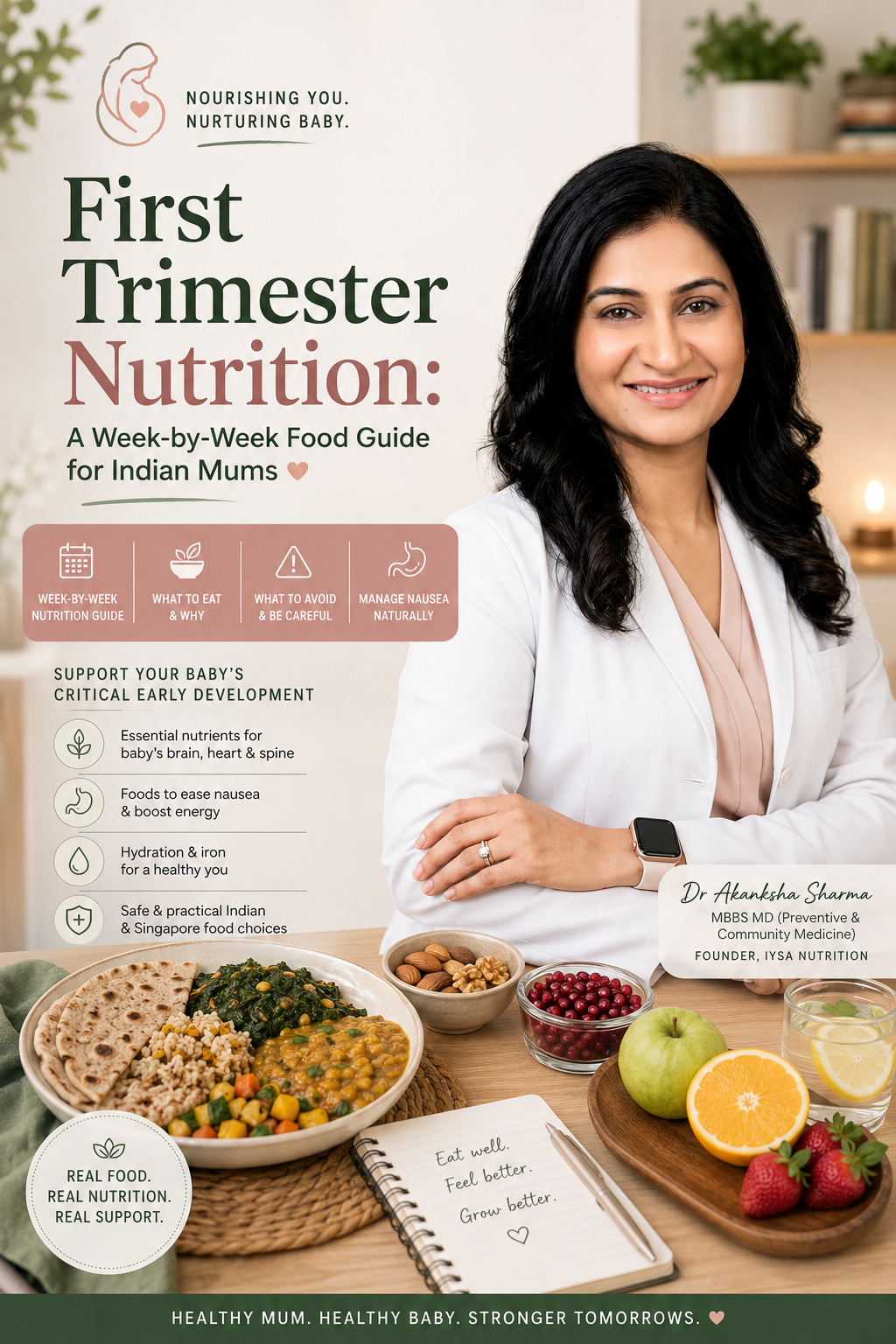
Written & reviewed by Dr Akanksha Sharma, MBBS, MD (Preventive & Community Medicine) | Founder, IYSA Nutrition, Singapore
The first trimester, weeks 1 through 13, is arguably the most nutritionally critical period of your entire pregnancy. During these twelve weeks, your baby’s neural tube closes, the heart begins beating, all major organ systems form, and the placenta is established. These are irreversible developmental milestones. The nutritional environment you create in these weeks has a direct and lasting impact on your baby’s brain, spine, heart, and immune system.
And yet, the first trimester is also when most women feel their worst. Nausea, food aversions, extreme fatigue, and heightened smell sensitivity make eating well feel like an impossible challenge. I hear this from Indian and South Asian women in my practice every week, women who know they need to eat well but cannot stomach the foods they are supposed to eat.
This guide is designed specifically for Indian mums, whether you are in India or Singapore, with practical, culturally grounded food guidance that works even when you can barely keep food down. I have structured it week by week so you know exactly what your baby needs at each stage, and what foods to focus on.
👉Second Trimester Nutrition: Step by step guide
👉Third Trimester Nutrition: Preparing Your Body for Labour
👉Best Dals and Lentils for Pregnancy: ICMR 2024 Guide
Before We Begin: Your First Trimester Nutritional Priorities
Before diving into the week-by-week guide, here are the four non-negotiable nutritional priorities of the first trimester:
- Folate/folic acid — critical for neural tube closure (weeks 3–4)
- Iron — supports rapid blood volume expansion and prevents maternal anaemia
- Iodine — essential for foetal brain development and thyroid function
- Omega-3 DHA — foundational for brain and retinal development
Everything else in your diet matters, but these four are your foundation. Every food recommendation in this guide is built around ensuring you meet these needs.
Doctor’s Note: According to ICMR-NIN 2020, a pregnant Indian woman’s requirements increase significantly from pre-pregnancy levels — iron goes from 21 mg/day to 35 mg/day, folate from 220 µg/day to 500 µg/day, and energy increases by approximately 350 kcal/day in the second and third trimesters (first trimester increase is modest — about 50–85 kcal/day). This means the first trimester is more about quality than quantity.
👉10 Foods Pregnant Woman Should Eat for a Healthy Pregnancy
👉Pregnancy & Postpartum Nutrition: A Doctor-Reviewed Guide
Weeks 1–4: The Foundation — Folate Above Everything
What Is Happening to Your Baby
By the time most women know they are pregnant (around week 4–5), the neural tube, which becomes the brain and spinal cord, has already begun forming. Neural tube closure happens between days 21 and 28 after conception. This is why folate is recommended even before conception: because by the time you miss your period, the most critical window for neural tube protection has already passed.
During weeks 1–4, the fertilised egg implants in the uterine wall, the placenta begins forming, and the embryonic disc differentiates into the three layers that will become all your baby’s organs. These processes are entirely dependent on DNA synthesis, cell division, and methylation, all of which require folate.
Your Key Nutrient: Folate and Folic Acid
The WHO and ICMR both recommend 400–500 µg of folic acid daily during early pregnancy, ideally starting at least one month before conception. If you are already pregnant, start immediately; it is never too late to benefit.
Best Indian food sources of folate:
- Methi leaves (fenugreek greens) — one of the richest Indian sources at approximately 140 µg per 100g
- Moong dal (split green gram) — approximately 180 µg per 100g dry weight
- Masoor dal (red lentils) — approximately 120 µg per 100g dry weight
- Palak (spinach) — approximately 190 µg per 100g cooked
- Broccoli — approximately 63 µg per 100g
- Chana (chickpeas) — approximately 172 µg per 100g dry weight
- Drumstick leaves (moringa) — exceptionally high in folate; widely used in South Indian cooking
- Beetroot — approximately 80 µg per 100g
Food folate (naturally occurring) is important, but supplemental folic acid is more bioavailable and more reliably absorbed. Do not rely on food alone in the first trimester — take your prescribed folic acid supplement every day without fail.
What to Eat in Weeks 1–4
Focus on folate-rich, easily digestible foods. If nausea has not yet kicked in, this is your window to build nutritional reserves:
- Start each day with a small, protein-rich meal before getting out of bed: a few soaked almonds, a small bowl of dahi, or a slice of whole-grain toast
- Include dal at every main meal: moong and masoor are particularly folate-rich and easy to digest
- Eat spinach or methi at least once a day: in sabzi, dal, paratha stuffing, or smoothies
- Have a small portion of fruit rich in vitamin C at each meal to enhance iron absorption
- Hydrate consistently: aim for 2.5–3 litres of fluids daily, including soups, dal, buttermilk, and water
Weeks 5–8: Managing Nausea While Meeting Nutritional Needs
What Is Happening to Your Baby
Weeks 5 to 8 represent an explosion of foetal development. The heart begins beating around week 5–6. Limb buds appear. The eyes, ears, and nose begin forming. The brain and spinal cord are rapidly developing. The liver begins producing blood cells. By week 8, your baby is roughly the size of a kidney bean and has all the major structures of the human body in early form.
This development requires an enormous supply of amino acids (from protein), essential fatty acids (from healthy fats), and micronutrients, including iron, zinc, vitamin B12, and iodine.
The Nausea Challenge
For most Indian women, nausea peaks between weeks 6 and 10. Morning sickness, which is badly named because it can occur at any time of day, is driven by rising human chorionic gonadotropin (hCG) levels and, in some women, by sensitivity to oestrogen. It is a sign of a healthy pregnancy, but it makes eating extremely difficult.
Here is what works clinically for managing nausea while maintaining nutrition:
- Never let your stomach be completely empty. Hunger worsens nausea. Keep small, bland snacks accessible at all times, like plain crackers, roasted makhana (fox nuts), plain toast, a few almonds, or plain rice.
- Eat small amounts every 1.5–2 hours rather than three large meals. A stomach that is neither too full nor too empty is a nausea-minimising stomach.
- Ginger in every form. Adrak (fresh ginger) is one of the most well-studied natural remedies for pregnancy nausea. Add it to warm water, chai (in small quantities), dal, or sabzi. Ginger laddoos and adrak candy are also useful on-the-go options.
- Cold foods are often better tolerated than hot, strongly-smelling foods. Cold dahi, chilled coconut water, cold lassi, fruit, and cold rice with plain dal may be easier to manage than freshly cooked hot meals with strong aromas.
- Avoid strong cooking smells where possible. Ask family members to cook, or use a slow cooker to reduce steam and smell.
- Vitamin B6 (pyridoxine) has the strongest evidence base among nutrients for nausea reduction in pregnancy. Food sources include banana, potato (boiled), chickpeas, and fish. Your doctor may prescribe a B6 supplement if nausea is severe.
What to Eat in Weeks 5–8 (Nausea-Friendly Indian Foods)
- Breakfast: Plain khichdi (rice and moong dal, lightly salted), easy to digest, provides protein and folate; or plain dahi with banana
- Mid-morning: Roasted makhana, a few almonds, or a plain Marie biscuit with coconut water
- Lunch: Plain moong dal soup + plain white rice + a small portion of any vegetable sabzi you can tolerate. If rice is aversive, try plain roti with a little ghee.
- Afternoon: Cold dahi or a small glass of chilled buttermilk (chaas) with a pinch of jeera
- Dinner: Whatever you can manage. If it is plain toast and a banana, that is fine. Surviving nausea is a legitimate nutritional strategy in weeks 5–8.
Do not force yourself to eat “perfectly” during peak nausea weeks. Your body has reserves from before pregnancy. Focus on hydration, taking your supplements, and eating small amounts of whatever you can tolerate. Nutritional quality will improve as nausea subsides.
Key Nutrient to Add: Iron
Your blood volume begins expanding significantly from around week 6. This expansion, which will ultimately increase your blood volume by 40–50% by the end of pregnancy, requires a substantial increase in iron production. Begin iron-rich foods now:
- Dal at every meal (moong, masoor, toor, chana)
- Ragi (finger millet) — one of the richest plant sources of iron in Indian cuisine
- Drumstick (saijan ki phalli) — excellent iron source used in sambar and curries
- Dark leafy greens (palak, methi) — always pair with lime or tomato for vitamin C
- For non-vegetarians: eggs (especially the yolk), chicken liver (very rich), lean mutton
👉Foods That Ease Morning Sickness Naturally
👉Morning Sickness Relief: 10 Foods That Actually Help
📥 Want a Printable Food & Nausea Tracker?
🎁 Download my FREE “Anti-Nausea Food List + Tracker” to keep by your bedside or fridge
👉 Click here to download or DM “NAUSEA” on Instagram @iysanutrition.doctor
Weeks 9–12: Brain Building — Omega-3, Iodine, and Choline
What Is Happening to Your Baby
By week 9, your baby is officially called a foetus. The brain is developing at a remarkable pace; approximately 250,000 new neurons are formed every minute during peak brain development. The cerebral cortex begins forming. The eyes develop pigment. Fingers and toes are distinct. By week 12, all major organ systems are in place, and the remainder of pregnancy is largely about growth and maturation.
The nutrients that matter most for this stage are those that support brain structure and function: DHA (an omega-3 fatty acid), iodine, and choline.
Key Nutrient: DHA (Omega-3 Fatty Acid)
DHA is the most abundant omega-3 fatty acid in the brain and retina. It is incorporated directly into cell membranes and is essential for the formation of synaptic connections. Adequate maternal DHA is associated with better cognitive outcomes, visual acuity, and reduced risk of preterm birth.
The best food sources of DHA are fatty fish. Indian and South Asian women in Singapore have excellent access to DHA-rich fish:
- Pomfret (Indian silver pomfret) — one of the best choices; low in mercury, widely available
- Sardines (tarli) — very high in DHA, low mercury, affordable
- Mackerel (bangda) — rich in omega-3s; choose Atlantic mackerel, not king mackerel (higher mercury)
- Salmon — excellent DHA source; available at major supermarkets in Singapore
Aim for 2–3 servings of low-mercury fish per week. For vegetarians, flaxseeds (alsi) and walnuts provide ALA, which the body can partially convert to DHA, though conversion efficiency is low. A vegetarian or vegan DHA supplement derived from algae (the original source of DHA in the food chain) is strongly recommended for pregnant Indian vegetarians.
Key Nutrient: Iodine
Iodine is essential for thyroid hormone production in both mother and baby. In the first trimester, the foetus is entirely dependent on maternal thyroid hormones for brain development; the foetal thyroid does not begin functioning until around week 10–12. Iodine deficiency during this period is one of the leading preventable causes of intellectual disability worldwide.
Indian diets are frequently iodine-insufficient, particularly in populations that do not consistently use iodised salt or consume seafood. Signs of iodine deficiency include fatigue, cold intolerance, and a feeling of mental sluggishness, symptoms that overlap considerably with normal first-trimester fatigue and are therefore easily missed.
Indian food sources of iodine:
- Iodised salt — ensure you are using iodised salt consistently; this is your most reliable daily source
- Dairy products (milk, dahi) — cows in India and Singapore are typically fed iodine-supplemented feed
- Eggs — approximately 25–50 µg per egg depending on the hen’s diet
- Seafood — fish and prawns are rich sources
Key Nutrient: Choline
Choline is a nutrient that does not receive enough attention in pregnancy nutrition discussions. It is essential for foetal brain development, particularly the memory and learning centres. Adequate choline during pregnancy is associated with better cognitive performance and reduced neural tube defect risk (it works synergistically with folate).
The richest food sources are eggs (the yolk specifically — one egg yolk provides approximately 140 mg of choline) and chicken liver. For vegetarians, significant sources include soya beans, kidney beans, and milk.
What to Eat in Weeks 9–12
By this stage, nausea typically begins to ease for most women, and you can start reintroducing more varied foods. Focus on rebuilding nutritional quality:
- Breakfast: Two eggs (any style) with whole-grain toast, OR a besan chilla with palak and a side of dahi
- Mid-morning: A small handful of walnuts (omega-3) + one fruit
- Lunch: Fish curry with brown rice and a large serving of vegetables, OR rajma/chana curry + 2 rotis + 1 bowl begetables well cooked
- Afternoon: A glass of milk or a glass of buttermilk (add 2 tbsp sattu powder for some minerals and protein)
- Dinner: Dal + sabzi + 2 rotis, or khichdi (3 parts dal:1 part rice) with added vegetables
- Throughout: Continue folate and iron-rich foods; ensure iodised salt is used in cooking.
- Fats: Add healthy fats like olive oil (low heat cooking or on salads), ghee (on roti, in dal & khichdi), & groundnut or mustard oil (for high heat cooking).
Week 13: Transitioning Into the Second Trimester
By week 13, most women feel significantly better, nausea subsides, energy returns, and appetite improves. This is the time to establish the strong nutritional habits that will carry you through the second and third trimesters, when your baby’s growth accelerates significantly, and your nutritional requirements increase further.
Key priorities to establish before week 13 ends:
- A consistent iron-rich meal pattern with vitamin C pairing
- At least 2 fish meals per week (or an algae-based DHA supplement if vegetarian)
- Protein at every meal — dal, eggs, dahi, paneer, fish, or chicken
- A daily folic acid supplement (continue until at least week 12, ideally throughout pregnancy)
- Iodised salt used consistently in cooking
- Adequate hydration — 2.5–3 litres daily
Foods to Avoid in the First Trimester
Knowing what to avoid is as important as knowing what to eat. The following should be limited or avoided entirely in the first trimester:
- Raw or undercooked meat, fish, and eggs — risk of listeria, toxoplasma, and salmonella, all of which can cause miscarriage or serious foetal harm
- High-mercury fish — shark, swordfish, king mackerel, and tilefish; these bioaccumulate mercury, which is a foetal neurotoxin
- Unpasteurised dairy and soft cheeses — listeria risk
- Papaya (raw) — contains papain and latex, which may stimulate uterine contractions; ripe papaya in small quantities is generally considered safe
- Pineapple in large quantities — bromelain in very large doses may soften the cervix; small amounts are fine
- Raw sprouts — bacterial contamination risk; cook your sprouts during pregnancy
- Alcohol — no safe level has been established in pregnancy; avoid completely
- Excess caffeine — limit to under 200 mg/day (approximately one cup of filter coffee or two cups of Indian chai)
- Processed and ultra-processed foods — high in sodium, trans fats, and sugar with minimal nutritional value
- Herbal teas and supplements not approved by your doctor — many herbs are contraindicated in pregnancy
👉Safe Fish to Eat During Pregnancy in Singapore: A Mercury Guide
Your First Trimester Supplement Checklist
Diet alone is unlikely to meet all first-trimester requirements. Discuss the following with your obstetrician or physician:
- ✅ Folic acid — 400–500 µg daily (often part of a prenatal multivitamin)
- ✅ Iron — only if blood tests confirm low ferritin or haemoglobin; do not supplement without testing
- ✅ Vitamin D — most Indian and South Asian women in Singapore are deficient; 1000–2000 IU daily is typically recommended in pregnancy
- ✅ Iodine — 150 µg/day in pregnancy if dietary intake is uncertain; often included in prenatal vitamins
- ✅ DHA (algae-based) — for vegetarians; 200–300 mg/day
- ✅ Vitamin B12 — for vegetarians and vegans; strict vegetarians are at significant risk of B12 deficiency which impairs foetal neurological development
📥 Want a FREE Supplement Checklist?
🎁 Download my Trimester-Wise Pregnancy Supplement Chart (with brand suggestions & Ayurvedic swaps!)
👉 Click here to download or DM me “SUPPLEMENTS” on Instagram @iysanutrition.doctor
You’ve got this, mama 💛
🔗 Related Posts:
-
[What to Eat in the First Trimester – Doctor-Approved Meal Plan]
- [7 Anti-Bloating Foods During Pregnancy]
Frequently Asked Questions
Is it safe to eat dahi (yoghurt) every day during the first trimester?
Yes, absolutely. Plain, pasteurised dahi is one of the best foods you can eat in pregnancy. It provides protein, calcium, probiotics (which support gut and immune health), iodine, and vitamin B12. Ensure it is made from pasteurised milk; homemade curd from pasteurised packaged milk is fine. Avoid unpasteurised raw milk curd.
I cannot tolerate dal because of the smell. What are my protein alternatives?
This is extremely common in the first trimester, the smell of cooking dal can be intensely aversive to some women. Alternatives that are easier to tolerate include: cold dahi (no cooking smell), a glass of milk, plain boiled eggs, a banana with peanut butter, roasted chana (eaten cold), or a small portion of paneer eaten plain or cold. Once nausea subsides, dal usually becomes tolerable again.
How much weight should I gain in the first trimester?
Weight gain in the first trimester is typically modest, most guidelines recommend 0.5 to 2 kg total in the first 13 weeks, depending on your pre-pregnancy BMI. Women with a lower pre-pregnancy BMI may need to gain slightly more; those who are overweight may gain less. The focus in the first trimester should be on nutritional quality, not calorie quantity. Your baby is tiny, but the nutrients they need are enormous in their importance. Due to excessive nausea, you might even lose a small amount of weight in the first trimester. This is also normal, and the weight gain catches up soon as the appetite returns.
Can I continue eating spicy Indian food during pregnancy?
In general, yes, spicy food does not harm the baby. However, in the first trimester, spicy food frequently worsens nausea and heartburn, both of which are already common. Many women find they need to reduce spice levels temporarily in the first trimester and can gradually reintroduce them as nausea settles. Follow your body’s signals. If spicy food makes you feel worse, eat milder versions of your favourite dishes.
Is it safe to drink chai during the first trimester?
Yes, in moderation. A standard cup of Indian chai (made with approximately one teaspoon of tea leaves and a small amount of milk) contains around 30–50 mg of caffeine. The recommended limit in pregnancy is under 200 mg of caffeine per day, which means 2–3 cups of chai is generally considered safe. However, avoid having chai with meals as tannins significantly inhibit iron absorption; have it between meals instead.
What if I cannot take iron tablets because they make me nauseous?
This is extremely common. Iron supplements, particularly ferrous sulphate, are notorious for worsening nausea and causing constipation. Discuss the following options with your doctor: switching to ferrous bisglycinate (better tolerated, comparable absorption), taking the tablet at night rather than in the morning, taking it every other day (emerging evidence suggests alternate-day dosing improves absorption and reduces side effects), or temporarily pausing supplementation and relying on dietary iron until nausea resolves.
If you’re pregnant or recently delivered, you may find this calm, doctor-reviewed guide on pregnancy and postpartum nutrition helpful—it explains what truly supports recovery and energy without extreme advice. 🌿🤍
👉 Pregnancy & Postpartum Nutrition: A Doctor-Reviewed Guide
The Bottom Line
The first trimester is not about eating perfectly; it is about meeting your baby’s most critical early needs while managing the real physical challenges of early pregnancy. Your neural tube protection needs folate now. Your baby’s brain needs DHA. Your blood volume expansion needs iron. Your thyroid needs iodine.
The good news is that Indian food, with its dals, green leafy vegetables, spices, fermented dairy, and fish-based curries, is extraordinarily well-suited to meeting these needs. You do not need to overhaul your diet or abandon your cultural food traditions. You need to understand which of your everyday foods serve your pregnancy best, and lean into them with intention.
If you would like a personalised first-trimester meal plan designed around your food preferences, nausea triggers, and specific nutritional gaps, I am here to help.
📩 Click here to book a free 20-minute consultation with Dr Akanksha
I work with Indian and South Asian pregnant women in Singapore and India to build evidence-based antenatal nutrition plans.
Disclaimer: This article is for educational purposes only and does not constitute personalised medical advice. Always consult your obstetrician or physician regarding your specific pregnancy nutritional needs.
References:
ICMR-NIN Expert Group. Recommended Dietary Allowances for Indians. 2020. nin.res.in
World Health Organization. Nutrition during pregnancy. who.int
Greenberg JA et al. Folic acid supplementation and pregnancy. Rev Obstet Gynecol. 2011. PubMed
Koletzko B et al. Dietary fat intakes for pregnant and lactating women. Br J Nutr. 2007. PubMed

Akanksha Sharma
Dr Akanksha Sharma (MBBS, MD) is a physician and women’s health nutrition specialist, and the founder of IYSA Nutrition. She provides evidence-based, doctor-led nutrition guidance for pregnancy, postpartum recovery, PCOS, child nutrition, and family health, helping women make calm, informed decisions about their health and their children’s well-being.