
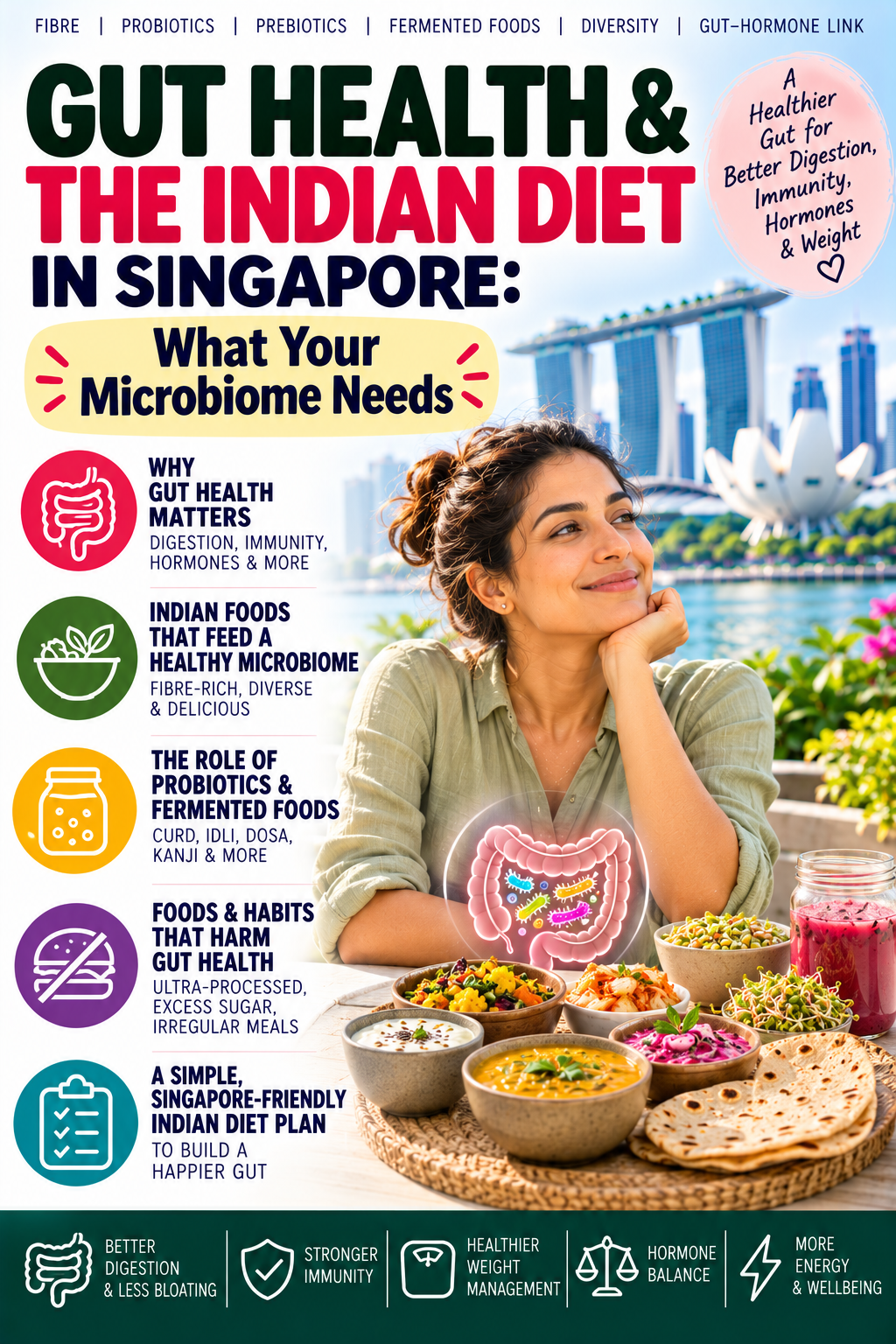
The gut microbiome has become the subject of an extraordinary volume of wellness marketing, and an equally extraordinary volume of legitimate science. For Indian women in Singapore, the microbiome conversation is particularly relevant: research from the HELIOS cohort at Nanyang Technological University (published 2026) demonstrated that Chinese, Indian, and Malay Singaporeans have distinct gut microbiome signatures despite living in the same urban environment, and that diet, more than ethnicity or genetics, shapes microbiome composition. The implication is direct: the dietary changes that come with urbanisation and acculturation in Singapore are reshaping the gut microbiome of Indian Singapore families in ways that have measurable metabolic and immune consequences.
This post is about what the evidence actually shows, not the supplement industry’s version, but the nutritional science, and what it means practically for an Indian Singapore kitchen.
👉IBS in Women: Managing Irritable Bowel Syndrome Through Diet
👉Gut Health and the Indian Diet: Probiotics, Prebiotics and Your Microbiome
What the Indian Gut Microbiome Actually Looks Like & Why It Is Changing
The traditional Indian gut microbiome is distinctive. A comparative study examining Indian and Chinese gut microbiomes found that Indian gut bacteria are significantly enriched with Prevotella and associated with a whole-grain, plant-based, high-fibre vegetarian diet. Prevotella copri and Lactobacillus species were identified as potential biomarkers of the traditional Indian diet, bacteria that thrive on the dal, vegetables, and whole grains that have been the foundation of Indian eating for generations.
This is not a bad thing. Prevotella-dominant microbiomes have been associated with superior short-chain fatty acid (SCFA) production — the metabolic byproducts of fibre fermentation that feed the gut lining, regulate inflammation, and signal to the immune system. The traditional Indian diet, with its diversity of dal (multiple legume varieties), vegetables, fermented foods (dahi, idli, dosa batter, kanji), and whole spices, is, from a microbiome perspective, one of the most protective dietary patterns available.
What is changing: the HELIOS cohort data and broader Singapore data consistently show that urbanisation, the shift from dal-rice-sabzi to hawker centre food, delivery apps, processed snacks, lower fibre intake, and higher refined carbohydrate consumption, is altering this microbiome signature in Indian Singapore families. The gut bacteria associated with health are being replaced by those associated with metabolic disease. The traditional diet was the medicine. The acculturation is the risk.
👉How Healthy Is Singapore Hawker Food? A Doctor’s Breakdown
👉 Download my Healthy Hawker Food Cheat Sheet (simple swaps that lower sugar & bloating triggers).
The Evidence Base: What the Microbiome Research Actually Shows
Fibre Is the Primary Prebiotic — Not a Supplement
The most robust and consistent finding across microbiome research is this: dietary fibre is the primary fuel for the beneficial bacteria in the gut. Specifically, fermentable fibre (resistant starch, pectin, beta-glucan, and inulin-type fructans) is fermented by the gut microbiome to produce short-chain fatty acids (SCFAs), principally butyrate, propionate, and acetate. Butyrate is the preferred fuel of colonocytes (the cells lining the large intestine) and has well-documented anti-inflammatory and anti-carcinogenic properties.
This means that the single most effective “gut health intervention” available is not a probiotic supplement; it is eating diverse, fibre-rich plant foods consistently, every day. The traditional Indian dal-sabzi-roti meal structure, eaten as designed, is a high-performance prebiotic delivery system. The average Indian adult in India consumes approximately 40 g of fibre daily. The WHO recommends 25–30 g daily. The average Indian adult in Singapore, eating more hawker food, processed snacks, and refined carbohydrates, consumes significantly less.
Fermented Foods — the Traditional Probiotic Strategy
The Indian culinary tradition has always included fermented foods: dahi (yoghurt), idli and dosa batter (fermented rice and urad dal), kanji (fermented rice water), lassi, chaas (buttermilk), and pickled vegetables. These are live-culture foods that directly introduce beneficial bacteria into the gut and have been part of Indian eating for thousands of years, long before the probiotic supplement industry existed.
A landmark 2021 Stanford RCT published in Cell (Wastyk et al.) compared a high-fibre diet to a high-fermented-food diet in healthy adults, measuring microbiome diversity as the primary outcome. The fermented food group showed significantly increased microbiome diversity and decreased inflammatory markers, including decreased activity of 19 inflammatory proteins. This was achieved through food, not supplements.
The practical implication: dahi (plain, with live cultures, not flavoured yoghurt) eaten daily is one of the highest-evidence gut health interventions available in a Singapore Indian kitchen. It is also cheap (Meiji Bulgaria Yoghurt, Marigold low-fat yoghurt, and supermarket own brands all contain live cultures; plain dahi made from live-culture starter is available at all Indian grocery stores in Little India and Mustafa Centre).
👉Fermented Foods: The Secret to Better Gut Health, Immunity, and Overall Wellness
Spices — the Anti-Inflammatory Microbiome Support
Emerging microbiome research has identified that many of the polyphenols in Indian spices, curcumin (turmeric), gingerols (ginger), piperine (black pepper), allicin (garlic), and quercetin (onion), act as prebiotics, selectively stimulating the growth of beneficial bacteria while reducing pathogenic ones. Curcumin in particular has been shown to increase Lactobacillus and Bifidobacterium species while reducing pro-inflammatory bacteria. The traditional Indian practice of cooking with a diverse spice base- haldi, jeera, dhania, adrak, lehsun, hing is, from a microbiome perspective, a polyphenol-delivery strategy that has been refined over centuries.
The critical caveat: these effects come from turmeric used as a spice in cooking, not from high-dose curcumin supplements. The bioavailability of curcumin from cooked food is sufficient for the microbiome effects observed; the supplement doses are different chemistry. Cook with turmeric. You do not need to take it as a supplement.
Sleep, Stress, and the Gut — the Often-Missed Bidirectional Connection
The 2025 systematic review of 41 studies on sleep and gut microbiota confirmed the bidirectional relationship: poor sleep alters gut microbiome composition, and microbiome dysbiosis disrupts sleep architecture. The gut-brain axis, operating through the vagus nerve and the enteric nervous system, means that gut dysbiosis, which produces inflammatory signals and disrupts serotonin production (90% of serotonin is produced in the gut), directly affects mood, anxiety, and sleep quality.
For Indian women in Singapore dealing with sleep disruption, anxiety, and fatigue alongside gut symptoms, this is relevant: the gut intervention and the sleep intervention are not separate. Improving gut microbiome diversity through diet improves the neurotransmitter environment for sleep and mood; improving sleep quality reduces the cortisol-driven dysbiosis that accompanies chronic stress.
👉The Mind-Gut Connection — Book Summary & Gut-Healing Insights
👉Gut-Brain Axis and Ayurveda: Did Ancient Wisdom Predict Modern Science?
👉How Anxiety Is Wrecking Your Gut: The Gut-Brain Connection Explained
What Is Actually Disrupting the Indian Singapore Gut
Before optimising, it is worth naming what is dysregulating:
- Antibiotic overuse: Singapore has among the highest antibiotic prescription rates in the Asia-Pacific. A single course of antibiotics significantly alters gut microbiome composition, and full recovery can take 6–12 months or may be incomplete. The standard practice of routinely prescribing antibiotics for viral respiratory infections, extremely common in Singapore private GP clinics, is the single largest iatrogenic cause of gut dysbiosis in this population.
- Ultra-processed food consumption: Hawker centre meals are largely unprocessed; the problem is the rising consumption of packaged snacks, instant noodles, biscuits, flavoured chips, and fast food. Ultra-processed foods are consistently associated with reduced microbiome diversity, lower SCFA production, and increased intestinal permeability (“leaky gut”).
- Reduced dal and vegetable diversity: Many Indian Singapore households have narrowed their dal repertoire to 1–2 varieties rather than the traditional 5–7 varieties used in Indian village cooking. Each dal species feeds a different set of gut bacteria; diversity of plant foods is directly associated with microbiome diversity.
- Chronic stress (the cortisol-gut connection): Chronic stress elevates cortisol, which alters gut permeability and microbiome composition directly. The pressure-cooker lifestyle of Indian Singapore families, particularly working mothers managing careers, children, and households simultaneously, is a structural risk factor for stress-driven gut dysbiosis that no amount of probiotic supplementation can override.
👉Gut Problems Common in Singapore Women (and What to Do About Them)
👉IBS in Indian Women — the gut microbiome connection and how fermented foods help
|
Metabolic Health · Singapore The traditional diet was already the gut health strategy. Getting back to it, in a Singapore context, is exactly what I help with.A personalised nutrition plan built around your Indian food framework, your Singapore kitchen, and your metabolic goals, not generic Western wellness advice repackaged with haldi in the title. 👉 Book a FREE 20-Minute Nutrition Call Dr Akanksha Sharma · MBBS MD · Singapore & worldwide via Zoom |
The Indian Singapore Gut Health Protocol
Daily Foundations
- Plain dahi (live-culture), 1 cup daily: The most evidence-based probiotic intervention available. Plain, not flavoured. Eaten with the meal or as a snack. Meiji Bulgaria Yoghurt (available NTUC, Cold Storage) explicitly states live L. bulgaricus and S. thermophilus cultures on the label.
- Dal, at least once daily, varied across the week: Masoor, toor, moong, chana, urad, rajma, chawli; rotate them. Each feeds a different bacterial genus. The total fibre from a single cup of cooked dal (10–15 g) is equivalent to the fibre benefit of most commercial prebiotic supplements, at a fraction of the cost.
- 30 different plant foods per week: The research benchmark for microbiome diversity. Include all vegetables, fruits, legumes, whole grains, nuts, seeds, and herbs. A modest increase in plant food variety, adding one new vegetable or legume variety per week — meaningfully shifts microbiome composition within 4–6 weeks.
- Whole grains over refined: Atta (whole wheat) roti over maida; brown rice or red rice alongside white rice; dalia (broken wheat porridge) for breakfast; adding oats to idli batter. These increase resistant starch, the most potent prebiotic for butyrate-producing bacteria.
Weekly Additions That Make a Measurable Difference
- Fermented rice water (kanji): A traditional Indian fermented drink with genuine probiotic content; particularly high in Lactobacillus; easy to prepare (soak washed rice in water overnight, strain and drink the water in the morning). A free, evidence-grounded gut intervention.
- Raw onion and garlic: Both are high in inulin-type fructans, among the most potent prebiotic fibres. Raw is more potent than cooked. Adding raw onion to raita, chopped garlic to a finished sabzi before serving, or raw onion rings alongside meals is a direct prebiotic intervention.
- Banana (slightly under-ripe): High in resistant starch when slightly under-ripe; a widely available Singapore fruit at every supermarket and market that directly feeds butyrate-producing bacteria.
- Turmeric + black pepper in cooking: The piperine in black pepper increases curcumin bioavailability by 2,000%; the combination is more effective than turmeric alone. Standard Indian cooking already achieves this; the practice of adding both haldi and kali mirch to sabzi and dal is nutritionally precise.
What to Reduce
- Ultra-processed snacks (chips, biscuits, instant noodles, packaged sweet snacks); actively reduce microbiome diversity
- Excessive sugar in all forms; fructose in particular selectively feeds pathogenic bacteria at the expense of beneficial ones
- Alcohol; directly toxic to beneficial gut bacteria and disrupts intestinal permeability
- Unnecessary antibiotic courses; ask your doctor whether antibiotics are genuinely indicated before accepting a prescription for a respiratory illness, which is overwhelmingly viral in Singapore’s context
On Probiotic Supplements: What the Evidence Actually Supports
The probiotic supplement market in Singapore (Guardian, Watsons, iHerb) is substantial, and the evidence is more nuanced than the marketing suggests. Key points from the current science:
- Specific strains for specific conditions: Probiotics are not interchangeable. Lactobacillus rhamnosus GG and Saccharomyces boulardii have the strongest evidence for antibiotic-associated diarrhoea. VSL#3 has evidence for IBS with bloating. Lactobacillus acidophilus NCFM has evidence for lactose digestion. A generic “multi-strain probiotic” supplement for general wellness has limited direct evidence.
- Diet is the prerequisite: Probiotic supplements work best when the dietary environment supports the introduced bacteria. Supplementing a probiotic while eating a low-fibre diet is planting seeds in concrete. The prebiotic substrate (fibre from food) needs to be in place for the probiotic to colonise.
- The food-based probiotic is more effective: The Stanford 2021 RCT found that fermented food dietary intervention outperformed probiotic supplementation for microbiome diversity and inflammatory marker reduction. Dahi, kefir, fermented vegetables, and kombucha (unsweetened): the food-based approach is the higher-evidence strategy.
- When supplements are appropriate: During and after antibiotic courses (take the probiotic at a different time of day from the antibiotic); for confirmed IBS with specific symptom patterns; for post-infectious gut recovery. Discuss with your doctor for condition-specific strain selection.
The Bottom Line
Your traditional Indian diet, dal diversity, fermented dahi, whole spices, and fibrous vegetables, is one of the most gut-microbiome-supportive dietary patterns in nutritional science. The evidence from Singapore’s own HELIOS cohort confirms that Indian Singaporeans have a distinctive gut microbiome shaped more by diet than by genetics. The threat is not a deficiency of probiotic supplements; it is the gradual erosion of the dietary pattern that made the traditional Indian gut microbiome robust. Eat your dal every day. Rotate your legumes. Add raw onion and garlic. Include plain dahi with the meal. Use your spice box. The gut health protocol was already in your kitchen. Getting back to it, deliberately, in a Singapore context, is where the work lies.
|
Metabolic Health · Singapore Gut Health Is Not a Supplement.
|
|
||
|
| 👉 Not Sure Which Programme? Book a FREE 20-Minute Call
Dr Akanksha Sharma · MBBS MD · Preventive Medicine Physician · Singapore & worldwide via Zoom |
References
- Distinct Gut Microbiome Signatures in Ethnically Diverse Populations within a Shared Urban Asian Geography (HELIOS cohort, NTU Singapore). medRxiv 2026. Full Text
- Similarities and differences in gut microbiome composition correlate with dietary patterns of Indian and Chinese adults. AMB Express. 2018. DOI: 10.1186/s13568-018-0632-1 [Prevotella and Lactobacillus as biomarkers of traditional Indian plant-based diet]
- Chandel N. Establishment and perturbation of human gut microbiome: common trends and variations between Indian and global populations. Gut Microbiome. 2024;5:e8. PMC11704572
- Wastyk HC et al. Gut-microbiota-targeted diets modulate human immune status. Cell. 2021;184(16):4137–4153. PMID 34256014. PubMed
- Olson M, Withrow D, Koelbel M, Southworth G, Phan A, Wright KP Jr, Whisner CM, Petrov ME. What is the nature of sleep and circadian rhythm health on gastrointestinal microbiota? A systematic review of studies in humans. Sleep Med Rev. 2026 Apr;86:102256. PubMed
Disclaimer: This article is for educational and informational purposes only. Specific gut health conditions including IBS, IBD, and SIBO should be assessed and managed by a qualified physician.

Akanksha Sharma
Dr Akanksha Sharma (MBBS, MD) is a physician and women’s health nutrition specialist, and the founder of IYSA Nutrition. She provides evidence-based, doctor-led nutrition guidance for pregnancy, postpartum recovery, PCOS, child nutrition, and family health, helping women make calm, informed decisions about their health and their children’s well-being.

Leave a Reply