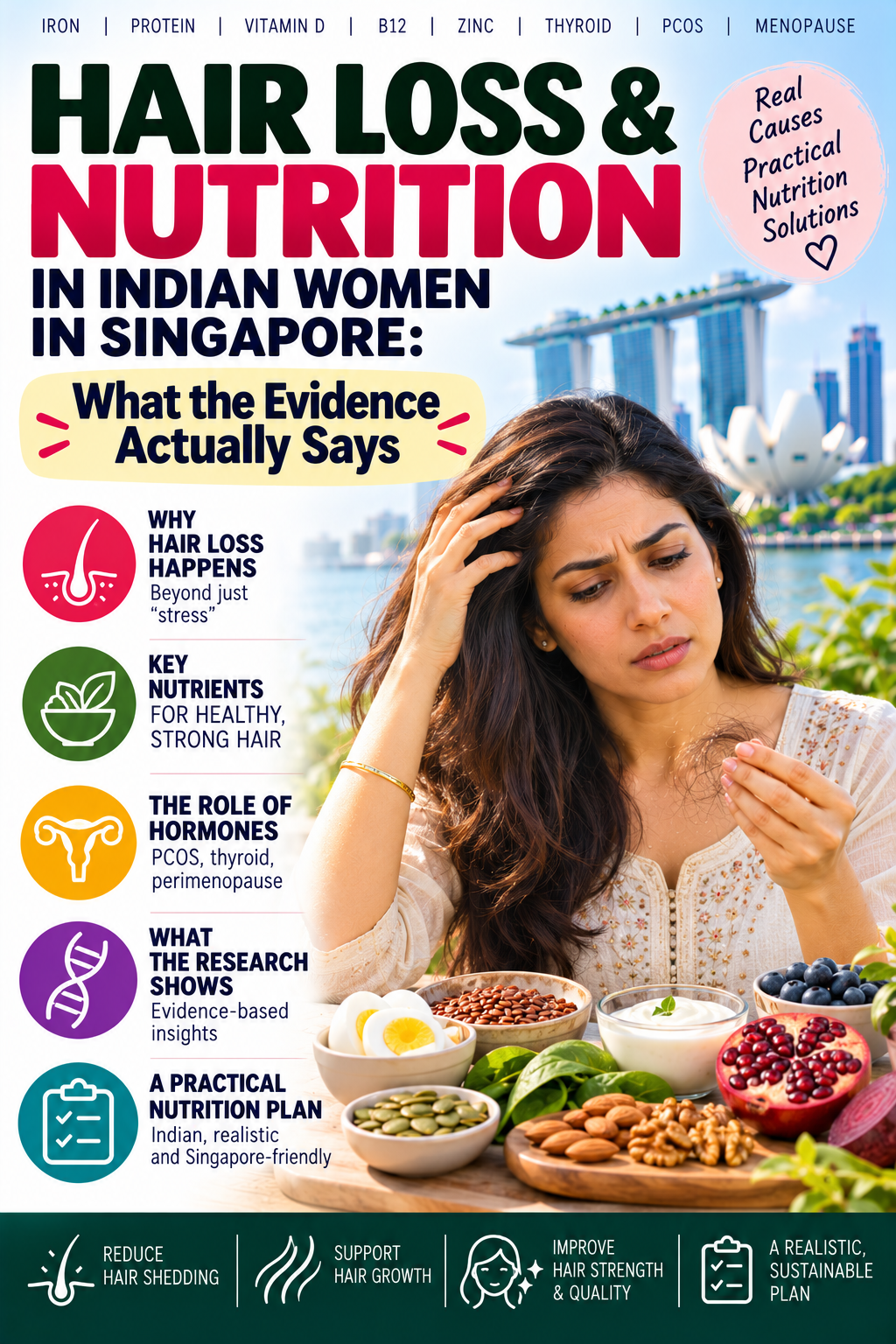
Hair loss is one of the most common complaints I hear from Indian women in Singapore, and one of the most frequently mismanaged. The dermatologist prescribes a topical treatment. The pharmacy sells a biotin supplement. The wellness influencer recommends an expensive collagen powder. And the hair keeps falling.
The reason most interventions fail is that they address the symptom without identifying the driver. Hair loss in Indian women in Singapore is overwhelmingly nutritional and hormonal, and the most common nutritional cause, iron deficiency, is routinely missed because doctors check haemoglobin rather than ferritin. Understanding the evidence, and being systematic about identifying the actual cause, is where effective management starts.
Why Indian Women in Singapore Are at Higher Risk
Several converging factors make hair loss particularly common in this population:
- Iron deficiency: Indian women in Singapore have multiple stacked risk factors, predominantly vegetarian diets (plant-based iron has 2–3× lower bioabsorption than haem iron), heavy menstrual bleeding (common in perimenopause), multiple pregnancies, postpartum depletion, and chronic low-grade iron insufficiency that never meets the diagnostic threshold for anaemia but is sufficient to impair hair follicle function.
- Postpartum telogen effluvium: The dramatic hair shedding 3–6 months after delivery, experienced by a large proportion of women, is physiologically normal and driven by the hormonal shift after delivery pushing a large number of follicles simultaneously into the resting (telogen) phase. Nutritional depletion in the postpartum period (iron, zinc, protein) delays recovery and prolongs the shedding phase.
- PCOS-related androgenic alopecia: Elevated androgens in PCOS drive pattern thinning, particularly at the crown. This is a hormonal driver, not a nutritional one, though nutrition is a lever for the underlying insulin resistance that drives androgen excess.
- Perimenopause and estrogen decline: Falling estrogen in the 40s extends the resting phase of the hair cycle and reduces hair follicle stimulation. This overlaps with the postpartum depletion period for many Indian women in Singapore who have children later.
- Protein restriction as a dietary norm: Many Indian vegetarian women in Singapore do not meet protein requirements, 0.8–1.0 g/kg/day at minimum, and closer to 1.2–1.6 g/kg/day when hair and muscle health are goals. Hair follicles are among the most metabolically active tissues in the body and among the first to be sacrificed when protein is limiting.
👉Postpartum Hair Loss: The Nutritional Truth Nobody Tells You
👉PCOS and Hair Loss: Why It Happens and What to Eat
👉How to Make Indian Vegetarian Meals High in Protein?
The Nutrients That Actually Matter: What the Evidence Shows
1. Iron — the Most Common Nutritional Cause of Hair Loss
Iron deficiency is the most common nutritional factor associated with hair loss in women of reproductive age. The mechanism: iron is a cofactor for ribonucleotide reductase, the enzyme limiting DNA synthesis, and hair follicle matrix cells have one of the highest cell division rates in the body. Iron deficiency directly impairs this rapid cell division.
The critical clinical point: ferritin, not haemoglobin. Serum ferritin, the iron storage protein, below 40 ng/mL is associated with significant hair shedding in women, even when haemoglobin is still within the “normal” range. Many Singapore GPs check haemoglobin and report it as normal; the ferritin remains unchecked and remains depleted. Ask specifically for serum ferritin at your next blood test. The target for hair health is ferritin ≥70 ng/mL, not simply “not anaemic.”
Best Indian food sources of iron:
- Rajma (kidney beans): ~6.7 mg iron per 100 g cooked, among the richest plant iron sources, a staple that most Indian Singapore families already cook regularly
- Masoor dal (red lentils): ~3.3 mg per 100 g cooked; chana dal, moong dal, toor dal, all significant contributors
- Tofu: ~2.7 mg per 100 g, particularly important for Indian vegetarians in Singapore where tofu is widely available and cheap
- Spinach (palak): ~2.7 mg per 100 g cooked, but paired with amchur (tamarind) or lemon juice to provide vitamin C, which dramatically increases non-haem iron absorption. The traditional combination of palak with lemon is nutritionally precise.
- Sesame seeds (til): ~14.6 mg per 100 g, til laddoo and sesame-based chutneys are concentrated iron sources; a tablespoon of sesame daily is a meaningful contribution
- For non-vegetarians: chicken liver (~13 mg/100 g) and red meat are the highest-bioavailability haem iron sources
Enhance absorption: Eat vitamin C alongside iron-rich plant foods, lemon juice on dal, amla (Indian gooseberry) as a daily addition, guava, and tomatoes with iron-rich meals. Avoid iron blockers at the same meal: tea and coffee (tannins), calcium-rich foods, and phytates in wheat bran. The standard Indian habit of having chai with every meal significantly reduces iron absorption from that meal.
👉Iron-Deficiency Anemia in Singapore Women
Reference: Wang R et al. Micronutrients and Androgenetic Alopecia: Systematic Review. Mol Nutr Food Res. 2025. DOI: 10.1002/mnfr.202400652 [vitamin B, vitamin D, iron, and zinc as critical micronutrients for hair growth and maintenance]
2. Protein — the Building Block the Hair Follicle Cannot Work Without
Hair is approximately 95% keratin, a structural protein. Protein deficiency directly impairs keratin synthesis and, in severe cases, pushes follicles prematurely into the resting (telogen) phase, causing diffuse shedding. This does not require frank protein malnutrition: chronic low-grade protein insufficiency, common in Indian vegetarian women in Singapore who eat predominantly dal-rice-roti without adequate protein at each meal, is sufficient to impair hair follicle function.
The target for hair health: 1.2–1.6 g of protein per kg of body weight daily; for a 55 kg woman, this is approximately 66–88 g of protein per day. Most Indian vegetarian women in Singapore consume 35–50 g daily. The gap is significant.
Best Indian vegetarian protein sources in Singapore:
- Paneer: 18–20 g protein per 100 g, the single most protein-dense Indian vegetarian food; two servings of paneer daily as part of a meal strategy cover a substantial protein gap
- Greek yoghurt (available at NTUC, Cold Storage, Giant): 10–15 g protein per 100 g, significantly higher than regular dahi; Chobani, Fage, and supermarket own-brand available at SGD 3–5 per tub
- Soy milk (unsweetened): The only plant milk with a complete amino acid profile comparable to dairy; choose unsweetened fortified versions (Vitasoy Organic, Marigold HL Soy)
- Rajma, chana, moong, masoor: 7–9 g protein per 100 g cooked; the foundation of protein in Indian vegetarian diets, eating dal twice daily rather than once is a meaningful change
- Eggs: 13 g protein per 100 g, with a complete amino acid profile including all cysteine and methionine needed for keratin synthesis; two eggs provide 12–13 g of highly bioavailable complete protein
- Tofu (firm): 8–10 g protein per 100g; silken tofu 5–6 g; widely available at all Singapore supermarkets from SGD 1–2 per block
3. Zinc — Required for Follicle Protein Synthesis
Zinc is required for over 100 enzymes and transcription factors, including those controlling genes expressed in hair follicles. A significant zinc deficiency causes hair loss, though true deficiency is less common than iron deficiency in this population. Low-normal zinc levels, sufficient to prevent overt deficiency symptoms but suboptimal for hair follicle function, are more relevant than frank deficiency.
Best sources for Indian women in Singapore: pumpkin seeds (8.1 mg zinc per 100 g; a handful daily is practical and available at NTUC and Cold Storage), sesame seeds, tahini, cashews, rajma, and dairy. For non-vegetarians: oysters have the highest zinc content of any food (~39 mg/100 g), with beef and lamb also significant.
👉Zinc: The Important Mineral You are Not Taking Enough
4. Vitamin D — the Follicle Receptor Connection
Vitamin D receptors are present in hair follicles, and low vitamin D levels have been associated with alopecia areata and, to a lesser extent, androgenetic hair loss. Indian women in Singapore are at high risk for vitamin D deficiency despite living near the equator: darker skin, indoor work, sun avoidance for cultural reasons, and high-SPF sunscreen use all reduce cutaneous vitamin D synthesis. The mechanism for hair: vitamin D promotes transition of follicles from the resting (telogen) to the growing (anagen) phase. Supplementing vitamin D corrects hair loss only when deficiency is confirmed; supplementing in a woman who is already replete does not stimulate additional hair growth.
Check 25-OH vitamin D. Target: 40–60 ng/mL for Indian women in Singapore. If below 30 ng/mL: supplement 2000–4000 IU daily with a fatty meal. Recheck in 3 months.
👉Vitamin D Deficiency in Singapore: Why You’re Still Low Despite the Sun
5. Biotin — the Supplement with the Most Marketing and the Least Evidence
Biotin supplements are the most commercially promoted hair supplement in Singapore, sold at Guardian, Watsons, and iHerb in doses of 5,000–10,000 mcg. The evidence does not support this. True biotin deficiency is rare in adults who eat a varied diet. When no deficiency exists, there is no strong evidence that biotin supplements improve hair growth or reduce shedding. A 2017 review in Skin Appendage Disorders found that of all published cases of biotin improving hair growth, every single one involved a confirmed pre-existing biotin deficiency. The daily adequate intake for biotin is 30 mcg; eggs (25 mcg per yolk), sunflower seeds, sweet potato, and almonds provide sufficient amounts through food. The high-dose supplements sold in Singapore pharmacies are not harmful, but for most women they are expensive placebos.
Exception: women taking anticonvulsants, women who consume large quantities of raw eggs, and pregnant or lactating women may have biotin requirements that warrant supplementation; discuss with your doctor.
👉Weight Loss with Hormonal Balance: Why Extreme Diets Backfire
|
Women’s Nutrition · Singapore Hair loss is rarely just one thing. Getting the right test and addressing the actual driver is the difference between months of supplements that don’t work and a strategy that does.I work with women in Singapore to identify the nutritional gaps actually driving their symptoms, and build a dietary strategy that addresses the root cause, not just the surface. 👉 Book a FREE 20-Minute Women’s Nutrition Call Dr Akanksha Sharma · MBBS MD · Singapore & worldwide via Zoom |
The Indian Foods with the Most Evidence for Hair Health
Rather than a supplement protocol, here is the evidence-ranked list of Indian foods that directly address the nutrients most relevant to hair health in this population:
- Eggs — the single most complete hair food available. Biotin (25 mcg per yolk), complete protein with all essential amino acids for keratin synthesis, zinc, iron, selenium, and vitamin D. Two eggs daily cover a meaningful portion of the nutritional gap.
- Rajma (kidney beans) — the highest plant-iron source in the Indian diet, combined with significant protein and zinc. Eating rajma twice per week as a main dish rather than a side is a meaningful intervention.
- Methi (fenugreek) seeds — contain nicotinic acid (niacin) and protein that nourish hair follicles; among the most consistently evidence-cited Indian foods specifically for hair. Soak 1 tsp overnight, consume in the morning or add to dosa batter, dal, or sabzi.
- Sesame seeds (til) — exceptional zinc and iron content; 1–2 tablespoons daily as chutney, on sabzi, in laddoo, or sprinkled on rice provides significant mineral support.
- Paneer — high-quality complete protein, calcium, and zinc; two servings daily as a regular meal component is the single highest-impact dietary change for protein-deficient Indian vegetarian women in Singapore.
- Pumpkin seeds — richest plant source of zinc (8.1 mg/100g), also contains iron and magnesium; a handful (30g) as a daily snack, available cheaply at all Singapore supermarkets and Mustafa Centre.
- Amla (Indian gooseberry) — one of the richest natural sources of vitamin C (600–700 mg per 100g), which dramatically enhances non-haem iron absorption from dal and vegetables; available fresh at Mustafa Centre and Little India shops, and as powder at Indian grocery stores in Singapore.
- Fatty fish (salmon, mackerel, sardines) — for non-vegetarians: omega-3 fatty acids support scalp health and reduce the inflammatory component of some hair loss; excellent protein source with complete amino acids; widely available at Singapore wet markets and supermarkets.
👉Hair Fall after Delivery: Causes, Remedies, and Ayurvedic Insights for New Moms
What Tests to Ask for at Your Next Blood Draw
If you are experiencing significant hair shedding, these are the investigations worth requesting from your GP or polyclinic in Singapore, before spending money on supplements:
- Serum ferritin (not just haemoglobin) — target ≥70 ng/mL for hair health; most labs report “normal” at ≥12–15 ng/mL, which is not the hair health threshold
- Serum 25-OH vitamin D — target 40–60 ng/mL; supplement if below 30 ng/mL
- TSH (thyroid stimulating hormone) — thyroid dysfunction (both hypo- and hyperthyroidism) causes hair loss and is common in Indian women in Singapore; a normal TSH rules this out
- Free androgen index / DHEAS — if you have PCOS, irregular cycles, or crown thinning pattern; elevated androgens require a different management approach
- Total protein / albumin — if you suspect chronic protein deficiency
- Zinc — less commonly deficient but worth checking if diet is restricted
Subsidised testing is available at all Singapore polyclinics. A fasting blood draw is required for the full panel. Bring this list to your next GP visit, most GPs will add ferritin and vitamin D to a standard blood panel on request.
👉PCOS and Hormonal Acne in Singapore Women: The Diet Strategy That Addresses the Root Cause
Frequently Asked Questions
How long does it take for dietary changes to improve hair shedding?
The hair growth cycle is slow. Changes in nutrition take 3–6 months to manifest in visible hair quality improvements, because the follicles growing today were being nourished 3–4 months ago. This is why supplement-of-the-month approaches fail: you need sustained nutritional correction over several months, not a 4-week trial. Commit to 3–4 months of consistent dietary change and appropriate supplementation (where deficiency is confirmed) before evaluating the result.
I have PCOS and significant hair thinning. Is this a nutritional issue?
It is both hormonal and nutritional. The androgenic component of PCOS-related hair loss requires addressing the underlying insulin resistance, which is a nutritional strategy. The nutritional component (iron deficiency, protein insufficiency) is often additive. Both need to be addressed simultaneously. The PCOS Hormone Harmony programme addresses this in an integrated way.
My hair loss started dramatically after delivery. Will it resolve on its own?
Postpartum telogen effluvium typically resolves on its own within 6–12 months as the hair cycle normalises. However, nutritional depletion in the postpartum period- iron, zinc, protein, vitamin D prolongs and worsens the shedding phase. Addressing nutrition proactively in the postpartum period shortens the recovery and reduces the severity of shedding. If shedding continues beyond 12 months postpartum, investigate ferritin, thyroid function, and vitamin D.
The Bottom Line
Hair loss in Indian women in Singapore is overwhelmingly nutritional and hormonal in origin, and the most common driver, iron deficiency, is routinely missed because ferritin is not checked. The intervention is systematic: identify the actual deficiency through blood tests, address it through targeted food strategy rather than generic supplement taking, build protein to 1.2–1.6 g/kg/day through paneer, eggs, legumes, and soy, ensure vitamin D adequacy, and give the dietary changes 3–4 months to show results. Biotin supplements without confirmed deficiency will not help. Methi seeds, sesame, rajma, amla, and eggs are among the most evidence-grounded Indian foods for hair. The hair your follicles grow three months from now is being nourished by what you eat today. That is the leverage point.
|
Women’s Health · Singapore The Supplements Won’t Work
|
|
||
|
| 👉 Not Sure Which Program? Book a FREE 20-Minute Call
Dr Akanksha Sharma · MBBS MD · Preventive Medicine Physician · Singapore & worldwide via Zoom |
References
- Wang R et al. Micronutrients and Androgenetic Alopecia: A Systematic Review. Mol Nutr Food Res. 2025. DOI: 10.1002/mnfr.202400652. [Vitamin B, vitamin D, iron, zinc as critical micronutrients; deficiencies represent modifiable risk factors for hair loss]
- Patel DP, Swink SM, Castelo-Soccio L. A Review of the Use of Biotin for Hair Loss. Skin Appendage Disord. 2017;3(3):166–169. DOI: 10.1159/000462981. [All published cases of biotin benefit involved confirmed prior deficiency]
- Neeland IJ et al. Changes in lean body mass with glucagon-like peptide-1-based therapies. Diabetes Obes Metab. 2024. [protein requirements during weight loss relevant to hair health]
Disclaimer: This article is for educational and informational purposes. Hair loss investigation and treatment should be discussed with your doctor. Blood testing is available at all Singapore polyclinics.

Akanksha Sharma
Dr Akanksha Sharma (MBBS, MD) is a physician and women’s health nutrition specialist, and the founder of IYSA Nutrition. She provides evidence-based, doctor-led nutrition guidance for pregnancy, postpartum recovery, PCOS, child nutrition, and family health, helping women make calm, informed decisions about their health and their children’s well-being.
Leave a Reply