
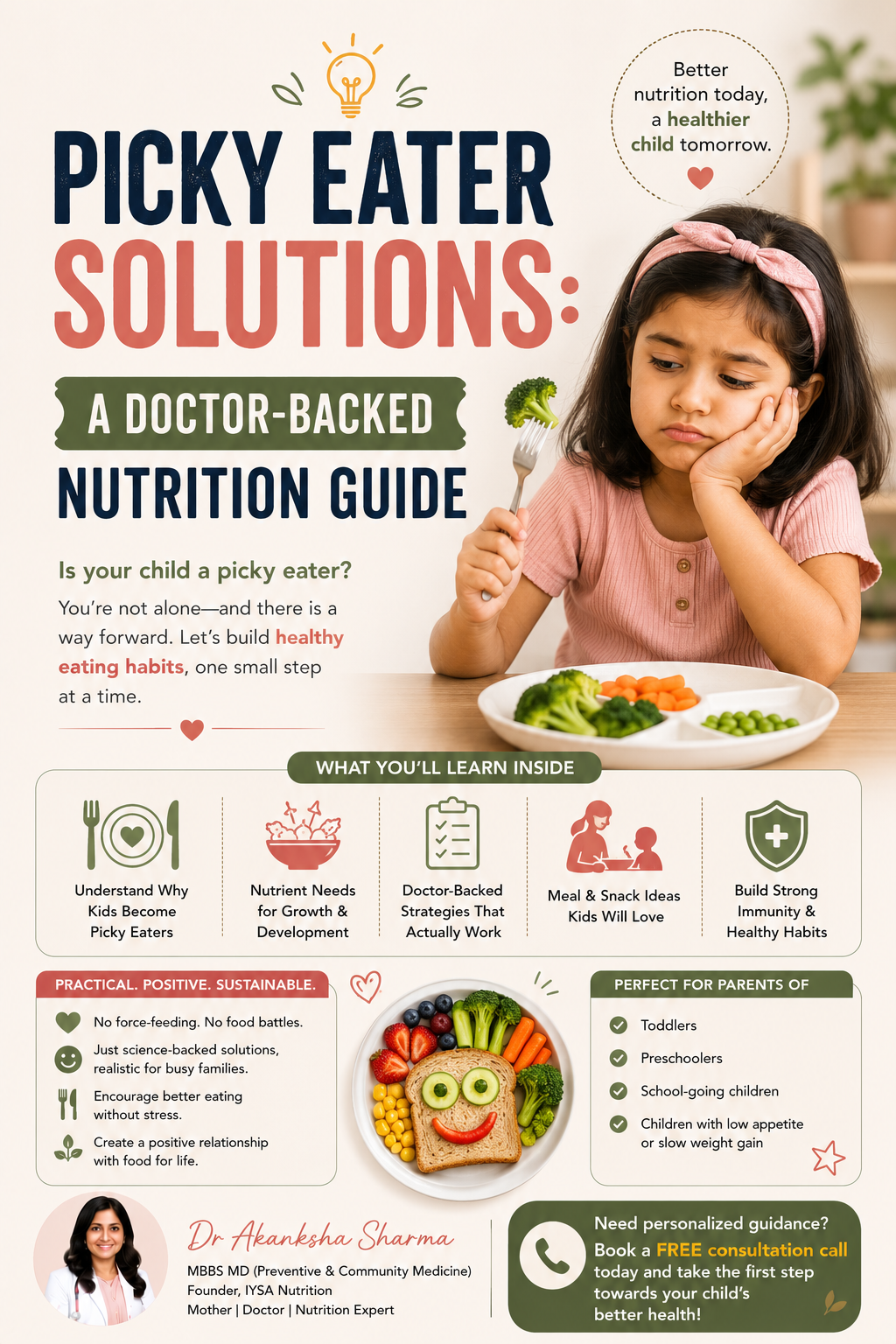
Written & reviewed by Dr Akanksha Sharma, MBBS, MD (Preventive & Community Medicine) | Founder, IYSA Nutrition, Singapore
If you are the parent of a picky eater, mealtimes have probably become one of the most stressful parts of your day. The child who ate everything as a baby now rejects nearly every food you prepare. Textures are wrong, colours are suspicious, familiar foods are suddenly “disgusting,” and the meal you spent 45 minutes cooking ends up untouched while your child eats plain rice for the fourth consecutive day.
You are not alone. Picky eating or selective eating is one of the most common concerns raised by parents in paediatric nutrition consultations. Studies estimate that 13–50% of toddlers and preschoolers display significant food selectivity, depending on how it is defined and measured. For Indian parents, where food is central to cultural identity, family connection, and expressions of love, a child who refuses home-cooked meals can feel like a deeply personal rejection.
But here is what decades of paediatric feeding research has established with clarity: most picky eating is developmentally normal, it does not indicate nutritional deficiency in the majority of cases, it is highly responsive to the right parental and environmental strategies, and the approaches most commonly used by well-meaning parents, force-feeding, bribing, rewarding, and pressuring, are precisely the ones that make picky eating significantly worse and more entrenched.
This guide gives you the evidence-based, culturally grounded strategies that actually work, and equally importantly, tells you what to stop doing immediately.
📌Why Are So Many Kids Becoming Fussy Eaters?
📌Screen Time and Sleep: How Your Child’s Diet Affects Both
📌Vitamin D in Indian Children in Singapore: Why Sunlight Is Not Enough
Understanding Picky Eating: Why Does It Happen?
Developmental Neophobia — Normal and Expected
Food neophobia, the fear or rejection of new foods, is a universal developmental phenomenon that peaks between the ages of 2 and 6 years. From an evolutionary perspective, this makes complete sense: toddlers who are newly mobile and exploring the world independently benefit from being cautious about unfamiliar foods. The child who ate everything you offered at 9 months (when you controlled all food intake) is not being difficult at 2 years; they are expressing a normal, species-appropriate survival mechanism.
The critical insight from decades of research by feeding scientist Leann Birch and others: Neophobia is not a personality trait to be overridden but a developmental phase to be navigated with patience and strategy. Children who are allowed to explore foods at their own pace, without pressure, consistently expand their food repertoire more effectively than children who are pressured, rewarded, or forced.
Sensory Sensitivity
Many picky eaters are not being wilful; they are genuinely experiencing certain food textures, smells, temperatures, and visual presentations as aversive in ways that adults do not. Oral sensory sensitivity, heightened responses to texture, temperature, or taste intensity, is a real neurological phenomenon, not a behaviour choice. It is particularly common in children with ADHD, autism spectrum conditions, and anxiety, though it also occurs in neurotypical children.
Understanding that your child’s “fussiness” about texture may be a genuine sensory experience, not manipulation, fundamentally changes how you respond to it. Forcing a child with genuine sensory sensitivity to eat a texture that is neurologically aversive to them does not desensitise them to it; it creates negative associations with the eating environment that persist for years.
The Control Dimension
Toddlers and preschoolers are in the developmental stage of autonomy, learning that they are separate individuals with their own preferences and the power to exercise choice. Food is one of the very few domains in which young children have genuine power: you can prepare the food, but you cannot make them swallow it. Picky eating in this age group is frequently a combination of genuine food preferences and an assertion of autonomy, and it is amplified when parents try to take that autonomy away through pressure and force.
The Exposure Paradox
Research has consistently found that children need to be exposed to a new food 10–15 times before they reliably accept it. This exposure does not mean eating; it means having the food on the plate, touching it, smelling it, and watching others eat it, over multiple encounters. Most parents give up after 2–3 rejections and conclude that the child “doesn’t like” the food, thereby eliminating all future exposure and making acceptance impossible. The 10–15 exposure rule is one of the most practically transformative findings in paediatric feeding research.
Worried your child is eating “too little” or too selectively?
👉 Book a child nutrition consult (FREE) (Singapore-friendly, practical, doable meal plans).
👉Childhood Food Allergy: What Parents Must Know
The Division of Responsibility: The Framework That Changes Everything
The single most evidence-supported framework for managing picky eating is Ellyn Satter’s Division of Responsibility in Feeding (sDOR):
- The parent is responsible for: What food is offered, when it is offered, and where eating happens
- The child is responsible for: Whether to eat, and how much to eat
This framework is counterintuitive for many Indian parents, whose cultural instinct is to ensure the child has eaten enough, often by any means necessary. But the research is unequivocal: when parents consistently respect this division, children eat more variety, eat more appropriate amounts, and develop healthier long-term relationships with food. When parents override the child’s side of the division (by forcing, pressuring, or bribing), the opposite happens.
In practical terms, for Indian families:
- You decide what is served at every meal — and you always include at least one food your child currently accepts alongside the new or challenging food
- You decide when meals happen — regular, predictable mealtimes with no grazing in between
- You do not comment on how much or how little the child eats at a given meal
- You do not offer alternative foods if the child rejects what is served (beyond the “safe” food that is always present)
- You do not cajole, pressure, bribe, or threaten around eating
- You trust that a healthy child will not starve themselves — and that hunger is a powerful driver of food acceptance
📌Children Are Not Mini Adults: Stop “Healthy” Food Trends From Harming Your Child
📌How to Know If Your Child Is Getting Enough Protein!
📌Is Your Child Getting Enough Calcium? (Without Milk/ Dairy)
Strategies That Work: Evidence-Based Approaches for Indian Families
1. The “Safe Food Plus One” Rule
At every meal, always include one food your child currently eats reliably, their “safe food.” This might be plain rice, plain roti, dahi, or whatever they consistently accept. Alongside it, serve small portions of the family’s food, including challenging foods, without comment or pressure. The child can eat the safe food if they choose. The challenging food is simply present, creating exposure. Over 10–15 exposures across weeks and months, acceptance of the challenging food gradually increases.
This approach eliminates the mealtime battle because the child is never without something they can eat, and therefore has no reason to panic or dig in defensively. It also eliminates the “short order cook” problem of cooking separate meals for the picky child.
2. Serve New Foods Alongside Accepted Foods — Never Alone
A new food presented alone, without a familiar context, activates maximum neophobia. The same food presented as a small portion alongside several familiar foods is far less threatening. Pair new foods with accepted foods, a small amount of new sabzi alongside accepted dal and roti, a new fruit alongside familiar banana and dahi. The child can touch, smell, or taste the new food at their own pace without feeling that their entire meal is threatened.
3. The 10–15 Exposure Rule — Keep Serving Rejected Foods
This is perhaps the most practically important strategy. When your child rejects a food, do not remove it from the meal rotation. Continue serving small amounts of it at approximately weekly intervals, without pressure, without comment, without expectation. Track exposures mentally rather than outcomes. Acceptance typically comes somewhere between the 8th and 15th exposure, but only if you keep serving the food. Parents who stop after 3 rejections never reach the acceptance threshold.
4. Involve Children in Food Preparation
Research consistently shows that children who participate in food preparation, washing vegetables, mixing dough, tearing leaves, and stirring dal are significantly more likely to taste and accept those foods at the table. This works because it increases familiarity (reducing neophobia), gives the child a sense of ownership (“I made this”), and creates positive associations with the food before it ever appears on the plate.
For Indian families, this is beautifully integrated into traditional cooking: children can help knead roti dough, wash dal, tear methi leaves, mix batter for dosa or chilla, or arrange ingredients for a chaat. Even a 2-year-old can wash vegetables or tear coriander leaves.
5. Family Meals — The Most Powerful Intervention
Children learn to eat by watching others eat. The family meal, where children observe parents, grandparents, and siblings eating with evident enjoyment, is the most powerful desensitisation tool available. A child who watches adults eat a food with pleasure over months of family meals is receiving hundreds of low-pressure exposures. Children who eat separately from adults miss this modelling entirely.
In Indian culture, the family meal is already deeply embedded; preserving this practice, even in busy urban households, is one of the most nutritionally and socially valuable things a family can do. Eat together. Eat the same food. Let the child observe. Do not comment on their eating.
6. Deconstruct Familiar Dishes
Many picky eaters accept the individual components of a dish but reject the combined dish. A child who rejects palak paneer may accept plain paneer and plain roti separately. A child who rejects dal makhani may accept plain dal and plain roti. Serve components separately and let the child combine them at their own pace, gradually moving toward the combined dish over weeks and months.
7. Change the Form, Not the Food
A child who rejects cooked carrots may accept raw carrots. A child who rejects whole dal may accept a smooth dal soup. A child who rejects palak sabzi may accept palak paratha (where the spinach is invisible). Changing the form, texture, temperature, or presentation of a food without changing the food itself is a legitimate and effective strategy, and different from “hiding” vegetables deceptively, which can backfire when discovered.
8. Reduce Grazing — Hunger Is Your Ally
Picky eating is significantly worsened when children are not hungry at mealtimes. A child who has grazed on biscuits, fruit, juice, and milk throughout the day arrives at the dinner table with no appetite and with no incentive to try the new or less-preferred food being served. Hunger is one of the most powerful drivers of food acceptance.
Establish structured meal and snack times with no eating in between. In practice for Indian families: breakfast, a mid-morning snack (one food, not an extended grazing period), lunch, an afternoon snack, and dinner, with only water between these times. Children who arrive at meals genuinely hungry make far less fuss about food variety.
9. Keep the Eating Environment Calm and Positive
Mealtime anxiety, driven by parental pressure, negative comments about eating, threats (“you won’t get dessert”), bribes (“finish your vegetables and you can watch TV”), and the child’s awareness of parental distress, creates a stress response that directly reduces appetite and increases food rejection. The nervous system does not function well under threat.
The goal is a calm, pleasant, pressure-free mealtime where the focus is on family connection rather than on what the child is eating. This is harder than it sounds, particularly for Indian grandparents whose love language includes ensuring the child has eaten, but it is the most consistently supported intervention in the picky eating research.
10. Consider Sensory-Friendly Presentation
For children with genuine sensory sensitivity: serve foods at room temperature rather than very hot or cold; separate foods on the plate so they do not touch (mixed foods often trigger rejection in sensory-sensitive children); use consistent, familiar tableware; reduce strong smells during cooking where possible; and allow the child to feed themselves rather than being fed (loss of control over pace and portion worsens sensory anxiety).
📌How to Pack A Nutritious and Fun Lunch Box for Your Kids
📌5 High-Protein & Delicious Snacks for Kids’ Lunch
What to Stop Doing Immediately
Stop Forcing and Pressuring
Force-feeding is the single most reliably counterproductive feeding strategy. It creates negative associations with the food being forced, with the mealtime environment, and with eating in general. It teaches the child that their body signals (fullness, aversion) are not to be trusted. It can contribute to long-term disordered eating. No feeding research supports it. Stop completely.
Stop Using Food as Reward or Punishment
“Eat your vegetables, and you can have mithai” teaches children that vegetables are a price to be paid for the real food (mithai), and elevates dessert foods to a higher psychological status. This systematically increases preference for the reward food and decreases preference for the “payment” food. Decades of research by Leann Birch confirm this mechanism. Avoid food rewards entirely.
Stop Cooking Separate “Children’s Meals”
While well-intentioned, cooking a separate meal for the picky child every time they reject the family’s food teaches the child that rejection is effective; it produces a more preferred meal. It also prevents the family meal modelling, which is one of the most powerful tools for food variety expansion. The exception: always include one accepted food alongside the family meal so the child is not left without anything to eat.
Stop Praising Eating
Praise (“good girl for eating your dal!”) focuses the child’s attention on external approval rather than internal hunger and satiety signals. It can create anxiety around meals when the child knows praise is expected but does not feel like eating. Keep mealtimes neutral and positive, about connection, not performance.
Stop Hiding Vegetables Indefinitely
Hiding spinach in paratha dough or dal is a useful short-term strategy to maintain nutritional intake during a difficult phase. But it should be a bridge, not a permanent solution, because if discovered, it can damage trust. Use it as a transition while simultaneously working on exposure-based acceptance of the visible, recognisable food.
📌Screen-Free Meals: How Ditching Distractions Can Help Your Child Overcome Fussy Eating
📌Why Zinc Deficiency is common in Indian Kids (And How to Fix It)
When Is Picky Eating a Clinical Concern?
Most picky eating is within the normal developmental spectrum and does not require medical intervention. However, seek evaluation if:
- Your child eats fewer than 20 different foods, and the list is shrinking rather than growing
- Food refusal is so severe that it is causing weight loss, growth faltering, or nutritional deficiency
- The child gags, vomits, or has extreme distress (panic, crying, tantrum) at the sight or smell of food, beyond typical picky eating reluctance
- The child cannot tolerate any texture beyond a very narrow range (e.g., only pureed or only crunchy)
- Picky eating is accompanied by other sensory sensitivities, social communication differences, or developmental concerns that may suggest an autism spectrum condition or sensory processing disorder
- The child is losing weight or has dropped significantly on the growth chart
In these cases, referral to a paediatric feeding specialist, which may include a paediatric dietitian, occupational therapist specialising in feeding, speech and language therapist, and/or developmental paediatrician, is appropriate. What is being described in these cases is Avoidant/Restrictive Food Intake Disorder (ARFID), a recognised clinical condition that requires specialised, multidisciplinary management beyond standard picky eating strategies.
Nutritional Safety Net: Ensuring Adequate Nutrition During the Picky Phase
While working on food variety expansion, these strategies help ensure adequate nutrition from the foods your child currently accepts:
- Maximise nutrition density in accepted foods: If the child eats plain dal, make it thick and protein-rich. If they eat dahi, choose full-fat for maximum nutrition. If they eat roti, add a small amount of ground flaxseed to the dough.
- Fortify accepted foods where possible: Add moringa powder to dal or khichdi (invisible, flavour-neutral in small amounts). Add ragi to milk or oat porridge. Add ground flaxseed to dahi. These “hidden” nutritional boosts are legitimate as short-term bridges.
- Consider a comprehensive children’s multivitamin during periods of extreme restriction, not as a replacement for working on food variety, but as a nutritional safety net. Discuss with your paediatrician.
- Prioritise protein, iron, and zinc from the foods the child accepts, these are the nutrients most likely to become insufficient during picky eating phases.
Frequently Asked Questions
My child ate everything until 18 months and then became picky. Is something wrong?
No, this is the exact developmental trajectory of normal toddler neophobia. The transition from the adventurous infant who mouths everything to the selective toddler who rejects novelty happens predictably at 18–24 months and is driven by the developmental emergence of food neophobia as autonomy increases. It is not regression; it is not caused by something you did wrong, and it does not predict lifelong picky eating. Most children naturally expand their food repertoire through school age with appropriate parental strategies and time.
My mother-in-law insists we should force the child to eat. How do I handle this?
This is one of the most common family dynamics I hear about in Indian households. The most effective framing for grandparents: explain that forcing actually makes picky eating worse and longer-lasting, it is not about being permissive, it is about using the strategy that actually works. Research consistently shows that pressure and force entrench food refusal rather than resolving it. Ask grandparents to redirect their love of feeding into sitting at the table, eating with evident enjoyment, and telling stories about food — all of which are among the most effective family meal strategies for expanding children’s food variety.
My 4-year-old only eats 5 foods. Should I be worried?
A child who eats only 5 foods is at the concerning end of the picky eating spectrum. This warrants a paediatric nutrition consultation and possibly referral to a feeding specialist to rule out ARFID. However, before concluding the list is truly 5 foods, consider all forms and preparations of each food; sometimes, what appears to be a very short list is actually more varied when all preparations are counted. Growth chart review by your paediatrician is the most important first step: if the child is growing consistently along their centile, immediate intervention may not be urgent while you implement the strategies above. If growth is faltering, earlier specialist involvement is warranted.
Should I supplement my picky eater with protein powder?
Protein powders designed for adults are not appropriate for children. For children with severely restricted diets who are genuinely protein-insufficient, a paediatric oral nutritional supplement (such as Pediasure or similar products recommended by your paediatrician) may be appropriate as a temporary nutritional bridge, but this should be guided by a paediatrician rather than self-prescribed. For most picky eaters who accept at least some dairy, eggs, or dal, protein deficiency is less common than parents fear. Get a dietary assessment from a paediatric nutrition specialist before supplementing.
My child only eats white foods — bread, rice, plain pasta. Why?
White food preference in picky eaters is not accidental; white, beige, and pale foods are typically mild in flavour, low in complexity, and visually predictable. This is a classic pattern in sensory-sensitive picky eaters who are avoiding the intense flavours, smells, and visual complexity of colourful foods. It is also common in children with high food neophobia. The approach is not to force colour, it is to slowly introduce one slightly off-white food at a time (pale yellow dhal soup, pale green cucumber, light beige oats) while maintaining the accepted white foods. Gradual, incremental expansion from the child’s current comfort zone is more effective than the sudden introduction of strongly coloured or flavoured foods.
The Bottom Line
Picky eating is one of the most universal challenges of raising young children, and one of the most reliably improved by shifting parental strategy rather than child behaviour. The single most impactful thing you can do today: stop pressuring, stop rewarding, stop cooking separate meals. Start serving one safe food plus family food at every meal. Start involving your child in food preparation. Start eating together as a family.
The research is unambiguous: patience, consistent exposure without pressure, and the division of feeding responsibility produce children who eat more variety, more appropriately, and with healthier relationships with food. The strategies are simple, but they require the hardest thing of all for a loving Indian parent: trusting your child’s body and letting them lead at the table.
💛 Want structured guidance? 📩 Click here to book a FREE consultation with Dr Akanksha Sharma
👉 Explore my programs:
-
Little Legends: The Doctor-Designed Growth & Strength Plan for Kids
- Teen Fuel: Doctor-Guided Nutrition & Routine Reset for Teenagers (Ages 12–19)
🔗 You May Also Find These Readings Helpful:
Disclaimer: This article is for educational purposes. If you have concerns about your child’s growth, nutritional status, or the severity of their food restriction, please consult your paediatrician.
References:
- Birch LL, Fisher JO. Development of eating behaviors among children and adolescents. Pediatrics. 1998;101(Suppl 2):539-549. PubMed
- Satter E. Eating competence: nutrition education with the Satter Eating Competence Model. J Nutr Educ Behav. 2007;39(5 Suppl):S189-194. PubMed
- Taylor CM, Emmett PM. Picky eating in children: causes and consequences. Proc Nutr Soc. 2019;78(2):161-169. PubMed
- Dovey TM et al. Food neophobia and ‘picky/fussy’ eating in children: a review. Appetite. 2008;50(2-3):181-193. PubMed

Akanksha Sharma
Dr Akanksha Sharma (MBBS, MD) is a physician and women’s health nutrition specialist, and the founder of IYSA Nutrition. She provides evidence-based, doctor-led nutrition guidance for pregnancy, postpartum recovery, PCOS, child nutrition, and family health, helping women make calm, informed decisions about their health and their children’s well-being.