
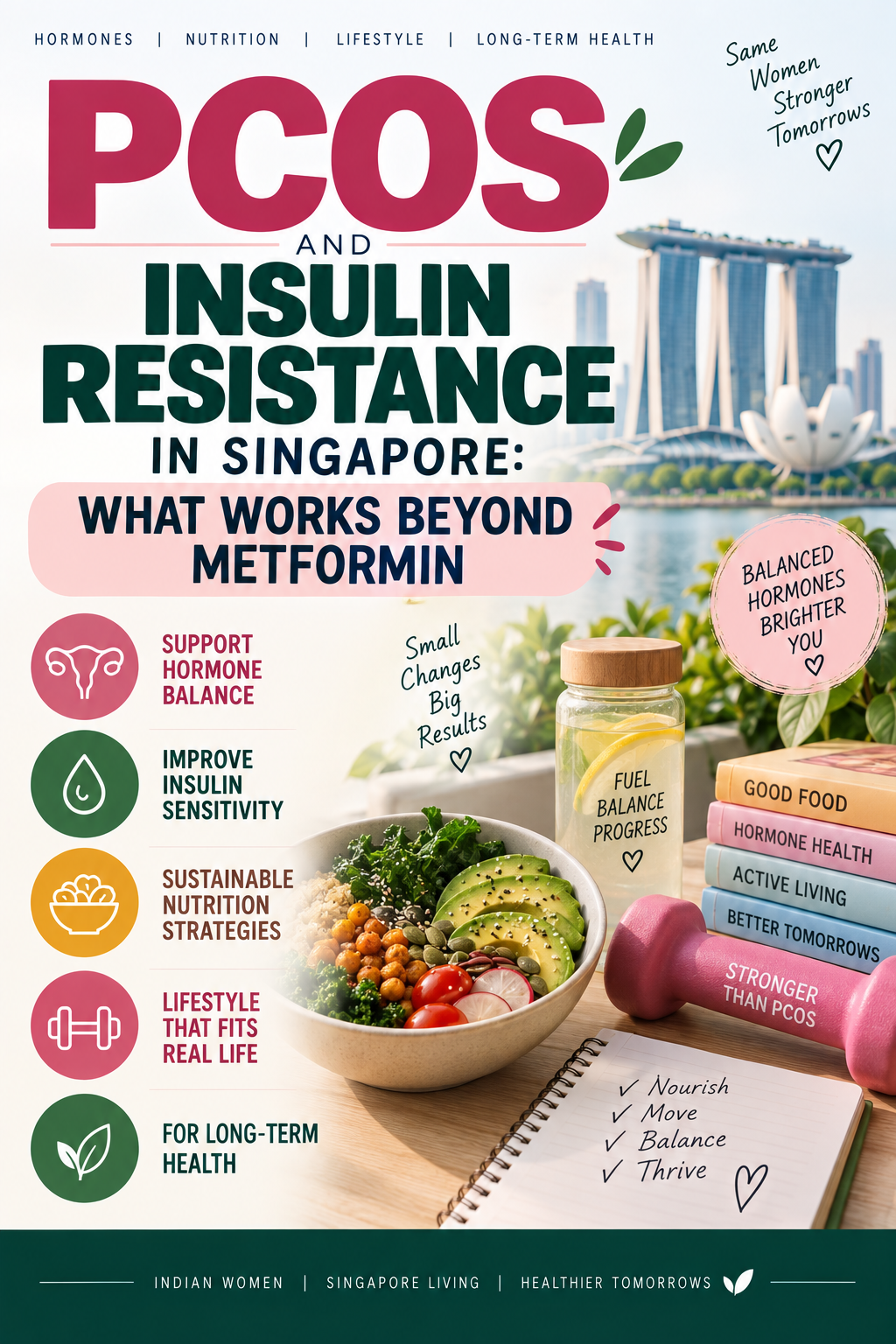
Why Insulin Resistance Is Central to PCOS: A Quick Recap
Insulin resistance is present in approximately 50–80% of women with PCOS, including lean PCOS patients, not only those who are overweight. This is important because many Indian women with PCOS in Singapore have a normal BMI by Singapore standards and are told their metabolic risk is low. The thin-fat phenotype means insulin resistance can be significant even at BMI 20–22 in Indian women with PCOS.
The insulin resistance cascade in PCOS drives all its major symptoms essentially:
- High insulin → stimulates ovarian testosterone production → hyperandrogenism → acne, hirsutism, hair loss
- High insulin → suppresses SHBG → more free testosterone available → worsened androgen symptoms
- High insulin → disrupts LH pulsatility → anovulation → irregular periods and subfertility
- High insulin → drives visceral fat accumulation → worsens insulin resistance (self-perpetuating cycle)
Breaking the insulin resistance cycle through diet, lifestyle, and targeted supplementation therefore addresses all PCOS symptoms simultaneously, rather than treating acne, irregular periods, and hair loss as separate issues requiring separate treatments.
👉PCOS and Hair Loss — the same DHT-insulin mechanism drives both hair thinning and hormonal acne
👉PCOS and Hormonal Acne Singapore — the androgen excess that insulin resistance drives
👉Ovarian Cyst vs PCOS Singapore — understanding what you have been diagnosed with
What Metformin Does — and What It Doesn’t
Metformin is a biguanide medication that primarily reduces hepatic glucose production (the liver’s contribution to fasting blood glucose) and modestly improves peripheral insulin sensitivity. In PCOS, it reduces fasting insulin, lowers androgen levels (through reduced ovarian stimulation), and improves ovulation rates. Its gastrointestinal side effects- nausea, diarrhoea, and bloating are common at initiation but typically improve over 4–6 weeks and are minimised by starting at a low dose (500 mg daily) and taking with food.
What metformin does not do:
- It does not change what you eat: the dietary patterns driving insulin resistance continue alongside the medication
- It does not reliably produce weight loss as a primary mechanism: weight reduction occurs only when a caloric deficit is also present
- It does not address the gut microbiome, inflammation, or the nutrient deficiencies (inositol, magnesium, zinc, Vitamin D) that independently impair insulin signalling in PCOS
- It is not suitable for all PCOS patients: those with renal impairment, liver disease, or significant gastrointestinal conditions may not tolerate or be appropriate for metformin
👉Metabolic Syndrome in South Asian Women — PCOS as the reproductive expression of metabolic syndrome
👉Insulin Resistance Indian Meal Plan — the complete dietary framework for PCOS in Indian women
Myo-Inositol: The Most Evidence-Grounded Alternative to Metformin
Myo-inositol has emerged over the past decade as the most rigorously studied natural insulin sensitiser for PCOS, with a 2023 systematic review and meta-analysis informing the international evidence-based PCOS guidelines directly addressing its efficacy.
The 2023 systematic review informing the 2023 International Evidence-based PCOS Guidelines evaluated 30 trials (n=2,230 women) comparing inositol to metformin, placebo, or dietary restriction, and found:
- Myo-inositol improves some metabolic measures (fasting insulin, HOMA-IR, and lipids) significantly compared to placebo
- Myo-inositol causes significantly fewer gastrointestinal adverse effects than metformin
- The evidence for ovulation and cycle regularisation with myo-inositol is promising, with some trials showing comparable outcomes to metformin for reproductive endpoints
A 2025 RCT (n=192 women, 12 weeks) directly comparing metformin monotherapy, myo-inositol monotherapy, dietary restriction alone, and combination therapy found that multimodal therapy combining all three: metformin, myo-inositol, and dietary restriction produced the greatest metabolic and reproductive improvement, outperforming any single intervention alone. This is the most important recent clinical message: these interventions are additive, not competing.
An umbrella review of inositol meta-analyses published in Frontiers in Endocrinology (2026) confirmed benefits for metabolic outcomes, ovulation, and hormonal parameters across multiple systematic reviews.
References:
- Inositol for PCOS: Systematic Review and Meta-analysis to Inform 2023 International PCOS Guidelines. JCEM. 2024. PubMed PMID 38163998 | PMC Full Text
- Multimodal Therapy With Metformin, Inositol and Dietary Restriction in PCOS: 12-week RCT (n=192). PMC. 2025. PMC Full Text | PubMed PMID 42517336
- Effects of inositol in PCOS: Umbrella review of meta-analyses. Front Endocrinol. 2026. Full Text
- Inositol is an effective and safe treatment in PCOS: Systematic review and meta-analysis. Reprod Biol Endocrinol. 2023. Full Text
How to Use Myo-Inositol: Dose and Formulation
The dosage studied in clinical trials is myo-inositol 2,000–4,000 mg daily, typically divided into two doses (2,000 mg morning and 2,000 mg evening) taken with meals. The optimal ratio for combining myo-inositol with its derivative D-chiro-inositol (DCI) is 40:1 (myo-inositol to DCI); this ratio mirrors the physiological ratio in most tissues and produces the best combined outcome on insulin signalling and ovarian function.
In Singapore, myo-inositol supplements are available at:
- Guardian and Watsons — several brands; verify the myo-inositol form and dose on the label
- iHerb Singapore — broader selection at competitive prices; Twinlab, Jarrow, and bulk powder forms
- Some gynaecology and women’s health clinics in Singapore now recommend specific inositol formulations alongside conventional PCOS management
Start with 2,000 mg twice daily for a minimum of 3 months before assessing clinical response. Effects on cycle regularity typically become apparent within 3 months; metabolic effects (fasting insulin, HOMA-IR improvement) within 3–6 months.
The Dietary Strategy for PCOS Insulin Resistance: What the Evidence Supports
1. The Low-Glycaemic Index Approach — The Most Robustly Evidenced Dietary Pattern
Multiple RCTs and systematic reviews confirm that a low-glycaemic index diet reduces fasting insulin, HOMA-IR, free testosterone, and androgen excess markers in women with PCOS, directly addressing the insulin-androgen cascade. The dietary PCOS guidelines consistently emphasise glycaemic load reduction as the primary nutritional intervention.
For Indian women in Singapore, this requires specific translation:
- Replace refined flour completely: Maida (refined wheat flour) is the highest-GI Indian staple: naan, parotta, puri, most commercial flatbreads, and biscuits are maida-based. Switch to whole wheat atta for daily roti and avoid maida preparations entirely
- Reduce white rice portion and add a lower-GI grain: Eat white rice last after dal and vegetables (meal sequencing dramatically reduces post-meal glucose response); reduce portion from a full cup to a half cup; substitute half the meal with millets on some days
- Swap sweetened drinks to zero: Sweetened Milo, chai with 2–3 teaspoons of sugar, packaged fruit drinks: the most impactful single dietary change for PCOS insulin resistance in Singapore Indian women, driven by the number of cups per day and the compounding fructose-driven uric acid and insulin production
2. Protein-First Meal Sequencing — The Highest-Impact Single Habit Change
Eating protein and fibre (dal) before carbohydrates (rice or roti) at every main meal reduces the post-meal glucose and insulin peak by 20–37%, a magnitude comparable to low-dose pharmaceutical intervention. This is not a diet, it is a meal sequence change. The food is identical; the order of consumption is different.
The practical implementation for Indian women in Singapore: serve dal first and eat it before touching the roti or rice. At hawker centres: request dal or protein dish first and eat it before the carbohydrate component of the meal. At Indian restaurants: start with rasam or dal soup before the main rice course.
3. Intermittent Fasting — The Evidence in PCOS
Time-restricted eating (a 12–16 hour overnight fast) has emerging evidence for PCOS-specific benefits, reducing fasting insulin, lowering androgen levels, and improving menstrual regularity in some studies. The most practical and sustainable approach for Singapore working women: finish dinner by 7:30–8 pm and have breakfast no earlier than 7:30–8 am the following morning, a 12-hour window that does not require an early dinner by Singapore social standards.
4. Anti-Inflammatory Dietary Pattern
PCOS is characterised by chronic low-grade inflammation that amplifies insulin resistance independently of body weight. The anti-inflammatory dietary priorities for PCOS in Singapore:
- Turmeric with black pepper at every main meal: curcumin reduces CRP and inflammatory cytokines
- Omega-3 daily (sardines, mackerel, algae DHA): reduces prostaglandin E2 and inflammatory mediators
- Eliminate ultra-processed food: the primary driver of inflammatory dietary load in Singapore
- Increase colourful vegetables: polyphenols and antioxidants reduce oxidative stress driving PCOS inflammation
5. Specific Nutrients With PCOS Insulin Resistance Evidence
- Magnesium: A cofactor for insulin receptor signalling, magnesium deficiency impairs insulin sensitivity independently. Indian women with PCOS are frequently magnesium-deficient due to high refined grain intake. Supplement with magnesium glycinate 300–400 mg daily, and include magnesium-rich foods: bajra roti, pumpkin seeds, almonds, palak.
- Vitamin D: Vitamin D receptors are present in insulin-sensitive tissues; Vitamin D deficiency impairs insulin signalling. Multiple studies have found that correcting Vitamin D deficiency improves insulin sensitivity and reduces testosterone in women with PCOS. Test and correct to above 75 nmol/L.
- Zinc: Required for insulin receptor function and also inhibits 5-alpha reductase (reducing DHT, the most potent androgen driving acne and hair loss). Pumpkin seeds daily (150 mg zinc per 30g), eggs, rajma.
- Chromium: Involved in insulin signalling as a cofactor for the chromodulin complex; chromium picolinate at 200–600 mcg daily has modest evidence for improving insulin sensitivity in PCOS. Less evidence than myo-inositol but a low-risk adjunct.
- N-acetylcysteine (NAC): An antioxidant and insulin sensitiser with emerging evidence in PCOS; 600 mg twice daily has been compared favourably to metformin in some RCTs for metabolic and hormonal outcomes in PCOS. Discuss with your gynaecologist or physician before initiating.
👉Managing PCOS while eating at Singapore Hawker Centres
👉Insulin Resistance Diet: Indian Meal Plan — the foundational dietary change for all PCOS symptoms
👉The Insulin Resistance Trap in PCOS: How to Break Free Naturally
PCOS Nutrition · Singapore
On metformin but still struggling with weight, acne, and irregular cycles? The dietary strategy is the missing piece.
I work with women in Singapore to build the complete PCOS insulin resistance strategy: dietary, supplemental, and lifestyle that works alongside or instead of medication to address the root cause, not just the symptoms.
👉 Book a FREE 20-Minute PCOS Discovery Call
Dr Akanksha Sharma · MBBS MD · Singapore & worldwide via Zoom
The Multimodal Framework: Combining Medication and Lifestyle
The 2025 RCT directly confirmed what clinical experience consistently shows: metformin + myo-inositol + dietary restriction combined produces greater metabolic and reproductive improvement than any of the three alone. This is the most evidence-grounded current approach for PCOS insulin resistance management:
| Component | Mechanism | Practical Implementation |
|---|---|---|
| Dietary intervention | Reduces insulin secretion demand by lowering glycaemic load | Dal before rice, jowar/ millet roti, no sweetened drinks, protein and fibre first sequencing |
| Myo-inositol 2g twice daily | Second-messenger for insulin signalling; restores insulin receptor sensitivity | Take with meals morning and evening; Guardian, Watsons, or iHerb Singapore |
| Metformin (if prescribed) | Reduces hepatic glucose production; modest peripheral insulin sensitisation | Take with food; start low and titrate; discuss dose with your gynaecologist at KKH/NUH |
| Resistance training 3×/week | Increases muscle GLUT4 transporters; most effective non-pharmacological insulin sensitiser | ActiveSG gyms; home bodyweight resistance; squats, lunges, rows; progressive overload |
| Vitamin D correction | Supports insulin receptor expression in peripheral tissues | Test; supplement 1,000–2,000 IU D3 daily; retest at 3 months |
| Magnesium glycinate 300 mg at night | Insulin signalling cofactor; also improves sleep and reduces cortisol | Guardian or Watsons; take before bed |
| Stress management | Cortisol directly raises insulin and androgens; PCOS is stress-sensitive | Sleep 7–8 hours; reduce tuition overload for school-age family members; mindfulness or yoga for adult women |
Testing to Track Progress
Managing PCOS insulin resistance without tracking the relevant markers is managing blindly. At your next appointment at KKH, NUH, or a private gynaecology clinic in Singapore, request:
- Fasting insulin and HOMA-IR: The direct measure of insulin resistance, the primary target of all interventions above. HOMA-IR below 1.9 is generally considered non-insulin resistant; values above 2.5 indicate meaningful insulin resistance in the clinical context of PCOS.
- Free testosterone and SHBG: The androgen markers that reflect the downstream impact of insulin resistance; as insulin resistance improves, free testosterone falls, and SHBG rises
- Fasting glucose and HbA1c: Standard metabolic markers; HbA1c provides the 3-month glucose average
- Lipid profile: PCOS frequently causes dyslipidaemia (elevated triglycerides, low HDL) driven by insulin resistance
- Vitamin D and ferritin: Two of the most common correctable contributors to worsened insulin resistance and PCOS symptoms
PCOS and Fertility: The Insulin Resistance Connection
Insulin resistance is the primary reversible cause of anovulation (failure to ovulate) in PCOS, the mechanism by which PCOS reduces fertility. Addressing insulin resistance through the multimodal approach above directly improves ovulation rates and menstrual regularity, without requiring ovulation induction medications in many cases.
The 2025 multimodal RCT found that combination therapy (metformin + myo-inositol + diet) produced the best reproductive outcomes, including menstrual cycle regularisation, directly relevant for PCOS women in Singapore planning conception.
👉Fertility Diet for Women: What to Eat When Trying to Conceive
👉Egg Freezing Singapore — addressing insulin resistance before fertility planning
👉PCOS Diet Plan for Indian Women in Singapore — the complete dietary framework
Frequently Asked Questions
I have been on metformin for two years, but my cycles are still irregular, and I am still gaining weight. What should I do?
Metformin monotherapy without dietary change has limited effectiveness for weight and cycle regularity in PCOS, as the 2025 RCT confirmed; dietary intervention alongside medication produces substantially better outcomes than medication alone. Revisit your dietary pattern specifically: are you eating dal before rice, eliminating sweetened drinks, and reducing maida? Have you tested fasting insulin and HOMA-IR recently to assess whether your metformin dose is adequate? Consider adding myo-inositol 2 g twice daily alongside your existing metformin (the combination is additive and safe; discuss with your gynaecologist). And request a Vitamin D and magnesium check.
My PCOS is “lean PCOS” — I am not overweight. Do I still have insulin resistance?
Yes, approximately 20–30% of lean PCOS patients have documented insulin resistance when measured by fasting insulin and HOMA-IR, despite normal BMI. For Indian women, this proportion is higher due to the thin-fat phenotype, normal BMI with elevated visceral fat and impaired insulin sensitivity. Do not assume lean body weight excludes insulin resistance in PCOS. Request fasting insulin and HOMA-IR specifically (not just fasting glucose) and discuss the results in the context of your PCOS diagnosis with your gynaecologist or endocrinologist at KKH or NUH.
Is myo-inositol safe to take alongside the oral contraceptive pill?
Myo-inositol is generally considered safe alongside the oral contraceptive pill. The OCP and myo-inositol address different aspects of PCOS: the OCP manages symptoms through exogenous hormone regulation; myo-inositol addresses the underlying insulin resistance that drives androgen excess. Discuss the combination with your gynaecologist to confirm appropriateness for your specific formulation and situation.
How long do I need to follow the dietary strategy before I see results?
Most women notice improvements in energy, skin, and mood within 4–6 weeks of consistent dietary change. Cycle regularity typically improves within 3–4 months of consistent low-GI eating, myo-inositol, and exercise. Blood test markers (fasting insulin, HOMA-IR, free testosterone) typically improve over 3–6 months. The evidence consistently shows that lifestyle intervention effects in PCOS require at least 12 weeks of consistency before meaningful clinical response can be assessed, this is not a quick fix, but it is a sustainable and root-cause-addressing approach.
The Bottom Line
Metformin is a valuable tool for PCOS insulin resistance management in Singapore, but it is most effective as part of a multimodal strategy, not as a standalone intervention while dietary patterns remain unchanged. Myo-inositol at 2g twice daily has strong systematic review evidence for metabolic and reproductive benefits in PCOS with fewer gastrointestinal side effects, and the combination of metformin + myo-inositol + dietary restriction outperforms any single intervention in the most recent RCT evidence. For Indian women in Singapore, the dietary translation is specific: dal before rice at every meal, elimination of sweetened drinks, switch from maida to jowar or whole wheat, protein-first sequencing, and a 12-hour overnight fast. These dietary changes, combined with targeted supplementation (myo-inositol, Vitamin D, magnesium, zinc) and resistance training three times per week, constitute the complete evidence-based multimodal approach to PCOS insulin resistance, with or without medication, for whatever stage of PCOS management you are at.
PCOS Management · Singapore
PCOS Is Not Just a Hormonal Condition.
It’s a Metabolic One, And Nutrition Is the Treatment.
I work with women in Singapore to build the complete PCOS insulin resistance management strategy: dietary, supplemental, and lifestyle, personalised for your blood results, your diet, and Singapore’s food environment.
Not sure which programme fits your PCOS situation? Let’s talk — 20 minutes, your symptoms, your numbers, your plan. 👉 Book a FREE 20-Minute PCOS Discovery Call Dr Akanksha Sharma · MBBS MD · Preventive Medicine Physician · Singapore & worldwide via Zoom |
Disclaimer: This article is for educational purposes only. PCOS management including metformin prescribing and myo-inositol supplementation should be discussed with your gynaecologist or endocrinologist at KKH, NUH, or a private clinic in Singapore. Do not discontinue prescribed medication without medical guidance.
References:
- Multimodal Therapy With Metformin, Inositol and Dietary Restriction in PCOS: 12-week RCT (n=192). PMC. 2025. PMC Full Text | PubMed PMID 42517336
- Inositol for PCOS: Systematic Review and Meta-analysis — 2023 International PCOS Guidelines. JCEM. 2024. PubMed PMID 38163998
- Effects of inositol in PCOS: Umbrella review of meta-analyses. Front Endocrinol. 2026. Full Text
- Inositol is an effective and safe treatment in PCOS: Systematic review and meta-analysis. Reprod Biol Endocrinol. 2023. Full Text
- Neubronner SA et al. Effect of BMI on phenotypic features of PCOS in Singapore women. BMC Women’s Health. 2021. PMC Full Text

Akanksha Sharma
Dr Akanksha Sharma (MBBS, MD) is a physician and women’s health nutrition specialist, and the founder of IYSA Nutrition. She provides evidence-based, doctor-led nutrition guidance for pregnancy, postpartum recovery, PCOS, child nutrition, and family health, helping women make calm, informed decisions about their health and their children’s well-being.
Leave a Reply