Written & reviewed by Dr Akanksha Sharma, MBBS, MD (Preventive & Community Medicine) | Founder, IYSA Nutrition, Singapore
If you are trying to conceive, the question of what to eat is one of the most important and most confusing questions you will face. The internet offers contradictory advice ranging from sensible to frankly dangerous, and the fertility industry has a financial interest in selling expensive supplements and “fertility superfoods” that often have minimal evidence behind them.
As a Preventive Medicine physician who works with women on preconception and fertility nutrition, I want to offer something different: a clear, evidence-based, practical guide to what the science actually shows about nutrition and fertility in women, anchored in the specific nutritional needs of Indian and South Asian women, whose fertility challenges and dietary patterns are often poorly served by Western-focused fertility nutrition advice.
The core message is this: fertility nutrition is not about exotic supplements or dramatic dietary overhauls. It is about systematically addressing the nutritional foundations that support egg quality, ovulation, hormonal balance, uterine lining health, and implantation — through food first, and targeted supplementation where dietary sources are insufficient.
👉Preconception Nutrition: Start Here 3 Months Before You Try
👉The Silent Surge: Why Women’s Reproductive Health Is Declining
How Nutrition Affects Fertility: The Key Mechanisms
Before diving into specific foods and nutrients, it helps to understand the mechanisms through which nutrition influences fertility, because this transforms the dietary recommendations from arbitrary rules into a logical, mechanistic strategy.
Egg Quality
Egg quality is arguably the most important determinant of fertility and early pregnancy outcomes, particularly for women over 35, where age-related decline in egg quality is a significant factor. Eggs take approximately 90 days to mature from a primordial follicle to a mature, ovulable oocyte. This 90-day maturation window is directly influenced by the nutritional environment, the supply of antioxidants, mitochondrial cofactors, and essential fatty acids that the developing egg is bathed in. Improving egg quality through nutrition is a 3-month project; changes made today affect eggs that will be released 3 months from now.
Ovulation
Regular ovulation requires a finely balanced hormonal cascade, GnRH from the hypothalamus, FSH and LH from the pituitary, and oestradiol and progesterone from the ovary. This cascade is nutritionally sensitive: severe caloric restriction, low body fat, iron deficiency, excessive exercise, and certain dietary patterns directly disrupt hypothalamic GnRH pulsatility and ovulation. Conversely, adequate nutrition, particularly adequate fat intake, iron status, and blood glucose regulation, supports the hormonal conditions necessary for regular, healthy ovulation.
Uterine Lining (Endometrium)
The endometrium must develop adequate thickness and receptivity to support implantation. This requires adequate blood flow (supported by omega-3 fatty acids and nitric oxide production), oestrogen (which depends on adequate body fat and nutritional status), and a non-inflammatory uterine environment (supported by an anti-inflammatory dietary pattern).
Sperm and Fertilisation
While this post focuses on female fertility, it is worth noting that male-factor infertility contributes to approximately 40–50% of infertility cases. Many of the nutritional strategies in this guide are equally relevant for male partners, antioxidants, zinc, selenium, omega-3s, and folate all support sperm quality. Fertility nutrition is ideally a joint endeavour.
👉The 90-Day Egg Quality Roadmap: Prepare to conceive
👉Egg Freezing in Singapore: What Indian Women Should Know
The Fertility Diet: Core Principles
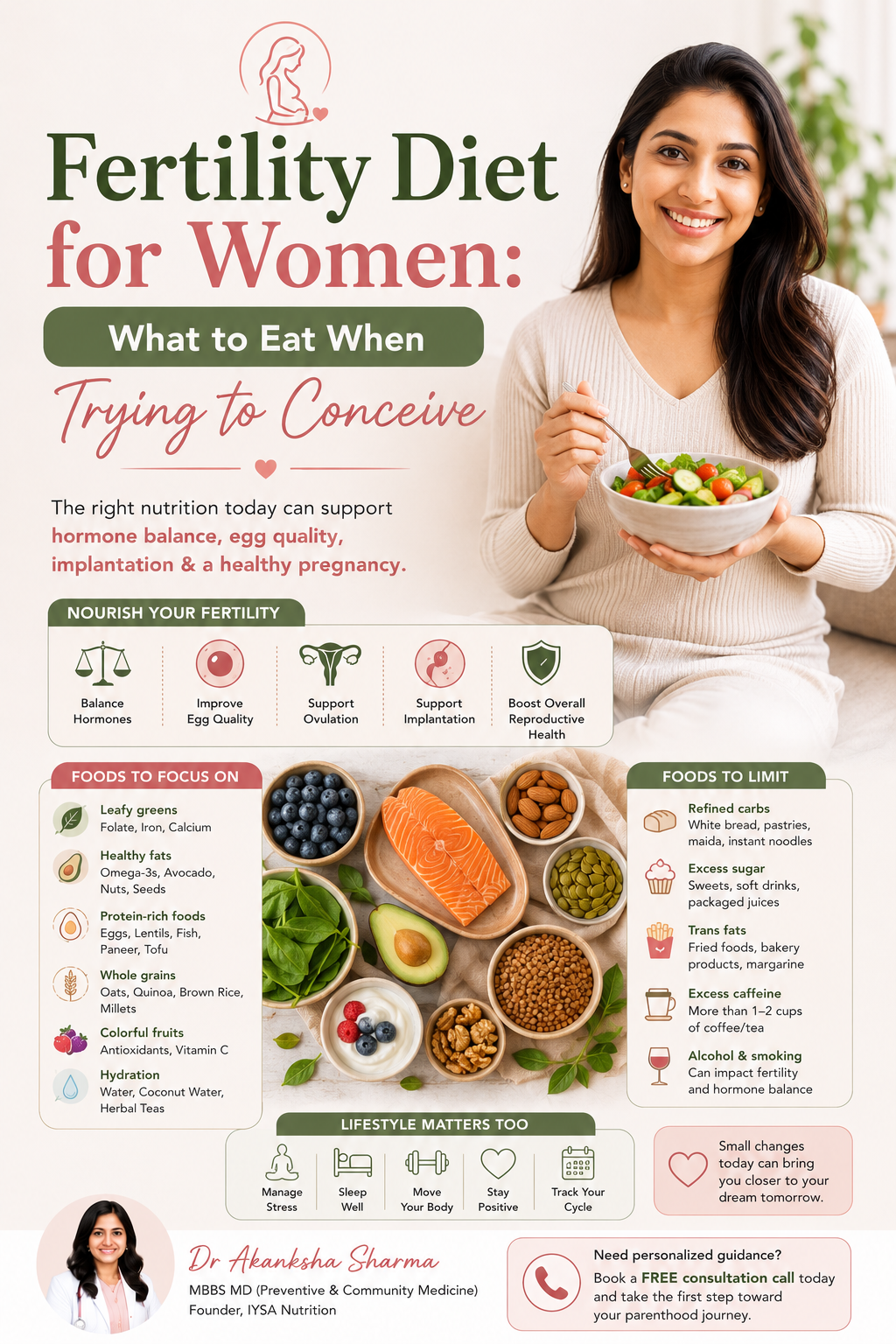
The dietary pattern with the strongest evidence base for female fertility is a Mediterranean-style pattern characterised by whole foods, healthy fats, adequate protein from plant and animal sources, low refined carbohydrate intake, and generous antioxidant-rich vegetables and fruits. The landmark Harvard Nurses’ Health Study II, which followed over 18,000 women for 8 years, identified a specific “Fertility Diet” pattern associated with a 66% lower risk of ovulatory infertility:
- Higher intake of monounsaturated fats over trans fats
- Higher vegetable protein than animal protein
- Higher-fat dairy over low-fat dairy (a counterintuitive finding)
- Lower glycaemic load carbohydrates
- More non-haem iron (from plant sources) supplemented with vitamin C
- Higher multivitamin use (particularly folate)
- Healthy body weight
This framework adapts beautifully to Indian vegetarian food culture, which is already rich in plant proteins, legumes, dairy, and low-GI whole grains when prepared traditionally.
👉10 Top Supplements for Women’s Reproductive Health
The Critical Nutrients for Female Fertility
1. Folate (Folic Acid) — Start Three Months Before Trying
Folate is the most universally recognised preconception nutrient, and the one most women know they should take. But the timing matters as much as the taking: folate supplementation should begin at least 3 months before trying to conceive, not after a positive pregnancy test, because neural tube closure occurs in weeks 3–4 of pregnancy, before most women know they are pregnant.
Beyond neural tube protection, folate is essential for DNA synthesis and cell division, both of which are happening at maximum rate in the developing egg and early embryo. Folate deficiency impairs oocyte maturation and is associated with chromosomal abnormalities in eggs.
Recommendation: 400–800 µg of folic acid daily from at least 3 months before conception. Women with a personal or family history of neural tube defects, or who are on medications that deplete folate (methotrexate, certain anticonvulsants), should take 5mg/day under medical guidance.
Methylfolate note: Approximately 15–20% of South Asian women carry the MTHFR C677T genetic variant that impairs the conversion of folic acid to its active form (methylfolate). For women with known MTHFR variants, or with a history of recurrent miscarriage (which may indicate folate metabolism issues), methylfolate (L-5-MTHF) is a more appropriate supplement form than standard folic acid. Discuss with your doctor.
Best Indian food sources of folate: Masoor dal, moong dal, chana, palak, methi leaves, moringa, broccoli, and rajma. Include multiple servings daily in the preconception period.
2. Coenzyme Q10 (CoQ10) — The Egg Mitochondria Energiser
CoQ10 is a compound that plays an essential role in mitochondrial energy production. Egg cells (oocytes) have the highest mitochondrial density of any cell in the human body; the energy demands of meiosis (the cell division that produces the egg) and early embryonic development are enormous. CoQ10 availability is a rate-limiting factor in oocyte energy production and has a direct impact on egg quality.
CoQ10 declines with age, which is one of the mechanisms underlying age-related decline in egg quality. Multiple observational studies and several clinical trials have found that CoQ10 supplementation improves egg quality markers and embryo quality in women undergoing IVF, and reduces ovarian ageing parameters. The evidence is particularly compelling for women over 35.
Supplementation: 200–600 mg/day of CoQ10 (ubiquinol form, more bioavailable than ubiquinone) for at least 3 months before conception. This is one of the most evidence-supported supplements specifically for egg quality. Available at Guardian, Watsons, and online retailers in Singapore.
Food sources: CoQ10 is found in meat (particularly organ meats), fish, nuts, and some vegetables, but dietary quantities are far below the therapeutic supplementation dose. Supplementation is necessary for the therapeutic effect.
3. Omega-3 DHA and EPA — For Egg Quality, Ovulation, and Implantation
Omega-3 fatty acids are incorporated into egg cell membranes, where they affect membrane fluidity, receptor function, and the ability of the egg to be fertilised. Higher omega-3 status is associated with better egg quality and higher pregnancy rates in IVF studies. EPA specifically reduces the prostaglandins that cause uterine contractions and may impair implantation, and supports the anti-inflammatory uterine environment needed for embryo implantation.
A 2024 meta-analysis by Trop-Steinberg et al. published in Heliyon found that omega-3 supplementation was associated with significantly higher pregnancy rates in women undergoing IVF/ICSI (OR 1.74, p ≤ 0.01), and a 2022 prospective cohort study in Human Reproduction found that omega-3 use was associated with higher fecundability in both natural and assisted conception.
The evidence base is now sufficiently strong that omega-3 supplementation is increasingly included in preconception care protocols at fertility clinics.
Recommendation: 500–1000 mg of combined EPA+DHA daily from at least 3 months before conception. Food sources: fatty fish 2–3 times per week (sardines, mackerel, salmon). For vegetarians: algae-based DHA+EPA supplement, fish oil’s benefits originate from algae, so algae-based supplements are equivalent.
4. Iron — For Ovulation and Early Pregnancy
The Nurses’ Health Study II found that women with higher non-haem iron intake had significantly lower rates of ovulatory infertility, a 40% reduction in risk among those in the highest quintile of iron intake. Iron is required for DNA synthesis in the developing follicle, for the thyroid function that regulates the hormonal cascade of ovulation, and for the haemoglobin that will supply oxygen to the early embryo and placenta after conception.
Indian women have extremely high rates of iron deficiency, and many enter pregnancy already iron-insufficient, compounding the problem. Testing ferritin before trying to conceive and addressing deficiency proactively is one of the most impactful preconception interventions.
Target: Serum ferritin above 40 ng/mL before conception, not just “within normal range.” Get tested. If below 30 ng/mL, supplement under medical guidance. Maintain iron-rich food strategies daily throughout the preconception period.
5. Vitamin D — The Fertility Hormone
As covered in my post on vitamin D deficiency, Vitamin D deficiency impairs ovulation, reduces egg quality, and is associated with higher rates of PCOS and unexplained infertility. Vitamin D receptors are present in ovarian granulosa cells and regulate oestrogen and progesterone synthesis directly. Multiple studies have found that adequate Vitamin D status is associated with better IVF outcomes and higher rates of natural conception.
Target: Serum 25-OH Vitamin D above 75 nmol/L before conception. Test, supplement to reach optimal levels, and maintain throughout pregnancy.
6. Antioxidants — Protecting Eggs from Oxidative Damage
Oxidative stress, the imbalance between free radical production and antioxidant defences, is one of the primary mechanisms of egg quality decline with age. Free radicals damage DNA in the egg, impair mitochondrial function, and reduce fertilisation rates. Antioxidants from diet and supplementation directly counteract this damage.
Key antioxidants for egg quality:
- Vitamin E: A fat-soluble antioxidant that protects cell membranes, including egg cell membranes, from oxidative damage. Found in almonds, sunflower seeds, avocado, and wheat germ. A targeted Vitamin E supplement (100–200 IU/day) may be appropriate for women over 35 or with known oxidative stress.
- Vitamin C: A water-soluble antioxidant that regenerates Vitamin E and directly protects DNA from oxidative damage. Amla is the richest source available in Indian cuisine, 1–2 fresh amla daily provides extraordinary antioxidant protection. Also found in guava, capsicum, kiwi, and citrus.
- Alpha-lipoic acid (ALA supplement, not ALA omega-3): A universal antioxidant that regenerates both Vitamin C and Vitamin E, and has direct mitochondrial protective effects in oocytes. A 200–300 mg/day supplement has shown promise in small fertility trials.
- Resveratrol: Found in grapes, pomegranate, and dark berries; has shown protective effects on egg quality in animal studies, with limited human RCT data but compelling mechanistic rationale.
- N-Acetyl Cysteine (NAC): A precursor to glutathione (the body’s master antioxidant). NAC supplementation (600 mg twice daily) has shown benefit for PCOS-related infertility and recurrent miscarriage in clinical trials. Discuss with your doctor.
7. Zinc — The Fertility Mineral
Zinc is required for every stage of the female reproductive cycle: follicle development, ovulation, fertilisation, and early embryonic cell division. Zinc deficiency impairs egg maturation, reduces fertilisation rates, and is associated with early pregnancy loss. Indian vegetarian women are at particularly high risk of zinc insufficiency given the lower bioavailability of plant-based zinc.
Best food sources: Pumpkin seeds, til, rajma, chana (well-soaked), eggs, chicken, and oysters (the single richest zinc source, for non-vegetarians). Consider supplementation (15–25 mg elemental zinc daily) if dietary intake is consistently low.
8. Selenium — The Thyroid and Antioxidant Mineral
Selenium is required for thyroid hormone metabolism (as discussed in Day 8), and adequate thyroid function is essential for fertility. Subclinical hypothyroidism impairs ovulation and is a common, correctable cause of unexplained infertility in Indian women. Selenium also acts as an antioxidant in the follicular fluid surrounding eggs.
Best source: 2 Brazil nuts daily — the simplest, most reliable selenium intervention available. Food selenium content from other sources varies by soil quality.
9. Inositol — The PCOS Fertility Supplement
For women with PCOS, the most common cause of ovulatory infertility, myo-inositol and D-chiro-inositol supplementation has the strongest evidence base of any fertility supplement. Inositol improves insulin signalling in ovarian cells, restores ovulation, reduces androgen levels, and improves egg quality in PCOS. Multiple RCTs have demonstrated that inositol supplementation restores spontaneous ovulation in a significant proportion of women with PCOS.
Dosing: Myo-inositol 2–4g/day, typically in a 40:1 ratio with D-chiro-inositol (the ratio found in healthy follicular fluid). Available as a powder or capsule; discuss with your doctor or reproductive endocrinologist. Not required for women without insulin resistance or PCOS, but valuable for this population.
👉The Insulin Resistance Trap in PCOS: How to Break Free Naturally
Your “Prep Phase”: How the Bloom Program (A 3-month Doctor-Led Pre-Conception & Fertility Program) Fits In
Deciding to freeze your eggs or going for IVF is the first step. Actually doing it successfully is the second.
Many leading local centres, such as Virtus Fertility Centre, Thomson Fertility Centre, or the public hospitals (NUH, KKH), are excellent at the procedural aspect of egg retrieval and IVF process. However, their primary focus is the stimulation cycle itself.
The Bloom Program is designed to be the essential 3-to-6-month “prep phase” before you walk through their doors.
We bridge the gap between your decision and your retrieval day. We use this window to:
-
Deep dive into your metabolic labs to identify silent insulin resistance.
-
Optimise your thyroid function using narrower, functional ranges tailored for fertility.
-
Create bespoke nutrition plans that fit a busy Singaporean lifestyle but reduce inflammation.
-
Ensure your body is flooded with the necessary antioxidants (like CoQ10) to protect egg DNA.
By the time you see your fertility specialist SG for the actual procedure, your body is primed, resilient, and ready to yield the highest possible quality eggs.
👉 Book a FREE 20-minute Fertility Foundation Discovery Call with Dr. Akanksha.
Foods to Limit When Trying to Conceive
Trans Fats and Refined Seed Oils
The Nurses’ Health Study II found that trans fat intake was the single strongest dietary predictor of ovulatory infertility; each 2% increase in trans fat calories (replacing carbohydrate calories) was associated with a 73% higher risk of ovulatory infertility. Replace refined vegetable oils and vanaspati (partially hydrogenated fat) with ghee, mustard oil, coconut oil, and olive oil.
High-GI Refined Carbohydrates and Sugar
High glycaemic load diets are associated with ovulatory infertility through insulin resistance-driven androgen excess. Reducing white rice portions, maida-based foods, and added sugar while increasing legumes, whole grains, and vegetables is a direct fertility-supporting strategy.
Alcohol
Alcohol disrupts LH pulsatility (the hormone that triggers ovulation), impairs liver oestrogen metabolism, reduces folate absorption, and increases oxidative stress. Even moderate alcohol consumption (3–6 units per week) is associated with reduced fertility in multiple studies. The preconception period is the ideal time to minimise or eliminate alcohol.
Excess Caffeine
High caffeine intake (above 300 mg/day, approximately 2 cups of strong coffee or 4–5 cups of Indian chai) is associated with reduced fertility and increased miscarriage risk in some studies. Reducing to under 200 mg/day (1 cup of filter coffee or 2 cups of Indian chai) is a reasonable precautionary measure.
Processed Soya in Large Quantities
Moderate soya consumption, tofu 2–3 times per week, occasional soya milk, is safe and not associated with impaired fertility. Very high soya isoflavone intake (multiple servings of soya daily, or high-dose soya isoflavone supplements) may interfere with ovarian function in susceptible women. Normal dietary soya consumption does not warrant concern.
Body Weight and Fertility
Both underweight and overweight are independently associated with reduced fertility:
- Underweight (BMI below 18.5): Inadequate body fat disrupts hypothalamic GnRH pulsatility, leading to hypothalamic amenorrhoea, absent or irregular periods and anovulation. The body interprets low energy availability as a famine state in which reproduction is physiologically suppressed. Restoring adequate caloric intake and body weight is the primary fertility intervention in this group — often more effective than any hormone treatment.
- Overweight or obese: Excess adipose tissue increases aromatase activity (converting androgens to oestrogens), worsens insulin resistance, increases inflammation, and disrupts ovulation. Even a 5–10% reduction in body weight in overweight women with PCOS significantly improves ovulation rates and pregnancy rates, more effectively than metformin alone in some studies.
- The South Asian BMI caveat: As discussed in previous posts, South Asian women develop metabolic dysfunction and ovulatory disruption at lower BMIs than Western women. A South Asian woman with a BMI of 23–24 who carries significant visceral fat may have equivalent metabolic disruption to a Western woman with a BMI of 28–30. BMI is an imperfect tool; waist circumference and metabolic markers are more informative for South Asian women.
A Sample One-Day Preconception Meal Plan (Indian Vegetarian)
- On waking: Warm water with fresh amla juice or amla powder (Vitamin C, antioxidants). 2 Brazil nuts (selenium). Begin your prenatal vitamin/folic acid supplement.
- Breakfast: Moong dal chilla (2 pieces) with spinach and tomato filling + a bowl of plain dahi + one cup of green tea. Alternatively: rolled oats with walnuts, ground flaxseed, and mixed berries.
- Mid-morning: A small handful of pumpkin seeds (zinc) + one kiwi or guava (Vitamin C) + CoQ10 supplement with food
- Lunch: One cup thick masoor dal + 2 jowar rotis + palak sabzi with garlic and lime + rajma or chana as a side (iron + zinc + folate) + a bowl of dahi
- Afternoon: Avocado on whole grain toast or roti (monounsaturated fat, Vitamin E, folate) + a cup of green tea
- Dinner: Salmon or sardine curry (omega-3 DHA+EPA) + half cup brown rice + broccoli sabzi (folate, sulforaphane, antioxidants) + plain chaas. For vegetarians: tofu in Indian spiced curry replacing fish + algae DHA supplement with dinner.
- Before bed: Warm milk with a pinch of saffron and cardamom. Omega-3 supplement (if not taken with dinner).
- Daily supplements (discuss with your doctor): Folic acid/methylfolate 400–800 µg, CoQ10 (ubiquinol) 200–400 mg, Vitamin D3 1500–2000 IU (or as prescribed), Omega-3 DHA+EPA 500–1000 mg, Iron (if ferritin low), Zinc 15mg (if vegetarian)
Frequently Asked Questions
How long does it take for dietary changes to improve egg quality?
Egg cells take approximately 90 days to mature from a primordial follicle to a mature oocyte. Nutritional interventions, particularly antioxidants, CoQ10, and omega-3s, that improve the follicular environment during this window will influence the quality of eggs released 3 months later. This is why preconception nutrition ideally begins at least 3 months before actively trying to conceive, and why women who have been on a fertility-supportive diet for 3+ months typically have better outcomes than those who change their diet the month they start trying. Consistency over 90 days matters more than perfection over 30 days.
I have been told I have diminished ovarian reserve (low AMH). Can diet help?
Diminished ovarian reserve (DOR) is one of the more challenging fertility diagnoses, as it reflects the quantity of remaining primordial follicles, which cannot be increased. However, the quality of eggs from a diminished reserve can be influenced by the nutritional environment. CoQ10, antioxidants, Vitamin D, and omega-3s are the most evidence-supported interventions for improving egg quality in women with DOR. Some small studies have shown that CoQ10 specifically (600 mg/day ubiquinol) can improve both AMH markers and IVF outcomes in women with DOR. This is an area where working with a reproductive endocrinologist alongside a nutrition specialist provides the most comprehensive approach.
Is full-fat dairy really better for fertility than low-fat dairy?
This is one of the most surprising findings from the Nurses’ Health Study II — and it has been replicated in several subsequent analyses. The proposed mechanism: skimmed and low-fat dairy products have a higher glycaemic index than full-fat equivalents, and the removal of fat during processing concentrates certain androgenic compounds that may impair ovulation. Full-fat dairy — whole milk, full-fat dahi, paneer — is associated with lower ovulatory infertility risk in these analyses. For women trying to conceive, switching from skimmed to full-fat dairy is a simple, evidence-based preconception dietary change. This does not apply to women with high LDL or cardiovascular risk — discuss with your doctor in those cases.
Should I avoid soya completely when trying to conceive?
No. Normal dietary soya consumption — tofu 2–3 times per week, occasional soya milk, edamame as a snack — is not associated with impaired fertility in the evidence base. Some studies have actually found modest fertility benefits from soya isoflavones in women with PCOS or high androgen levels, as the isoflavones may compete with and partially block more potent endogenous androgens at ovarian receptors. Avoid high-dose isolated soya isoflavone supplements; eat soya as a whole food in moderate quantities.
My partner’s sperm analysis is abnormal. Should he also change his diet?
Absolutely yes. Male-factor infertility contributes to approximately 40–50% of infertility cases, and sperm quality — motility, morphology, DNA fragmentation — is directly influenced by nutritional status. The same antioxidants, omega-3s, zinc, selenium, and folate that support female egg quality are equally important for sperm quality. CoQ10 supplementation (200–300 mg/day) has shown consistent improvement in sperm motility in clinical trials. Vitamin C and Vitamin E reduce sperm DNA fragmentation. Lycopene (from tomatoes and watermelon) improves sperm morphology. A joint preconception nutrition approach is the most logical and effective strategy.
The Bottom Line
Fertility nutrition is not magic, and it is not a substitute for medical evaluation and treatment when indicated. But it is a powerful, modifiable factor that directly influences egg quality, ovulation, hormonal balance, and implantation, through mechanisms that are increasingly well-understood and well-supported by clinical evidence.
For Indian women, the preconception dietary framework fits naturally within traditional Indian food culture: folate-rich dals and green leafy vegetables, antioxidant-rich spices and amla, full-fat dahi, plant proteins, and, for non-vegetarians, fatty fish. The key additions are targeted supplementation (CoQ10, algae DHA, methylfolate, Vitamin D) that addresses the nutritional gaps that diet alone cannot fully close.
Start three months before you plan to try. Be consistent. Test and correct your nutritional deficiencies. And give your eggs the nutritional environment they need to develop into their full potential.
Ready to Optimise Your Fertility? 🌸
Ready to prepare your body for conception—calmly and scientifically?
Bloom is a 3-month, doctor-led pre-conception and fertility program focused on hormonal balance, metabolic health, and evidence-based nutrition—without pressure or extremes.
👉 Explore Bloom: The Doctor-Led Fertility Program
👉 Book your FREE 20-minute Discovery Call
Struggling with PCOS? Our targeted PCOS Hormone Harmony Program provides the specific nutritional protocols needed to restore ovulation and egg quality.
🔗 You May Also Find These Readings Helpful:
-
[Thinking of Having a Baby? Supplements for Healthy Pregnancy]
-
[CoQ10 & Reproductive Health: What the Research Really Says]
-
[The Silent Surge: Why Women’s Reproductive Health Is Declining]
-
[The Rise of Fem-Tech: Empowering Women’s Health Through Technology]
Disclaimer: This article is for educational purposes only. Fertility challenges require medical evaluation. Nutritional strategies are supportive interventions and should complement appropriate medical care.
References:
- Chavarro JE et al. Diet and lifestyle in the prevention of ovulatory disorder infertility. Obstet Gynecol. 2007;110(5):1050-1058. PubMed
- Ben-Meir A et al. Coenzyme Q10 restores oocyte mitochondrial function and fertility during reproductive aging. Aging Cell. 2015;14(5):887-895. PubMed
- Hammiche F et al. Dietary patterns and preconception nutrition: a systematic review. Hum Reprod Update. 2018. PubMed
- Unfer V et al. Myo-inositol effects in women with PCOS: a meta-analysis of randomized controlled trials. Endocr Connect. 2017;6(8):647-658. PubMed
- ICMR-NIN Expert Group. Recommended Dietary Allowances for Indians. 2020. nin.res.in

Akanksha Sharma
Dr Akanksha Sharma (MBBS, MD) is a physician and women’s health nutrition specialist, and the founder of IYSA Nutrition. She provides evidence-based, doctor-led nutrition guidance for pregnancy, postpartum recovery, PCOS, child nutrition, and family health, helping women make calm, informed decisions about their health and their children’s well-being.