
👉Singapore’s Healthier SG Program: How Women Can Use It to Prevent Disease
Why Women Over 40 Lose Muscle — and Why It Matters
Muscle mass and muscle strength peak in the late 20s to early 30s and decline progressively thereafter, a process called sarcopenia when it reaches clinically significant thresholds. In women, this decline accelerates sharply in perimenopause and the years immediately following menopause, driven by the withdrawal of oestrogen’s direct anabolic (muscle-building) effect on skeletal muscle.
The consequences of accelerating muscle loss in Indian women over 40 are not merely aesthetic; they are metabolic and functional:
- Declining resting metabolic rate: Muscle is the most metabolically active tissue in the body. Each kilogram of muscle lost reduces resting energy expenditure by approximately 13–20 kcal per day, meaning the same diet that maintained weight at 35 produces weight gain at 45 even without eating more, because the body’s baseline calorie burn has fallen.
- Worsening insulin resistance: Muscle is the primary site of insulin-mediated glucose disposal; approximately 80% of post-meal glucose is taken up by skeletal muscle. As muscle mass declines, insulin resistance worsens directly; the same carbohydrate portion that was managed effectively at 35 drives a larger glucose spike and more insulin secretion at 45.
- Accelerating bone loss: The mechanical loading of resistance exercise directly stimulates osteoblast (bone-building) activity. Bone, like muscle, responds to mechanical signals; without loading, bone resorption exceeds bone formation, particularly in the oestrogen-depleted postmenopausal environment.
- Reduced physical function and fall risk: Muscle strength, particularly in the lower limbs, is the primary determinant of fall prevention in older age; a critical public health concern in Singapore’s ageing population.
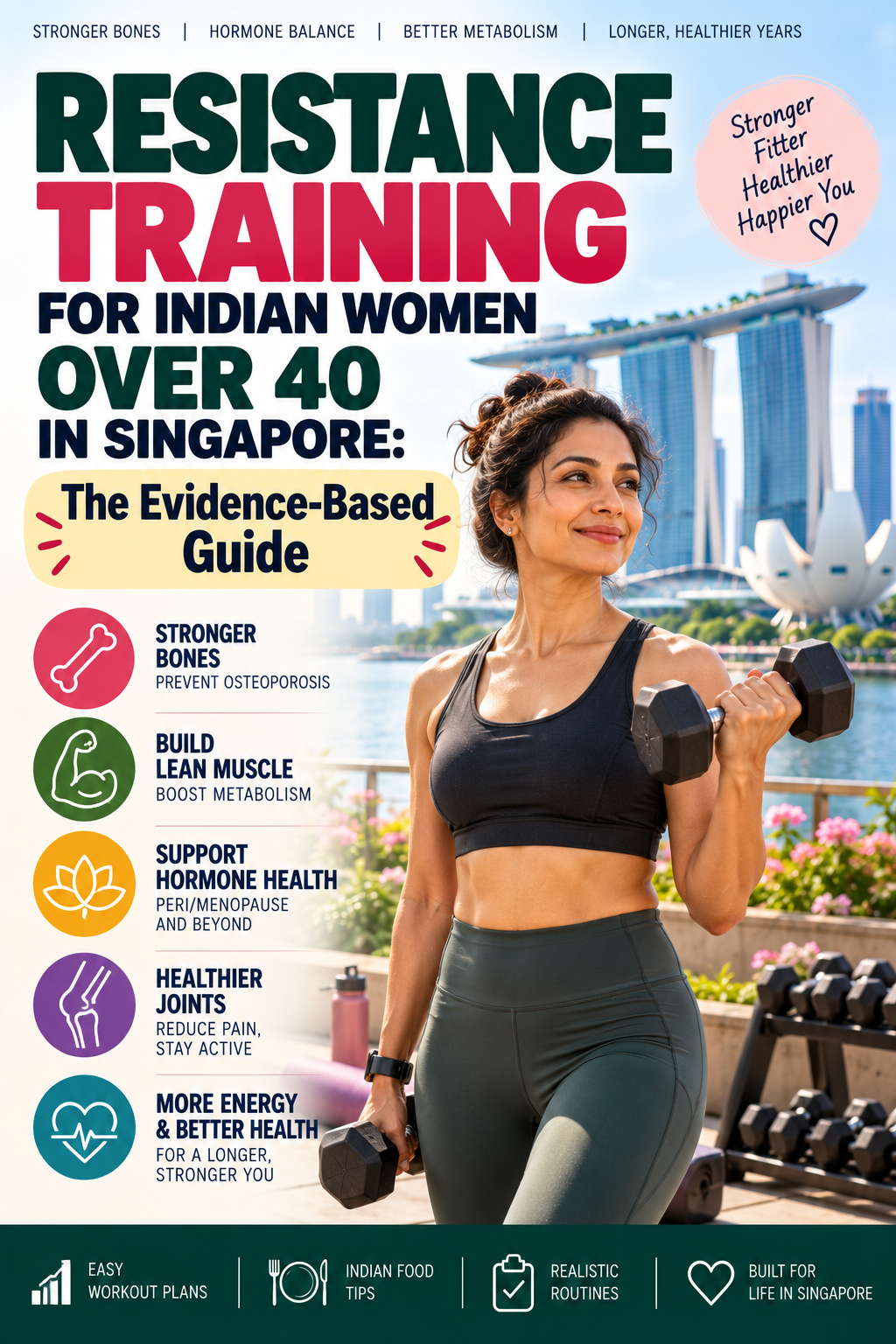
👉Fitness After 40: Why It Feels Different (And What To Do)
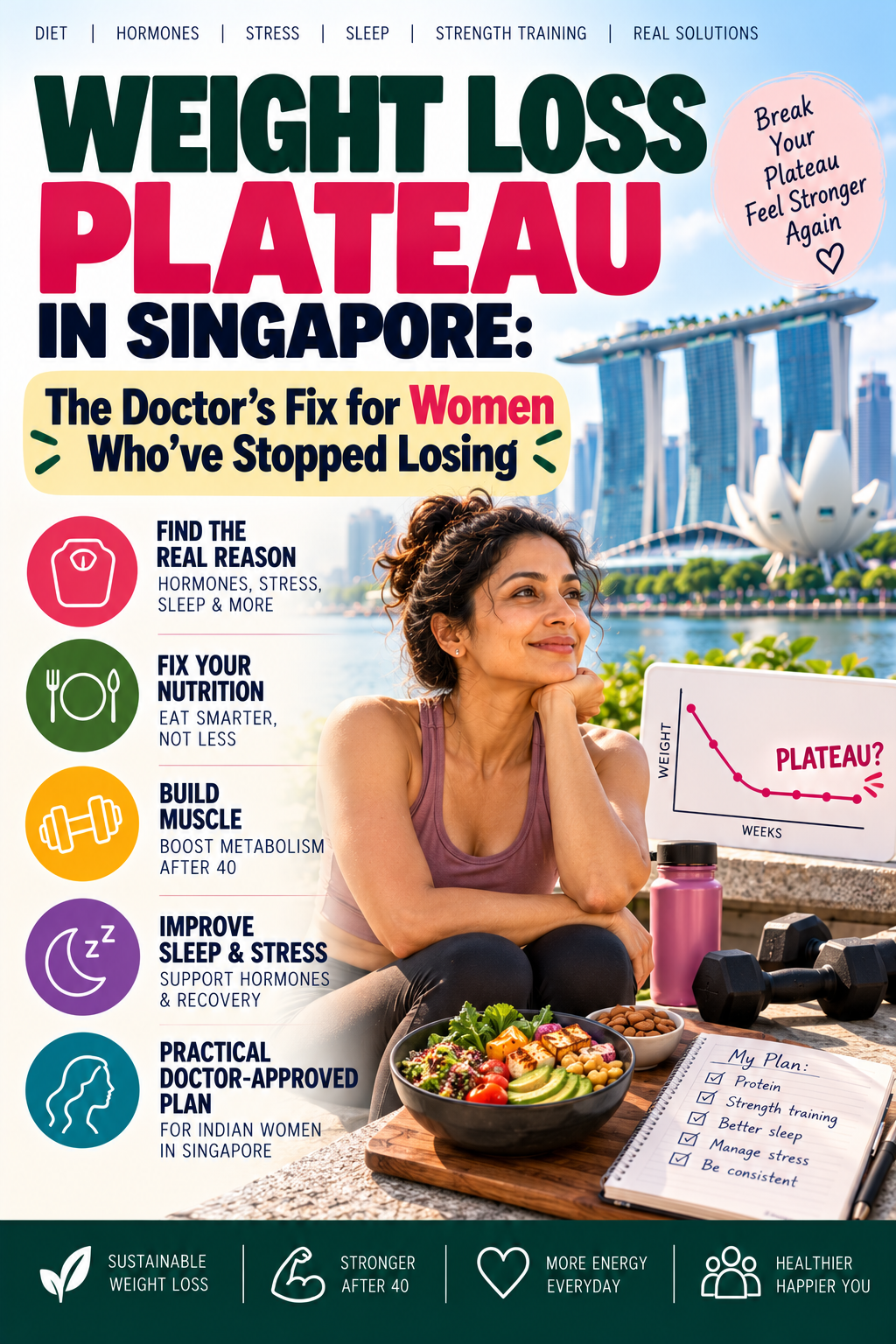
👉Weight Loss Plateau in Singapore: The Doctor’s Fix
What the Evidence Shows: Resistance Training in Women Over 40
Muscle Mass and Body Composition
A 2023 systematic review and meta-analysis published in PMC examining the effects of exercise training on body composition in postmenopausal women found that resistance training significantly increased muscle mass, muscle fibre cross-sectional area, and fat-free mass, and significantly decreased fat mass, body fat percentage, waist circumference, and visceral fat. Critically, the subgroup analysis confirmed that resistance training had greater beneficial effects on muscle mass outcomes than aerobic training; aerobic exercise alone does not preserve or rebuild muscle.
Bone Mineral Density
A 2025 systematic review and meta-analysis specifically examining optimal resistance training parameters for improving bone mineral density in postmenopausal women (published in Journal of Orthopaedic Surgery and Research, covering all records up to March 2025) found that resistance training produces statistically significant improvements in lumbar spine, femoral neck, and total hip bone mineral density, with sessions of ≥40 minutes showing particularly significant effects on lumbar spine density. The review confirmed that 3 sessions per week at moderate-to-high intensity is the clinically preferred protocol.
The landmark LIFTMOR trial, a supervised progressive high-intensity resistance and impact training (HiRIT) protocol conducted in postmenopausal women with low bone mass, demonstrated lumbar spine BMD improvement of approximately 4% over 8 months versus a loss in the low-intensity comparison group, a net difference that far exceeds what most pharmaceutical interventions achieve in similar timeframes. The LIFTMOR protocol was two 30-minute sessions per week, a minimal time investment with substantial skeletal outcome.
Insulin Resistance and Metabolic Health
Resistance training is the most effective non-pharmacological intervention for improving insulin sensitivity, superior to aerobic exercise for this specific outcome. The mechanism is direct: progressive resistance training increases GLUT4 transporter expression in muscle cells, improving insulin-mediated glucose uptake even at rest. For Indian women with the thin-fat phenotype, carrying excess visceral fat and insulin resistance at normal BMI, this is the most relevant exercise benefit available.
How Much Is Enough? The Evidence-Based Minimum Effective Dose
The most common barrier for Indian women in Singapore is time. The good news: the effective dose of resistance training for meaningful health outcomes is lower than most people assume.
| Outcome Goal | Evidence-Based Minimum | Optimal Protocol |
|---|---|---|
| Muscle mass preservation | 2 sessions/week, 20–30 min each | 3 sessions/week, 45 min, progressive overload |
| Bone mineral density improvement | 2 sessions/week, 30 min (LIFTMOR) | 3 sessions/week, ≥40 min, moderate-high intensity |
| Insulin sensitivity improvement | 2 sessions/week, full-body compound movements | 3 sessions/week with protein-adequate nutrition |
| Body composition (fat loss + muscle gain) | 2–3 sessions/week alongside adequate protein | 3 sessions/week + 1.2–1.5 g protein/kg/day |
The practical minimum for a Singapore working Indian woman: two 30-minute resistance sessions per week, achievable before children wake on weekday mornings, during a lunch break, or in a condominium gym on weekday evenings. This is not an ambitious athletic programme. It is the minimum evidence-based health maintenance dose for a woman over 40.
👉Strength Training: Your Secret to a Healthier, Longer Life
👉Understanding the Body’s Mechanism to Maintain Weight
What Exercises to Do: The Indian Women Over 40 Starter Framework
Resistance training does not require a commercial gym membership or a personal trainer to begin, though both are excellent accelerants. The five compound movements that provide the greatest functional and metabolic return for women over 40:
- Squat (bodyweight → goblet squat → barbell squat): The highest-return lower body movement; loads the quadriceps, hamstrings, glutes, and core simultaneously. Mimics the functional movement of sitting and standing. Bodyweight squats require no equipment and can be done at home; progress to a goblet squat holding a dumbbell or water bottle as strength improves.
- Hip hinge / Romanian deadlift: Loads the posterior chain- glutes, hamstrings, lower back, the most commonly undertrained muscles in Singapore’s largely sedentary office population. Start with a bodyweight hip hinge to a wall, progress to dumbbell Romanian deadlift.
- Push-up (wall → incline → full): Upper body pushing pattern- chest, shoulders, triceps, and core. Wall push-ups for absolute beginners; incline push-ups (hands on a kitchen counter height) as an intermediate step; full push-up as the progression target.
- Dumbbell row or resistance band row: Upper body pulling movement- upper back, rhomboids, biceps. The antidote to Singapore’s forward-head, rounded-shoulder posture from hours of desk and phone work. A resistance band over a door handle is the lowest-equipment entry point.
- Glute bridge: Specifically targets the gluteus maximus, the largest muscle in the body and a primary insulin sink. Lying on the floor, feet flat, drive hips toward the ceiling. No equipment; complete beginners can achieve this on day one.
Progressive Overload — The Non-Negotiable Principle
Resistance training only produces ongoing adaptation, muscle building, bone density improvement, and metabolic enhancement when the load progressively increases over time. The body adapts to a fixed challenge and stops responding. Progressive overload means: as the current weight or repetition number becomes manageable, increase either the weight, the repetitions, or the sets. The body does not distinguish between a dumbbell and a filled water bottle at the beginning; what matters is progressive challenge.
Where to Start in Singapore
- ActiveSG gyms: Singapore’s government-subsidised gym network, affordable (SGD 2.50–3.50 per entry for residents; monthly passes available), well-equipped, located near MRT stations and community centres across the island. Use the ActiveSG app to find the nearest facility. This is the most accessible and most affordable resistance training option for Singapore Indian women.
- Condominium gym: Most Singapore condominiums have free-to-use gyms, a completely accessible entry point for residents that requires no commute or cost. The equipment is typically sufficient for the five foundational movements above.
- Community Centre fitness corners: Free outdoor resistance equipment at many CC and HDB fitness corners, pull-down machines, chest press stations, leg press, accessible and no membership required.
- Home resistance training: A set of resistance bands (SGD 15–25 at Decathlon at Bedok, Jurong, or online) and two adjustable dumbbells (SGD 30–60 depending on weight) provide enough resistance for the full beginner and intermediate programme at home. Decathlon Singapore is the most affordable sports equipment source in Singapore for this purpose.
- Classes and personal training: F45 Training, KX Pilates (resistance-based), and multiple private personal trainers in Singapore offer structured programme design for women over 40. More expensive but provides accountability and technique guidance for those who prefer supervised starts.
Metabolic Health · Singapore
Resistance training without the right nutrition is a half-strategy. Together, they are the most powerful metabolic intervention available after 40.
I work with Indian women in Singapore over 40 to build the nutritional strategy- protein, timing, & bone-supporting nutrients- that makes resistance training work as hard as possible for muscle, bone, and metabolic health.
👉 Book a FREE 20-Minute Metabolic Health Call
Dr Akanksha Sharma · MBBS MD · Singapore & worldwide via Zoom
The Nutrition That Makes Resistance Training Work
Resistance training provides the mechanical stimulus for muscle protein synthesis, but synthesis requires substrate. The nutritional environment determines how effectively the training signal translates into muscle retention and growth:
- Protein: 1.2–1.5 g per kg body weight daily, minimum: The anabolic response to resistance training is significantly impaired by inadequate protein intake. For a 58 kg Indian woman, this is 70–87g daily, substantially more than average Indian dietary protein intake. Distribute across three meals and one snack: eggs at breakfast, dal at lunch, paneer or fish at dinner, dahi at afternoon snack.
- Pre-workout meal (1–2 hours before): A small protein + complex carbohydrate meal, dahi with a banana, or two boiled eggs with a small roti, provides both amino acid substrate for the training session and glycogen fuel for performance.
- Post-workout protein within 2 hours: The post-exercise anabolic window, when muscle protein synthesis is maximally upregulated, lasts approximately 2 hours. A protein-containing meal or snack within this window (eggs, dahi, paneer, a quality protein supplement) maximises the adaptive response to the training stimulus.
- Calcium and Vitamin D: Resistance training improves BMD only when calcium and Vitamin D are adequate. The mechanical loading signal stimulates osteoblasts — but without the building materials (calcium, directed by Vitamin D to bone rather than vasculature via Vitamin K2), bone formation cannot proceed. Ragi roti daily, dahi, corrected Vitamin D above 75 nmol/L, Vitamin K2 MK-7 100mcg daily.
👉Protein for Menopause: Are You Eating Enough?
👉Menopause Nutrition Singapore — muscle-supporting nutrition for postmenopausal women
Frequently Asked Questions
I am worried resistance training will make me look bulky. Will it?
No, and this is the most persistent and most evidence-contradicted fear about resistance training in women. Women do not have the testosterone levels required to build large, bulky muscles. The physique changes that women experience from resistance training are almost universally described as: a more defined, firmer body; better posture; clothes fitting better across the shoulders and arms; and, critically for Indian women over 40, a reduction in the abdominal fat accumulation that occurs with muscle loss, because more muscle means better insulin sensitivity and less visceral fat deposition. The women whose physiques you might associate with “bulk” train at professional or competitive levels with caloric surpluses and often pharmaceutical support; this is not a realistic or relevant comparison for a working Indian mother in Singapore doing two to three sessions per week.
I have osteopenia. Is it safe for me to do resistance training?
Yes, and in fact, resistance training is particularly important for you. The 2025 BMD meta-analysis confirmed that resistance training is effective for improving lumbar spine, femoral neck, and total hip bone density in postmenopausal women specifically, including those with low bone mass. The LIFTMOR trial included women with osteoporosis and osteopenia and found high-intensity resistance and impact training to be “safe and well-tolerated” while producing significant BMD improvement. Start in a supervised setting to ensure correct form; a physiotherapist or trained fitness instructor at a Singapore community health hub or KK Health Hub can provide initial form guidance for women with osteopenia specifically.
I only have 20 minutes. Is that worth doing?
Yes. A 20-minute session of four compound exercises, squat, hip hinge, push variation, and row variation, performed with adequate effort provides meaningful stimulus for muscle preservation and metabolic benefit. The dose-response curve for resistance training is steep at the low end: going from zero to two 20-minute sessions weekly produces most of the available health benefit. Going from two 20-minute sessions to four 45-minute sessions produces additional benefit, but the first step, doing something consistently, is far more important than the specifics of what that something is. Twenty minutes, twice a week, consistently, is infinitely more valuable than a perfect programme started and abandoned.
The Bottom Line
The evidence for resistance training in women over 40 is among the most consistent in exercise science: it is the primary intervention for muscle mass preservation (which determines metabolic rate), the most effective exercise for insulin sensitivity improvement, significantly effective for bone mineral density increase (including lumbar spine BMD improvements of up to 4% in 8 months from two 30-minute sessions weekly), and the exercise modality with the broadest benefit profile across body composition, cardiovascular risk, and functional capacity. For Indian women in Singapore navigating perimenopause, insulin resistance, creeping weight gain, and bone density concerns, resistance training is not optional. It is the non-negotiable foundation. Start with ActiveSG gyms (SGD 2.50–3.50 per session), condominium fitness rooms, or a resistance band at home. Two 30-minute sessions per week. Five compound movements. Progressive overload. Protein at 1.2–1.5g/kg daily. This is the most evidence-grounded investment in your next decade of health available to you in Singapore today.
Strength & Metabolic Health · Singapore
The Strongest Version of You Is Built in the Next 12 Weeks.
Nutrition Is Where It Starts.
A personalised nutrition plan built around your resistance training: protein targets, meal timing, bone-supporting nutrients, and the metabolic reset that makes every session count.
Ready to combine resistance training with the right nutrition? Let’s talk: 20 minutes, your current habits, & a clear plan. 👉 Book a FREE 20-Minute Metabolic Health Call Dr Akanksha Sharma · MBBS MD · Preventive Medicine Physician · Singapore & worldwide via Zoom |
Disclaimer: This article is for educational purposes only. Women with osteoporosis, osteopenia, joint conditions, or cardiovascular disease should seek medical clearance before beginning a resistance training programme.
References:
- Effects of exercise training on body composition in postmenopausal women: SR and meta-analysis. PMC. 2023. PMC10306117
- Optimal resistance training parameters for BMD in postmenopausal women: SR and meta-analysis to March 2025. J Orthop Surg Res. 2025;20:523. Springer Full Text
- Exercise for Postmenopausal Bone Health — LIFTMOR HiRIT trial (+4% lumbar BMD). PMC. 2025. PMC11985624
- Comparative efficacy of resistance training protocols on BMD: SR and network meta-analysis. Front Physiol. 2023. PMC9941565
- Effect of different exercise types on BMD in postmenopausal women: SR and network meta-analysis. PMC. 2025. PMC11972399

Akanksha Sharma
Dr Akanksha Sharma (MBBS, MD) is a physician and women’s health nutrition specialist, and the founder of IYSA Nutrition. She provides evidence-based, doctor-led nutrition guidance for pregnancy, postpartum recovery, PCOS, child nutrition, and family health, helping women make calm, informed decisions about their health and their children’s well-being.


Leave a Reply