Written & reviewed by Dr Akanksha Sharma, MBBS, MD (Preventive & Community Medicine) | Founder, IYSA Nutrition, Singapore
Zinc is one of those nutrients that rarely makes headlines; it lacks the name recognition of iron, the cultural familiarity of calcium, and the wellness-influencer cachet of Vitamin D. Yet zinc deficiency is arguably one of the most consequential and most under-recognised nutritional problems affecting Indian children today.
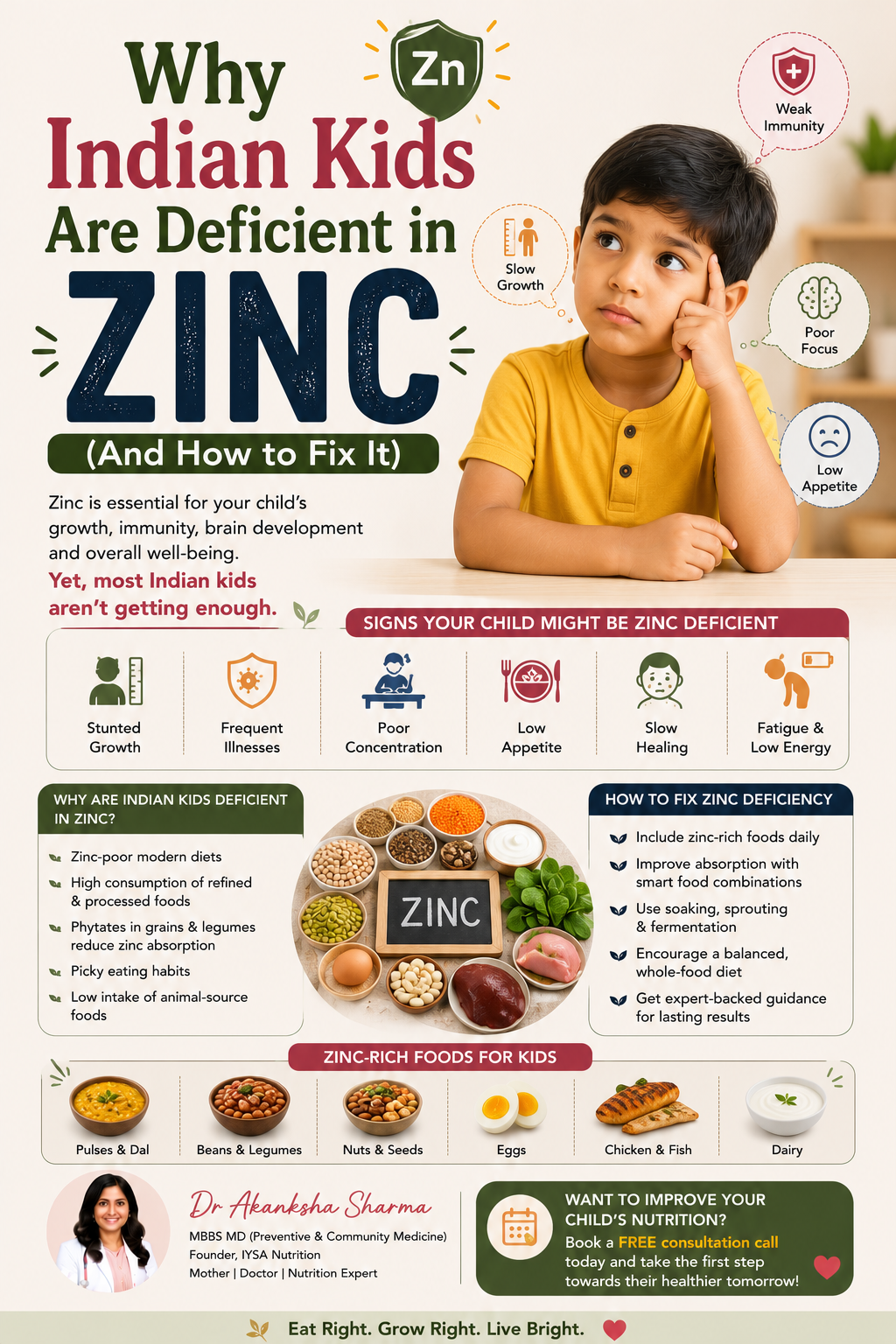
India has one of the highest rates of childhood zinc deficiency in the world. A 2020 analysis estimated that over 30% of the Indian population, and a significantly higher proportion of children, are zinc-deficient or insufficient. The WHO classifies India as a country with high zinc deficiency prevalence among children. And yet routine paediatric health checks in India and Singapore rarely include zinc testing, most parents have never been counselled about zinc, and the foods richest in bioavailable zinc are precisely the foods that are most under-consumed in modern Indian children’s diets.
This post is the zinc guide that Indian parents should have been given at their child’s first health check. Why zinc matters more than most people realise, why Indian children are so specifically vulnerable, what the signs look like, and exactly which foods fix it — without supplements in most cases.
📌Ultra-Processed Foods and Children: What Parents Think vs What Guidelines Say
📌Vitamin D in Indian Children in Singapore: Why Sunlight Is Not Enough
What Zinc Does in a Child’s Body
Zinc is involved in over 300 enzymatic reactions in the human body. It is not a single-function nutrient, it is a fundamental cofactor for virtually every aspect of growth, immunity, and brain development. Here is what zinc specifically does in children:
Growth and Development
Zinc is required for the activity of insulin-like growth factor 1 (IGF-1), the primary mediator of childhood growth hormone action. Without adequate zinc, growth hormone signalling is impaired even when growth hormone production is normal. Zinc deficiency is one of the most well-established nutritional causes of stunting and growth faltering in children, and one of the most responsive to correction.
The landmark zinc supplementation trials in India and other South Asian countries have consistently found that zinc supplementation in deficient children produces significant increases in height velocity and weight gain, effects that dietary intervention would not fully achieve. However, the prevention of deficiency through dietary zinc is far more effective than correction after stunting is established.
Immune Function
Zinc is the most critical mineral for immune system development and function. It is required for the development and activation of T-lymphocytes, natural killer cells, and neutrophils, the front-line defences against infections. Zinc deficiency specifically impairs:
- Thymic (thymus gland) development, where T-cells mature
- Cytokine production, the molecular signalling that coordinates immune responses
- The integrity of mucosal barriers in the respiratory and gastrointestinal tracts
- Wound healing and tissue repair
The practical consequence: children with zinc deficiency get sick more often, stay sick longer, and recover more slowly. Recurrent upper respiratory infections, frequent ear infections, repeated gut infections, and slow healing from minor injuries are all clinical hallmarks of zinc deficiency in children, but are almost never attributed to zinc in routine paediatric care.
Brain Development and Cognitive Function
Zinc is the most abundant trace mineral in the brain. It is concentrated at glutamatergic synapses, the excitatory nerve connections critical for learning, memory, and cognitive processing. Zinc regulates BDNF (brain-derived neurotrophic factor), which drives the formation of new neural connections. Zinc deficiency during critical periods of brain development impairs cognitive function, attention, and school performance in ways that may not be fully reversible after the deficiency window has passed.
📌Is Ghee for Children Good? An Evidence-Based Answer
Taste and Appetite Regulation
Zinc is required for the function of gustin, a zinc-dependent protein essential for taste receptor development. Zinc deficiency causes hypogeusia (reduced taste sensitivity), which manifests in children as reduced appetite, food rejection, and picky eating. This creates a self-perpetuating cycle: zinc deficiency reduces taste sensitivity and appetite, leading to further reduction in food intake, further worsening zinc deficiency. Many children labelled as “picky eaters” may have underlying zinc deficiency contributing to their food aversion.
📌Why Are So Many Kids Becoming Fussy Eaters?
Skin and Wound Healing
Zinc is essential for keratinocyte proliferation and collagen synthesis. Deficiency causes delayed wound healing, skin dryness and roughness, perioral dermatitis (rash around the mouth), and a characteristic skin condition called acrodermatitis enteropathica in severe cases. White spots on fingernails, often attributed to calcium deficiency, are more commonly a sign of mild zinc deficiency.
📌Picky Eating Solutions: A Doctor-Backed Nutrition Guide
Why Indian Children Are Specifically Vulnerable
Plant-Based Diets and Phytate Interference
This is the most fundamental reason. Indian diets are predominantly plant-based, and plant-based zinc has significantly lower bioavailability than animal-sourced zinc. The primary reason: phytates, antinutrients found in the bran of grains and the seed coats of legumes, bind zinc in the gut, forming insoluble complexes that are not absorbed. Studies have found that zinc absorption from a typical high-phytate Indian vegetarian meal is 10–15%, compared to 30–40% from animal-sourced foods.
For a child eating dal, roti, rice, and vegetables, with minimal eggs, dairy, or meat, the dietary zinc intake may appear adequate on paper, but the absorbed zinc is substantially lower than the numbers suggest.
Low Animal Food Consumption
The foods richest in highly bioavailable zinc are beef, lamb, oysters, chicken (dark meat), and eggs, in descending order. Indian children from vegetarian families (which constitutes a significant proportion of the Indian population) receive none of the haem-zinc from red meat and shellfish. Eggs are the most accessible high-bioavailability zinc source for semi-vegetarian families, but egg consumption in Indian children remains lower than optimal in many households.
High Consumption of Zinc-Depleting Foods
The modern Indian child’s diet, heavy in refined wheat (maida-based biscuits, bread, and packaged snacks), refined rice, and sugar, is high in phytates relative to zinc content. Ultra-processed foods also tend to be very low in zinc. The replacement of traditional zinc-rich snacks (roasted chana, sesame chikki, mixed nuts) with packaged biscuits and chips has significantly worsened the dietary zinc profile of Indian children over the past two generations.
Rapid Growth Rate
Children have the highest zinc requirements relative to body weight of any age group. The rapid cellular proliferation of growth means zinc demand is proportionally highest during childhood and adolescence. Any dietary inadequacy is amplified by the high metabolic demand of growing tissues.
Frequent Infections — The Depletion Cycle
Infections deplete zinc rapidly; the acute phase response of infection diverts zinc away from tissues toward the liver and immune cells. Children who have frequent infections (driven partly by zinc deficiency) are in a state of perpetual zinc depletion; each infection worsens the deficiency, which makes the next infection more likely. Breaking this cycle requires addressing zinc status proactively.
Worried your child is eating “too little” or too selectively?
👉 Book a child nutrition consult (FREE) (Singapore-friendly, practical, doable meal plans).
Signs of Zinc Deficiency in Children: What to Watch For
- Slow growth or height faltering — dropping centiles on the growth chart without a clear explanation
- Frequent infections — more than 6–8 respiratory infections per year, recurrent ear infections, recurrent gut infections
- Slow wound healing — cuts, scrapes, and skin irritations that take significantly longer than expected to resolve
- White spots on fingernails (leukonychia) — commonly misattributed to calcium; more often zinc
- Reduced appetite and picky eating — particularly if accompanied by reduced taste sensitivity
- Rough, dry skin — particularly on the elbows, knees, and around the mouth
- Poor concentration and learning difficulties at school
- Delayed puberty in adolescents — zinc is required for sexual maturation and gonadal hormone production
- Hair loss or thin hair
- Irritability and mood changes
Doctor’s Note: Serum zinc is not a reliably sensitive marker of zinc status, it can remain within the normal range even when tissue zinc is depleted. Plasma zinc is slightly more accurate. A dietary assessment combined with clinical signs is the most practical way to identify zinc insufficiency in children. If multiple signs above are present, empirical dietary zinc optimisation is warranted even without a definitive blood test.
📌How to Know If Your Child Is Getting Enough Protein!
📌Is Your Child Getting Enough Calcium? (Without Milk/ Dairy)
Zinc Requirements for Indian Children: ICMR-NIN 2020
| Age Group | Zinc RDA (mg/day) | Notes |
|---|---|---|
| 0–6 months (breastfed) | ~2 mg | From breast milk, colostrum is very rich in zinc |
| 6–12 months | 4 mg | Complementary foods must provide zinc from 6 months |
| 1–3 years | 5 mg | Toddler growth demand is high; zinc is most likely to be insufficient |
| 4–6 years | 6 mg | Preschool age; picky eating peak period |
| 7–9 years | 7 mg | School age; frequent infection vulnerability |
| 10–12 years | 8–9 mg | Pre-pubertal growth acceleration |
| 13–15 years | 10–12 mg | Peak adolescent demand; boys higher than girls |
The Best Zinc-Rich Indian Foods for Children
Tier 1: Highest Bioavailability (Animal Sources)
- Eggs: One egg provides approximately 0.6 mg of highly bioavailable zinc. Not the richest source in absolute terms, but the bioavailability is excellent, and eggs are culturally accessible, affordable, and accepted by most Indian families. Two eggs daily contribute approximately 1.2 mg of well-absorbed zinc, a meaningful daily contribution.
- Chicken (dark meat): 100g of cooked chicken thigh or leg provides approximately 3.5 mg of bioavailable zinc, the most accessible high-bioavailability animal zinc source for non-strictly vegetarian Indian families. Chicken curry, 3–4 times per week, provides significant zinc alongside protein and iron.
- Fish and prawns: Prawns provide approximately 1.7 mg of zinc per 100g; fish varies (salmon provides approximately 0.6 mg per 100g). Less zinc-dense than chicken or red meat, but still makes meaningful contributions with good bioavailability.
Tier 2: Good Plant Sources (Bioavailability Improved by Soaking/Sprouting)
- Pumpkin seeds (kaddu ke beej): The richest plant zinc source available, approximately 2.2 mg per 30g. Roasted pumpkin seeds are an excellent lunchbox snack, can be added to dahi, sprinkled over khichdi, or included in trail mixes. Start including pumpkin seeds as a daily habit for all Indian children, they are affordable, widely available, and consistently under-utilised.
- Sesame seeds (til): Approximately 2.0 mg per 30g. Deeply embedded in Indian culinary culture, til laddoos, til chutney, til chikki, and seasame-coated preparations. A serving of til laddoo provides meaningful zinc alongside calcium and iron.
- Rajma (kidney beans, well-soaked): Approximately 1.4 mg per 100g cooked, the highest zinc content among commonly used Indian dals. Soaking overnight reduces phytates by 40–50%, significantly improving the zinc that is actually absorbed.
- Kabuli chana (chickpeas): Approximately 1.5 mg per 100g cooked. Well-soaked and pressure-cooked chickpeas in chole, hummus, or chana masala provide meaningful zinc with improved bioavailability.
- Cashews: Approximately 1.6 mg per 30g, among the highest zinc nuts. Cashews are generally well accepted by Indian children and can be served as a snack, added to kheer, or incorporated into sabzi.
- Almonds: Approximately 0.9 mg per 30g, slightly lower zinc than cashews, but a useful daily contributor. Soaked almonds are a culturally familiar Indian morning habit.
- Whole wheat and jowar: Moderate zinc content, but phytate content in whole grains significantly limits absorption. The zinc in roti is partially offset by phytates unless the dough is fermented or the diet contains vitamin C and animal protein that enhance zinc absorption.
Zinc Absorption Enhancers — Use These Consistently
- Animal protein: Consuming even a small amount of animal protein (egg, chicken, fish) at the same meal as plant zinc sources significantly improves plant zinc absorption, a mechanism called the “meat factor” that applies to both iron and zinc
- Organic acids (vitamin C, citric acid): Lime, lemon, and tamarind at meals improve zinc absorption by reducing phytate-zinc binding
- Soaking legumes: 8–12 hours of soaking with water discarded reduces phytates 30–50%
- Sprouting: Further reduces phytates beyond soaking; cook sprouts before serving to children
- Fermentation: Idli and dosa batter fermentation reduces phytates by up to 50%, fermented preparations dramatically improve zinc bioavailability from urad dal
- Leavening bread with yeast: Yeast produces phytase (the enzyme that degrades phytate), traditionally leavened whole grain bread has significantly higher zinc bioavailability than unleavened rotis
📌How Much Protein Children Need Actually? An Age-by-Age Guide
📌Childhood Food Allergy: What Parents Must Know
Practical Daily Zinc Plan for Indian Children
Here is a simple, achievable daily framework for meeting zinc requirements in Indian children without supplementation in most cases:
- Morning snack (daily): A small handful of pumpkin seeds (2.2 mg zinc), keep a jar on the kitchen counter and give a small handful every morning alongside breakfast. This single habit provides a meaningful daily zinc contribution.
- Breakfast (3–4 times per week): Two eggs in any form, scrambled, omelette, egg paratha, boiled (0.6 mg x 2 = 1.2mg zinc, highly bioavailable)
- Lunch (daily): Well-soaked rajma or kabuli chana (1.4–1.5 mg zinc per 100g cooked) or a generous portion of moong/masoor dal. Include a squeeze of lime on the dal.
- Snack (3–4 times per week): Til laddoo or til chikki (2 mg zinc per serving), replace commercial biscuits
- Dinner (3–4 times per week): Chicken curry or fish curry for non-vegetarian families (3–5 mg zinc per serving, high bioavailability)
This framework, implemented consistently, should meet or approach the zinc RDA for most Indian children aged 3–12 years without supplementation.
📌How to Pack A Nutritious and Fun Lunch Box for Your Kids
📌5 High-Protein & Delicious Snacks for Kids’ Lunch
When Is Zinc Supplementation Appropriate for Children?
Zinc supplementation is appropriate for children in specific clinical situations:
- Confirmed zinc deficiency on plasma zinc testing
- Growth faltering (dropping centiles) despite adequate caloric intake
- Severe or recurrent infections with suspected immune compromise
- Children with malabsorption conditions (coeliac disease, inflammatory bowel disease, short bowel syndrome)
- Strictly vegan children who do not consume any animal products and whose dietary assessment confirms inadequate zinc intake
- WHO and UNICEF recommend zinc supplementation (10–20mg/day for 10–14 days) as standard treatment for diarrhoeal illness in children, this is the most evidence-backed indication for therapeutic zinc use in children globally
Do not supplement beyond the RDA without medical guidance. Excess zinc (above 40mg/day in children) impairs copper absorption, causes gastrointestinal distress, and can paradoxically impair immunity. More is not better.
Frequently Asked Questions
Are white spots on my child’s nails a sign of zinc deficiency?
Probably, though the evidence is not as definitive as widely believed. White spots on fingernails (leukonychia) have traditionally been attributed to calcium deficiency, but calcium deficiency rarely causes this sign. Zinc deficiency is a more consistent association in the research literature. They can also result from minor nail trauma. If your child has multiple white spots across several nails alongside other signs of zinc deficiency (frequent infections, slow growth, reduced appetite), dietary zinc optimisation is a reasonable first step, and recurrence of white spots after they grow out is a more significant indicator than an isolated spot.
My child refuses to eat eggs. How do I get zinc into them?
Focus on maximising zinc from the best plant sources with absorption-enhancing strategies. Daily pumpkin seeds (the most practical intervention), til laddoo or chikki 3–4 times per week, well-soaked rajma or kabuli chana at least twice a week, and cashews as a snack. For non-vegetarian children who accept chicken, chicken curry 3–4 times per week provides meaningful zinc. If the child is older and accepts dahi, a bowl of plain dahi with pumpkin seeds stirred in is a good combination. Fermenting idli/dosa batter and soaking all legumes overnight are the absorption strategies that make the biggest difference for vegetarian zinc status.
Does zinc help with frequent colds in children?
Yes, zinc supplementation at the onset of a cold has strong clinical trial evidence for reducing duration and severity. The landmark Cochrane review of zinc for the common cold (Hemilä, 2017) found that zinc lozenges or syrup started within 24 hours of symptom onset reduced cold duration by approximately 33% in adults. Children’s evidence is more limited but supportive. More importantly, correcting chronic zinc deficiency (which impairs immune function between infections) reduces the frequency of colds over time. Zinc lozenges are appropriate for acute use in children over 3 years at the onset of cold symptoms; long-term dietary zinc optimisation is the preventive strategy.
How long does it take to correct zinc deficiency through diet?
Plasma zinc levels typically normalise within 4–8 weeks of consistent dietary zinc improvement, as zinc is not stored in large quantities and the body recycles it efficiently once intake becomes adequate. Growth velocity improvements may take 3–6 months to become measurable. Immune function improvements, fewer and shorter infections, are often noticed within 2–3 months of dietary zinc correction.
The Bottom Line
Zinc deficiency in Indian children is not a rare clinical diagnosis; it is a widespread nutritional gap that silently affects growth, immunity, brain development, and appetite regulation in a significant proportion of Indian children. The solution does not require exotic foods or expensive supplements in most cases. It requires two changes: adding pumpkin seeds as a daily snack habit, and increasing the frequency of well-soaked rajma, kabuli chana, eggs, and sesame-based preparations in children’s meals.
Roasted pumpkin seeds on the kitchen counter. Til laddoo instead of biscuits. Rajma twice a week. Soaked almonds and cashews. Idli from properly fermented batter. Eggs at breakfast several times a week. These are not extraordinary interventions, they are the restoration of the nutritional density that traditional Indian food culture provided before ultra-processed snacks displaced it.
💛 Want structured guidance? 📩 Click here to book a FREE consultation with Dr Akanksha Sharma
👉 Explore my programs:
-
Little Legends: The Doctor-Designed Growth & Strength Plan for Kids
- Teen Fuel: Doctor-Guided Nutrition & Routine Reset for Teenagers (Ages 12–19)
🔗 You May Also Find These Readings Helpful:
Disclaimer: This article is for educational purposes. If you have concerns about your child’s growth, nutritional status, or the severity of their food restriction, please consult your paediatrician.
References:
- Black RE. Zinc deficiency, infectious disease and mortality in the developing world. J Nutr. 2003;133(5 Suppl 1):1485S-1489S. PubMed
- Bhutta ZA et al. Prevention of diarrhea and pneumonia by zinc supplementation in children in developing countries. J Pediatr. 1999;135(6):689-697. PubMed
- Hemilä H, Chalker E. The effectiveness of high dose zinc acetate lozenges on various common cold symptoms. Open Forum Infect Dis. 2015;2(3):ofv099. PMC
- ICMR-NIN Expert Group. Recommended Dietary Allowances for Indians. 2020. nin.res.in
- WHO/UNICEF. Clinical management of diarrhoea. Joint statement on zinc treatment. who.int

Akanksha Sharma
Dr Akanksha Sharma (MBBS, MD) is a physician and women’s health nutrition specialist, and the founder of IYSA Nutrition. She provides evidence-based, doctor-led nutrition guidance for pregnancy, postpartum recovery, PCOS, child nutrition, and family health, helping women make calm, informed decisions about their health and their children’s well-being.