Written & reviewed by Dr Akanksha Sharma, MBBS, MD (Preventive & Community Medicine) | Founder, IYSA Nutrition, Singapore
“Is my child getting enough protein?” is one of the most common questions I receive from Indian parents, whether they are in Singapore or India. And it is also one of the most frequently misunderstood areas of child nutrition, because the answer varies enormously by age, body weight, activity level, and whether the child is vegetarian or not.
The concern is legitimate. Protein is not just about muscle building; it is the structural raw material for every cell in your child’s body. It is required for brain development, immune function, enzyme and hormone synthesis, growth, tissue repair, and the production of neurotransmitters that affect mood, focus, and behaviour. A child who is chronically under-eating protein will grow more slowly, fall sick more often, have poorer concentration, and recover more poorly from illness.
But here is the reassuring truth: most Indian children who are eating a reasonably varied diet, with dal, eggs, dahi, milk, and occasional meat or fish, are meeting their protein needs. The children who are most at risk are picky eaters, children who have replaced meals with packaged snacks and biscuits, and children following poorly planned vegan or restrictive diets.
This guide gives you the exact numbers by age, the best Indian food sources, practical meal ideas, and the warning signs of protein insufficiency to watch for.
📌Why Are So Many Kids Becoming Fussy Eaters?
📌Picky Eating Solutions: A Doctor-Backed Nutrition Guide
📌Vitamin D in Indian Children in Singapore: Why Sunlight Is Not Enough
Why Protein Is So Critical for Growing Children
Adults need protein primarily for maintenance, replacing worn-out cells, producing enzymes, and sustaining immune function. Children need all of that plus the additional demands of growth. Every new cell added to your child’s body requires protein. Every centimetre of height gained requires protein. Every gram of muscle added requires protein.
Beyond physical growth, protein plays a central role in brain development and cognitive function:
- Amino acids from dietary protein are the precursors to neurotransmitters — serotonin (from tryptophan), dopamine (from tyrosine and phenylalanine), and GABA
- Protein supports myelination — the formation of the protective fatty sheath around nerve fibres that determines how quickly signals travel in the brain
- Adequate protein intake in early childhood is associated with better school performance, attention, and executive function
The ICMR-NIN 2020 guidelines provide specific protein recommendations for Indian children that account for Indian dietary patterns, body sizes, and typical digestibility of Indian food sources. These are the numbers I use in clinical practice.
📌Hidden Sugar in Indian Kids’ Snacks (And Healthier Swaps)
📌Why Zinc Deficiency is common in Indian Kids (And How to Fix It)
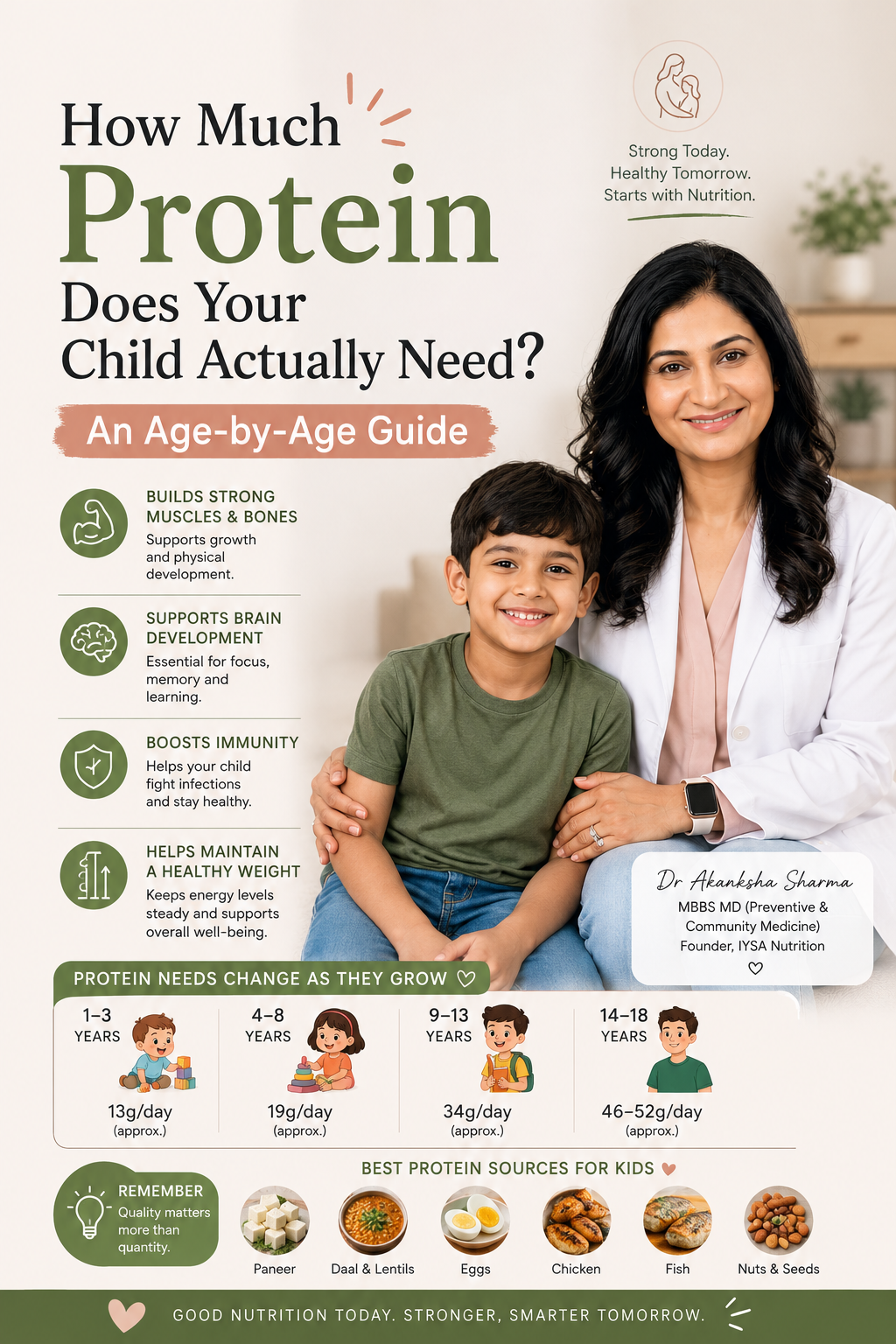
How Much Protein Does Your Child Need? Age-by-Age Breakdown
Infants (0–6 Months): Breast Milk Is Complete
For the first six months of life, breast milk provides all the protein your baby needs, approximately 1.5–1.8 g per kg of body weight per day, delivered in a perfectly bioavailable form. Formula-fed infants receive comparable amounts through standard infant formula.
No additional protein sources are needed or appropriate before six months. Introducing protein foods too early stresses the immature kidneys and does not provide any benefit.
Infants (6–12 Months): Introducing Complementary Foods
Protein requirement: approximately 1.6–1.8 g per kg of body weight per day
From six months, breast milk or formula remains the primary nutrition source, but complementary foods begin introducing protein. For a typical 7-month-old weighing approximately 7–8 kg, this translates to roughly 11–14 g of protein per day from all sources combined.
Best first protein foods for Indian babies (6–12 months):
- Moong dal mashed well — easily digestible, low allergenic potential, good introduction protein
- Soft-cooked well-mashed moong or masoor dal mixed into rice porridge (dal khichdi)
- Well-mashed egg yolk from 6 months; whole egg from 8–9 months (current IAP guidelines support early egg introduction; no need to delay)
- Plain whole-milk yoghurt (dahi) from 6–7 months — excellent protein, calcium, and probiotic source
- Soft-cooked and mashed chicken or fish from 8 months (as a smooth puree; remove all bones)
- Soft-mashed paneer from 8–9 months
Introduce one new protein food at a time, three days apart, to monitor for allergic reactions. Current global and Indian paediatric guidelines (IAP, AAP) support introducing allergenic foods, including egg, fish, and legumes, early; waiting does not prevent allergy and may increase risk.
Toddlers (1–3 Years)
Protein requirement: approximately 1.5 g per kg of body weight per day
For a typical 12 kg toddler: approximately 16–18 g of protein per day
This is the stage where picky eating commonly emerges, and parents begin to worry about protein intake. The good news: 16–18 g of protein is a surprisingly achievable target. One cup of dal provides approximately 8–9 g; one egg provides 6 g; 100 ml of milk provides 3.4 g. A toddler who drinks two small cups of milk, eats half a cup of dal, and has a small portion of dahi has already met most of their daily protein requirement.
Practical protein targets for a toddler (aim for 2–3 of these daily):
- Half cup of thick dal — 4–5 g protein
- One whole egg — 6 g protein
- Half cup of whole milk dahi — 4 g protein
- One cup of whole milk — 3.4 g protein
- 30g paneer — 6 g protein
- 2 tablespoons peanut butter — 7 g protein
- Small portion (30–40g) cooked chicken or fish — 8–10 g protein
Preschoolers (3–5 Years)
Protein requirement: approximately 20–25 g per day (ICMR-NIN 2020)
At this age, children are in preschool or kindergarten, their appetite varies day to day, and their food preferences become more pronounced. Focus on protein-rich foods at every main meal rather than trying to get all the protein in one sitting.
A simple preschooler protein day might look like:
- Breakfast: One egg paratha or besan chilla with paneer — 8–10 g
- Lunch: Half cup thick dal + one roti + some broccoli florets — 6–8 g
- Snack: A small bowl of dahi with a fruit — 4 g
- Dinner: Small portion of paneer sabzi or dal or khichdi + aloo beans sabzi— 6–8 g
- Total: approximately 24–30 g — comfortably meeting requirements
School-Age Children (6–9 Years)
Protein requirement: approximately 29–32 g per day (ICMR-NIN 2020)
School-age children have significantly increased energy and protein needs to support the rapid growth of middle childhood. Physical activity, sports, outdoor play, and PE at school increase protein demand further. Children who are particularly active may need up to 1.2–1.4 g per kg per day.
This is also the age when lunchbox content becomes critical. Many Indian school children in Singapore eat a significant portion of their daily nutrition at school, and poorly planned lunchboxes (biscuits, packaged snacks, white bread sandwiches) can significantly undermine daily protein intake.
Best lunchbox protein additions for school-age children:
- Hard-boiled egg — 6 g; easy, no refrigeration needed for a few hours
- Rajma or chana in a small container — 5–6 g per half cup
- Paneer cubes — easy finger food; 5–6 g per 30g
- Small portion of leftover chicken or fish curry
- Dahi in a small insulated container
- Peanut butter on whole-grain bread or roti — 7 g per 2 tbsp
- Roasted chana — portable, no refrigeration needed; 10 g per 30g
📌How to Pack A Nutritious and Fun Lunch Box for Your Kids
📌5 High-Protein & Delicious Snacks for Kids’ Lunch
Pre-Teens (10–12 Years)
Protein requirement: approximately 40–54 g per day (ICMR-NIN 2020, varies by sex and weight)
Pre-adolescence brings accelerated growth, and protein requirements increase significantly. Girls who are approaching puberty and boys in late pre-adolescence both have substantially higher protein needs than younger children. This is also the stage where awareness of body image begins, and some children, particularly girls, start voluntarily restricting food intake in ways that can compromise protein and overall nutritional status.
At this age, involving children in understanding why they need protein (for energy, sports performance, skin and hair health, themes they care about) is far more effective than simply insisting they eat their dal.
Teenagers (13–18 Years)
Protein requirement: approximately 55–70 g per day, higher for physically active teens
Adolescence is one of the highest protein-demand periods of the entire lifespan. Peak bone mass is being established. Muscle mass is developing. The brain is undergoing its second major period of structural reorganisation (the first being infancy). Teens who are athletes, dancers, or particularly active may need 1.4–1.7 g per kg per day.
Teen-specific protein challenges in Indian families:
- Skipping breakfast — losing a critical protein opportunity
- Replacing home meals with fast food or instant noodles
- Vegetarian teens who are not strategically compensating with eggs, dairy, and legumes
- Teen girls restricting food intake for weight management
Worried your child is eating “too little” or too selectively?
👉 Book a child nutrition consult (Indian & western, practical, doable meal plans).
Quick Reference: Protein in Common Indian Foods (Per Serving)
| Food | Serving Size | Protein (g) | Notes |
|---|---|---|---|
| Whole egg | 1 large | 6 | Complete protein; all essential amino acids |
| Chicken (cooked) | 100g | 27–31 | Highest protein density on this list |
| Fish (cooked) | 100g | 20–25 | Varies by type; pomfret, salmon, and sardines are excellent |
| Masoor dal (cooked) | 1 cup (200g) | 9 | Also rich in iron and folate |
| Moong dal (cooked) | 1 cup (200g) | 8 | Most digestible dal; good for children |
| Rajma (cooked) | 1 cup (200g) | 15 | High protein + fibre; excellent school-age food |
| Chana (cooked) | 1 cup (200g) | 15 | Also provides zinc and iron |
| Paneer | 100g | 18 | Concentrated protein; good vegetarian source |
| Whole milk | 1 cup (250ml) | 8–9 | Also provides calcium, iodine, and B12 |
| Plain dahi (thick) | 1 cup (200g) | 8–10 | Probiotic benefits: excellent daily staple |
| Peanut butter | 2 tbsp (32g) | 7–8 | Good lunchbox protein |
| Roasted chana | 30g (small handful) | 10 | Best portable protein snack for school kids |
| Besan (chickpea flour) | 50g (2 chillas) | 11 | Versatile; excellent breakfast protein |
| Soybeans/soya chunks | 50g dry | 25 | High protein; useful for vegetarians |
Are Indian Vegetarian Children Getting Enough Protein?
This is the question I am most frequently asked, and my honest answer is: it depends on how varied and planned the diet is.
Plant proteins differ from animal proteins in two important ways:
- Digestibility: Plant proteins are generally less digestible than animal proteins. ICMR-NIN 2020 accounts for this by recommending slightly higher protein intakes for children consuming primarily plant-based diets, approximately 15–20% more than the baseline recommendation.
- Amino acid completeness: Most individual plant proteins are “incomplete”; they are deficient in one or more essential amino acids. However, this is easily addressed by combining different plant proteins across the day (not even necessarily at the same meal). Dal and roti, or rice and beans, together provide a complete amino acid profile, something Indian cuisine has known for centuries.
Vegetarian Indian children who eat a variety of dal, legumes, dahi, milk, paneer, and eggs (lacto-ovo vegetarians) typically meet protein needs without difficulty. The highest-risk groups are:
- Strict vegans (no dairy, no eggs), particularly if tofu, legumes, and soya are not consumed in adequate quantities
- Extremely picky eaters who refuse dal and eggs
- Children whose diets are dominated by white rice, chapati, biscuits, and packaged snacks with no protein-dense accompaniments
📌Is Ghee for Children Good? An Evidence-Based Answer
Warning Signs Your Child May Not Be Getting Enough Protein
Protein deficiency in children rarely presents dramatically; it tends to manifest gradually through a constellation of subtle signs:
- Slow or faltering growth — dropping centiles on the growth chart
- Frequent infections — protein is required for immune cell production; chronically low protein impairs immunity
- Poor wound healing — cuts and scrapes that take longer than expected to heal
- Thin, brittle hair and nails
- Oedema (swelling, particularly around the feet and belly) — in severe deficiency (kwashiorkor), low serum albumin causes fluid to leak into tissues
- Fatigue and poor stamina — children who tire unusually quickly during normal activity
- Poor concentration and academic performance
- Muscle wasting — thin arms and legs relative to the child’s overall size
- Mood changes — irritability, low mood, or anxiety (related to neurotransmitter deficiency)
If your child is showing several of these signs, please consult a paediatrician. A simple blood test (serum albumin, prealbumin, total protein) can give a reasonable indication of protein status, though clinical assessment and a detailed dietary history are equally important.
Does My Child Need a Protein Supplement?
Almost certainly not, if they are eating a varied diet. Protein supplements marketed for children are largely unnecessary and frequently over-consumed. Here is my clinical position:
- Children who eat a varied diet with regular servings of dal, dairy, eggs, and/or meat almost never need protein supplementation
- Many commercial protein supplements for children contain added sugar, artificial flavours, and excessive vitamin doses that are not appropriate for children’s nutritional needs
- High protein intake above requirements does not provide additional benefit and may stress developing kidneys
- The rare situation where supplementation may be justified: extremely picky eaters who refuse all protein-dense foods, children with malabsorption conditions (e.g. coeliac disease), or children recovering from serious illness, always under medical supervision
Invest in whole food protein sources before reaching for supplements. One extra egg, a larger portion of dal, and a small bowl of dahi as a snack are almost always sufficient.
📌Children Are Not Mini Adults: Stop “Healthy” Food Trends From Harming Your Child
Frequently Asked Questions
My toddler refuses dal. How do I get protein into them?
Dal refusal is extremely common in toddlers. Alternative protein strategies: hide moong dal puree into khichdi, paratha dough, or soups where the texture and flavour are minimal. Besan (chickpea flour) chillas and pancakes are often accepted because of their texture. Eggs in scrambled or omelette form are usually well-tolerated. Dahi is another reliable protein source that most toddlers accept. Paneer, when cut into small cubes and lightly seasoned, works as a finger food. Try one new protein source at a time and do not give up after one rejection. Research shows children need 10–15 exposures to a new food before accepting it.
Is cow’s milk protein enough for my toddler?
Cow’s milk is an excellent protein source, but should not be the sole protein source. A toddler drinking 500 ml of milk per day gets approximately 17 g of protein, which meets most of the daily requirement. However, milk does not provide all essential amino acids in optimal ratios for toddler growth, and it displaces other iron-rich foods when consumed in very large quantities. Aim for 2–3 cups of milk or dairy equivalents daily alongside other protein sources, rather than relying on milk alone.
How do I know if my child is growing well on their protein intake?
The most reliable indicator is your child’s growth chart. Children who are consistently tracking along their own growth centile, even if that centile is the 25th or 50th, are growing appropriately for their genetic potential. It is the child who is consistently dropping centiles over time who warrants nutritional investigation. Your paediatrician will monitor this at every check-up.
Are protein powders safe for teenagers?
Most teenagers do not need protein powders. Teen athletes with very high training volumes may have protein needs that are difficult to meet through food alone. In these cases, a single serving of plain whey protein (not a pre-workout or mass-gainer formula) may be appropriate. Avoid products with added creatine, stimulants, or excessive micronutrient doses. Always prioritise whole food protein first. Discuss with a sports dietitian or physician before introducing supplements for teens.
Does my child need more protein when they are sick?
Yes, illness, fever, and the immune response all increase protein requirements significantly. This is one reason why children who are frequently sick and eating poorly can fall into a cycle of nutritional depletion and further immune compromise. During and after illness, prioritise easily digestible, high-protein foods: dal khichdi, egg soup, warm dahi, milk, even in small quantities, over low-protein comfort foods like plain rice or biscuits.
The Bottom Line
Protein requirements change significantly as your child grows, and the foods that meet those needs are already present in most Indian kitchens: dal, eggs, dahi, milk, paneer, rajma, and chana. The gap, when it exists, is rarely about food availability and more often about consistency, variety, and understanding which foods are actually delivering meaningful protein.
Use the age-by-age numbers in this guide to check whether your child’s typical daily intake is on track. If you have specific concerns about growth, picky eating, or nutritional status, a paediatric nutrition consultation can provide personalised clarity.
💛 Want structured guidance? 📩 Click here to book a FREE consultation with Dr Akanksha Sharma
👉 Explore my programs:
-
Little Legends: The Doctor-Designed Growth & Strength Plan for Kids (ideal for malnourished kids and picky-eaters)
- Teen Fuel: Doctor-Guided Nutrition & Routine Reset for Teenagers (Ages 12–19)
🔗 You May Also Find These Readings Helpful:
References
- ICMR-NIN Expert Group. Recommended Dietary Allowances and Estimated Average Requirements for Indians. 2020. nin.res.in
- Indian Academy of Pediatrics (IAP). Feeding the Normal Child. IAP Guidelines 2020. iapindia.org
- WHO. Complementary feeding: family foods for breastfed children. 2000. who.int
- Michaelsen KF et al. Protein needs early in life and long-term health. Am J Clin Nutr. 2014;99(3):718S-722S. PubMed
Disclaimer: This article is for educational purposes and does not constitute personalised medical advice. Always consult your paediatrician for concerns about your child’s growth and nutrition.

Akanksha Sharma
Dr Akanksha Sharma (MBBS, MD) is a physician and women’s health nutrition specialist, and the founder of IYSA Nutrition. She provides evidence-based, doctor-led nutrition guidance for pregnancy, postpartum recovery, PCOS, child nutrition, and family health, helping women make calm, informed decisions about their health and their children’s well-being.