Postpartum depression gets almost all the attention in postnatal mental health conversations. The screening questionnaire at your KKH or NUH six-week postnatal check, the Edinburgh Postnatal Depression Scale (EPDS), is universally administered, well-known, and directly addresses depression. What it captures less completely is the other mental health condition that affects new mothers at comparable rates: postpartum anxiety.
A 2025 state-of-the-art review published in The Lancet Psychiatry found a global prevalence of postpartum anxiety of approximately 12.3%, affecting roughly one in eight new mothers worldwide. This is comparable to postpartum depression rates, yet postpartum anxiety is far less likely to be identified, named, or treated, because it looks different, feels different, and is not yet as systematically screened for.
For Indian women in Singapore navigating the fourth trimester, often far from extended family, adjusting to Singapore’s fast-paced work culture during maternity leave, managing confinement practices that may be at odds with medical advice, and carrying the specific cultural pressures of Indian motherhood, postpartum anxiety deserves its own conversation, its own recognition, and its own nutritional support strategy.
👉Postpartum Depression and Nutrition — overlapping nutritional strategies for postnatal mood
Postpartum Anxiety vs Postpartum Depression: What’s the Difference?
Postpartum depression and postpartum anxiety can coexist, and frequently do. But they present differently, and recognising the distinction helps both self-identification and seeking appropriate support.
Postpartum Depression
- Persistent low mood, sadness, or emptiness
- Loss of interest in the baby or in things previously enjoyed
- Feeling worthless, hopeless, or guilty
- Difficulty bonding with the baby
- Withdrawing from family and friends
Postpartum Anxiety
- Persistent, excessive worry about the baby’s health, feeding, safety, or development, that cannot be reassured away
- Racing thoughts that do not stop, even when the baby is sleeping, and you have a chance to rest
- Physical symptoms: heart racing, chest tightness, shortness of breath, dizziness, trembling, that may feel like physical illness
- Irritability and hypervigilance: being on edge constantly, unable to relax, jumping at every sound
- Avoidance: avoiding situations, places, or activities out of fear something will go wrong
- Sleep difficulty beyond what feeding requires: unable to sleep even when the baby is settled, lying awake worrying
- In some women: intrusive thoughts (unwanted, distressing thoughts about harm coming to the baby), which are extremely anxiety-provoking and typically ego-dystonic (the mother is horrified by them, not planning to act on them)
If you are recognising these symptoms, I want to say clearly: you are not going mad, you are not a bad mother, and you are not alone. Postpartum anxiety is a recognised, common, and treatable condition with biological underpinnings, not a character failing or a reflection of how much you love your baby.
The Singapore Context: Why Indian Mothers Are Particularly Vulnerable
The GUSTO study (Growing Up in Singapore Towards Healthy Outcomes), Singapore’s largest long-running birth cohort, specifically examined postpartum mental health in Singaporean women of Chinese, Malay, and Indian ethnicity. The study found a prevalence of probable postpartum depression (EPDS ≥13) of 9.8%, with mean state-anxiety scores also clinically significant across the cohort. Indian women in the GUSTO cohort were among those with noted mental health vulnerability in the postnatal period.
Several Singapore-specific factors compound postpartum anxiety risk for Indian women:
- Physical distance from family support: Many Indian women in Singapore are expatriates or second-generation migrants whose extended family is in India. The traditional Indian 40-day confinement, designed precisely to provide maximum support and rest through community, is often navigated with minimal help or with family flown in for a short time, creating a support vacuum at the most vulnerable period.
- Pressure to return to work quickly: Singapore’s 16-week government-paid maternity leave feels generous compared to many countries but is short relative to the fourth trimester’s demands, particularly for Indian professional women who may face professional identity loss, career anxiety, or workplace pressure during leave.
- Confinement food conflicts: Indian confinement practices (specific foods, avoidance of cold, 40-day rest) can conflict with hospital discharge advice, creating anxiety about doing something “wrong”, a uniquely Singapore Indian dilemma where two authorities (traditional and medical) give different guidance.
- The perfectionism of Singapore parenting culture: Singapore’s performance-oriented society can translate into intense maternal perfectionism, anxious monitoring of feeding volumes, weight gain trajectories, and developmental milestones that amplifies normal new-parent concern into clinical anxiety.
The Nutritional Connection: What the Evidence Shows
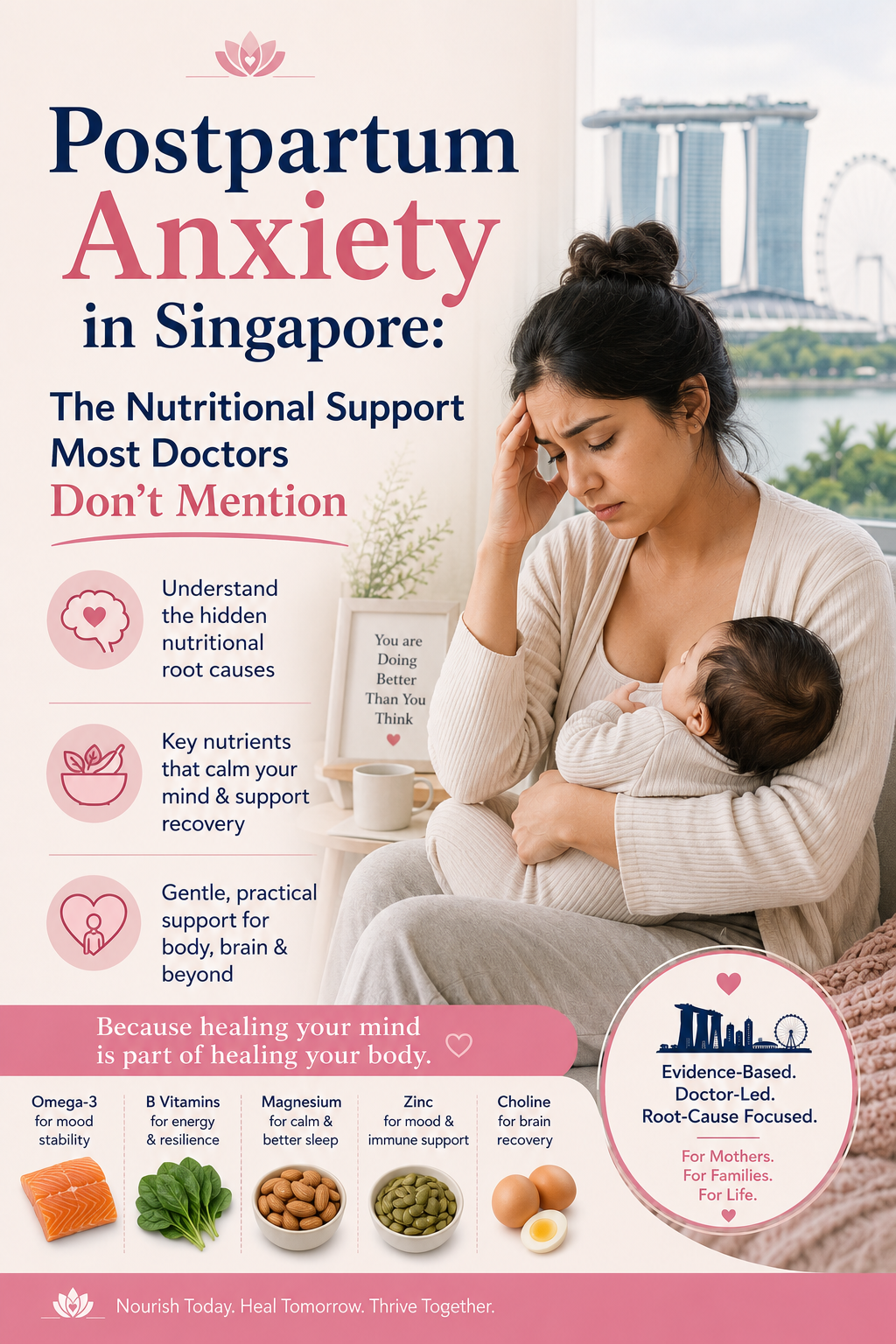
Nutrition does not cure postpartum anxiety, and I want to be clear that significant postpartum anxiety warrants professional support, which I will address below. But nutrition plays a real, documented role in the neurobiology of anxiety, and several specific nutritional factors are consistently associated with postnatal mental health outcomes. Addressing these is not an alternative to professional support; it is a parallel strategy that supports the same physiological systems.
1. Omega-3 DHA Depletion — The Most Documented Nutritional Factor
The developing foetus draws DHA from maternal stores throughout pregnancy, and breastfeeding continues this transfer. The maternal brain is literally depleted of a key structural fatty acid it needs for neuronal membrane function and neuroinflammation regulation. Lower DHA status is consistently associated with higher rates of both postpartum depression and postpartum anxiety. The GUSTO study found associations between maternal dietary patterns and postnatal mental health outcomes in Singapore women, with protective dietary patterns characterised by higher omega-3 intake.
For Indian vegetarian women in Singapore, who are most at risk of DHA depletion given no fish intake, algae-based DHA supplementation (200–400 mg daily) continued through the breastfeeding period is one of the most evidence-grounded nutritional interventions for postnatal mental health. Available at Guardian, Watsons, and iHerb Singapore.
👉Omega-3 DHA for Vegetarian Pregnant Women — continuing DHA into the postnatal period
2. Iron Deficiency — The Most Treatable Overlapping Cause
Postpartum iron deficiency, from blood loss at delivery, inadequate dietary intake, and depletion from the demands of breastfeeding, is one of the most common and most commonly missed causes of postpartum fatigue and anxiety. Iron is required for the synthesis of dopamine and serotonin, the neurotransmitters most directly involved in mood and anxiety regulation. A woman who is told her “postnatal anxiety” is simply adjustment to motherhood may in fact have ferritin of 8 ng/mL driving her symptoms through a correctable biochemical pathway.
Request a ferritin test (not just haemoglobin) at your six-week postnatal check, or at any polyclinic in Singapore. If ferritin is below 30 ng/mL, correct with ferrous bisglycinate supplementation under your GP’s guidance.
Related reading:
👉Iron-Deficiency Anemia in Singapore Women
👉Postpartum Hair Loss: The Nutritional Truth Nobody Tells You
3. Magnesium — The Nervous System Mineral
Magnesium is a cofactor for over 300 enzymatic reactions, including those involved in the regulation of the hypothalamic-pituitary-adrenal (HPA) axis, the stress response system. Magnesium deficiency is associated with heightened anxiety and HPA reactivity. Pregnancy and breastfeeding both increase magnesium requirements, and most Indian diets are already insufficient in magnesium due to refined grain consumption. Magnesium glycinate supplementation at 200–300mg before bed supports sleep quality, reduces muscle tension, and blunts cortisol reactivity, all directly relevant to postpartum anxiety. Available at Guardian and Watsons Singapore.
4. B Vitamins — Particularly B12 and Folate
B12 and folate are required for the methylation cycle, the biochemical process that produces dopamine, serotonin, and other neurotransmitters. Vegetarian Indian women are at particular risk of B12 deficiency postpartum, and B12 deficiency independently causes anxiety, fatigue, and cognitive slowing. Continue your prenatal supplement through the breastfeeding period, or switch to a postnatal supplement that includes B12 at 500–1000 mcg daily.
5. Blood Sugar Stability
Postpartum blood sugar instability, from skipped meals, irregular eating driven by newborn demands, and the exhaustion-driven reliance on quick carbohydrates, directly worsens anxiety through the cortisol-blood glucose cycle described in my blog (Cortisol and Food: How Stress Eating Wrecks Your Hormones). A blood glucose drop triggers cortisol release, which directly activates the anxiety response. For new mothers in Singapore: eating before the baby feeds (not after), keeping protein-rich snacks accessible without cooking (roasted chana, nuts, cheese, boiled eggs, plain dahi), and never skipping breakfast are the most practical blood sugar stabilisation habits with direct impact on anxiety.
Related reading:
👉The Insulin Reset: A Women’s Guide
👉5 Science-Backed Morning Drinks to Balance Blood Sugar
Practical Nutritional Protocol for Postpartum Anxiety
Daily Non-Negotiables
- Algae-based DHA 200–400 mg daily (or fish oil if non-vegetarian), morning with food
- Magnesium glycinate 200–300mg — before bed (also supports sleep, which directly reduces anxiety)
- Postnatal B-complex or B12 500–1000mcg, morning with food
- Iron supplementation if ferritin below 30 ng/mL — as prescribed by your GP
- Protein at every eating occasion — even a small amount; keep plain dahi, roasted chana, and boiled eggs accessible at all times
Confinement Food Adaptation
Indian confinement food traditions have much in their favour: the warming spices (ajwain, methi, dry ginger), the emphasis on dal and ghee, the restriction of cold foods, and are broadly consistent with the nutritional priorities above. Adaptations that specifically support postnatal anxiety:
- Add moringa leaves to dal preparations — iron, calcium, and emerging evidence for mood support
- Include walnuts and almonds daily — omega-3 ALA (not a substitute for DHA but a supportive addition) and magnesium
- Avoid restricting protein sources in the name of confinement “purity” — masoor dal, moong dal, eggs, and paneer are all appropriate confinement foods and are critical for postnatal neurotransmitter synthesis
- Warm til laddoos — sesame, jaggery, and ghee are nutritionally excellent postpartum foods providing iron, calcium, and healthy fats
What to Buy at NTUC FairPrice and Guardian Singapore
- Algae DHA supplement: Nordic Naturals Algae Omega or similar at Guardian/Watsons/iHerb
- Magnesium glycinate: Available at Guardian and Watsons; choose glycinate or bisglycinate form over oxide for better absorption
- Roasted chana and mixed nuts: NTUC FairPrice health foods aisle; Mustafa for Indian varieties
- Plain dahi (low sugar): Meiji, Marigold, or Greenfields plain yoghurt at all supermarkets
- Moringa powder: Available at Mustafa Centre, Phoon Huat, and online at iHerb Singapore
👩⚕️ Navigating the Fourth Trimester in Singapore?
I work with new mothers in Singapore to support postnatal recovery, mental wellbeing, and nutrition, with guidance that understands both your Chinese/Indian food traditions and Singapore’s healthcare landscape.
Explore my programmes:
🤱 NURTURE — 3-Month Mother & Baby Fourth Trimester Program
🤱THE HEALING MOTHER— 45-Day Physician-Led Postpartum Recovery & Lactation Support Program
Getting Professional Support in Singapore
If you are experiencing postpartum anxiety, please know that help is available in Singapore, and that reaching out is an act of strength, not weakness.
- Your GP or polyclinic: The first and most accessible point of care. Polyclinics across Singapore offer subsidised consultations and can refer you to a psychiatrist or psychologist. Ask specifically for a postnatal mental health assessment, the EPDS is routinely administered, but you can also tell your GP directly: “I am experiencing anxiety, not just low mood, and I need support.”
- KKH Women’s Mental Wellness Service: KK Women’s and Children’s Hospital has a dedicated perinatal mental health service. Referral through your obstetrician or GP is the typical pathway.
- NUH Department of Psychological Medicine: Offers perinatal psychiatry services. Accessible through referral from your NUH obstetrician or GP.
- IMH (Institute of Mental Health): Singapore’s primary psychiatric hospital offers perinatal psychiatry services, accessible through GP referral or self-referral at their outpatient services.
- Singapore’s national mindline 1771: Launched June 2025, this provides 24/7 mental health support via call, text, and online chat — a no-wait, immediate resource for moments when anxiety is acute.
- Samaritans of Singapore (SOS): 1-767, 24-hour crisis line.
Frequently Asked Questions
Is it normal to worry constantly about my baby’s safety?
Some degree of vigilance and concern for a newborn’s well-being is completely normal and biologically protective; it is part of what makes new mothers so attentive. The distinction between normal worry and postpartum anxiety is one of degree, persistence, and impact: if the worry is excessive, unrelenting, cannot be reassured away by evidence that the baby is fine, and is significantly disrupting your sleep, relationship, or functioning, that crosses into anxiety that warrants support.
Will taking anxiety medication affect my breast milk?
This is a very common concern and a very common reason Indian mothers in Singapore delay seeking treatment. Several medications used for anxiety, including some SSRIs, are considered compatible with breastfeeding and have been used by nursing mothers extensively. The decision involves weighing the benefits of treatment against any theoretical risks of medication transfer, and is made individually with a psychiatrist or GP. Untreated maternal anxiety also affects the mother-baby relationship and infant development; it is not a neutral alternative. Discuss openly with your doctor rather than avoiding treatment out of fear.
My partner says I just need to relax. How do I explain that this is more than that?
Postpartum anxiety is a neurobiological condition with measurable changes in HPA axis function, cortisol regulation, and neurotransmitter levels, not a choice or a failure to relax. Sharing this post with your partner may help. In many cases, the most effective conversation starter is framing it as: “I need your help getting me to the doctor, not your reassurance that I am fine.” Partners of anxious new mothers are often doing their best with inadequate understanding of what postpartum anxiety is, education, not blame, tends to be the more productive first step.
The Bottom Line
Postpartum anxiety affects approximately one in eight new mothers globally and is as common as postpartum depression, but far less systematically identified and supported. For Indian women in Singapore, the combination of reduced family support networks, confinement food pressures, the performance culture of Singapore parenting, and the nutritional vulnerabilities of postpartum depletion (DHA, iron, magnesium, B12) creates a specific anxiety landscape that deserves specific attention. Nutrition addresses the biochemical substrate; professional support addresses the psychological dimension; and community, finding other Indian mothers in Singapore who understand the specific experience, addresses the isolation that so often makes postpartum anxiety worse.
If you are a new mother in Singapore reading this and recognising yourself in these symptoms: please reach out to your GP, to KKH or NUH’s perinatal mental health services, to the mindline at 1771, or to me. Book a FREE 20-Minute Support Call
👩⚕️ You Don’t Have to Navigate the Fourth Trimester Alone
As a Preventive Medicine physician based in Singapore, I support new mothers through postnatal recovery, covering nutrition, mental wellbeing, breastfeeding, and return-to-health, with an understanding of both Chinese/ Indian food traditions and Singapore’s unique fourth-trimester landscape.
🌿 Explore My Programmes:
🤱 NURTURE — 3-Month Mother & Baby Fourth Trimester Program
A dedicated postnatal programme for mothers in Singapore, covering postnatal depletion, anxiety, nutrition support, breastfeeding, confinement food adaptation, and return-to-health strategies.
🤱 THE HEALING MOTHER— 45-Day Physician-Led Postpartum Recovery & Lactation Support Program
For new mothers battling anxiety, lactation, nutrition, and newborn care. A hand-holding program to support and care for struggling moms.
🌸 Not sure where to start? Begin with a complimentary 20-minute support call.
Serving Indian women in Singapore and worldwide via Zoom. WhatsApp: +65 8316 7412
Disclaimer: This article is for educational purposes only. Postpartum anxiety is a medical condition that requires professional assessment and management. If you are in distress, please contact your GP, KKH/NUH perinatal mental health services, or the Singapore mindline at 1771 immediately.
References:
- Postpartum anxiety: a state-of-the-art review. Lancet Psychiatry. 2025. The Lancet Psychiatry
- Prospective associations of maternal dietary patterns and postpartum mental health in a multi-ethnic Asian cohort: the GUSTO study. Nutrients. 2018;10(3):299. doi:10.3390/nu10030299
- MOH Singapore. Supporting Health and Well-Being Across Every Life Stage. 2025. moh.gov.sg

Akanksha Sharma
Dr Akanksha Sharma (MBBS, MD) is a physician and women’s health nutrition specialist, and the founder of IYSA Nutrition. She provides evidence-based, doctor-led nutrition guidance for pregnancy, postpartum recovery, PCOS, child nutrition, and family health, helping women make calm, informed decisions about their health and their children’s well-being.