Written & reviewed by Dr Akanksha Sharma, MBBS, MD (Preventive & Community Medicine) | Founder, IYSA Nutrition, Singapore
A gestational diabetes (GDM) diagnosis during pregnancy is one of the most anxiety-provoking moments for mothers, and also one of the most manageable, when approached with the right nutritional knowledge.
India has one of the highest rates of gestational diabetes in the world. Studies suggest that 10–20% of Indian pregnant women develop GDM, with rates significantly higher in urban populations, women with PCOS, and those with a family history of type 2 diabetes. South Asian women are metabolically predisposed to gestational glucose intolerance, developing it at lower BMIs and earlier gestational ages than Western populations.
The good news: in the majority of GDM cases, blood glucose can be effectively managed through dietary changes alone, without insulin or medication. The challenge for Indian women is that most GDM dietary advice is designed around Western eating patterns, eliminating rice, avoiding dal in large quantities, and avoiding fruit, in ways that are culturally alienating, nutritionally incomplete, and often unnecessary when a more nuanced Indian food approach is applied.
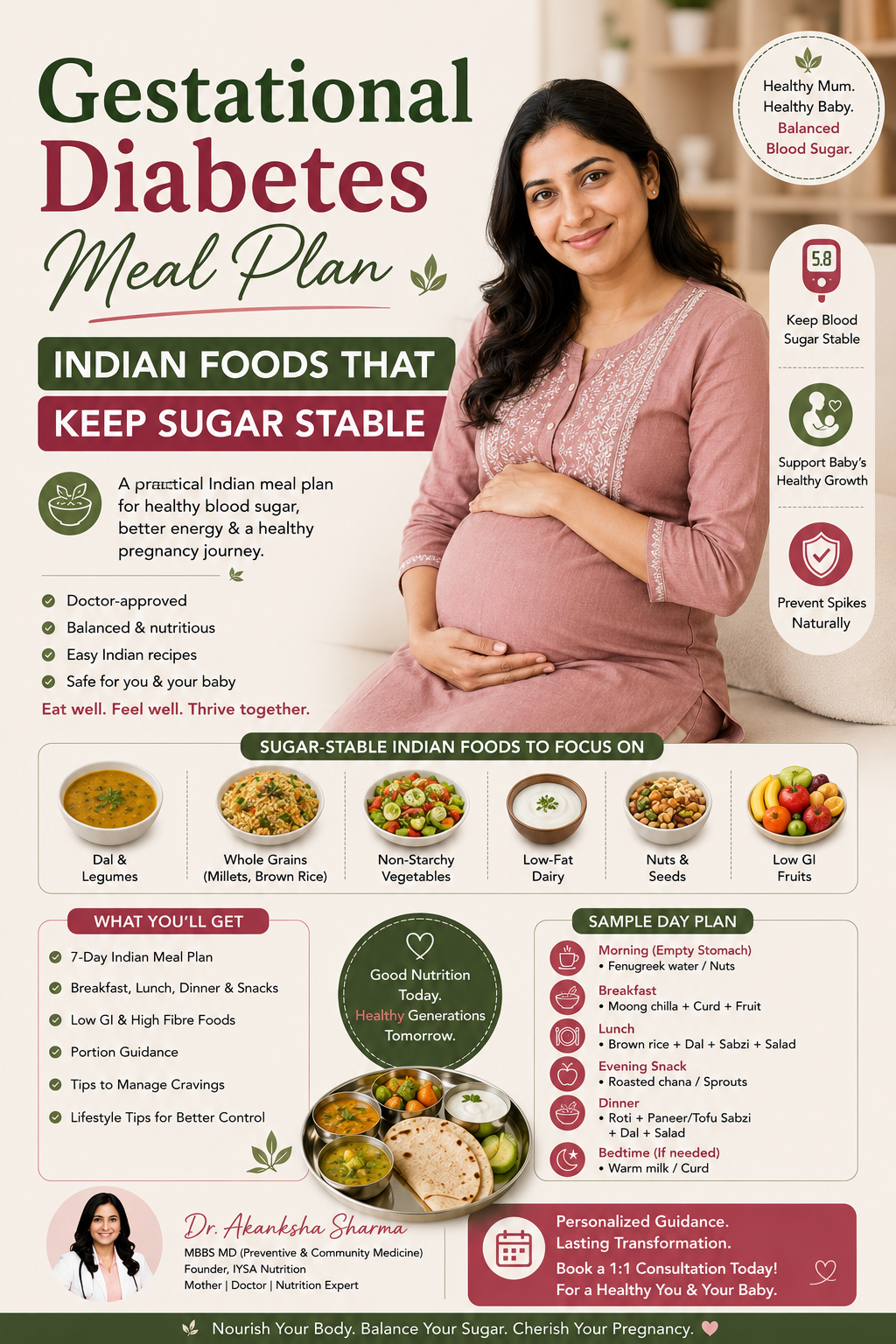
This post gives you a complete, evidence-based, culturally grounded Indian GDM meal plan, the principles, the foods, the portions, the strategies, and a week’s framework, developed specifically for Indian pregnant women who want to manage their blood glucose effectively without abandoning their food culture.
Related reading:
👉Everything You Need to Know About Routine Antenatal Screenings and Tests
👉Gestational Diabetes Screening in Singapore: What Happens at KKH and NUH — and What to Eat
What Is Gestational Diabetes and Why Does It Happen?
Gestational diabetes is carbohydrate intolerance that develops or is first recognised during pregnancy. It is caused by the insulin resistance that develops as a normal feature of the second and third trimesters, driven by placental hormones (human placental lactogen, cortisol, oestrogen, and progesterone) that progressively impair insulin sensitivity to ensure adequate glucose supply to the foetus. In most women, the pancreas compensates by increasing insulin output. In women who develop GDM, this compensatory response is insufficient, blood glucose rises above pregnancy-specific thresholds.
The consequences of poorly controlled GDM include: large-for-gestational-age baby (macrosomia), increased caesarean section risk, neonatal hypoglycaemia, preterm birth, pre-eclampsia, and, in the long term, significantly increased risk of type 2 diabetes in both mother (50–70% lifetime risk after GDM) and child (higher metabolic disease risk in childhood and adulthood).
The consequences of well-controlled GDM: outcomes comparable to non-GDM pregnancies, normal birth weight, and significantly reduced long-term metabolic risk for both mother and child. The dietary management matters enormously, both for the current pregnancy and for decades of health beyond it.
👉Second Trimester Nutrition: Step by step guide
👉How Much Weight Gain During Pregnancy is Normal According to Singapore Guidelines?
Blood Glucose Targets in Gestational Diabetes
Management targets vary slightly between guidelines. The following are widely used in India and Singapore:
| Measurement | Target |
|---|---|
| Fasting blood glucose | Below 5.3 mmol/L (95 mg/dL) |
| 1-hour post-meal glucose | Below 7.8 mmol/L (140 mg/dL) |
| 2-hour post-meal glucose | Below 6.7 mmol/L (120 mg/dL) |
Home blood glucose monitoring, testing fasting each morning and 1 or 2 hours after each main meal, is the most valuable tool for understanding your individual glucose response to specific Indian foods. Every woman’s response differs, and self-monitoring allows you to identify which foods spike your glucose and which do not, enabling a personalised Indian GDM diet that is not based on generic food lists.
👉 Balanced Pregnancy Diet at 6 Months
👉 10 Foods Pregnant Woman Should Eat for a Healthy Pregnancy
The GDM Dietary Principles: Adapted for Indian Cooking
Principle 1: Never Skip Meals or Fast
Fasting raises cortisol and glucagon, both of which raise blood glucose independently of food intake. In GDM, the fasting glucose (measured each morning) is often the most difficult target to meet, precisely because the overnight fast allows hepatic glucose output to accumulate unchecked. Eating a small, protein-rich snack before bed (discussed below) is one of the most effective strategies for controlling fasting glucose in GDM.
Principle 2: Distribute Carbohydrates Across 3 Small Meals and 2–3 Snacks
The volume of carbohydrate at any single sitting is one of the most important determinants of post-meal glucose spike. Eating the same total daily carbohydrate in three large meals produces much higher glucose peaks than distributing it across five or six smaller meals and snacks. The GDM dietary structure is therefore: three moderate meals and two to three planned snacks, rather than the traditional Indian pattern of a light breakfast, a larger lunch, and the largest meal at dinner.
Principle 3: Pair Every Carbohydrate with Protein and Fat
Protein and fat both slow gastric emptying and reduce the glycaemic impact of carbohydrates eaten in the same meal. A bowl of plain rice eaten alone produces a much larger glucose spike than the same rice eaten with a generous portion of dal (protein + fibre) and a sabzi cooked with a teaspoon of ghee (fat). The protein-fat-fibre matrix of a well-constructed Indian meal is naturally glucose-stabilising — the problem in GDM is when carbohydrates are eaten in isolation or in disproportionately large quantities relative to the other components.
Principle 4: Choose Low-GI Carbohydrates
Not all carbohydrates are equal in their glucose impact. In GDM, choosing lower-GI alternatives makes a meaningful and measurable difference to post-meal readings.
Principle 5: Portion Control — Not Elimination
Rice, roti, and fruit are not forbidden in GDM. They require portion control and strategic pairing. Eliminating entire food groups creates nutritional gaps and cultural distress without being necessary for glucose control in most GDM cases. The goal is intelligent portioning, not prohibition.
📥 Want a FREE Supplement Checklist?
🎁 Download my Trimester-Wise Pregnancy Supplement Chart (with brand suggestions & Ayurvedic swaps!)
👉 Click here to download or DM me “SUPPLEMENTS” on Instagram @iysanutrition.doctor
GDM-Friendly Indian Carbohydrate Choices
Grains and Starches — What to Choose and How Much
| Food | GDM-Appropriate? | Safe Portion | Strategy |
|---|---|---|---|
| Jowar (sorghum) roti | ✅ Excellent | 1–2 rotis per meal | Best grain choice for GDM; GI ~55 |
| Bajra (pearl millet) roti | ✅ Excellent | 1–2 rotis per meal | High magnesium improves insulin sensitivity |
| Ragi (finger millet) roti/porridge | ✅ Good | 1 roti or 1 small bowl porridge | High fibre; monitor as ragi is moderate GI |
| Whole wheat atta roti | ✅ Acceptable | 1–2 small rotis | Better than maida; monitor post-meal readings |
| Brown or parboiled rice | ✅ In moderation | 1/3 to 1/2 cup cooked | Always pair with generous dal + sabzi |
| Oats (rolled) | ✅ Good | 40g dry | Beta-glucan fibre; excellent breakfast option |
| Barley (jau) | ✅ Excellent | 1/2 cup cooked | Lowest GI grain; best glucose control |
| White rice (large portion) | ⚠️ Limit | Max 1/3 cup cooked if at all | High GI; monitor closely; reduce significantly |
| Maida roti/naan/paratha | ❌ Avoid | — | Very high GI; avoid during GDM management |
| Instant oats/upma rava | ⚠️ Limit | Small portions only | Higher GI than rolled oats; monitor |
| Poha (flattened rice) | ⚠️ Moderate | 1 small bowl | Moderate GI; pair with protein (peanuts, egg) |
Dal and Legumes — The GDM Superfoods
Dal is one of the most valuable foods in the GDM dietary plan. The combination of protein, fibre, and complex carbohydrates in dal produces a very low glycaemic response, making it simultaneously a carbohydrate source, a protein source, and a blood glucose stabiliser. There is no reason to limit dal in GDM; if anything, it should be increased.
All dals are appropriate: moong, masoor, toor, chana, rajma, kabuli chana. Eat a generous cup of thick (not watery) dal at every main meal. The thicker the dal, the higher the protein and fibre content per serving and the lower the glycaemic impact.
Fruit — Yes, With Strategy
Fruit is frequently and unnecessarily eliminated from GDM diets. Whole fruit, with its fibre intact, has a significantly lower glycaemic impact than fruit juice or other sugary foods. However, portion and timing matter:
- Best GDM fruits: Guava (low GI, high Vitamin C, high fibre), jamun (Indian blackberry, one of the lowest GI fruits available), apple, pear, papaya (ripe, small portion), berries
- Eat fruit with protein: A small apple with 10 almonds produces a much lower glucose response than the same apple eaten alone
- Avoid fruit on an empty stomach: it produces the highest glucose response when the stomach is empty
- Avoid fruit juice entirely: including “natural” and “no added sugar” varieties
- Eat fruit as a snack, not as a dessert after a meal: Post-meal glucose is already being managed by the meal’s protein and fibre; adding fruit on top can push it over target
- Monitor your response: Test 1 hour after eating a fruit serving to understand your individual response
- Limit mango, banana, grapes, and chikoo to very small portions: these have higher sugar content and GI than other fruits
The Pre-Bed Snack — Critical for Fasting Glucose
This is one of the most clinically effective and least known strategies for GDM fasting glucose management. Many women with GDM find that their fasting glucose each morning is the most difficult target to meet, even when post-meal values are well controlled.
The mechanism: during the overnight fast, the liver releases glucose to maintain blood glucose levels (hepatic gluconeogenesis). In GDM, this process is exaggerated by the insulin resistance of pregnancy. A small, high-protein, low-carbohydrate snack before bed reduces the stimulus for hepatic glucose release overnight, directly lowering fasting morning readings.
Best pre-bed GDM snacks:
- A small bowl of plain dahi (200g): protein 8–10g, minimal carbohydrate, probiotic
- Two to three soaked almonds + a teaspoon of peanut butter: protein + fat, very low carbohydrate
- A boiled egg: 6g protein, zero carbohydrate
- A small piece of paneer (30g): protein + fat
- Plain chaas (200ml): protein, probiotic, very low carbohydrate
Avoid high-carbohydrate pre-bed snacks, including fruit, biscuits, milk with jaggery or sugar, and sweet preparations, as these directly raise fasting glucose.
The Morning Meal — The Most Glucose-Challenging Time
Many women with GDM find that their morning glucose response to breakfast is the most difficult to control. This is driven by the “dawn phenomenon”, a natural early-morning cortisol surge that raises blood glucose, insulin resistance, and appetite simultaneously. Breakfast options that spike glucose are more problematic in the morning than the same foods eaten at lunch or dinner.
GDM-appropriate Indian breakfast options:
- Two eggs (scrambled or boiled) + one small jowar roti + a bowl of dahi: high protein, moderate carbohydrate, excellent glucose control
- Moong dal chilla (2 pieces) with mint chutney + dahi: very low GI, high protein
- Rolled oats (40g) cooked with water + one tablespoon ground flaxseed + a small handful of mixed seeds: beta-glucan slows glucose absorption significantly
- Ragi porridge (2 tablespoons ragi flour) made with water (not milk) + one egg on the side: moderate GI, manageable with protein pairing
Problematic Indian breakfasts in GDM — test carefully or avoid:
- Poha alone (without protein): moderate to high GI response in most GDM women
- Idli (2–3 pieces) without sambar and chutney: idli alone has a high GI; with generous sambar, the glycaemic impact is reduced
- Upma from rava: semolina has a moderate to high GI; test your response
- Paratha without protein accompaniment: high GI, especially maida-based
- Fruit alone for breakfast: without protein, this reliably spikes glucose
👉Third Trimester Nutrition: Preparing Your Body for Labour
Complete One-Week GDM Meal Framework (Indian)
Daily Structure (Every Day)
- 3 main meals + 2–3 planned snacks
- Maximum 3–4 hours between eating occasions
- Protein at every meal and snack
- No carbohydrates eaten alone
- Blood glucose tested fasting + 1–2 hours after each main meal
Day 1
- Breakfast: 2 scrambled eggs + 1 small jowar roti + cucumber slices
- Mid-morning: A small apple + 10 almonds
- Lunch: 1 cup thick masoor dal + 1 jowar roti + palak sabzi + salad
- Afternoon: A bowl of plain dahi + 1 tablespoon pumpkin seeds
- Dinner: Moong dal khichdi (1 cup, vegetable-heavy, dal-heavy, add some paneer) + sauteed veggies
- Pre-bed: Small bowl plain dahi
Day 2
- Breakfast: Rolled oats (40g, cooked with water) + ground flaxseed + mixed seeds + dahi
- Mid-morning: 2 boiled eggs
- Lunch: Rajma curry (1/2 cup) + brown rice (1/3 cup) + gobi sabzi + salad with lime
- Afternoon: Roasted chana (20g) + one guava
- Dinner: Grilled fish or paneer + stir-fried vegetables (no rice or roti at dinner) + cooked sprouts salad
- Pre-bed: 2–3 almonds + 1 small cube paneer
Day 3
- Breakfast: 2 moong dal chilla + mint chutney + dahi (150g)
- Mid-morning: A small pear + 10 walnuts
- Lunch: 1 cup chana masala + 1 bajra roti + bhindi sabzi + dahi
- Afternoon: Plain chaas + 5 almonds
- Dinner: Lightly spiced fish curry or tofu curry + 1 small jowar roti + Sauteed veggies
- Pre-bed: 1 boiled egg
Day 4
- Breakfast: Ragi porridge (water-based, small portion) + 2 eggs scrambled alongside
- Mid-morning: Plain dahi (150g) + 1 tablespoon mixed seeds
- Lunch: 1 cup toor dal + sambar vegetables + 1 small jowar roti + cucumber salad
- Afternoon: A small bowl of sprouts chaat (moong sprouts, cooked) with lime
- Dinner: Dal makhani (no cream; small portion) + 1 roti + sautéed broccoli
- Pre-bed: Small bowl plain dahi
Day 5
- Breakfast: Besan chilla (2) with palak + dahi
- Mid-morning: 1 small apple + peanut butter (1 teaspoon)
- Lunch: Barley khichdi (barley + moong dal, vegetable-heavy) + plain dahi
- Afternoon: 2 boiled eggs
- Dinner: Grilled chicken or paneer bhurji + stir-fried vegetables + 1 jowar roti
- Pre-bed: Plain chaas (200ml)
Day 6
- Breakfast: 2 eggs any style + 1 small multigrain toast + tomato slices
- Mid-morning: 10 almonds + 1 small guava
- Lunch: 1 cup masoor dal + 1/3 cup brown rice + palak sabzi with lime + salad. This is the one day with a small rice portion — monitor 1-hour post-meal reading.
- Afternoon: Plain dahi (150g)
- Dinner: Moong dal soup (thick) + 1 jowar roti + bottle gourd sabzi
- Pre-bed: 30g paneer
Day 7
- Breakfast: Oats with dahi, flaxseed, mixed seeds (no fruit at breakfast today, test your morning response)
- Mid-morning: 2 boiled eggs + cucumber slices
- Lunch: Kabuli chana curry + 1 bajra roti + gobi sabzi + dahi
- Afternoon: Small bowl sprouts (cooked moong) + 1 small pear
- Dinner: Sardine or mackerel curry (omega-3)/ Paneer gravy + sauteed veggies. No starch at dinner.
- Pre-bed: Plain dahi
👉 Pregnancy & Postpartum Nutrition: A Doctor-Reviewed Guide
👉First Trimester Nutrition: A Week-by-Week Food Guide for Indian Mums
If you are a woman struggling with optimising your diet during pregnancy:
👉 Join my program Nourish Nine: Doctor-Led Pregnancy Nutrition & Care Program (Trimester-Wise, 3 months)
📥 Want a Printable Food & Nausea Tracker?
🎁 Download my FREE “Anti-Nausea Food List + Tracker” to keep by your bedside or fridge
👉 Click here to download or DM “NAUSEA” on Instagram @iysanutrition.doctor
Nutrients That Need Special Attention in GDM
Iron — Avoid High-Dose Supplementation Near Meal Time
Iron supplements raise blood glucose in some studies; the mechanism is not fully understood. In GDM, take iron supplements away from meals and blood glucose testing times when possible. Discuss timing with your obstetrician.
Magnesium — For Insulin Sensitivity
Magnesium improves insulin sensitivity and is frequently deficient in Indian women. Bajra roti (137mg per 100g), pumpkin seeds, almonds, and dark leafy greens are the best daily sources. Discuss magnesium supplementation (150–300mg glycinate) with your obstetrician if dietary intake is consistently low.
Vitamin D — For Glucose Metabolism
Low Vitamin D is associated with worse GDM outcomes. Test and correct to above 75 nmol/L; this remains a priority throughout pregnancy, including when GDM is diagnosed.
👉 Best Indian Vegetarian Sources of Omega-3 During Pregnancy
👉Best Dals and Lentils for Pregnancy: ICMR 2024 Guide
Frequently Asked Questions
Can I eat rice at all with gestational diabetes?
Yes, with significant modification. A small portion of brown or parboiled rice (one-third to half a cup cooked) paired with a generous amount of dal, a sabzi, and some protein, eaten in the middle of the day when insulin sensitivity is highest, is manageable for many GDM women. White rice in large portions, eaten without substantial protein and fibre accompaniment, is the problem, not rice per se. Test your post-meal glucose after a well-paired small rice portion versus after a larger portion without adequate accompaniment, and let your numbers guide you.
My obstetrician said I need insulin. Does diet still matter?
Absolutely yes. Insulin does not replace dietary management in GDM, it works alongside it. Women on insulin for GDM still need to manage carbohydrate portions and distribution, because unmanaged dietary glucose spikes require higher insulin doses and produce greater glucose variability. Dietary optimisation reduces the insulin dose required, reduces glucose variability, and produces better outcomes for both mother and baby. Think of diet and insulin as partners, not alternatives.
Will gestational diabetes affect my baby?
Well-controlled GDM, brought within blood glucose targets through diet and if necessary, medication, produces outcomes comparable to non-GDM pregnancies. The risks, macrosomia, neonatal hypoglycaemia, and increased c-section rates are associated with poorly controlled GDM, not with the diagnosis itself. Your glucose control, not the diagnosis, determines the outcome. This is the most important message: a GDM diagnosis is not a sentence, it is an opportunity to manage something that is entirely within your influence.
Will I develop type 2 diabetes after this pregnancy?
GDM significantly increases lifetime type 2 diabetes risk — approximately 50–70% of women with GDM develop type 2 diabetes within 10 years if no preventive action is taken. However, this risk is dramatically modifiable. The Diabetes Prevention Program showed that lifestyle intervention (the dietary pattern described in this post, combined with regular exercise) reduces progression from pre-diabetes to type 2 diabetes by 58%. The dietary habits you build managing GDM are the exact same habits that reduce your post-pregnancy type 2 diabetes risk. Think of GDM as an early warning and an opportunity, not a permanent verdict.
Can traditional Indian postpartum foods be eaten after GDM delivery?
Many traditional postnatal foods are fine, but some require modification. Methi laddoos, high in iron and galactagogues, but also in sugar (jaggery) and fat (ghee), can be eaten in moderation (one per day, not several). Ragi porridge is excellent, low to moderate GI, high in iron and calcium. Gond laddoos are high in energy and fat, one daily is reasonable. Sweet preparations with large amounts of jaggery or sugar should be monitored, as women with a history of GDM continue to have some degree of insulin resistance in the postpartum period. Monitor blood glucose postpartum as directed by your obstetrician.
The Bottom Line
Gestational diabetes is not a reason to abandon Indian food. It is a reason to eat Indian food more strategically, more jowar and bajra, less white rice; more dal, less starchy carbohydrate alone; consistent protein at every meal; planned snacks every 3–4 hours; and a pre-bed protein snack for fasting glucose control.
The Indian dietary tradition, with its dal, legumes, fermented foods, spices, and whole grains, is extraordinarily well-adapted to blood glucose management when used with intelligence and intention. Your numbers are your guide. Monitor them. Understand what your individual body responds to. And work with your obstetrician and nutrition specialist to build a plan that controls your glucose, nourishes your baby, and prepares you for the decades of metabolic health that follow this pregnancy.
If you are a woman struggling with optimising your diet during pregnancy or need help managing your gestational diabetes:
👉 Join my program Nourish Nine: Doctor-Led Pregnancy Nutrition & Care Program (Trimester-Wise, 3 months),
customised for Indian diets and Singapore lifestyles.
👉Book a consultation call (FREE) to discuss your concerns
Disclaimer: This article is for educational purposes only. Gestational diabetes requires medical supervision. Please follow your obstetrician’s specific guidance on blood glucose targets, monitoring frequency, and medication requirements.
References:
- HAPO Study Cooperative Research Group. Hyperglycemia and adverse pregnancy outcomes. N Engl J Med. 2008;358(19):1991-2002. PubMed
- Seshiah V et al. Gestational diabetes mellitus in India. J Assoc Physicians India. 2004;52:707-711. PubMed
- Knowler WC et al. Reduction in incidence of type 2 diabetes with lifestyle intervention. N Engl J Med. 2002;346(6):393-403. PubMed
- ICMR-NIN Expert Group. Recommended Dietary Allowances for Indians. 2020. nin.res.in

Akanksha Sharma
Dr Akanksha Sharma (MBBS, MD) is a physician and women’s health nutrition specialist, and the founder of IYSA Nutrition. She provides evidence-based, doctor-led nutrition guidance for pregnancy, postpartum recovery, PCOS, child nutrition, and family health, helping women make calm, informed decisions about their health and their children’s well-being.