Written & reviewed by Dr Akanksha Sharma, MBBS, MD (Preventive & Community Medicine) | Founder, IYSA Nutrition, Singapore
Weaning: the introduction of solid foods alongside breast milk or formula, is one of the most anxiety-inducing milestones for new parents. Every grandmother has an opinion. Every social media post contradicts the last one. And somewhere in the noise, the actual evidence-based guidance often gets lost.
In 2023, the World Health Organisation released its first major update to complementary feeding guidelines in over two decades, consolidating the evidence into seven clear recommendations. This post translates those guidelines into a practical, food-specific weaning plan: what to start with, when, and how to do it safely.
Read ‘The First Food of Your Baby: A Doctor’s Guide‘ to know when to introduce which food item!
When to Start: The Six-Month Rule
The WHO 2023 guideline confirms that complementary feeding should begin at six months of age, while breastfeeding continues. This recommendation is not arbitrary; it reflects two converging facts about infant development at this age.
First, by around six months, a baby’s iron stores from birth (built up during the third trimester) are largely depleted, and breast milk alone, while otherwise excellent, does not provide sufficient iron to meet a growing infant’s needs from this point onward. This is the single most important reason complementary feeding begins when it does, and it is why the WHO guideline places such emphasis on iron-rich first foods rather than starting with fruit or rice cereal alone.
Second, the digestive and motor systems required to safely manage solid food, the gut’s ability to handle more complex foods, the loss of the tongue-thrust reflex, and the ability to sit with support and control head movement are typically in place by six months, not earlier.
The WHO guideline is explicit that introducing complementary foods earlier, even when fortified with iron, does not reliably prevent iron deficiency in high-risk infants, reinforcing that six months, not four, is the appropriate general starting point for most babies. Some babies show developmental readiness signs slightly before six months; this should be discussed with your paediatrician rather than self-determined.
👉Childhood Food Allergy: What Parents Must Know
The WHO 2023 Guideline: What Changed
The 2023 WHO guideline replaced the previous Guiding Principles documents with seven consolidated recommendations. The two most clinically significant for parents are:
- Daily animal-source foods are recommended: meat, fish, or eggs should be consumed daily where possible, because when these are excluded from a 6–8-month-old’s diet, requirements for iron, zinc, and Vitamin B12 cannot be met through plant foods alone at this age.
- Pulses, nuts, and seeds should be consumed frequently: particularly important when animal-source foods are limited, as is the case in vegetarian Indian households. This is direct, recent, global guidance validating the dal-based weaning that Indian tradition has used for generations.
For vegetarian Indian families, this guidance is reassuring: a well-planned vegetarian weaning diet built around dal, legumes, dairy, and eggs (if the family includes eggs) can meet a baby’s nutritional needs, but it requires more deliberate attention to iron and zinc than a diet including meat or fish, because plant-based iron and zinc are less bioavailable.
👉Is Your Child Getting Enough Calcium? (Without Dairy Supplements)
👉Why Zinc Deficiency is common in Indian Kids (And How to Fix It)
The First Foods: What to Start With
Priority One: Iron-Rich Foods
Given the WHO’s emphasis on addressing depleting iron stores from six months, the very first foods offered should ideally include an iron-rich option, not necessarily as the literal first bite, but within the first one to two weeks of starting solids.
Best Indian iron-rich first foods:
- Ragi (finger millet) porridge: One of the most traditional and nutritionally sound first foods in Indian weaning practice, particularly in South India. Ragi provides iron, calcium, and amino acids in an easily digestible form. Cook ragi flour with water or breast milk to a smooth, thin consistency for the first introduction, gradually thickening as the baby’s feeding skills develop.
- Moong dal water/puree: Well-cooked, mashed moong dal mixed into rice or eaten alone is gentle, low-allergenic, and provides iron and protein.
- Egg yolk (from 6 months) or whole egg (from approximately 6-7 months): Current Indian Academy of Pediatrics and global guidance no longer recommends delaying egg introduction; early introduction is now associated with reduced allergy risk, not increased risk. Well-cooked egg yolk, mashed, is an excellent iron and choline source.
- Well-cooked, finely mashed or pureed chicken or fish (from 6–7 months, for non-vegetarian families): introduced as a smooth puree once the baby is tolerating initial complementary foods. Among the most bioavailable iron sources available and appropriate to introduce early rather than delaying.
Priority Two: Building Variety
The WHO guideline emphasises dietary diversity, moving beyond a single starchy staple toward a varied diet that includes animal-source foods (if the family includes them), pulses, vegetables, and fruits regularly, not just occasionally. The global data shows that infants in South Asia have among the lowest minimum dietary diversity rates of any region, making this a particular area of focus for Indian weaning practice.
Foods to introduce across the first month of weaning, one at a time:
- Mashed banana — easy, mildly sweet, well-tolerated
- Mashed or pureed sweet potato — beta-carotene, mild flavour
- Mashed or pureed cooked carrot
- Soft-cooked, mashed apple or pear
- Pureed or mashed cooked moong dal khichdi (rice + moong dal)
- Mashed ripe papaya (ripe, not raw/green)
- Soft-cooked, mashed bottle gourd (lauki) or pumpkin
- Plain dahi (from 6 months, made from pasteurised milk) — calcium, probiotics, B12
Introducing One Food at a Time
Introduce each new food for 2–3 days before adding another, to identify any allergic reaction or intolerance clearly. This is a cautious and sensible practice, though current evidence does not support extended delays for the most common allergens (egg, peanut, dairy), early, gradual introduction is now the recommended approach for reducing allergy risk, not avoiding it.
👉Is Ghee for Children Good? An Evidence-Based Answer
👉Why Cow’s Milk May Not Be the Best Choice for Toddlers Under Two
Texture Progression: From Puree to Family Food
| Age | Texture | Examples |
|---|---|---|
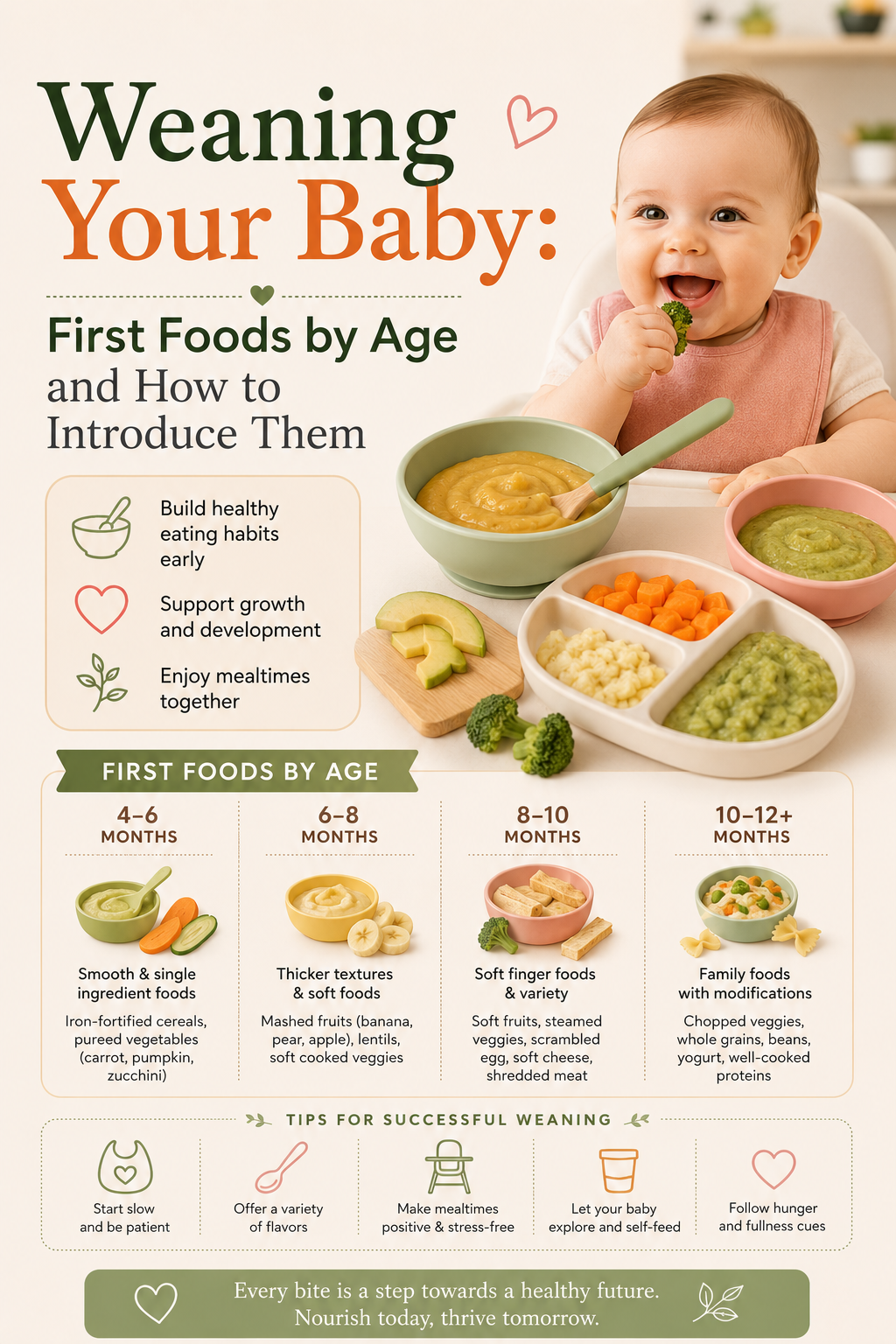
| 6–7 months | Smooth purees, porridges | Ragi kanji, mashed banana, smooth dal puree |
| 7–9 months | Mashed/lumpy textures, soft finger foods | Mashed khichdi with visible rice grains, soft boiled vegetable sticks, mashed egg |
| 9–12 months | Chopped, minced, soft finger foods | Soft roti pieces, well-cooked vegetable pieces, minced chicken/fish, idli pieces |
| 12+ months | Family food, modified for size/spice | Most family meals, cut appropriately, with reduced chilli |
Delaying the progression from puree to more textured food beyond what is developmentally appropriate is one of the most common weaning mistakes; it can contribute to later feeding difficulties and reduced acceptance of textured foods. Most babies are ready for some lumpy and soft finger-food textures by 8–9 months, even if pureed foods remain part of the diet.
Baby-Led Weaning vs Traditional Spoon-Feeding
Baby-led weaning (BLW), offering soft, graspable whole or cut pieces of food for the infant to self-feed from the start of weaning, rather than spoon-fed purees, has grown in popularity globally. Research comparing BLW and traditional complementary feeding methods has found differences in feeding practices and developmental engagement, though large definitive trials on long-term nutritional outcomes are still developing.
For Indian families, a hybrid approach often works well in practice: starting with traditional mashed and pureed foods for the iron-rich first foods (ragi porridge, dal, mashed egg), while introducing soft finger foods (steamed carrot sticks, soft roti pieces, banana pieces) from around 7–8 months once the baby can sit well and bring food to their mouth. This combines the nutritional reliability of purees for critical first foods with the self-feeding skill development of BLW-style finger foods.
👉The Ultimate Indian Complementary Feeding Guide (6–24 Months)
Foods to Avoid Before 12 Months
- Honey: Risk of infant botulism; avoid until after the first birthday
- Cow’s milk as a main drink (not in cooking): Most guidelines recommend delaying cow’s milk as the primary drink until 9–12 months, as it can displace breast milk/formula and is low in iron; small amounts in cooking (e.g., in porridge) from 6 months are generally fine
- Added salt and sugar: WHO guidance is explicit that complementary foods should be prepared with little to no added salt or sugar, infant kidneys and taste preferences are both affected by early exposure
- Whole nuts and hard, round foods: Choking risk: nuts should be given as smooth nut butter or finely ground, not whole, until well past the toddler years
- Raw or undercooked eggs, meat, and fish: Always fully cook for infants
- Unpasteurised dairy: Listeria risk
Worried your child is eating “too little” or too selectively or not sure what to start first?
👉 Book a child nutrition consult (FREE) (Singapore-friendly, practical, doable meal plans).
A Sample First Week of Weaning (6 Months)
- Day 1–2: Ragi kanji (porridge), one teaspoon increasing to a few teaspoons, once daily after a breastfeed/bottle
- Day 3–4: Mashed ripe banana, small amount, once daily
- Day 5–6: Smooth moong dal puree mixed with a little rice, once daily
- Day 7: Mashed, well-cooked egg yolk (if the family includes eggs), small amount
- Ongoing: Continue breast milk or formula as the primary nutrition source; solids are complementary, not a replacement, at this stage. Gradually increase to 2–3 small meals per day by 8 months, alongside continued breastfeeding.
👉How Much Protein Children Need Actually? An Age-by-Age Guide
Frequently Asked Questions
My elders say to start with rice water or sugar water. Is this outdated advice?
Yes, and current evidence specifically cautions against this approach. Starting weaning with plain rice cereal, rice water, or sweetened liquids provides minimal iron, zinc, or protein at exactly the developmental stage when these nutrients are most needed. The WHO 2023 guideline’s strong recommendation for animal-source foods, pulses, and nuts reflects a deliberate shift away from starch-only first foods. If continuing a starch-based first food for cultural or practical reasons, ensure iron-rich foods are introduced within the same first one to two weeks rather than delayed for months.
Is it safe to give my baby eggs from 6 months if there is a family history of allergies?
Current evidence, including findings that informed updated allergy prevention guidance from bodies such as the American Academy of Pediatrics, supports introducing common allergens like egg early (from 6 months) rather than delaying; even in infants with a family history of allergy, early introduction is associated with reduced, not increased, allergy risk in most infants. If your baby has severe eczema or a diagnosed food allergy already, discuss the introduction of egg and other allergens with your paediatrician or an allergist first, as a more structured introduction protocol may be recommended in that specific situation.
My baby refuses lumpy textures and only wants smooth purees at 9 months. What should I do?
This is common and usually resolves with patient, gradual exposure rather than abrupt change. Try offering a slightly thicker version of an already-accepted puree, mixing small soft lumps into a familiar smooth food, and offering soft finger foods alongside (not instead of) purees so the baby can explore at their own pace without pressure. If texture refusal is severe, persistent beyond 12 months, or accompanied by gagging, choking, or significant distress, discuss with your paediatrician, as this can occasionally indicate an underlying feeding or sensory difficulty that benefits from occupational therapy input.
How much food should my 7-month-old be eating?
At 7 months, most babies are having one to two small meals of solids per day, building toward three meals by around 9 months. The amount per meal varies considerably, but a rough guide is 2–4 tablespoons of food per meal at 7 months, increasing as appetite and interest grow. Breast milk or formula remains the primary source of nutrition through the first year, solids are complementary, exactly as the term “complementary feeding” implies, not a replacement.
The Bottom Line
Weaning your baby well comes down to a few consistent principles: start at six months, prioritise iron-rich foods from the outset rather than starch alone, build dietary diversity steadily, progress textures in line with developmental readiness, and avoid added salt, sugar, and honey. Indian tradition already provides excellent first foods in ragi and moong dal — the task is simply to ensure they appear early and consistently, alongside the dietary variety that current global guidance recommends.
💛 Want structured guidance? 📩 Click here to book a FREE consultation with Dr Akanksha Sharma
👉 Explore my programs:
🔗 You May Also Find These Readings Helpful:
- [Fueling Little Minds: Best School Tiffin Ideas for Singaporean Kids!]
- [The Growth-Smart School Tiffin Recipes Guide]
-
[Children Are Not Mini Adults: Stop “Healthy” Food Trends From Harming Your Child]
- [Positive Reinforcement Tips to Encourage Good Behaviour in Your Child]
Disclaimer: This article is for educational purposes only. Always consult your paediatrician regarding your baby’s individual readiness for weaning and any concerns about allergies, growth, or feeding difficulties.
References:
- WHO. Guideline for complementary feeding of infants and young children 6–23 months of age. Geneva: World Health Organization; 2023. NCBI Bookshelf NBK596430
- Domellöf M et al. Iron requirements of infants and toddlers. J Pediatr Gastroenterol Nutr. 2014;58(1):119-129. PubMed
- Indian Academy of Pediatrics. IAP Guidelines on Complementary Feeding. iapindia.org

Akanksha Sharma
Dr Akanksha Sharma (MBBS, MD) is a physician and women’s health nutrition specialist, and the founder of IYSA Nutrition. She provides evidence-based, doctor-led nutrition guidance for pregnancy, postpartum recovery, PCOS, child nutrition, and family health, helping women make calm, informed decisions about their health and their children’s well-being.