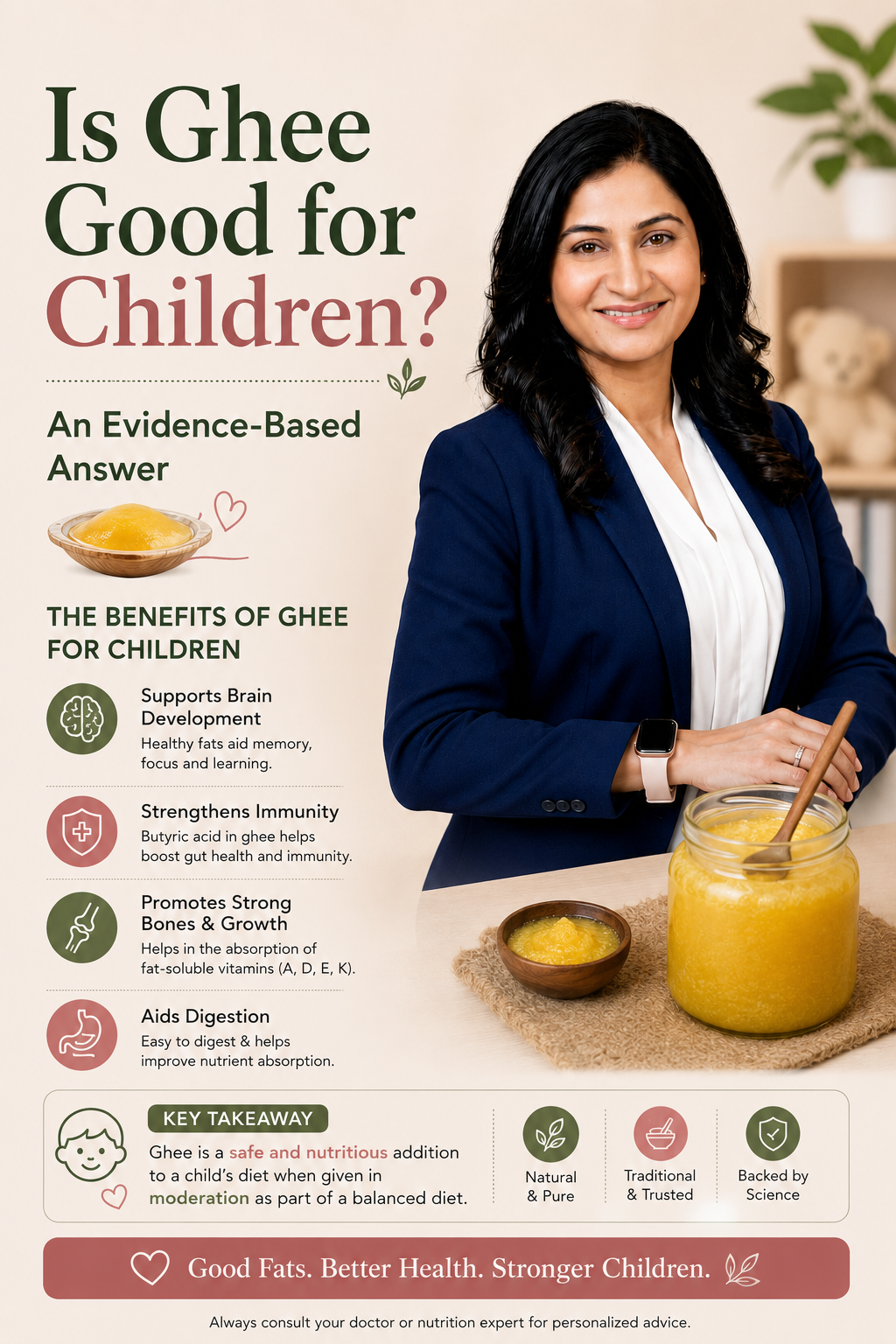
Written & reviewed by Dr Akanksha Sharma, MBBS, MD (Preventive & Community Medicine) | Founder, IYSA Nutrition, Singapore
Few foods generate more passionate debate in Indian households than ghee. On one side: generations of grandmothers who consider a generous serving of ghee over dal and roti an essential act of nourishment, convinced that ghee builds strong bones, sharp minds, and healthy children. On the other hand, health-conscious urban parents who have absorbed decades of low-fat dietary messaging worry that ghee is simply a saturated fat delivery vehicle that clogs arteries and causes obesity.
Both positions are, in their extreme forms, wrong. And as a Preventive Medicine physician, I want to replace both the uncritical enthusiasm and the unfounded fear with something more useful: what the actual evidence says about ghee for children, how it fits into the larger context of children’s dietary fat needs, and how to use it intelligently.
📌Powerhouse in the Kitchen: A Complete Guide to Ghee Benefits
📌Does Milk Cause Early Puberty in Girls? A Doctor’s Evidence-Based Answer
What Is Ghee?
Ghee is clarified butter, butter that has been simmered until the milk solids and water are removed, leaving almost pure butterfat. The removal of milk solids gives ghee several distinctive properties:
- High smoke point (approximately 250°C), significantly higher than butter (177°C), making it stable for cooking at higher temperatures without oxidation
- Lactose and casein-free: the milk proteins and lactose that cause dairy intolerance are largely removed; many lactose-intolerant and milk-protein-sensitive individuals tolerate ghee without difficulty
- Long shelf life: the absence of moisture prevents bacterial growth; traditionally stored at room temperature in Indian kitchens for months
- Rich flavour: the Maillard reaction during clarification creates a distinctive nutty, caramelised aroma that is central to Indian culinary culture
The Nutritional Composition of Ghee
Per tablespoon (14g) of ghee:
- Calories: approximately 130 kcal
- Total fat: 14g
- Saturated fat: approximately 9g (64% of total fat)
- Monounsaturated fat: approximately 4g (29%)
- Polyunsaturated fat: approximately 0.5g (4%)
- Omega-3 (ALA): trace amounts (slightly higher in grass-fed cow ghee)
- Butyrate: approximately 3–4% of fat content
- Vitamin A: approximately 108 IU (8% of daily value)
- Vitamin K2 (MK-4): present in varying amounts depending on the cow’s diet
- Conjugated linoleic acid (CLA): small amounts, higher in grass-fed cow ghee
📌Is A2 Ghee Really Better — or Just Clever Marketing?
Why Children Need Dietary Fat — The Foundation
Before evaluating ghee specifically, it is essential to establish that children, particularly young children, have a genuine, significant need for dietary fat that is categorically different from adult fat requirements.
Brain Development
The human brain is approximately 60% fat by dry weight. During the first two years of life, the brain grows to approximately 80% of its adult size, the most rapid and fat-demanding period of brain development in the human lifespan. This growth requires a continuous supply of dietary fat, particularly long-chain fatty acids (DHA and arachidonic acid), for the formation of neuronal membranes and myelin (the fatty insulating sheath around nerve fibres that determines how quickly signals travel in the brain).
This is why low-fat diets are inappropriate and potentially harmful for children under 2 years, as they restrict the primary raw material for brain development. Dietary fat restriction should never be applied to infants or toddlers without a specific medical indication.
📌Ghee: The Superfood for Babies – An Ayurvedic and Scientific Perspective
Caloric Density
Fat provides 9 kcal per gram, more than twice the caloric density of carbohydrates or protein. Young children have small stomach volumes but high caloric requirements relative to their body weight. Fat allows them to meet their caloric needs within the limited volume their small stomachs can accommodate. A toddler who eats primarily low-fat foods must eat significantly larger volumes to meet their energy needs, which is often physiologically impossible given their stomach size.
Fat-Soluble Vitamin Absorption
Vitamins A, D, E, and K are fat-soluble; they require dietary fat for absorption from the gut. A child eating a low-fat diet absorbs significantly less of these critical vitamins from their food, regardless of how much they eat. Ghee specifically contributes Vitamins A and K2, and the fat in ghee facilitates absorption of these vitamins from other foods eaten in the same meal.
Hormonal Development
Dietary fat is the precursor for steroid hormone synthesis, including cortisol, sex hormones, and growth-regulating hormones. Adequate dietary fat is required for normal hormonal development from infancy through adolescence.
📌Hidden Sugar in Indian Kids’ Snacks (And Healthier Swaps)
📌Why Zinc Deficiency is common in Indian Kids (And How to Fix It)
What the Evidence Actually Shows About Ghee
Butyrate — The Most Compelling Evidence for Ghee
Ghee contains approximately 3–4% butyrate (as tributyrin), a short-chain fatty acid that has emerged as one of the most important compounds in gut and metabolic health research of the past decade.
Butyrate is the primary fuel source for colonocytes (the cells lining the colon). It maintains the integrity of the intestinal barrier, preventing “leaky gut” and the systemic inflammation associated with it. It has anti-inflammatory effects throughout the body, has shown neuroprotective properties in emerging research, supports the development of regulatory T-cells that modulate immune responses, and may have beneficial effects on gut microbiome composition by favouring butyrate-producing bacterial species.
For children, whose gut barrier is still developing and whose immune system is being shaped by early microbiome interactions, butyrate from ghee provides direct, locally relevant gut health support. This is not speculative, the role of butyrate in intestinal health is one of the better-established findings in gut physiology.
The Saturated Fat Question — What the Evidence Actually Says in 2025
For decades, saturated fat was treated as a uniform dietary villain, a direct cause of cardiovascular disease that should be minimised at all ages. Science has become considerably more nuanced since then.
The 2020 Dietary Guidelines for Americans, one of the most rigorously evidence-based dietary guidelines globally, still recommends limiting saturated fat to less than 10% of total calories for adults. For children over 2 years, similar limits are generally applied. This recommendation is based on saturated fat’s effect on LDL cholesterol, which is associated with cardiovascular risk in long-term epidemiological studies.
However, several important nuances have emerged:
- Not all saturated fatty acids have the same cardiovascular effects. The saturated fats in ghee are predominantly butyric acid (4 carbons), caproic acid (6 carbons), caprylic acid (8 carbons), capric acid (10 carbons), lauric acid (12 carbons), and palmitic acid (16 carbons); a diverse profile with different metabolic effects. Butyric and medium-chain saturated fats (caproic, caprylic, capric) are rapidly oxidised for energy and do not raise LDL in the same way as longer-chain saturated fats.
- The food matrix matters. Saturated fat consumed as part of whole, minimally processed food (ghee, full-fat dairy, coconut) has a different metabolic effect than saturated fat in ultra-processed foods containing trans fats, refined carbohydrates, and artificial additives.
- What saturated fat is replaced in the diet matters as much as the saturated fat itself. Replacing saturated fat with refined carbohydrates, the dietary pattern that followed the low-fat dietary movement of the 1980s–2000s, produced no cardiovascular benefit and may have worsened metabolic outcomes. Replacing saturated fat with polyunsaturated fat (omega-3 and omega-6) is associated with cardiovascular benefit; replacing it with refined carbohydrates is not.
Vitamin A in Ghee — Relevant for Indian Children
Ghee provides Vitamin A, important because Vitamin A deficiency remains a significant concern in Indian children. India has one of the highest rates of childhood Vitamin A deficiency globally, and the National Vitamin A Supplementation Programme (NVASP) of the Indian government reflects this ongoing public health concern. While ghee alone cannot address Vitamin A deficiency, its contribution to dietary Vitamin A and the fat that facilitates absorption of beta-carotene (provitamin A) from vegetables is clinically meaningful.
Conjugated Linoleic Acid (CLA) and Vitamin K2
Grass-fed cow ghee contains small but meaningful amounts of CLA and Vitamin K2 (MK-4 form). CLA has anti-inflammatory and potentially anti-obesity properties in animal studies; human evidence is more limited. Vitamin K2 MK-4 specifically supports bone mineralisation and has emerging evidence for cardiovascular protection. These components are modest in quantity but represent nutritional value that is not present in refined seed oils or vanaspati.
Worried your child is eating “too little” or too selectively?
👉 Book a child nutrition consult (FREE) (Singapore-friendly, practical, doable meal plans).
📌How Much Protein Children Need Actually? An Age-by-Age Guide
📌Childhood Food Allergy: What Parents Must Know
How Much Ghee Is Appropriate for Children?
This is where enthusiasm must be tempered by nutritional context. Ghee is a fat, 130 kcal per tablespoon, and while fat is necessary, caloric excess from any source (including ghee) contributes to unhealthy weight gain. The traditional practice of adding multiple tablespoons of ghee to a toddler’s meals reflects an era of food scarcity and growth concerns that is not universally applicable in modern urban contexts.
Evidence-based, age-appropriate ghee guidance:
| Age Group | Appropriate Amount | Context |
|---|---|---|
| 6–12 months (complementary feeding) | ½–1 teaspoon per day | Add to dal, khichdi, or porridge for caloric density and fat-soluble vitamin support |
| 1–3 years (toddlers) | 1–2 teaspoons per day | Over dal, roti, or khichdi; supports the caloric density needs of toddler growth |
| 3–10 years (children) | 1–2 teaspoons per day | As a cooking fat and condiment, not in addition to large amounts of other fats |
| Adolescents | 1–2 teaspoons per day | Moderate use in cooking; ensure total dietary fat is balanced across sources |
One teaspoon = approximately 5g ghee = approximately 45 kcal
The qualifier: these are amounts appropriate for children eating a generally balanced diet. A child who is overweight, sedentary, or consuming significant amounts of other fats (fried foods, full-fat dairy in large quantities, nuts and seeds daily) should have ghee in the lower part of these ranges. A child who is underweight, a picky eater, or not meeting caloric needs may benefit from the higher end.
📌How to Know If Your Child Is Getting Enough Protein!
📌Is Your Child Getting Enough Calcium? (Without Milk/ Dairy)
📌The Ultimate Indian Complementary Feeding Guide (6–24 Months)
Ghee vs Other Cooking Fats for Children: A Practical Comparison
| Fat | Key Benefits for Children | Limitations | Best Use |
|---|---|---|---|
| Ghee | Butyrate (gut health), Vitamin A, K2, high smoke point, tolerated by most lactose-intolerant children | High in saturated fat; calorie-dense; limit in overweight children | Over dal and roti, in porridge, for cooking at a higher heat |
| Mustard oil | ALA omega-3, low omega-6:omega-3 ratio, anti-inflammatory | Pungent flavour some children dislike; contains erucic acid (limit raw use) | Cooking sabzi and dal in North and East Indian households; cook thoroughly |
| Coconut oil | Medium-chain fatty acids rapidly oxidised for energy; stable for cooking | Very high in saturated fat; limited omega-3; not appropriate as sole cooking fat | South Indian cooking; small amounts in baking |
| Extra virgin olive oil | High in monounsaturated fat; anti-inflammatory polyphenols; heart-protective | Lower smoke point than ghee; more expensive; less culturally familiar in Indian cooking | Salad dressings, low-heat cooking, can be used for making paratha, chilla, and dosa on a low flame, not ideal for high-heat traditional Indian cooking |
| Refined vegetable oil (sunflower, corn) | Affordable, neutral flavour | Very high omega-6, low omega-3; high omega-6:omega-3 ratio worsens inflammation | 🚫AVOID — replace with mustard oil, ghee, or coconut oil for Indian cooking, olive oil for low-heat cooking |
| Vanaspati (hydrogenated fat) | None | Contains trans fats — demonstrably harmful; associated with cardiovascular disease | 🚫Avoid entirely in children’s diets (many packaged foods have this, check the label) |
Traditional Indian Uses of Ghee for Children: The Nutritional Rationale
Ghee on Dal and Roti
The traditional practice of adding a teaspoon of ghee to dal before serving and spreading a thin layer on roti has a genuine nutritional rationale. The fat in ghee slows the gastric emptying of the meal, reducing the glycaemic impact of the roti (lowering the blood glucose spike). It adds caloric density to a meal that might otherwise be calorically insufficient for a growing child. It facilitates absorption of fat-soluble vitamins from the dal and vegetables in the meal. And the butyrate it contains supports the gut epithelial cells that absorb the rest of the meal’s nutrients.
Ghee in Dal Khichdi (Complementary Feeding)
Dal khichdi with a small amount of ghee is one of the most nutritionally complete first foods for Indian babies from six months. The moong dal provides protein, folate, and iron; the rice provides carbohydrate and energy; the ghee provides caloric density, butyrate, and fat-soluble vitamins; and the combination provides complementary amino acids. This is traditional Indian complementary feeding wisdom that is nutritionally validated.
Ghee in Ragi Porridge
A teaspoon of ghee added to ragi porridge increases caloric density (important for children who cannot eat large volumes), enhances the absorption of Vitamin A from ragi, and provides butyrate. The combination of ragi’s iron and calcium with ghee’s fat-soluble vitamin contribution is nutritionally synergistic.
The “Ghee Massage” Tradition
Some Indian families apply ghee topically to newborns and young children, on the scalp, skin, and sometimes inside the nostrils. This is a traditional practice without clinical nutritional evidence for benefit through the skin route. The skin does not absorb fat-soluble vitamins significantly from topical application. This tradition is not harmful (ghee applied to intact skin is safe), but the nutritional benefits of ghee are achieved through consumption, not topical application.
📌How to Pack A Nutritious and Fun Lunch Box for Your Kids
📌5 High-Protein & Delicious Snacks for Kids’ Lunch
📌Weaning Your Baby: First Foods by Age and How to Introduce Them
When to Be More Cautious About Ghee in Children
- Overweight or obese children: Ghee’s caloric density means it contributes meaningfully to caloric excess in children already in positive energy balance. In overweight children, limit to half a teaspoon per day and ensure the overall dietary pattern is balanced.
- Children with familial hypercholesterolaemia: A genetic condition causing very high LDL cholesterol from birth; in these children, dietary saturated fat management is more critical and should be guided by a paediatric cardiologist and dietitian.
- Children with established cardiovascular disease risk factors: Rare in childhood, but some children with metabolic syndrome, obesity, or type 2 diabetes require more careful fat management. Discuss with your paediatrician.
- Do not use ghee as compensation for overall dietary inadequacy: Adding extra ghee to a diet that is nutritionally inadequate in other ways does not compensate for missing protein, iron, zinc, or micronutrients. Ghee complements a nutritionally complete diet; it does not substitute for one.
Frequently Asked Questions
Is ghee better than butter for children?
Ghee has several advantages over butter for children: the removal of milk solids means it is better tolerated by lactose-intolerant and milk-protein-sensitive children; its higher smoke point makes it safer for cooking at typical Indian cooking temperatures where butter would oxidise and smoke; it contains somewhat higher concentrations of butyrate than butter; and its Vitamin A content is marginally higher. From a saturated fat perspective, ghee and butter are broadly similar; ghee is approximately 64% saturated fat, and butter is approximately 63%. For practical purposes in Indian cooking, ghee is the appropriate choice over butter; Western cooking applications are where butter makes more cultural sense.
Does ghee make children smarter?
This is one of the most persistent claims in Indian traditional medicine, and it requires an honest, nuanced answer. Fat is essential for brain development in young children. Ghee, as a fat source, contributes to the caloric density that supports overall nutrition, the fat-soluble vitamin absorption relevant to brain function, and the butyrate that supports gut health (which influences the gut-brain axis). However, there is no clinical trial evidence that ghee specifically improves cognitive outcomes above and beyond any other adequate dietary fat source. The broader claim that a specific food “makes children smarter” is almost always an oversimplification. The accurate statement: adequate dietary fat from quality sources, of which ghee is one, is necessary for optimal brain development.
My child is underweight. Should I add more ghee to their food?
Ghee is a high-calorie-density food and can be a useful tool for increasing caloric intake in underweight children who cannot eat large volumes, but it should not be the primary strategy. Increasing the caloric density of existing meals with ghee (adding a teaspoon to dal, khichdi, and roti) is appropriate and practical. However, investigate why the child is underweight: is it primarily low appetite, picky eating, inadequate feeding opportunities, a medical condition affecting absorption, or simply a small natural build tracking below average but along their own growth centile? Address the underlying cause alongside the dietary strategy. If growth is significantly below the 3rd centile or crossing centiles downward, paediatric assessment is warranted alongside nutritional intervention.
Which ghee is best for children — homemade or commercial?
The nutritional profile of ghee is primarily determined by the source cow’s diet. Grass-fed cow ghee contains higher concentrations of Vitamin K2, CLA, and omega-3 fatty acids than grain-fed cow ghee. Homemade ghee from grass-fed cow cream (traditionally prepared by fermenting milk to make dahi, churning into butter, and then clarifying) is likely nutritionally superior to commercially produced ghee from grain-fed cows. However, any pure ghee (checking that the label shows 100% ghee with no vegetable oil additions, a common adulteration in commercial Indian ghee) is nutritionally adequate. Reputable commercial brands include Amul (in India) and various imported grass-fed ghee brands available in Singapore at Indian grocery stores and health food retailers.
At what age can babies start having ghee?
Ghee can be introduced as complementary feeding begins at six months, as a cooking fat in dal khichdi and porridge, and as a spread on soft roti pieces. Half a teaspoon per day is appropriate initially. Ghee is not a common allergen (milk proteins are largely removed during clarification), though a very small number of children with severe milk protein allergy may react to trace residual proteins. Introduce carefully and watch for any reaction, as with any new food. Current IAP and WHO complementary feeding guidelines support the introduction of all appropriate fats, including ghee, from six months of age.
The Bottom Line
Ghee for children is neither the miracle food of traditional Indian enthusiasm nor the cardiovascular villain of low-fat dietary fear. It is a nutritionally genuine food with specific benefits, butyrate for gut health, fat-soluble vitamins, caloric density for small stomachs, and cultural and culinary value that cannot be separated from its role in Indian food identity, and specific limits, primarily around caloric contribution in the context of the overall dietary fat load.
One to two teaspoons per day over dal and roti, in khichdi, or in porridge, as part of a nutritionally complete and varied diet, is appropriate and beneficial for most Indian children. It does not need to be eliminated, and it does not need to be given by the tablespoon. The middle path, which is where the evidence actually sits, is usually less exciting than the extremes, but it is almost always more useful.
💛 Want structured guidance? 📩 Click here to book a FREE consultation with Dr Akanksha Sharma
👉 Explore my programs:
-
Little Legends: The Doctor-Designed Growth & Strength Plan for Kids
- Teen Fuel: Doctor-Guided Nutrition & Routine Reset for Teenagers (Ages 12–19)
🔗 You May Also Find These Readings Helpful:
- [Fueling Little Minds: Best School Tiffin Ideas for Singaporean Kids!]
- [The Growth-Smart School Tiffin Recipes Guide]
-
[Children Are Not Mini Adults: Stop “Healthy” Food Trends From Harming Your Child]
- [Positive Reinforcement Tips to Encourage Good Behaviour in Your Child]
Disclaimer: This article is for educational purposes only. Dietary recommendations for children should be individualised based on the child’s growth, health status, and overall dietary pattern. Consult your paediatrician if you have concerns about your child’s growth or diet.
References:
- Canani RB et al. Potential beneficial effects of butyrate in intestinal and extraintestinal diseases. World J Gastroenterol. 2011;17(12):1519-1528. PMC
- Siri-Tarino PW et al. Meta-analysis of prospective cohort studies evaluating the association of saturated fat with cardiovascular disease. Am J Clin Nutr. 2010;91(3):535-546. PubMed
- Dinicolantonio JJ, O’Keefe J. The importance of marine omega-3s for brain development and the prevention and treatment of behaviour, mood, and other brain disorders. Nutrients. 2020;12(8):2333. PMC
- ICMR-NIN Expert Group. Recommended Dietary Allowances for Indians. 2020. nin.res.in
- Indian Academy of Paediatrics. Feeding the Normal Child 2019. iapindia.org

Akanksha Sharma
Dr Akanksha Sharma (MBBS, MD) is a physician and women’s health nutrition specialist, and the founder of IYSA Nutrition. She provides evidence-based, doctor-led nutrition guidance for pregnancy, postpartum recovery, PCOS, child nutrition, and family health, helping women make calm, informed decisions about their health and their children’s well-being.