
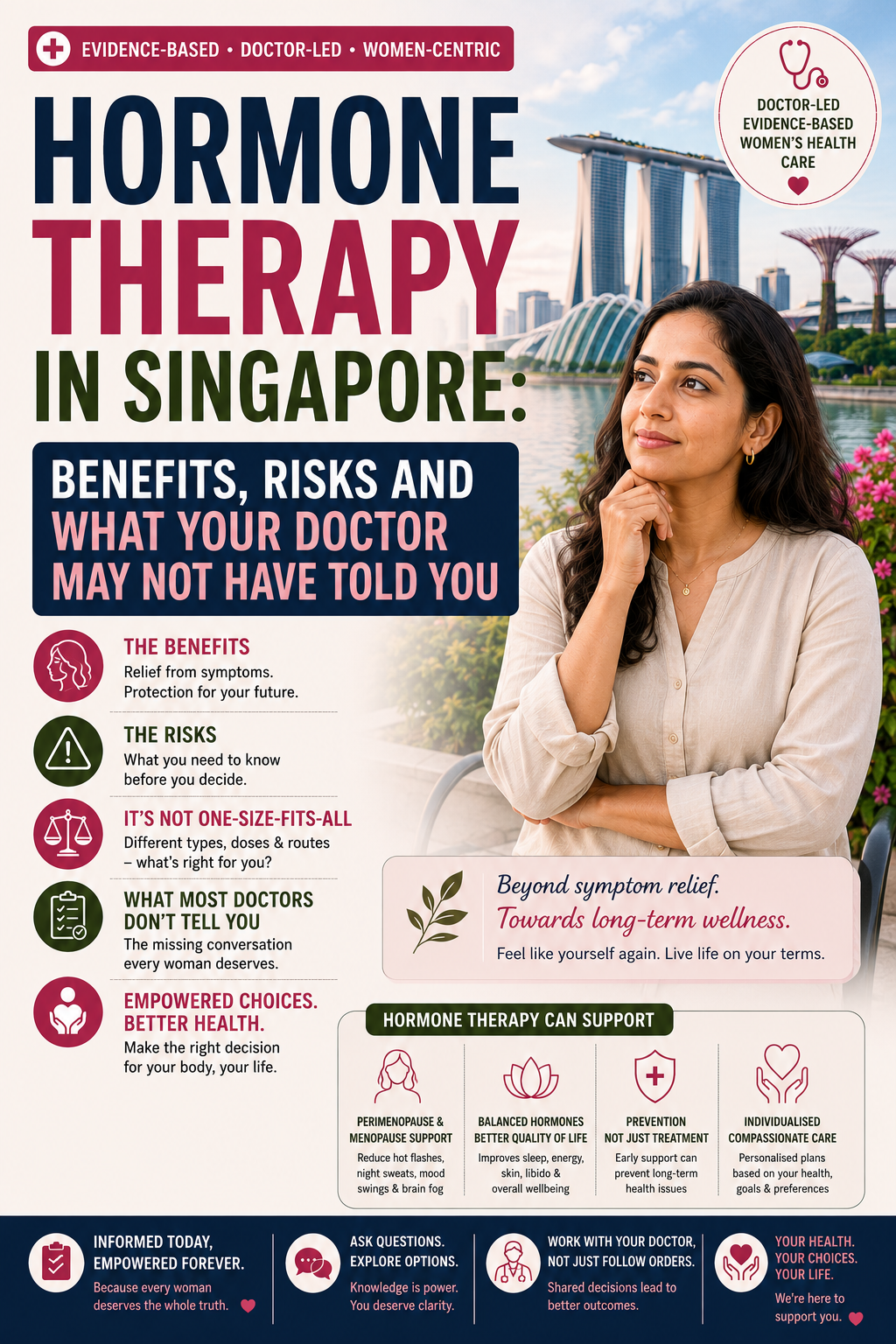
What Is Menopausal Hormone Therapy?
Menopausal hormone therapy (MHT, previously called HRT) refers to the administration of exogenous oestrogen, alone or combined with a progestogen, to compensate for the declining endogenous oestrogen production of the menopausal transition. The primary rationale is symptom management: MHT is the most effective treatment available for vasomotor symptoms (hot flashes, night sweats), genitourinary syndrome of menopause (vaginal dryness, urinary symptoms, reduced libido), and sleep disruption. Beyond symptom relief, emerging evidence documents broader metabolic and cardiovascular benefits when initiated at the right time.
The major formulation distinction:
- Oestrogen-only MHT: For women who have had a hysterectomy, no uterus means no need for progestogen to protect the endometrium
- Combined MHT (oestrogen + progestogen): For women with an intact uterus, the progestogen prevents the oestrogen-driven endometrial hyperplasia and cancer risk
- Local (vaginal) oestrogen: Low-dose topical preparations addressing genitourinary syndrome, vaginal dryness, atrophy, urinary urgency, without significant systemic absorption. Available in cream, pessary, or ring formulations. Has an excellent safety profile and is distinct from systemic MHT in terms of risk considerations.
👉Brain Fog in Perimenopause: The Nutritional Cause and Fix
👉Protein for Menopause: Are You Eating Enough?
The 2002 WHI Study: What It Actually Found and Why It Was Misinterpreted
The WHI trial that alarmed the world had a specific population: women with a mean age of 63, 10 or more years post-menopause, many of whom had pre-existing cardiovascular disease. This is not the population in whom MHT is typically initiated in current practice. The results: increased cardiovascular events, blood clots, and breast cancer risk, were applied to all women on hormone therapy regardless of age or time since menopause, which was a fundamental misapplication of the data.
Subsequent reanalysis of the WHI data and two decades of additional research have established what is now called the “timing hypothesis” or the “window of opportunity”: the benefits and risks of MHT are critically dependent on when it is initiated relative to menopause onset.
Reference: Menopausal Hormone Replacement Therapy and Reduction of All-Cause Mortality and Cardiovascular Disease: It Is About Time and Timing. Cancer J. 2022;28(3):208-223. PubMed PMID 35594469
The Timing Hypothesis: The Most Important Concept in Current MHT Evidence
The 2022 review published in Cancer Journal (PMID 35594469) summarised the timing evidence clearly: initiated in women younger than 60 years and/or within 10 years of menopause onset, MHT significantly reduces all-cause mortality and cardiovascular disease — effects not seen with other primary cardiovascular prevention therapies including statins in this population. This is a remarkable finding that has not adequately entered public consciousness or clinical practice in Singapore.
The North American Menopause Society’s 2022 position statement, the most comprehensive current international guideline, confirmed:
“For women who are younger than 60 years or who are within 10 years of menopause onset and have no contraindications, the benefit-risk ratio is favorable for treatment of bothersome vasomotor symptoms and for those at elevated risk for bone loss or fracture.”
The 2024 NICE (UK) guideline update similarly stated that CHD risk and mortality from CHD do not increase with combined HRT when initiated appropriately, and specifically noted that the 2024 review found no increase in CHD risk with transdermal oestrogen preparations.
References:
- The North American Menopause Society. The 2022 hormone therapy position statement. Menopause. 2022;29:767-794. PubMed PMID 35797481
- Menopausal Hormone Therapy — Risks, Benefits and Emerging Options: A Narrative Review. Int J Mol Sci. 2025. PMC Full Text
- Reconsidering Hormone Replacement Therapy: Current Insights. PubMed. 2025. PubMed PMID 41156026
👉Menopause and Osteoporosis: Prevention Starts Earlier Than You Think
What MHT Does — Current Evidence Summary
Confirmed Benefits
- Vasomotor symptoms: MHT is the most effective treatment available for hot flashes and night sweats, the primary indication. Symptom reduction of 75–90% in clinical trials compared to 25–35% for placebo. No other pharmacological or non-pharmacological intervention approaches this efficacy.
- Genitourinary syndrome of menopause (GSM): Local vaginal oestrogen is the most effective and safest treatment for vaginal atrophy, dryness, dyspareunia (painful intercourse), and urinary urgency. The 2025 narrative review (PMC12652300) confirmed it as first-line treatment for GSM. Indian women in Singapore are particularly affected by GSM; research shows South Asian women are more likely to experience genitourinary symptoms than vasomotor symptoms,f yet this is one of the least discussed and least treated aspects of menopause in the Indian community.
- Bone protection: Oestrogen directly suppresses osteoclast (bone breakdown) activity. MHT prevents the accelerated bone loss of early menopause and reduces fracture risk, particularly relevant for Indian women whose lower baseline bone density makes this protection more urgent.
- All-cause mortality and cardiovascular disease: When initiated within 10 years of menopause in women under 60, MHT significantly reduces all-cause mortality and cardiovascular disease, benefits not achieved by statins or other primary prevention strategies in this group. (PMID 35594469)
- Sleep quality: By reducing night sweats and supporting serotonin/melatonin pathways, MHT improves sleep quality, one of the most quality-of-life-affecting perimenopausal symptoms.
- Mood and cognitive function: Oestrogen is neuroprotective and supports serotonin synthesis. MHT initiated in the perimenopausal window may reduce depression risk and support cognitive function during the transition.
Risks — Contextualised and Clarified
- Breast cancer: This is the most feared risk and requires the most careful contextualisation. The absolute risk increase associated with combined MHT (oestrogen + progestogen) is small; the 2025 narrative review (PMC12652300) noted that risks including breast cancer are “rare (<10 events/10,000 women)” and comparable to other commonly prescribed medications. The specific risk depends heavily on the type of progestogen used: micronised progesterone (bioidentical progesterone) has a significantly better breast cancer risk profile than synthetic progestins. Oestrogen-only MHT (in women who have had hysterectomy) does not increase breast cancer risk at standard doses.
- Venous thromboembolism (blood clots): Oral oestrogen formulations increase VTE risk due to first-pass liver metabolism effects. Transdermal oestrogen (patches, gels, sprays) does not significantly increase VTE risk; this is a critical distinction that makes transdermal the preferred route in women with cardiovascular risk factors. Indian women with higher metabolic syndrome prevalence benefit from transdermal rather than oral formulations.
- Stroke: Oral oestrogen is associated with a modest increased stroke risk in older women; transdermal oestrogen is not. Route of administration matters.
- Endometrial cancer: Oestrogen alone without progestogen increases endometrial cancer risk in women with an intact uterus. This is why combined MHT (oestrogen + progestogen) is used for women who have not had a hysterectomy; the progestogen completely eliminates this risk.
👉Menopause-Friendly Gut & Bone Health Diet and Lifestyle Plan
👉The Ultimate Guide to the Best Diet for Menopause: What to Eat (and to Avoid) to Thrive
The Route Distinction: Oral vs Transdermal — Critical for Indian Women
The 2025 narrative review (PMC12652300) explicitly stated: “Initiation within 10 years of menopause as well as the use of transdermal estradiol at low–moderate doses are favoured when cardiometabolic or thrombotic risk is salient.”
For Indian women, who carry higher baseline cardiovascular and metabolic risk, this means transdermal oestrogen (patches, gels, or sprays) is generally preferred over oral oestrogen tablets. Transdermal delivery bypasses first-pass liver metabolism, avoids the hepatic effects that increase clotting factor production and VTE risk, and may have a more favourable cardiovascular risk profile.
In Singapore, transdermal oestrogen preparations are available on prescription through:
- KKH Women’s Services
- NUH Women’s Centre
- SGH Department of Obstetrics and Gynaecology
- Private gynaecology practices at Raffles Medical, Mount Elizabeth, Thomson Medical, and Gleneagles
The Progestogen Choice: Why It Matters for Breast Cancer Risk
Not all progestogens carry equal breast cancer risk. The evidence clearly differentiates:
- Micronised progesterone (bioidentical progesterone — Utrogestan): The most favourable breast cancer risk profile of all progestogens. Multiple European studies have found no increase in breast cancer risk with oestrogen combined with micronised progesterone, making it the preferred progestogen for women with breast cancer risk concerns. Available in Singapore at private gynaecology clinics.
- Dydrogesterone: Also shows a favourable breast safety profile in French cohort data, better than older synthetic progestins.
- Older synthetic progestins (MPA — medroxyprogesterone acetate): Associated with higher breast cancer risk in the WHI data. Less preferred in contemporary practice.
When discussing MHT with your Singapore gynaecologist, asking specifically about micronised progesterone (Utrogestan) combined with transdermal oestradiol is a clinically informed, evidence-based choice that reflects current best practice rather than the older formulations that generated the 2002 fear.
Hormonal Health · Singapore
On hormone therapy or considering it — nutrition determines how well it works.
MHT addresses the hormonal deficit. Nutrition supports the metabolic, skeletal, and inflammatory environment that determines your outcomes on and off therapy. I work with Indian women in Singapore to build the nutritional complement to their hormonal treatment plan.
👉 Book a FREE 20-Minute Hormonal Health Call
Dr Akanksha Sharma · MBBS MD · Singapore & worldwide via Zoom
Who Should and Should Not Consider MHT
Good Candidates for MHT
- Women under 60 or within 10 years of menopause onset with bothersome vasomotor symptoms (hot flashes, night sweats)
- Women with genitourinary syndrome of menopause (vaginal dryness, dyspareunia, urinary symptoms), local vaginal oestrogen is appropriate regardless of systemic MHT decision
- Women with elevated fracture risk or low bone density at menopause
- Women with premature ovarian insufficiency (POI, menopause before age 40), MHT is strongly recommended until at least the average age of natural menopause to prevent the accelerated cardiovascular and skeletal consequences of early oestrogen loss
- Women with significant quality-of-life impairment from menopausal symptoms that diet and lifestyle have not adequately addressed
Contraindications and Cautions
- Active or recent breast cancer; systemic MHT is contraindicated; local vaginal oestrogen may be considered on specialist advice in some cases
- Active or recent thromboembolic disease (DVT, PE); oral oestrogen contraindicated; transdermal may be considered on specialist evaluation
- Unexplained vaginal bleeding; investigate cause before initiating MHT
- Active liver disease; impairs oestrogen metabolism
- History of endometrial cancer; specialist evaluation required
Nutrition on MHT: What to Optimise Alongside Therapy
MHT is not a substitute for the nutritional strategies documented in our perimenopause and menopause posts, it is a complement to them. Women on MHT should not assume the medication covers all bases. The nutritional priorities remain:
- Adequate protein: MHT helps preserve muscle mass, but the effect is significantly enhanced by adequate dietary protein (1.2–1.5g/kg/day) and resistance training
- Calcium and Vitamin D: MHT protects bone, but adequate calcium and Vitamin D are required for the oestrogen-driven bone preservation to be effective
- Omega-3 fatty acids: Support the cardiovascular, neurological, and anti-inflammatory benefits of MHT
- Phytoestrogens: Safe to continue alongside MHT, they provide mild additional oestrogenic support without clinically significant interaction
- Reduced saturated fat and refined carbohydrates: MHT improves lipid profiles, but the combination of MHT and a poor diet produces worse outcomes than MHT with a supportive diet
👉Menopause Nutrition in Singapore: The Complete Indian Women’s Guide to Eating Well After 50
Frequently Asked Questions
My Singapore gynaecologist offered me MHT, but I am scared of breast cancer. What should I do?
The fear is understandable, but the current evidence indicates the absolute risk increase from MHT is small and formulation-dependent. Ask your gynaecologist specifically about transdermal oestradiol combined with micronised progesterone (Utrogestan); this combination has the most favourable breast cancer risk profile in the current evidence. Ask about your individual risk factors (personal and family history of breast cancer, genetic status, BRCA testing if relevant) as the context for your individual risk-benefit calculation. The decision should be made with your gynaecologist based on your specific situation, not based on 2002 data that has been substantially refined.
I am 48 and have been having hot flashes for two years. My GP said I should “just wait it out.” Is this the right advice?
Not necessarily, and this perspective does not reflect current evidence-based guidelines. The 2022 NAMS position statement and 2024 NICE guidelines both clearly state that MHT is appropriate and beneficial for women with bothersome symptoms who are under 60 and/or within 10 years of menopause, without contraindications. Suffering through severe symptoms for years when an effective treatment exists, and when that treatment has documented additional health benefits at this life stage, is not a required or optimal outcome. Seek a second opinion from a menopause specialist at KKH’s Women’s Services or a private gynaecology practice if your GP is not engaging with the current evidence.
My mother took HRT and got breast cancer. Should I avoid it completely?
A first-degree relative with breast cancer increases your personal breast cancer risk; this is relevant context for your MHT discussion, but it does not automatically contraindicate MHT. The specific nature of your mother’s breast cancer (hormone receptor positive or negative), your own risk factors, whether you have BRCA testing, your age and proximity to menopause, and the severity of your symptoms all factor into an individual risk-benefit analysis. This conversation belongs with a gynaecologist or menopause specialist in Singapore who can assess your complete picture, not with a generalised rule based on family history alone.
Can I take MHT if I have had a blood clot in the past?
Oral oestrogen is contraindicated with a history of VTE. However, transdermal oestrogen, delivered through patches, gels, or sprays, does not significantly increase VTE risk because it bypasses hepatic first-pass metabolism. For women with prior VTE who have bothersome menopausal symptoms, transdermal oestrogen with haematology input may be a safe option. This decision requires specialist evaluation; do not self-prescribe, but equally do not assume past VTE means lifetime denial of symptom treatment.
Where in Singapore can I get a thorough menopause assessment?
Dedicated menopause services are available at: KKH Women’s Services (referral through polyclinic or direct private booking); NUH Women’s Centre; SGH Obstetrics and Gynaecology; private women’s health specialists at Raffles Medical Group, Mount Elizabeth Medical Centre, Thomson Medical, Gleneagles, and PKWY Health. For a holistic assessment including metabolic risk factors, hormonal testing, and individualised MHT evaluation, a private menopause specialist consultation is typically more comprehensive than a polyclinic appointment.
The Bottom Line
The evidence on menopausal hormone therapy in 2025 is meaningfully different from the evidence that shaped the 2002 fear. When initiated within 10 years of menopause in women under 60, MHT significantly reduces all-cause mortality, cardiovascular disease, and fracture risk, alongside being the most effective treatment for vasomotor and genitourinary symptoms. Risks are formulation-dependent, route-dependent, timing-dependent, and small in absolute terms. For Indian women in Singapore, who reach menopause earlier, carry higher baseline metabolic and bone risk, and have a longer post-menopausal lifespan, the case for an informed, evidence-based conversation with a Singapore gynaecologist about MHT is strong. The decision should be individualised and medically supervised. The conversation should start now.
Hormonal & Metabolic Health · Singapore
Whether You Choose MHT or Not — Nutrition Determines Your Outcome.
I work with Indian women in Singapore navigating the menopause decision — building the nutritional strategy that supports hormonal therapy when it is chosen, and that serves as the primary metabolic intervention when it is not.
Let’s talk about your hormonal health — 20 minutes, your symptoms, your options, a clear next step. 👉 Book a FREE 20-Minute Hormonal Health Call Dr Akanksha Sharma · MBBS MD · Preventive Medicine Physician · Singapore & worldwide via Zoom |
Disclaimer: This article is for educational purposes only. The decision to initiate, continue, or discontinue menopausal hormone therapy requires individual medical assessment by a qualified gynaecologist or menopause specialist in Singapore.
References:
- Menopausal Hormone Replacement Therapy and Reduction of All-Cause Mortality and CVD. Cancer J. 2022;28(3):208-223. PubMed PMID 35594469
- The North American Menopause Society 2022 Hormone Therapy Position Statement. Menopause. 2022;29:767-794. PubMed PMID 35797481
- Menopausal Hormone Therapy — Risks, Benefits and Emerging Options. Int J Mol Sci. 2025. PMC Full Text
- Reconsidering Hormone Replacement Therapy: Current Insights on Utilisation. PubMed. 2025. PubMed PMID 41156026
- Davis SR et al. The 2023 practitioner’s toolkit for managing menopause. Climacteric. 2023;26:517-536. PubMed PMID 37718006

Akanksha Sharma
Dr Akanksha Sharma (MBBS, MD) is a physician and women’s health nutrition specialist, and the founder of IYSA Nutrition. She provides evidence-based, doctor-led nutrition guidance for pregnancy, postpartum recovery, PCOS, child nutrition, and family health, helping women make calm, informed decisions about their health and their children’s well-being.



3 responses to “Hormone Therapy in Singapore: Benefits, Risks and What Your Doctor May Not Have Told You”
[…] 👉Hormone Therapy in Singapore: Benefits, Risks and What Your Doctor May Not Have Told You […]
[…] 👉Hormone Therapy in Singapore: Benefits, Risks and What Your Doctor May Not Have Told You […]
[…] 👉Hormone Therapy in Singapore: Benefits, Risks and What Your Doctor May Not Have Told You […]