👉Cervical Cancer Screening in Singapore: What Every Indian Woman Should Know
What Is an Ovarian Cyst?
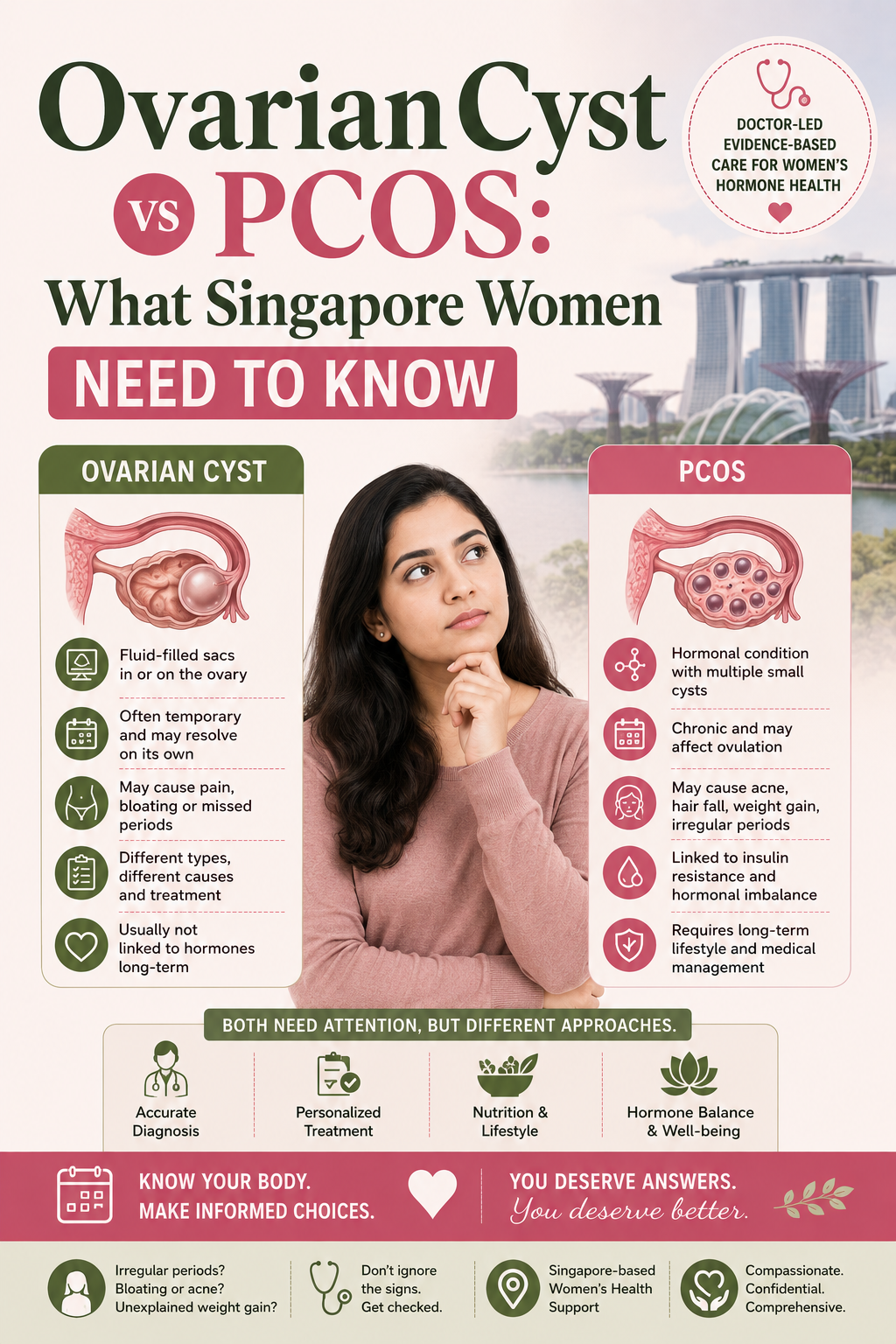
An ovarian cyst is a fluid-filled sac that develops on or within an ovary. Ovarian cysts are extremely common; most women will develop at least one ovarian cyst during their reproductive years, and the vast majority are benign, cause no symptoms, and resolve spontaneously within one to three menstrual cycles without any treatment.
Types of Ovarian Cysts
- Functional cysts: The most common type. They develop as a normal part of the menstrual cycle; follicular cysts form when a follicle does not release its egg as expected, and corpus luteum cysts form when the follicle sac does not dissolve after ovulation. Both are physiological, self-resolving, and not pathological.
- Dermoid cysts (teratomas): Benign cysts containing tissue such as skin, hair, or teeth. Typically slow-growing and found incidentally on ultrasound. May require surgical removal if large or symptomatic.
- Endometriomas: Cysts formed by endometriosis, where endometrial tissue grows on or within the ovary. Associated with pelvic pain and may affect fertility.
- Cystadenomas: Cysts arising from the surface of the ovary, typically benign but may grow large enough to cause symptoms.
The key clinical point: most ovarian cysts do not cause significant symptoms, are discovered incidentally on ultrasound, and resolve without intervention. Ovulation typically continues normally. Fertility is generally not affected by functional ovarian cysts.
👉Endometriosis and Nutrition — endometriomas are distinct from functional cysts
What Is PCOS?
Polycystic Ovary Syndrome (PCOS) is a systemic endocrine and metabolic disorder, not simply an ovarian condition. It is one of the most common endocrine disorders in women of reproductive age, affecting approximately 10–13% of women globally, with prevalence among Indian women estimated at around 22.5% in some studies.
The “polycystic” in the name is misleading; it refers to the appearance of multiple small follicles on ovarian ultrasound, which look like multiple small cysts but are actually undeveloped follicles arrested in development due to hormonal disruption. They are not true cysts in the sense of fluid-filled sacs, and their presence on an ultrasound is one of three possible diagnostic criteria, not a mandatory finding for diagnosis.
👉PCOS and Hormonal Acne in Singapore Women: The Diet Strategy That Addresses the Root Cause
The Rotterdam Criteria: How PCOS Is Diagnosed in Singapore
KKH, NUH, and gynaecologists across Singapore use the Rotterdam Criteria, the internationally agreed diagnostic standard, to diagnose PCOS. This requires the presence of at least two of the following three features:
- Oligomenorrhea or anovulation: Irregular periods (cycles longer than 35 days, or fewer than 8 cycles per year) or evidence of failure to ovulate regularly
- Clinical or biochemical signs of hyperandrogenism: Clinically, acne, hirsutism (excess facial or body hair in a male distribution), scalp hair thinning. Biochemically, elevated free testosterone, elevated DHEA-S, or low SHBG on blood testing
- Polycystic ovarian morphology on ultrasound: 20 or more follicles per ovary (updated 2018 threshold with modern ultrasound technology), or increased ovarian volume (>10 mL)
Critically: a diagnosis of PCOS can be made without the ultrasound finding if the other two criteria are present. Conversely, polycystic-appearing ovaries on ultrasound alone, without irregular periods or signs of androgen excess, do not constitute a PCOS diagnosis, this ultrasound appearance occurs in approximately 25% of women with entirely normal hormones and cycles.
Reference: Neubronner SA et al. Effect of BMI on phenotypic features of PCOS in Singapore women: a prospective cross-sectional study. BMC Women’s Health. 2021. PMC Full Text
The Key Differences — Side by Side
| Feature | Ovarian Cyst | PCOS |
|---|---|---|
| Nature | Localised fluid-filled sac in or on the ovary | Systemic endocrine and metabolic disorder |
| Cause | Usually part of the menstrual cycle (functional); can be structural | Insulin resistance, hormonal dysregulation, genetic predisposition |
| Ovulation | Usually unaffected; most women with cysts ovulate normally | Often disrupted, irregular or absent ovulation |
| Periods | Usually regular | Typically irregular, infrequent, or absent |
| Hormones | Usually normal | Elevated androgens, disrupted LH/FSH ratio, often insulin resistant |
| Fertility | Generally not affected by functional cysts | May be affected; anovulation is a common fertility challenge |
| Resolution | Most functional cysts resolve within 1–3 cycles | Lifelong condition requiring ongoing management |
| Treatment | Usually watchful waiting; surgery if large or symptomatic | Lifestyle, dietary, and medical management of the hormonal and metabolic drivers |
| Long-term risk | Generally low, watchful waiting with repeat ultrasound | Higher risk of T2DM, cardiovascular disease, endometrial cancer if unmanaged |
What to Do If Your Singapore Ultrasound Showed “Cysts” or “Polycystic Morphology”
If You Have Regular Periods and No Androgen Symptoms
Polycystic-appearing ovaries on ultrasound with regular periods and no acne, hirsutism, or hair thinning is almost certainly not PCOS, it is a common normal variant. Your gynaecologist will typically arrange a repeat scan in 6–12 weeks to confirm resolution, or simply reassure you if the morphology is incidental. No dietary change or medical management is required beyond watchful follow-up. Approximately 25% of all women have this ultrasound appearance without any syndrome or disorder.
If You Have Irregular Periods and/or Signs of Androgen Excess
This warrants a full hormonal workup: free testosterone, SHBG, DHEA-S, LH, FSH, prolactin (to exclude hyperprolactinaemia, which causes similar symptoms), TSH and fasting insulin (to exclude thyroid dysfunction and assess insulin resistance). A fasting glucose and lipid profile complete the metabolic picture. This assessment is available at polyclinics, KKH, NUH, and private women’s health clinics across Singapore. The workup can usually be initiated by your GP at the polyclinic before specialist referral.
If You Have a Single Large Cyst
A single cyst above approximately 5–6 cm, a cyst that does not resolve over 6–8 weeks, or a cyst with concerning features on ultrasound (solid components, internal vascularity) warrants gynaecologist review. This is not PCOS; it is a structural ovarian cyst that may require assessment for endometrioma, dermoid, or other pathology. CA-125 blood testing may be requested to assess ovarian cancer markers in appropriate cases.
👉PCOS Diet: What PCOS/ PMOS Women on Medication Must Eat
Nutrition: What Each Condition Means for Your Diet
For Ovarian Cysts (Functional)
There is no specific diet for functional ovarian cysts, as benign, self-resolving physiological events, they do not require dietary intervention. Maintaining a generally healthy diet for hormonal health (adequate fibre, healthy fats, adequate protein, minimal ultra-processed food) is sensible but not specifically therapeutic for the cyst itself.
For PCOS
PCOS has a substantial, well-evidenced dietary management framework, covered in depth in our dedicated PCOS posts. The core priorities:
- Reducing insulin resistance through low-glycaemic carbohydrates, protein at every meal, and meal sequencing (dal before rice)
- Myo-inositol supplementation (2,000–4,000mg daily); the most evidence-supported PCOS-specific supplement for insulin signalling and androgen reduction (Inositol and PCOS: A Natural Approach to Hormonal Balance)
- Zinc for 5-alpha-reductase inhibition and sebum regulation
- Spearmint tea for anti-androgenic effect
- Omega-3 for anti-inflammatory and androgen-modulating effects
- Correction of iron deficiency (common in PCOS due to irregular, sometimes heavy periods)
👉The Insulin Resistance Trap in PCOS: How to Break Free Naturally
👉 PCOS Diet Myths – What Actually Works (Doctor Explains)
PCOS Nutrition · Singapore
Just diagnosed with PCOS in Singapore? Let’s build your personalised plan.
I work with Indian women in Singapore to build evidence-based PCOS nutrition plans, addressing insulin resistance, androgen excess, fertility, and metabolic health through the Indian food patterns you already cook with.
Explore my programmes:
 PCOS Balance: A 12-Week Physician-Led Hormone & Fertility Restoration
 Weight Wise: A 12-Week Physician-Led Weight Loss & Body Recomposition Program
👉 Book a FREE 20-Minute PCOS Discovery Call
Dr Akanksha Sharma · MBBS MD · Singapore & worldwide via Zoom
Frequently Asked Questions
My doctor in Singapore said I have “polycystic ovaries” but not “PCOS.” What is the difference?
This is precisely the distinction this post covers. “Polycystic ovaries” (PCO) refers to the ultrasound appearance, multiple small follicles visible on scan. “Polycystic ovary syndrome” (PCOS) is the clinical diagnosis requiring at least two of three Rotterdam criteria (irregular periods, signs of androgen excess, and/or the ultrasound morphology). Having PCO on ultrasound with regular periods and no hormonal symptoms is a normal variant, not a diagnosis requiring management.
Can PCOS be cured?
PCOS is currently considered a lifelong condition without a cure, but its symptoms and metabolic consequences are highly responsive to dietary and lifestyle management. Many women achieve complete symptom resolution (regular periods, clearing acne, improved fertility) through sustained dietary changes, maintaining a healthy weight, and targeted supplementation. The underlying hormonal predisposition remains, and symptoms typically return if dietary habits revert — which is why management is framed as a lifestyle approach rather than a temporary treatment.
I have PCOS and want to conceive. What should I do in Singapore?
Start with a gynaecologist at KKH, NUH, or a fertility specialist for assessment of ovulatory function and full hormonal workup. Simultaneously, begin the dietary interventions above — myo-inositol specifically has RCT evidence for improving ovulation rates and egg quality in PCOS. See our Day 9 post (Omega-3 for Vegetarian Pregnant Women) and our dedicated Bloom fertility programme for the complete preconception nutrition strategy. Fertility outcomes in PCOS are significantly improved by addressing insulin resistance before attempting conception.
Can ovarian cysts affect fertility?
Most functional ovarian cysts do not affect fertility — they resolve within one to three cycles and ovulation continues normally. Endometriomas (ovarian cysts from endometriosis) can affect ovarian reserve and fertility and warrant specialist assessment if conception is planned. Large dermoid cysts or other structural cysts requiring surgery may also temporarily affect ovarian function. For most women with incidental functional cysts discovered on routine scan, fertility is not compromised.
The Bottom Line
Polycystic-appearing ovaries on ultrasound and PCOS are not the same thing, and this distinction matters enormously for both anxiety management and appropriate medical response. An ultrasound showing multiple follicles is a common, normal finding in approximately one in four women and does not require treatment. PCOS is a systemic hormonal and metabolic diagnosis requiring at least two of three Rotterdam criteria and warranting active management. If your Singapore scan showed “cysts” and you have regular periods and no signs of androgen excess, speak with your gynaecologist for reassurance rather than alarm. If irregular periods or hormonal symptoms accompany the scan findings, a full workup is the appropriate next step, available through KKH, NUH, or your polyclinic.
PCOS Management · Singapore
Understanding Your Diagnosis Is the First Step.
Acting on It Is the Second.
Whether you have just been diagnosed with PCOS or have been managing it for years without the right nutritional support, I am here to help you build a plan that addresses the root cause, not just the symptoms.
Not sure which programme fits your situation? Start with a free 20-minute call. 👉 Book a FREE 20-Minute Discovery Call Dr Akanksha Sharma · MBBS MD · Preventive Medicine Physician · Singapore & worldwide via Zoom |
Disclaimer: This article is for educational purposes only. Any concerns about ovarian cysts or PCOS should be discussed with your gynaecologist at KKH, NUH, or a qualified women’s health physician in Singapore.
References:
- Neubronner SA et al. Effect of BMI on phenotypic features of PCOS in Singapore women. BMC Women’s Health. 2021. PMC Full Text
- PKWomensClinic Singapore. Difference Between PCO and PCOS: Key Distinctions Explained. 2025. Full Text
- Pharmacological and Non-Pharmacological Interventions for PCOS in Indian Women: Systematic Review. Pharmaceuticals. 2024. doi:10.3390/ph18050680

Akanksha Sharma
Dr Akanksha Sharma (MBBS, MD) is a physician and women’s health nutrition specialist, and the founder of IYSA Nutrition. She provides evidence-based, doctor-led nutrition guidance for pregnancy, postpartum recovery, PCOS, child nutrition, and family health, helping women make calm, informed decisions about their health and their children’s well-being.