👉Brain Fog in Perimenopause: The Nutritional Cause and Fix
👉Fitness After 40: Why It Feels Different (And What To Do)
Why Indian Women Are at Higher Risk
Lower Peak Bone Mass
Peak bone mass, the maximum bone density achieved in early adulthood, typically around age 25–30, is the single most important determinant of osteoporosis risk later in life. Indian and South Asian women have consistently lower peak bone mass than age-matched European women in population studies. A lower peak means the inevitable age-related bone loss of adulthood begins from a lower baseline, reaching the osteoporosis threshold earlier and at a younger age than Western comparators.
The ISBMR (Indian Society for Bone and Mineral Research) position statement specifically acknowledges that Indian-specific bone mineral density reference ranges are needed because using Western reference data may underestimate or overestimate osteoporosis prevalence in Indian populations.
Endemic Vitamin D Deficiency
Vitamin D deficiency is near-universal in Indian women in Singapore and common in urban India despite year-round sunshine. Vitamin D is essential for calcium absorption in the gut; without adequate Vitamin D, even a calcium-rich diet cannot be effectively utilised for bone mineralisation. Chronic Vitamin D deficiency causes secondary hyperparathyroidism; the parathyroid glands increase PTH production to maintain serum calcium by drawing it from bone, accelerating bone mineral loss.
👉Vitamin D Deficiency in Singapore: Why You’re Still Low Despite the Sun
Inadequate Dietary Calcium
Studies consistently document that dietary calcium intake in Indian women falls well below ICMR-NIN recommendations. A study examining calcium intake in Indian adults found median calcium intake to be significantly below the 600–800 mg daily recommendation, with vegetarian women from low dairy intake households most at risk. Inadequate calcium intake across the life course directly limits the bone density that can be built and maintained.
Early Menopause and Accelerated Bone Loss
Indian women tend to reach menopause approximately 2–4 years earlier than Western women (median age approximately 47 years in India versus 51 years in Western populations). Oestrogen is a critical bone protector; it suppresses osteoclast (bone breakdown) activity. The menopause-related acceleration of bone loss therefore begins earlier in Indian women and extends across a longer post-oestrogen lifespan, cumulatively resulting in greater total bone loss.
👉Hot Flashes and Menopause — oestrogen decline accelerates bone loss; address both simultaneously
Physical Inactivity
Bone is a mechanosensitive tissue; it responds to mechanical loading by increasing density. Weight-bearing exercise and resistance training are the most potent non-pharmacological stimuli for bone formation. Urban Indian women have among the lowest structured physical activity rates in Asia, and the domestic work that does constitute activity is predominantly non-weight-bearing.
👉Menopause Care in Singapore: A Doctor Explains Your Treatment & Support Options
The Four Nutritional Pillars of Bone Health
Pillar 1: Calcium — The Structural Foundation
Calcium is the primary mineral component of bone hydroxyapatite, the mineral crystal that gives bone its hardness and strength. Approximately 99% of the body’s calcium is stored in bone. When dietary calcium is insufficient, the body withdraws calcium from bone to maintain serum calcium levels (critical for cardiac and neural function), a process that, sustained chronically, directly reduces bone density.
ICMR-NIN 2020 recommendations: 600 mg per day for adults, 800 mg per day for postmenopausal women and older adults. A systematic review of calcium and Vitamin D for premenopausal women confirmed that calcium supplementation improved bone mineral density, though the magnitude of effect was modest in those with already-adequate dietary intake, reinforcing that food-first calcium strategies are the appropriate foundation.
Best Indian calcium food sources:
| Food | Calcium (mg per serving) | Notes |
|---|---|---|
| Ragi flour (100g dry) | 344 mg | Best non-dairy Indian calcium source; use in roti, porridge, laddoo |
| Sesame seeds/til (30g) | ~290 mg | Til laddoo, til chutney, tahini; highly bioavailable |
| Plain dahi (200g) | ~300 mg | Probiotic plus calcium; daily staple |
| Milk (250ml) | ~300 mg | Calcium-dense; fortified milk adds Vitamin D |
| Moringa/drumstick leaves (100g fresh) | ~440 mg | Extraordinarily calcium-rich; moringa sabzi, moringa powder |
| Paneer (100g) | ~208 mg | Versatile; high calcium plus protein |
| Urad dal (100g cooked) | ~138 mg | Highest-calcium dal; idli, dosa, dal makhani |
| Almonds (30g) | ~75 mg | Daily snack; calcium plus Vitamin E |
| Palak/spinach (100g cooked) | ~136 mg | Note: oxalates reduce calcium bioavailability; cooking improves it |
👉Lactose Intolerance in Indians — how to get calcium when dairy is limited
👉Calcium for Children: Beyond Milk — the Indian food sources that build bone density from childhood
Pillar 2: Vitamin D — The Calcium Enabler
Vitamin D enables calcium absorption in the small intestine through Vitamin D receptor-mediated upregulation of calcium transport proteins. Without adequate Vitamin D (above 75 nmol/L), intestinal calcium absorption falls to 10–15%, compared to 30–40% with sufficient Vitamin D, meaning that calcium consumed without adequate Vitamin D is largely wasted. Every calcium strategy must be paired with Vitamin D correction.
A systematic review and meta-analysis of 37 RCTs with 43,397 patients confirmed that Vitamin D and calcium supplementation together significantly support bone mineral density in women undergoing osteoporosis management.
Test serum 25-OH Vitamin D. Correct to above 75 nmol/L. Maintain with 1000–2000 IU D3 daily. See Day 21 for the complete Singapore-specific guide.
Pillar 3: Vitamin K2 — Directing Calcium to Bone
Vitamin K2 (menaquinone, particularly MK-7 form) is an increasingly recognised bone health nutrient that addresses a specific problem: ensuring that absorbed calcium is directed to bone rather than to arterial walls and soft tissues. Vitamin K2 activates two key Vitamin K-dependent proteins, osteocalcin (which incorporates calcium into bone matrix) and matrix Gla-protein (which inhibits calcium deposition in arteries). Inadequate K2 leaves these proteins underactivated (carboxylated), reducing the efficiency of calcium utilisation for bone despite adequate intake.
A systematic review and meta-analysis of 16 RCTs involving 6,425 subjects published in Frontiers in Public Health (2022) found that Vitamin K2 supplementation produced significant improvement in lumbar spine bone mineral density (p=0.006) in postmenopausal women, and a review in Nutrients (2024) confirmed that Vitamin K2 supplementation is safe and beneficial in the preventive treatment of osteoporosis for postmenopausal women.
Best Indian K2 food sources:
- Ghee from grass-fed cows — contains MK-4 form of K2; a daily teaspoon is a culturally natural K2 source
- Hard cheeses including paneer — moderate K2 content
- Egg yolks — small but daily contributor
- Natto (fermented soybean) — the richest food source of K2 (MK-7), but not commonly available in India; available at Japanese grocery stores in Singapore
- Supplemental MK-7 (100–200 µg daily) — the most practical option for most Indian women who do not eat natto regularly
Pillar 4: Magnesium — The Forgotten Bone Mineral
Approximately 60% of the body’s magnesium is stored in bone, where it contributes to hydroxyapatite crystal structure and influences parathyroid hormone activity. Magnesium deficiency impairs Vitamin D activation (magnesium is a cofactor for Vitamin D hydroxylation enzymes) and is associated with lower bone mineral density in multiple population studies. Modern Indian diets, refined grains replacing whole grains, packaged snacks replacing nuts and seeds, are frequently magnesium-insufficient.
Best Indian magnesium sources: bajra roti (137mg per 100g flour), pumpkin seeds (150mg per 30g), almonds (80mg per 30g), dark leafy greens, and dark chocolate (64mg per 30g). Target 320mg daily from food; magnesium glycinate supplementation (200–300mg at night) is appropriate if dietary intake is consistently low.
Exercise: The Non-Negotiable Bone Stimulus
Nutrition alone cannot build strong bones without mechanical loading. Bone responds to physical forces by increasing density, a principle called Wolff’s Law. The most bone-stimulating exercise types are:
- Resistance training (weights, resistance bands, bodyweight): The most effective intervention for increasing bone density in both premenopausal and postmenopausal women. Even two sessions per week of progressive resistance training produces measurable bone density improvements. Squats, lunges, deadlifts, rows, and push-ups all apply beneficial loading to the spine, hip, and wrist, the three most common osteoporotic fracture sites.
- Weight-bearing impact exercise: Walking, jogging, jumping, dancing, and stair climbing create the ground-reaction forces that stimulate bone remodelling. 30 minutes of brisk walking daily is the minimum recommendation; jumping exercises (jumping jacks, jump rope) add beneficial high-impact loading that walking alone does not provide.
- Yoga and Pilates: Improve balance, coordination, and the proprioception that prevents falls, the proximate cause of most osteoporotic fractures. These are complementary to, not substitutes for, weight-bearing and resistance exercise for bone density purposes.
👉Strength Training: Your Secret to a Healthier, Longer Life
👉Understanding the Body’s Mechanism to Maintain Weight
👩⚕️ Need Personalised Bone Health Support?
I work with Indian women to build a complete bone health strategy, nutrition, supplementation, and lifestyle, personalised for your life stage and risk factors.
Explore my programmes:
 Flourish: The 12-Week Doctor-Designed Peri-Menopause Reset
 Menopause Metabolic Reset (50+): 12-Week Nutrition & Lifestyle Program
When to Get a DEXA Scan
DEXA (dual-energy X-ray absorptiometry) scanning is the gold standard for measuring bone mineral density. In India and Singapore, guidelines recommend DEXA screening for:
- All women aged 65 and above
- Postmenopausal women under 65 with risk factors, including early menopause (before 45), family history of osteoporosis or hip fracture, low body weight, prolonged steroid use, malabsorption conditions (celiac disease, IBD), smoking, or long-term alcohol use
- Women with a fragility fracture at any age
- Women with confirmed Vitamin D deficiency, secondary hyperparathyroidism, or conditions associated with bone loss
In Singapore, DEXA scanning is available at public hospitals (SGH, KKH, TTSH, NUH) and private diagnostic centres. Cost is approximately SGD 150–300 at private centres; may be subsidised at public hospitals under specialist referral. In India, DEXA is available at most major city hospitals and private diagnostic chains at approximately INR 2,000–5,000.
Frequently Asked Questions
I am 38 and feel healthy. Is bone health already a concern for me?
Yes, and this is the most important message of this post. Peak bone mass is reached around age 25–30, and bone density begins slowly declining from the early 30s. By 38, you are already in the phase of gradual bone loss; the question is how much you are preserving through adequate calcium, Vitamin D, Vitamin K2, and weight-bearing exercise. The interventions that most effectively prevent osteoporosis are those started in the 30s and 40s, not the 60s when fractures are already occurring. Starting now is not too early, waiting is.
Is calcium supplementation safe? I have heard it causes heart disease.
This concern stems from a widely discussed 2010 meta-analysis that found an association between calcium supplementation (without co-supplementation with Vitamin D) and increased cardiovascular risk. Subsequent research has provided more nuance: the association appears to be specifically with high-dose calcium supplements taken in the absence of adequate Vitamin K2, which directs calcium away from arteries toward bone. The current evidence supports calcium supplementation at appropriate doses (no more than 500mg per single dose, with food, not exceeding 1,000mg supplemental calcium daily) alongside Vitamin D and K2 as a safe and effective bone health strategy. Food-based calcium does not carry the same concerns as high-dose supplements.
My mother has osteoporosis. Is it inevitable for me?
Family history increases your risk significantly; genetics account for approximately 50–80% of variance in peak bone mass. However, the non-genetic 20–50% — determined by diet, physical activity, and lifestyle- is substantial and highly modifiable. Children and grandchildren of women with osteoporosis have the strongest possible motivation to prioritise bone-building nutrition and exercise from early adulthood. Genetic predisposition means earlier and more proactive bone health investment, not inevitable fracture.
Does dairy need to be the main calcium source?
No, though dairy is the most calcium-dense single food group and the most accessible for many Indian women. Ragi, sesame, moringa, and urad dal provide meaningful non-dairy calcium. For women who are lactose intolerant, most can continue dahi and paneer (both low-lactose dairy forms). For those who genuinely cannot tolerate any dairy, a calcium supplement (calcium citrate rather than calcium carbonate for better absorption without food) alongside the non-dairy food sources listed above is appropriate under medical guidance.
The Bottom Line
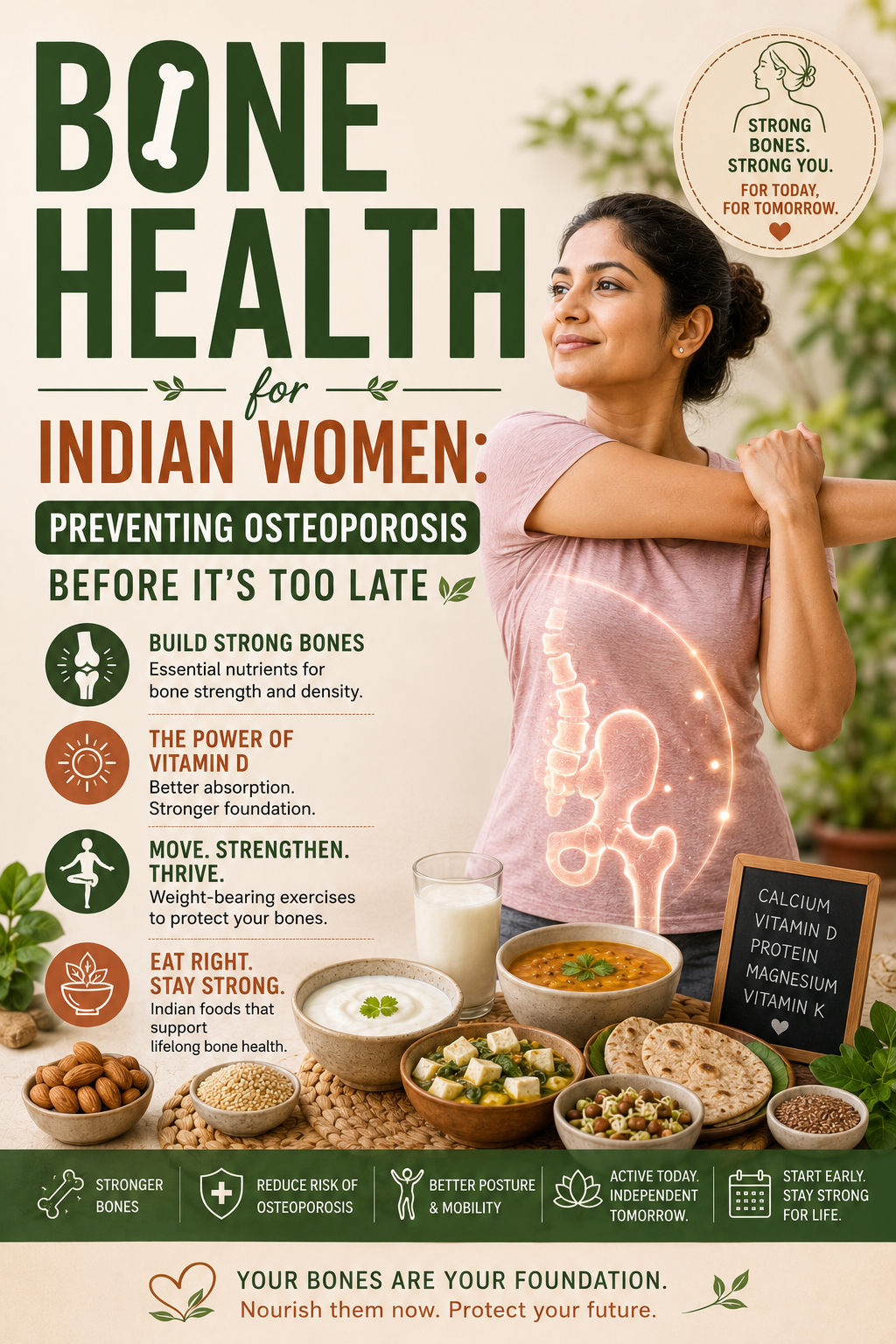
Osteoporosis is not an old person’s disease; it is a lifetime of inadequate bone investment expressing itself in old age. The prevention window for Indian women is wide, the interventions are clear, and the Indian dietary tradition offers some of the most bone-supportive foods available, ragi, til, moringa, dahi, urad dal, and almonds. Pair these with Vitamin D correction, Vitamin K2 (from ghee and, where needed, supplemental MK-7), adequate magnesium, and progressive weight-bearing exercise, and you have a comprehensive bone health strategy that requires no exotic interventions, only the deliberate application of what Indian food culture has always offered.
👩⚕️ You Don’t Have to Figure This Out Alone
As a Preventive Medicine physician, I work with Indian women across all life stages to build bone health from the inside out, through personalised nutrition, targeted supplementation, and lifestyle guidance.
🌿 Explore My Programmes:
Flourish: The 12-Week Doctor-Designed Peri-Menopause Reset
Includes bone health assessment and nutritional optimisation, because body composition, muscle mass, and bone density are deeply interconnected and need to be addressed together.
Menopause Metabolic Reset (50+): 12-Week Nutrition & Lifestyle Program
Addresses the significant calcium, Vitamin D, and bone density demands of menopause, along with supporting long-term hormonal and metabolic health.
🌸 Not sure where to start? Begin with a complimentary 20-minute support call.
Serving clients in Singapore, India, and worldwide via Zoom.
Disclaimer: This article is for educational purposes only. If you have concerns about bone density or fracture risk, please seek medical assessment including DEXA scanning through a qualified physician.
References:
- Bhadada SK et al. ISBMR position statement for the diagnosis and treatment of osteoporosis in adults. Arch Osteoporos. 2021;16(1):102. PubMed PMID 34244885
- Calcium and vitamin D for increasing bone mineral density in premenopausal women. Cochrane Database Syst Rev. 2023. PMC Full Text
- Efficacy of vitamin K2 in prevention and treatment of postmenopausal osteoporosis: systematic review and meta-analysis of RCTs. Front Public Health. 2022. PMC Full Text
- The importance of Vitamin K and combination of Vitamins K and D for calcium metabolism and bone health. Nutrients. 2024. Full Text
- ICMR-NIN Expert Group. Recommended Dietary Allowances for Indians. 2020. nin.res.in

Akanksha Sharma
Dr Akanksha Sharma (MBBS, MD) is a physician and women’s health nutrition specialist, and the founder of IYSA Nutrition. She provides evidence-based, doctor-led nutrition guidance for pregnancy, postpartum recovery, PCOS, child nutrition, and family health, helping women make calm, informed decisions about their health and their children’s well-being.