Written & reviewed by Dr Akanksha Sharma, MBBS, MD (Preventive & Community Medicine) | Founder, IYSA Nutrition, Singapore
If you are a parent, you are probably already aware that too much sugar is not good for your child. But awareness and reality are two very different things, because sugar is hiding in the foods most Indian children eat every day, in quantities that would alarm most parents if they knew.
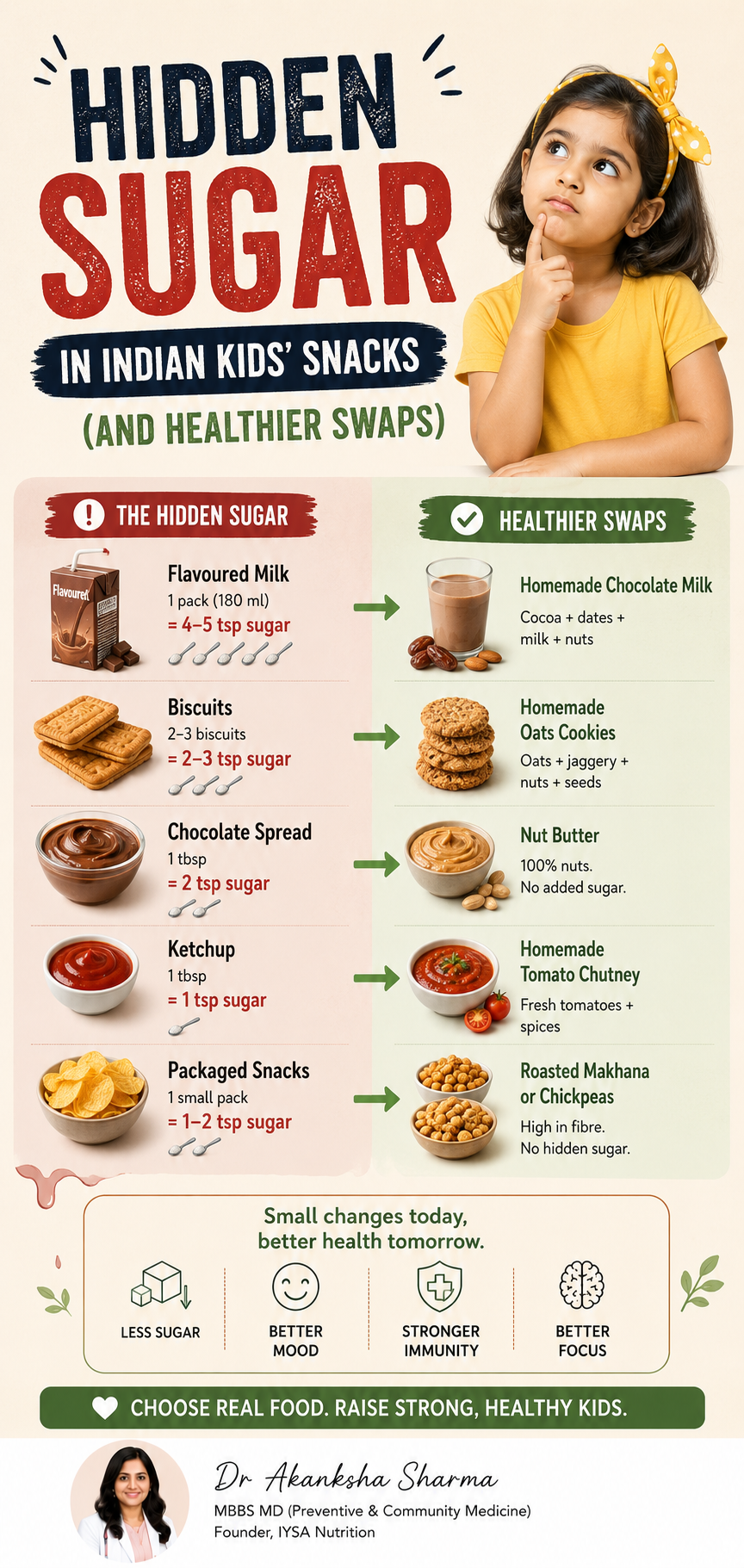
The familiar tin of Bournvita that has been a fixture in Indian kitchens for generations? Approximately 42g of sugar per 100g, meaning nearly half of it by weight is sugar. The “digestive” biscuits in your child’s lunchbox? Up to 20g of sugar per 100g. The packaged fruit juice they drink after school? As much sugar as a cola, without the fizz that at least signals “this is a treat.” The flavoured yoghurt marketed specifically at children with cartoon branding? Up to 15g of added sugar per small cup.
These are not fringe products. They are the most trusted, most purchased, most heavily advertised children’s food products in India and Singapore, and they are delivering far more sugar than most parents realise, in the guise of health, nutrition, and nourishment.
This post is about transparency, not alarmism. I want to show you exactly where the sugar is, explain why it matters for your child’s health, and then give you practical, achievable, child-tested alternatives that fit Indian family life.
📌Picky Eating Solutions: A Doctor-Backed Nutrition Guide
📌Ultra-Processed Foods and Children: What Parents Think vs What Guidelines Say
📌MOH’s Grow Well SG Health Plan for Singapore Children: What Indian Parents Need to Know
Why Sugar Matters — Especially in Childhood
Sugar is not inherently poisonous. Small amounts of natural sugars from whole fruits, dairy, and traditionally prepared foods are part of a balanced diet for children. The problem is the quantity, frequency, and form of added sugar in modern Indian children’s diets, and the cumulative effects of chronic excess.
The Immediate Effects
When a child consumes a high-sugar food or drink, blood glucose rises rapidly and then crashes. During the crash, the child becomes irritable, inattentive, unable to concentrate, and hungry again, creating a cycle that parents recognise as “after-school moodiness” or “afternoon energy crashes” but rarely connect to the juice box or biscuit consumed an hour earlier.
For children with ADHD or attention difficulties, this blood glucose instability is particularly damaging. The prefrontal cortex is highly sensitive to glucose crashes, and the resulting impairment in executive function, attention, and impulse control compounds existing neurological vulnerabilities.
📌Screen Time and Sleep: How Your Child’s Diet Affects Both
The Medium-Term Effects
- Dental caries: Sugar is the primary substrate for the oral bacteria that produce the acids that dissolve tooth enamel. India has one of the highest rates of childhood dental caries in the world, directly correlated with sugar consumption. Childhood dental decay is not a cosmetic issue; it causes chronic pain, impairs eating, affects speech development, and often requires costly treatment.
- Gut microbiome disruption: Excess sugar feeds pathogenic gut bacteria, disrupts the beneficial microbiome, and increases intestinal permeability (“leaky gut”), with downstream effects on immunity, mood, and metabolism.
- Nutritional displacement: A child who fills up on sugary snacks has less appetite for nutrient-dense meals. The snack calories are empty, displacing the protein, iron, zinc, calcium, and B vitamins that a growing child’s body genuinely needs.
The Long-Term Effects
Chronically high sugar intake in childhood is the primary driver of insulin resistance, which predisposes to type 2 diabetes, fatty liver disease, and metabolic syndrome. South Asian children are genetically more susceptible to these metabolic complications at lower sugar intakes than Western children. The metabolic seeds of adult disease are being planted in childhood, largely through packaged snack foods.
Emerging research also links high early-life sugar intake with impaired cognitive development, poorer academic performance, and higher rates of mood disorders in adolescence.
📌How to Know If Your Child Is Getting Enough Protein!
📌Childhood Obesity in Singapore: What Indian Parents Must Know
The Sugar Reality Check: How Much Is Your Child Actually Getting?
The WHO recommends that added sugar should constitute less than 10% of total daily caloric intake for children, and for additional health benefits, less than 5%. For a 7-year-old with a caloric requirement of approximately 1600 kcal/day, this means:
- Less than 40g of added sugar per day (10% threshold)
- Less than 20g of added sugar per day (5% threshold, strongly recommended)
Now look at what a fairly typical Indian school child’s day might contain:
| Food/Drink | Serving | Added Sugar (g) |
|---|---|---|
| Bournvita in milk (3 tsp) | 15g powder | ~6.3g |
| Marie or Digestive biscuits (4 pieces) | ~40g | ~6–8g |
| Packaged fruit juice box | 200ml | ~20–22g |
| Flavoured yoghurt (kids brand) | 100g cup | ~12–15g |
| One packaged sweet/candy | 10g | ~8g |
| Sweet neembu paani (one cup, 2 tsp sugar) | 150ml | ~8g |
| Daily total | ~60–67g |
That is three to four times the WHO’s recommended 5% sugar limit, in a day that most parents would describe as “fairly normal” eating. And this does not even include the sugar in dal, sabzi, roti, or rice, because the above are all snacks and beverages, not meals.
📌How to Pack A Nutritious and Fun Lunch Box for Your Kids
📌5 High-Protein & Delicious Snacks for Kids’ Lunch
The Most Common Hidden Sugar Offenders in Indian Households
1. Malted Health Drinks: Bournvita, Horlicks, Complan, and Boost
This category is perhaps the most controversial because these products are actively marketed as “health drinks” and “nutrition supplements” for growing children. Parents buy them in good faith, believing they are providing their child with nutritional support. The reality on the label tells a different story.
- Bournvita (Mondelez): Approximately 42–48g sugar per 100g of powder. Three teaspoons of Bournvita in 200ml of milk provides approximately 6–8g of added sugar, plus the milk is typically served sweetened with additional sugar in most Indian households.
- Horlicks Original: Approximately 34g sugar per 100g. “Junior Horlicks” variants, marketed for younger children, vary but still contain significant added sugar.
- Boost: Approximately 39g sugar per 100g.
- Complan: Approximately 29–35g sugar per 100g, depending on flavour.
The micronutrients in these products (vitamins and minerals) are typically present at modest levels and could be obtained through real food or a basic multivitamin without the accompanying sugar load. Plain whole milk, to which these products are added, is already nutritionally complete for children and is significantly better for children’s health without these additions.
What to do instead: Plain whole milk with a teaspoon of ragi powder and a small amount of jaggery (not white sugar). Or plain milk with a pinch of cardamom and a few strands of kesar. Or a genuine malt powder without added sugar, several brands, including Organic India and some premium health stores, offer sugar-free or low-sugar alternatives. The iron, calcium, and protein your child needs from this category come from the milk itself, not the powder.
2. Packaged Fruit Juice
Packaged fruit juices, including those labelled “100% juice,” “no added sugar,” or “natural”, are one of the most misleading products in the children’s food market. Even genuinely 100% juice (containing only fruit juice, no added sugar) delivers a concentrated hit of fructose without the fibre that slows its absorption in whole fruit. The glycaemic effect of a glass of apple juice or orange juice is virtually identical to that of cola.
A 200ml tetra pack of commercial “mango juice drink” in India (Maaza, Frooti, Slice) contains approximately 20–26g of sugar, comparable to a 200ml portion of cola. Even the “premium” packaged juices marketed to health-conscious parents in Singapore (Innocent, Tropicana) deliver 15–20g of natural sugar per serving without the fibre, polyphenols, and satiety signals of whole fruit.
What to do instead: Whole fruit, always. A child who eats an orange gets the same vitamins as orange juice, plus 3g of fibre that slows the absorption of sugar, a food that requires chewing (which supports jaw development and satiety signalling), and a snack that takes longer to consume. A glass of fresh nimbu paani (lemon water) with a small amount of jaggery is far superior to packaged juice. For children who strongly prefer juice, diluting packaged juice 50:50 with water halves the sugar load while maintaining the flavour they want.
3. Flavoured and Sweetened Yoghurt
Plain dahi is one of the best foods you can give a child, providing protein, calcium, probiotics, B12, and iodine in one food. But the flavoured yoghurts and “fruit yoghurts” marketed at Indian children under brands like Nestlé, Amul, and various Singapore supermarket brands are a fundamentally different product. Added sugar, fruit concentrates (not whole fruit), artificial flavours, and thickeners transform a nutritious food into essentially a dessert.
A 100g cup of flavoured strawberry yoghurt typically contains 12–15g of added sugar. Compared to plain dahi (approximately 4g of naturally occurring lactose per 100g, no added sugar), this is three to four times the sugar content.
What to do instead: Plain dahi, always. Add flavour with a small amount of fresh mango puree or banana, a teaspoon of jaggery, a drizzle of honey, or a handful of fresh fruit. The child gets the real probiotic benefits of plain dahi along with genuine fruit nutrition, without the added sugar load.
4. “Digestive” and “Multigrain” Biscuits
McVitie’s Digestive Biscuits, Britannia NutriChoice, and similar “healthy” biscuit variants marketed in India and Singapore are widely believed by parents to be a nutritionally superior alternative to regular biscuits. The reality: most contain 15–20g of sugar per 100g, significant refined flour (despite the “multigrain” or “whole wheat” label), and palm oil or refined vegetable oil. The fibre content is marginally higher than that of regular biscuits, but not meaningfully so.
The “healthy biscuit” category is primarily a marketing category, not a nutritional one. The healthiest version of a biscuit is still a biscuit, a processed, sugar-containing, low-nutrition food that is best kept as an occasional treat rather than a daily lunchbox staple.
What to do instead: Homemade ragi or oat cookies (recipe using ragi flour, jaggery, ghee, and nuts, dramatically lower sugar and higher nutrition than packaged biscuits). Roasted chana (the best lunchbox protein snack available). A small portion of homemade chikki (jaggery and nuts, the natural sugar in jaggery is modestly better than refined sugar, and the nuts provide protein, fat, and minerals). Puffed rice (murmura) with minimal additions. Khakra (a traditional Gujarati cracker), plain versions are lower in sugar than most packaged biscuits.
5. Breakfast Cereals
Commercial breakfast cereals marketed at children, Kellogg’s Chocos, Froot Loops, Honey Stars, Coco Pops, and similar products, are among the highest-sugar foods in the supermarket when expressed as a percentage of the total product. Many contain 30–40g of sugar per 100g, before the milk is added. Even the “healthier” cereals like Kellogg’s Corn Flakes contain approximately 8g of sugar per serving and have a very high glycaemic index, not meaningfully better than the confectionery-adjacent products in terms of blood sugar impact.
What to do instead: Rolled oats (not instant oats, instant oats have a higher GI) cooked with milk, a small amount of jaggery, and a sprinkle of mixed seeds. Takes 5 minutes, costs a fraction of packaged cereal, and provides dramatically better nutrition. Ragi porridge (see above). Eggs in any form, the highest-nutrition breakfast a child can have. Besan or moong dal chilla. Plain dahi with fruit and a small amount of granola (check the sugar content of granola carefully, many commercial granolas contain significant added sugar).
6. Commercial Mithai and Indian Sweets
Traditional Indian sweets, like ladoo, barfi, halwa, kheer, gulab jamun, are high in sugar by nature and are culturally understood as treats rather than daily staples. The problem in modern practice is frequency and quantity rather than existence. When mithai appears at daily snack time, at religious observances, at school celebrations, at grandparent visits, and at birthday parties, all in the same week, the cumulative sugar load is significant.
The cultural solution is straightforward: mithai is a celebration food, not a daily snack. One piece at a festival or family occasion, celebrated, enjoyed, and savoured, is part of a child’s cultural experience and nutritional life. A piece of mithai every day after school, because the child asks for it, is a different matter.
📌Is Your Child Getting Enough Calcium? (Without Milk/ Dairy)
📌Why Are So Many Kids Becoming Fussy Eaters?
Reading Sugar on Indian Food Labels: A Quick Guide
Identifying added sugar on Indian food labels requires knowing where to look:
- Ingredients list: Ingredients are listed in descending order by weight. If sugar (or any of its aliases) appears in the first three ingredients, the product is high in sugar.
- Sugar aliases to recognise: Sugar, sucrose, glucose, fructose, dextrose, corn syrup, high-fructose corn syrup, maltose, lactose (naturally in dairy, not the same as added sugar), fruit juice concentrate, honey, jaggery, molasses, caramel, invert sugar, treacle, agave syrup, rice syrup, barley malt extract.
- Nutrition facts panel: Look for “Total sugars” and, in newer labelling formats, “Added sugars” separately. For a children’s snack, aim for less than 5g of total sugar per serving for savoury products and less than 8–10g for sweet products.
- The “per 100g” column: Always compare using the per 100g column rather than the per-serving column; manufacturers often use very small “serving sizes” to make the sugar look lower than it actually is.
Worried your child is eating “too little” or too selectively?
👉 Book a child nutrition consult (FREE) (Singapore-friendly, practical, doable meal plans).
Practical Healthy Swaps: Child-Approved Indian Alternatives
| Common Sugary Snack | Healthier Indian Swap | Why It’s Better |
|---|---|---|
| Bournvita/Horlicks in milk | Plain milk + teaspoon ragi powder + pinch jaggery | Same calcium, more iron, no refined sugar |
| Packaged fruit juice | Whole fruit or nimbu paani with jaggery | Fibre intact, lower GI, real vitamins |
| Flavoured yoghurt | Plain dahi + fresh fruit + drizzle of honey | Real probiotics, no added sugar, actual fruit |
| Packaged biscuits | Roasted chana or puffed rice chivda (homemade) | Protein, complex carbs, no added sugar |
| Breakfast cereal | Rolled oats with milk, jaggery, seeds, and banana | Low GI, high protein, real fibre |
| Flavoured chips/crisps | Khakra, homemade popcorn with ghee and jeera | Lower sugar, no artificial additives |
| Commercial candy/sweets | Til chikki, dates with almond butter, and homemade coconut laddoo | Natural sweetness with mineral and protein benefits |
| Ice cream bar (daily) | Frozen banana “nice cream” or homemade kulfi with jaggery | Dramatically less added sugar, more nutrients |
| Packaged noodles/Maggi | Homemade rice noodles or oat upma with vegetables | No MSG, no preservatives, real fibre and vegetables |
| Sugary cake (daily) | Ragi or banana muffins sweetened with jaggery or banana | Lower sugar, iron from ragi, real fruit |
Making the Transition: Practical Tips for Indian Families
Change One Thing at a Time
Attempting to overhaul your child’s entire snack repertoire at once creates resistance and failure. Choose one swap per week, start with the easiest win (replacing juice with whole fruit is the single most impactful change for most families). Do it consistently for two weeks until it is normalised, then add the next change.
Never Use Sugar as a Reward or Withhold It as Punishment
This creates psychological elevation of sugary foods — making them more desirable and “special” precisely because they are restricted. A more effective approach is treating all foods neutrally, making naturally sweet whole foods (fruit, dates, coconut) available freely, and serving traditional sweets as part of festive and family occasions without drama or restriction.
Involve Children in Food Preparation
Children who help make their food are significantly more likely to eat it. A 6-year-old who helps roll til chikki will eat it with far more enthusiasm than a child simply handed an unfamiliar snack. Weekend snack preparation, making ragi laddoos, roasting chana, rolling chikki, is a practical and relationship-building approach to shifting snack habits.
The 80/20 Rule
Aim for nutrient-dense, low-added-sugar foods 80% of the time. The remaining 20%, birthday cake at a party, mithai at Diwali, and an ice cream on a hot Singapore afternoon, are part of a healthy, normal, culturally connected childhood. The goal is not the elimination of all sugar; it is the reduction of habitual, daily, invisible added sugar from products marketed as healthy.
What to Say to Grandparents
In most Indian families, grandparents are a significant source of sugary treats, and redirecting this is a social challenge as much as a nutritional one. The most effective framing: ask grandparents to express love through specific healthy foods (fruits, homemade snacks, nuts) rather than commercial sweets and biscuits. Most grandparents, when given specific alternatives, are happy to adapt; they want to nourish, not harm. Frame it as “she loves walnuts and dates from you, Nani” rather than “please stop giving her biscuits.”
📌Children Are Not Mini Adults: Stop “Healthy” Food Trends From Harming Your Child
📌Is Ghee for Children Good? An Evidence-Based Answer
Frequently Asked Questions
Is jaggery better than white sugar for children?
Jaggery and white sugar are actually quite similar in terms of glycemic impact.
Approximate values:
- White sugar (sucrose): GI ~ 60–65
- Jaggery (gur): GI ~ 70–84 (varies by source and processing)
So contrary to popular belief, jaggery is not a low-GI sweetener. In some cases, its glycemic index may even be higher than regular sugar. Why do people think jaggery is “healthier”? It contains tiny amounts of iron, potassium, magnesium, and antioxidants and it is less refined than white sugar. But nutritionally, it is still mostly sugar, it still spikes blood glucose, and it should still count as free sugar. Use jaggery as a flavouring in small amounts rather than as a “healthy” unlimited alternative to sugar.
My child will only eat if I add Bournvita to their milk. What should I do?
This is a very common situation, and the transition away from it takes time. The strategy that works: reduce the quantity of Bournvita gradually (from 3 teaspoons to 2.5, then 2, then 1.5) over 4–6 weeks while adding a small amount of ragi powder or cocoa powder (unsweetened) to maintain a familiar flavour. Most children adapt without noticing the gradual reduction. Adding a teaspoon of jaggery to plain milk with ragi and a pinch of cardamom gives a pleasant, sweet, malt-like flavour that many children accept as an eventual substitute. Cold turkey elimination typically fails because the taste change is too abrupt.
Are natural fruit sugars in whole fruit bad for children?
No. The sugar in whole fruit (fructose and glucose) is accompanied by fibre, water, vitamins, polyphenols, and enzymes that fundamentally change its metabolic effect. The fibre slows absorption, the food volume and water content provide satiety signals, and the polyphenols support gut health and antioxidant defence. Whole fruit in age-appropriate portions is a healthy, recommended food for children and should not be restricted out of concern about “sugar.” The concern is with added sugars and concentrated fruit sugars (juice), not with whole fresh fruit.
What is a healthy amount of sugar for a child per day?
The WHO recommends less than 10% of total daily calories from free sugars (added sugars plus sugars naturally present in honey, syrups, and fruit juices), and ideally less than 5% for additional health benefits. For a 5-year-old needing approximately 1400 kcal/day, this means less than 35g/day at the 10% threshold, and less than 17.5g/day at the 5% threshold. The American Heart Association goes further and recommends less than 25g of added sugar per day for children above 2 years, and no added sugar at all for children under 2. These targets are achievable but require conscious awareness of the hidden sugar in packaged products.
Is honey safe for children over 1 year?
Yes, honey is safe for children over 12 months of age. It should never be given to infants under 12 months due to the risk of infant botulism. For children over one year, honey in small amounts (a teaspoon in warm water, dahi, or as a flavouring) is safe. Nutritionally, honey is similar to sugar; it contains trace enzymes and antioxidants, but is primarily sucrose and fructose, and should be used in small, flavouring quantities rather than as a free sweetener.
The Bottom Line
The single most impactful thing you can do for your child’s metabolic health, dental health, mood, and focus is to reduce their daily hidden sugar load, not by eliminating all sweetness from their lives, but by identifying and replacing the habitual, daily, invisible added sugars in the products marketed as healthy.
Replace the Bournvita with ragi milk. Replace the juice box with a whole orange. Replace the digestive biscuit with roasted chana. Replace the flavoured yoghurt with plain dahi and fresh fruit. These are not deprivations; they are upgrades that taste good, cost less, and build a child’s nutritional foundation rather than eroding it.
Your Indian kitchen already has the tools. Traditional Indian snacks like til chikki, ragi laddoo, chana chaat, fresh fruit chaat, and dahi with honey are nutritionally magnificent. The goal is simply to let them reclaim the space currently occupied by packaged products that are selling you health while delivering something quite different.
💛 Want structured guidance? 📩 Click here to book a FREE consultation with Dr Akanksha Sharma
👉 Explore my programs:
-
Little Legends: The Doctor-Designed Growth & Strength Plan for Kids (ideal for malnourished kids and picky-eaters)
- Teen Fuel: Doctor-Guided Nutrition & Routine Reset for Teenagers (Ages 12–19)
🔗 You May Also Find These Readings Helpful:
- [How to Know If Your Child Is Getting Enough Protein!]
- [Screen-Free Meals: How Ditching Distractions Can Help Your Child Overcome Fussy Eating]
Disclaimer: This article is for educational purposes. Food product sugar contents cited are approximate and based on publicly available label data at time of writing — check current product labels for accurate figures as formulations change.
References:
- WHO. Guideline: Sugars intake for adults and children. 2015. who.int
- Vos MB et al. Added sugars and cardiovascular disease risk in children. Circulation. 2017;135(19):e1017-e1034. PubMed
- FSSAI (Food Safety and Standards Authority of India). Regulations on labelling and display of information. fssai.gov.in
- Lustig RH et al. Public health: the toxic truth about sugar. Nature. 2012;482(7383):27-29. PubMed

Akanksha Sharma
Dr Akanksha Sharma (MBBS, MD) is a physician and women’s health nutrition specialist, and the founder of IYSA Nutrition. She provides evidence-based, doctor-led nutrition guidance for pregnancy, postpartum recovery, PCOS, child nutrition, and family health, helping women make calm, informed decisions about their health and their children’s well-being.