Written & reviewed by Dr Akanksha Sharma, MBBS, MD (Preventive & Community Medicine) | Founder, IYSA Nutrition, Singapore
Celiac disease was once thought to be a Western condition, a disorder of European populations who consumed large amounts of wheat and had the genetic predisposition to react to gluten. In India, it was considered rare. That understanding is now definitively outdated.
Community-based studies from North India have found the prevalence of celiac disease to be approximately 1% of the general population, comparable to many Western countries, and representing an estimated 5–8 million people with celiac disease in India, most of them undiagnosed. The problem is not that celiac disease is uncommon in India. The problem is that it looks different in Indian patients, is rarely suspected by clinicians, and the dietary management requires adaptation to an Indian food culture built heavily around wheat.
👉Childhood Food Allergy: What Parents Must Know
👉The Rising Tide of Childhood Allergies: Causes & Management
👉IBS in Women: Managing Irritable Bowel Syndrome Through Diet
What Is Celiac Disease?
Celiac disease (CeD) is a chronic, immune-mediated enteropathy triggered by the ingestion of gluten, a protein complex found in wheat (including atta, maida, semolina, and all wheat products), barley, and rye, in genetically predisposed individuals. When someone with celiac disease consumes gluten, the immune system mounts an inflammatory response that damages the villi of the small intestine, the tiny finger-like projections responsible for nutrient absorption. Over time, this villous atrophy causes malabsorption of multiple nutrients, including iron, calcium, folate, Vitamin D, and zinc.
Celiac disease is not a food intolerance or a wheat allergy; it is an autoimmune disease. Even small amounts of gluten (as little as 50 mg per day, about one-eighth of a teaspoon of wheat flour) can maintain intestinal damage in someone with celiac disease, even without causing obvious symptoms.
How Common Is It in India and the Indian Diaspora?
A community-based study from North India, enrolling 10,488 subjects from rural and urban populations, found seroprevalence of celiac disease to be 1.44% and confirmed prevalence by biopsy to be 1.04%, meaning approximately 1 in 96 people in that population had celiac disease. Studies in Punjab, where wheat consumption is particularly high, found prevalence as high as 1 in 310 school children. Based on these figures, researchers estimate that 5–8 million Indians have celiac disease.
A review confirmed that celiac disease is emerging across Asia, with India among the countries where prevalence is highest in the region, particularly in the wheat-consuming North Indian population. Among Indian children, it is now one of the most common causes of chronic diarrhoea and growth faltering presenting to gastroenterology services.
👉Is Your Child Getting Enough Calcium? (Without Dairy Supplements)
👉Why Zinc Deficiency is common in Indian Kids (And How to Fix It)
Why It Is So Commonly Missed
The classical presentation of celiac disease, chronic diarrhoea, significant weight loss, and obvious malnutrition, is now recognised as just one of many presentations, and not necessarily the most common. A detailed review of the changing clinical profile of celiac disease in Indian children found that over time, non-classical and atypical presentations are becoming increasingly recognised. Patients may present with:
- Short stature and growth faltering, often the presenting complaint in Indian children with CeD
- Iron deficiency anaemia unresponsive to oral iron, one of the most important clinical clues; unexplained iron deficiency should always prompt celiac testing
- Chronic abdominal pain and bloating without diarrhoea
- Constipation, yes, constipation, not just diarrhoea
- Delayed puberty
- Infertility and recurrent miscarriage
- Osteoporosis or low bone density at a young age
- Neurological symptoms including peripheral neuropathy, ataxia, and headaches
- Dental enamel defects
- Dermatitis herpetiformis, an itchy, blistering rash typically on elbows, knees, and buttocks
- Unexplained elevation of liver enzymes
- Asymptomatic; a proportion of patients have no symptoms at all and are detected only through family screening
The breadth of this presentation list means celiac disease should be considered in Indian patients with unexplained iron deficiency, growth faltering, infertility, or osteoporosis — not only in those with gastrointestinal symptoms.
👉Iron-Deficiency Anemia in Singapore Women
👉Gut Problems Common in Singapore Women (and What to Do About Them)
Diagnosis: What Tests Are Needed
Celiac disease diagnosis requires a combination of serology and histology. Guidelines from multiple international gastroenterology societies have been systematically reviewed and show high concordance on the following diagnostic approach:
- Anti-tissue transglutaminase IgA antibody (anti-tTG IgA): The first-line screening test. A positive result in the context of consistent symptoms strongly suggests celiac disease. Must be done while the patient is eating gluten; a gluten-free diet before testing will produce a false negative.
- Total serum IgA: Always check alongside anti-tTG IgA, because selective IgA deficiency (which causes false-negative anti-tTG IgA) is more common in people with celiac disease than in the general population. If IgA deficient, use anti-tTG IgG or anti-DGP (deamidated gliadin peptide) IgG instead.
- Duodenal biopsy via endoscopy: The gold standard for confirming diagnosis. Multiple biopsies from the duodenum are graded using the Marsh classification. Must be done while the patient is consuming gluten.
- HLA typing (HLA-DQ2/DQ8): Useful for ruling out celiac disease; the absence of HLA-DQ2 and HLA-DQ8 makes celiac disease extremely unlikely. Not diagnostic on its own, as these HLA types are present in up to 30% of the general population.
Important: Never start a gluten-free diet before completing diagnostic testing. Once gluten is removed, antibody levels fall, and intestinal damage begins to heal, making confirmation of diagnosis impossible without a gluten challenge. Many patients in India begin a gluten-free diet before being tested, which then prevents definitive diagnosis and access to appropriate follow-up.
Newly diagnosed with celiac disease? My Celiac Clear programme is a 12-week one-to-one nutrition programme that helps Indian families understand what gluten-free really means in an Indian kitchen, and how to correct the nutritional deficiencies that celiac disease causes.
Book a free discovery call here.Or Click here to know the details of the Celiac Clear 12-week Program
The Only Treatment: The Strict, Lifelong Gluten-Free Diet
A strict gluten-free diet remains the cornerstone of management of celiac disease; there are currently no approved pharmacological alternatives for routine use, though research into non-dietary therapies is ongoing. “Strict” means less than 20 parts per million (ppm) of gluten, the internationally accepted threshold for “gluten-free” labelling, in all food consumed, for life.
For Indian patients, this creates specific practical challenges that are not well-addressed by Western gluten-free guidance:
What Indian Celiac Patients Must Avoid
- All wheat-based preparations: Atta roti, paratha, poori, naan, bhatura, chapati, pav, bread, maida-based preparations, biscuits, cakes, suji/rava (semolina), dalia (broken wheat)
- Barley: Jau, barley water preparations
- Rye: Uncommon in Indian cooking but present in some imported products
- Hidden gluten in Indian foods: Many Indian packaged and restaurant foods contain wheat as a hidden ingredient — hing (asafoetida) in most commercial preparations is typically mixed with wheat flour; many spice blends contain wheat; most packaged dal mixes, namkeen, and snack foods may contain wheat; soy sauce contains wheat; most Indian street food is prepared in shared environments with wheat contamination
What Indian Celiac Patients Can Eat — The Good News
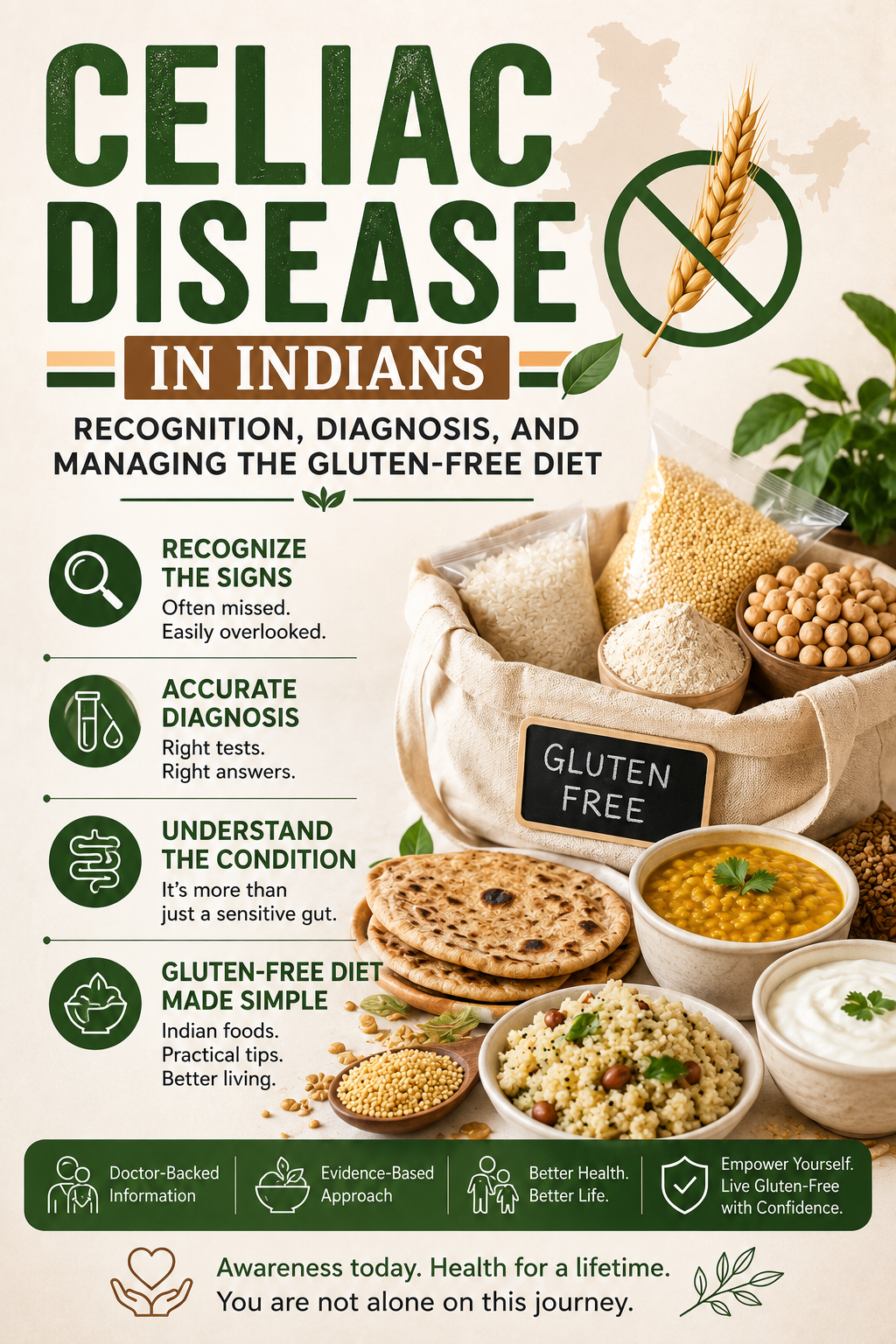
The Indian dietary tradition is actually better positioned for gluten-free eating than many Western cuisines, because several staple Indian grains are naturally gluten-free:
- Rice (chawal): Completely gluten-free; can form the carbohydrate base of most meals
- Ragi (finger millet): Gluten-free, high in calcium and iron, excellent for rotis and porridge
- Jowar (sorghum): Gluten-free, suitable for rotis and bhakri
- Bajra (pearl millet): Gluten-free, suitable for rotis
- Sama (barnyard millet), kuttu (buckwheat — despite the name, gluten-free), singhara (water chestnut flour): All traditionally eaten during religious fasts and therefore already familiar in many Indian households as wheat alternatives
- All dal and legumes: Naturally gluten-free when purchased whole and uncontaminated; check packaged versions for additives
- All vegetables and fruits: Naturally gluten-free
- Dairy: Naturally gluten-free; watch flavoured or malted dairy products
- Idli, dosa, uttapam, dhokla: When made from traditional fermented rice and urad dal batter, these are naturally gluten-free, one of the most nutritious and culturally rich gluten-free meal options available
Addressing Cross-Contamination
In India and Singapore, the risk of cross-contamination in shared cooking environments is significant. At home, dedicated utensils, separate storage for gluten-free flours, and washing all surfaces thoroughly before preparing gluten-free food are necessary. In restaurants, cross-contamination through shared oil, utensils, and preparation surfaces is a real risk even when a dish is nominally gluten-free. Individuals with celiac disease need to communicate clearly with restaurant staff and understand that even trace contamination matters.
Nutritional Monitoring After Diagnosis
Because celiac disease causes malabsorption of multiple nutrients before diagnosis, a full nutritional assessment at diagnosis and regular monitoring thereafter is important:
- Serum ferritin, haemoglobin — iron deficiency is the most common deficiency
- Serum 25-OH Vitamin D — consistently low in Indian patients with CeD
- Folate and Vitamin B12
- Bone density (DEXA scan) — particularly for adults diagnosed after years of untreated disease
- Anti-tTG IgA antibody levels — typically fall toward negative within 6–12 months of strict gluten-free diet adherence; persistent elevation indicates ongoing gluten exposure
Newly diagnosed with celiac disease? My Celiac Clear programme is a 12-week one-to-one nutrition programme that helps Indian families understand what gluten-free really means in an Indian kitchen, and how to correct the nutritional deficiencies that celiac disease causes.
Book a free discovery call here.Or Click here to know the details of the Celiac Clear 12-week Program
Frequently Asked Questions
Can I occasionally eat a small amount of wheat if my symptoms are mild?
No, and this is one of the most clinically important points about celiac disease management. Unlike food intolerance, where small amounts may be tolerated, celiac disease involves an immune response that causes ongoing intestinal damage even without obvious symptoms. “Asymptomatic” celiac disease still causes villous atrophy, continued malabsorption, and increased risk of long-term complications including osteoporosis, infertility, and (with very long-term non-adherence) slightly elevated risk of intestinal lymphoma. The gluten-free diet must be strict and lifelong, regardless of symptom severity.
My child has been diagnosed with celiac disease. Will they always have it?
Yes, celiac disease is a lifelong condition. Unlike some childhood food allergies that may be outgrown, celiac disease does not resolve with age. The intestine heals on a strict gluten-free diet, and symptoms resolve, but the underlying immune reactivity to gluten persists permanently. Returning to gluten at any point will re-trigger intestinal damage.
Is non-celiac gluten sensitivity (NCGS) the same as celiac disease?
No. NCGS is a condition in which individuals experience symptoms in response to gluten without the autoimmune response and intestinal damage of celiac disease, and without wheat allergy. Diagnosis of NCGS requires ruling out both celiac disease and wheat allergy first. Unlike celiac disease, NCGS does not carry the same long-term complication risk, and the degree of gluten restriction required is less stringent. The distinction matters and requires medical assessment to establish.
The Bottom Line
Celiac disease is not rare in India. It is under-diagnosed, under-suspected, and under-managed, particularly in patients without obvious gastrointestinal symptoms. If you have unexplained iron deficiency anaemia, growth faltering in a child, chronic abdominal symptoms, infertility, or early osteoporosis, celiac disease testing is clinically warranted. Diagnosis requires testing while eating gluten, do not start a gluten-free diet before completing the workup. Management is a lifelong strict gluten-free diet, with Indian cuisine providing a strong natural foundation of gluten-free alternatives.
🌿 Ready to Navigate Life With Celiac Disease — Without Losing Your Indian Food Identity?
If you or your child has recently been diagnosed with celiac disease, or if you have been struggling on a gluten-free diet without the right nutritional support, I would love to work with you.
Celiac Clear is my 12-week, one-to-one nutrition programme designed specifically for Indian families navigating celiac disease. Together, we work through what gluten-free actually means for an Indian kitchen, from roti alternatives to hidden gluten in masalas, eating out safely, correcting the nutrient deficiencies celiac disease causes, and building a diet that nourishes rather than
restricts.
No generic Western gluten-free advice. No unnecessary food eliminations. Just clear, personalised, evidence-based support, from a Preventive Medicine physician who understands Indian food.
Disclaimer: This article is for educational purposes only. Celiac disease requires medical diagnosis and should not be self-diagnosed or managed without appropriate clinical assessment.
References:
- Makharia GK et al. Prevalence of celiac disease in the northern part of India. BMC Gastroenterol. 2011;11:94. PubMed PMID 21182543
- Mohta S et al. Emergence of celiac disease and gluten-related disorders in Asia. J Neurogastroenterol Motil. 2021;27(3):337-346. PubMed PMID 33967028
- Clinical spectrum and changing presentation of celiac disease in Indian children. Indian J Med Res. 2023. PMC Full Text
- Current guidelines for the management of celiac disease: a systematic review. PMC. 2022. PMC Full Text

Akanksha Sharma
Dr Akanksha Sharma (MBBS, MD) is a physician and women’s health nutrition specialist, and the founder of IYSA Nutrition. She provides evidence-based, doctor-led nutrition guidance for pregnancy, postpartum recovery, PCOS, child nutrition, and family health, helping women make calm, informed decisions about their health and their children’s well-being.