Written & reviewed by Dr Akanksha Sharma, MBBS, MD (Preventive & Community Medicine) | Founder, IYSA Nutrition, Singapore
You are sleeping eight hours a night but waking up exhausted. You are reaching for your third coffee by 11 am. Your hair is thinning, your nails keep splitting, and you feel breathless climbing one flight of stairs. Your GP runs a basic blood test and tells you everything is “borderline normal.”
Sound familiar?
For millions of women across Singapore and South Asia, this is the invisible reality of iron-deficiency anaemia, a condition so common it has become normalised, and so underdiagnosed it quietly steals years of a woman’s vitality before anyone names it correctly.
In this post, I want to tell you exactly what is happening in your body, why Singapore women are particularly vulnerable, and what you can do about it, starting with food.
👉Celiac Disease in Indians: Diagnosis, and Gluten-Free Diet
What Is Iron-Deficiency Anaemia, and Why Does It Matter?
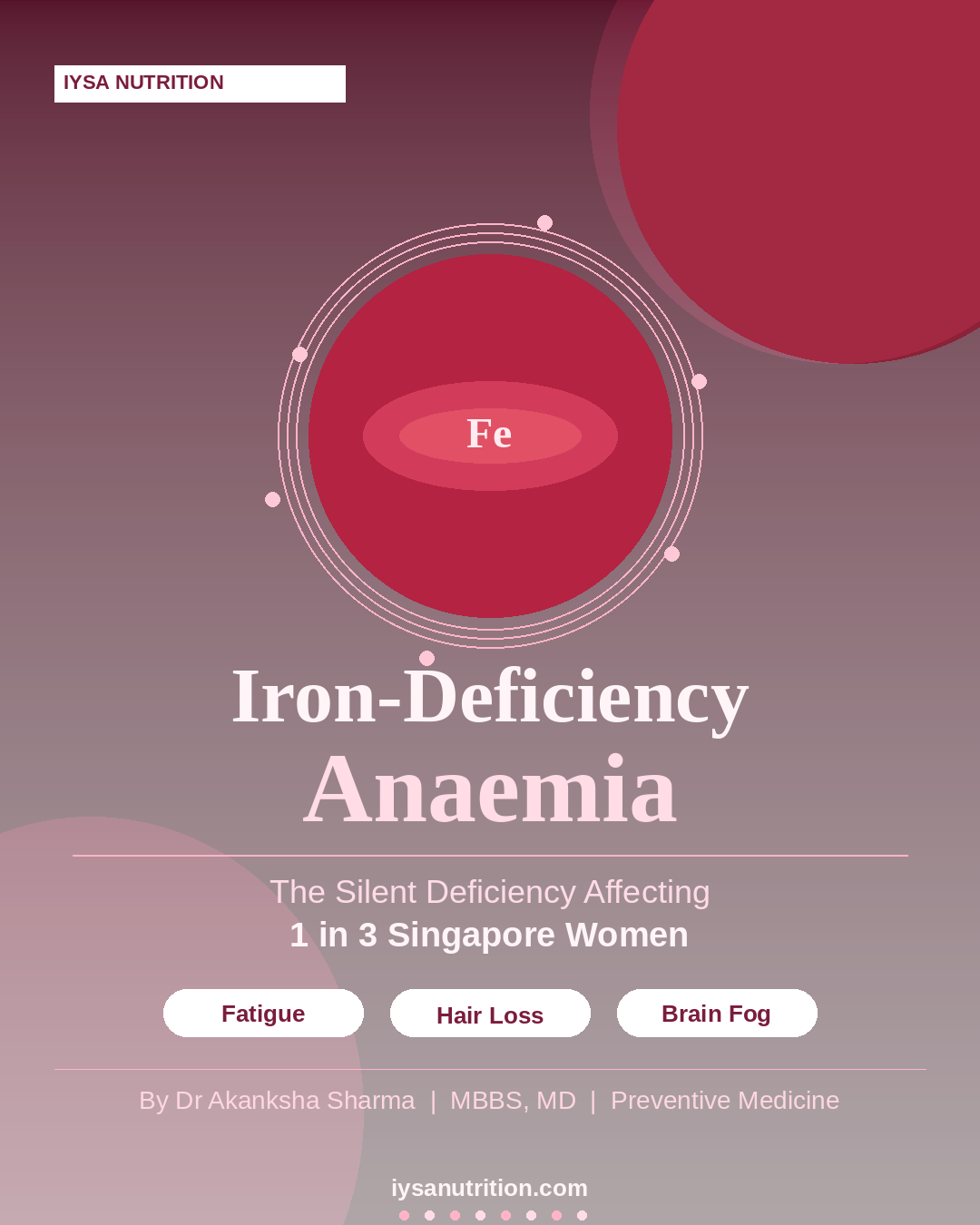
Iron-deficiency anaemia (IDA) is the most common nutritional deficiency worldwide. According to the World Health Organisation, anaemia affects approximately 30% of the global female population of reproductive age. In Singapore, the National Nutrition Survey has consistently flagged inadequate iron intake as a concern among women, particularly those aged 18 to 49.
Iron has one critical job in your body: it sits inside haemoglobin, the protein in your red blood cells, and carries oxygen from your lungs to every cell, organ, and tissue. When iron stores are depleted, your blood literally carries less oxygen. Everything slows down. Your brain gets less oxygen. Your muscles get less oxygen. Your hair follicles, which are among the most metabolically active structures in your body, get less oxygen and begin to shut down.
This is not a minor inconvenience. IDA affects your cognition, your mood, your immunity, your fertility, and your long-term cardiovascular health.
The Three Stages Before Anaemia Is Diagnosed
Most women are only diagnosed at Stage 3, when their haemoglobin is visibly low. But the damage begins far earlier:
- Stage 1 — Iron depletion: Your ferritin (stored iron) drops. Haemoglobin is still normal. You may feel slightly more tired than usual, but assume it is stress or poor sleep.
- Stage 2 — Iron-deficient erythropoiesis: Your body cannot make enough healthy red blood cells. You start feeling noticeably fatigued, cold intolerant, and mentally foggy. Blood tests still look “normal” on basic panels.
- Stage 3 — Iron-deficiency anaemia: Haemoglobin falls below 12 g/dL in women. This is what gets flagged on a standard blood report.
The problem is that most women suffer through Stages 1 and 2 for months, sometimes years, before reaching Stage 3. If your doctor is only checking haemoglobin and not ferritin, you will be told you are fine while your body is already iron-depleted.
Doctor’s Note: Always ask for your ferritin level, not just haemoglobin. In my clinical practice, I consider a ferritin below 30 ng/mL as functionally deficient in women, even if haemoglobin is technically within range. Many laboratories set their “normal” lower limit at 12 or 15 ng/mL, which is simply too low for optimal function.
Why Are Singapore Women Particularly at Risk?
Iron deficiency does not affect all populations equally. Several factors converge to make women in Singapore, particularly Indian, Chinese, and South Asian women, more vulnerable than average.
1. Menstrual Blood Loss
Every menstrual cycle, a woman loses between 30 and 80 mL of blood. Each ml of blood contains approximately 0.5 mg of elemental iron. Even a normal 50 ml loss represents 25 mg of iron, nearly double the daily recommended intake, which must be replaced every single month. Women with heavy periods (menorrhagia), fibroids, or endometriosis lose significantly more.
2. Low Dietary Iron Intake
Singapore’s busy urban lifestyle, long work hours, frequent eating out, and reliance on hawker food and delivery, make consistent iron-rich eating genuinely difficult. Many women routinely under-eat meat, dark leafy greens, and legumes. The National Nutrition Survey found that a significant proportion of women fall below the estimated average requirement for iron.
3. Plant-Based and Vegetarian Diets
There is nothing wrong with a vegetarian diet, but it requires careful planning for iron. Plant-based iron is non-haem iron, which has an absorption rate of just 2–20%, compared to 15–35% for haem iron from animal sources. Many Indian women in Singapore follow predominantly vegetarian diets and are at elevated risk of inadequate iron absorption without strategic food combining.
4. Tea and Coffee With Meals
This one surprises many of my patients. Tannins in tea and polyphenols in coffee are potent iron absorption inhibitors. Drinking a cup of tea or coffee with or immediately after a meal can reduce iron absorption by up to 60–70%. Given that tea is a cultural staple for many South Asian families in Singapore, this is a clinically significant contributor to iron deficiency.
5. Calcium Competition
Calcium and iron compete for the same absorption transporter in the gut. Consuming high-calcium foods (dairy, fortified foods) at the same time as iron-rich foods reduces iron absorption. This is a common error in well-intentioned meal plans.
6. Pregnancy and Postpartum Depletion
Pregnancy increases a woman’s iron requirement from 18 mg/day to approximately 27 mg/day. Many women enter pregnancy already iron-insufficient, and postpartum recovery depletes stores further, particularly in women who breastfeed. The result is a significant iron debt that can persist for years after delivery.
Symptoms of Iron Deficiency: Beyond the Obvious Fatigue
Most women know that anaemia causes tiredness. But the full symptom picture is much wider, and many symptoms are routinely attributed to other causes (stress, thyroid issues, ageing) when iron is the underlying factor.
- Persistent fatigue and weakness, particularly in the morning
- Breathlessness on mild exertion, climbing stairs, carrying groceries
- Rapid or irregular heartbeat (palpitations)
- Pallor: pale inner lower eyelids, pale nail beds, pale lips
- Hair thinning and excessive shedding (telogen effluvium)
- Brittle nails, sometimes with a spoon-shaped curvature (koilonychia)
- Cold hands and feet
- Difficulty concentrating, brain fog, poor memory
- Headaches, particularly in the afternoon
- Craving non-food items such as ice, clay, or starch (pica)
- Restless legs at night
- Reduced immunity, frequent infections, slow recovery
- Low mood, anxiety, and irritability
If you recognise five or more of these symptoms, please do not self-diagnose or self-supplement without a blood test. Both iron deficiency and iron overload are harmful; you need to know your actual levels before supplementing.
How to Diagnose Iron Deficiency Correctly
Ask your GP or physician to run a full iron panel, not just a complete blood count. This should include:
- Serum ferritin — your iron storage marker (most important)
- Haemoglobin — oxygen-carrying capacity of blood
- Serum iron — circulating iron level
- Total iron-binding capacity (TIBC) — how much transferrin is available to carry iron
- Transferrin saturation — percentage of transferrin bound to iron
In iron deficiency, you will typically see: low ferritin, low serum iron, high TIBC, and low transferrin saturation, even before haemoglobin drops.
The Best Iron-Rich Foods for Women: A Singapore and Indian Context
Before reaching for supplements, food should always be your first strategy. Here is a practical, culturally relevant guide to iron-rich foods, divided by haem and non-haem sources.
Haem Iron Sources (Higher Absorption)
- Chicken liver — one of the richest iron sources available; 100g provides approximately 13 mg of iron
- Lean red meat (beef, mutton, lamb) — 100g provides 2.5–3.5 mg
- Chicken and turkey (dark meat) — 100g provides 1.5–2 mg
- Fish and seafood — particularly clams, oysters, and sardines
Non-Haem Iron Sources (Require Pairing with Vitamin C)
- Rajma (kidney beans) — 100g cooked provides approximately 2.9 mg
- Masoor dal (red lentils) — 100g cooked provides approximately 3.3 mg
- Chana dal (split chickpeas) — 100g cooked provides approximately 2.8 mg
- Tofu (firm) — 100g provides approximately 2.7 mg
- Spinach and dark leafy greens — 100g cooked provides 2–3.5 mg
- Pumpkin seeds — 30g provides approximately 2.5 mg
- Fortified breakfast cereals — check the label; many provide 4–8 mg per serving
- Dried apricots and raisins — useful snack additions
- Dark chocolate (70%+) — 30g provides approximately 3.4 mg
The Vitamin C Rule: Non-Negotiable
Non-haem iron absorption increases dramatically, by 2 to 4 times, when consumed alongside vitamin C. This is one of the most evidence-backed nutrition strategies available, and it costs nothing. Simply pair your iron-rich plant foods with a vitamin C source at the same meal.
- Squeeze lemon or lime over your dal, sabzi, or leafy greens
- Add tomatoes, capsicum, or amla to iron-rich meals
- Eat a small portion of guava, kiwi, or orange alongside iron-rich foods
- Add fresh coriander and green chilli (both high in vitamin C) to your cooking
What to Avoid (Or Time Strategically)
Knowing what blocks iron absorption is as important as knowing what enhances it.
- Tea and coffee: Wait at least 60 minutes after an iron-rich meal before drinking these
- Calcium-rich foods and dairy: Avoid consuming large amounts of dairy in the same meal as iron-rich foods. The most common mistake in the Indian diet is having curd with food. Rather, have it as a snack with fruits.
- Phytates: Found in whole grains, legumes, and seeds; soaking and sprouting your legumes before cooking reduces phytate content significantly
- Oxalates: High in spinach and beetroot — these bind iron; eating these with vitamin C helps partially offset this
- Antacids and proton pump inhibitors: These reduce stomach acid, which is essential for iron absorption; discuss with your doctor if you are on long-term antacid medication
When Food Is Not Enough: A Note on Supplementation
If your ferritin is below 20 ng/mL, or your haemoglobin is below 12 g/dL, dietary changes alone will likely be insufficient to restore your iron stores in a clinically meaningful timeframe. In this case, supplementation is appropriate, but the type and dose matter.
- Ferrous sulfate is the most commonly prescribed form and is effective, but it frequently causes constipation, nausea, and dark stools
- Ferrous bisglycinate (chelated iron) is gentler on the gut and has comparable absorption. I typically recommend this for women who find ferrous sulfate intolerable
- Iron IV infusion is indicated in severe anaemia, malabsorption conditions (coeliac disease, IBD), or when oral supplementation is not tolerated
Do not take iron supplements without a confirmed diagnosis and a clinician’s guidance. Iron overload is a real and damaging condition.
A Sample One-Day Iron-Optimised Meal Plan (Indian Vegetarian)
- Breakfast: 1 small bowl of poha made with iron-fortified rice flakes + 80 g tofu stir fry + half a cup of sliced guava or one kiwi. Avoid chai with this meal — have it 90 minutes later.
- Mid-morning snack: A small handful of pumpkin seeds + one dried apricot
- Lunch: One cup masoor dal + roti + palak sabzi with a squeeze of lemon + tomato and onion salad. No dairy in this meal.
- Evening snack: Hummus (made from chickpeas) + raw capsicum sticks (high vitamin C) OR 1 bowl Greek yoghurt with a handful of berries
- Dinner: Rajma or chana curry + brown rice + cucumber
- Post-dinner: 1 small cup of turmeric milk (if tolerated). This is an acceptable time for a small cup of milk if desired, as it is away from the iron-heavy meals.
👉 Struggling with weight or energy despite “doing everything right”?
A structured, hormone-aware approach can make the difference. Click here to book a FREE 20-minute consultation call.
Frequently Asked Questions
What is a normal ferritin level for women?
Laboratory “normal” ranges vary, but in clinical practice, most women’s health specialists consider ferritin below 30 ng/mL as functionally low. Optimal ferritin for women is generally considered to be between 50 and 150 ng/mL. Always interpret your results in the context of your symptoms and full iron panel.
Can iron deficiency cause anxiety and depression?
Yes. Iron is essential for the synthesis of dopamine and serotonin, two neurotransmitters that regulate mood, motivation, and stress response. Iron deficiency has been associated with increased rates of anxiety, low mood, and irritability in women. Correcting iron levels often leads to significant mood improvement.
How long does it take to correct iron deficiency with food alone?
If ferritin is only mildly low (20–30 ng/mL) and haemoglobin is normal, a consistent iron-rich diet with good absorption strategies can raise ferritin meaningfully within 3 to 6 months. If ferritin is severely depleted or haemoglobin is low, supplementation under medical supervision is required and recovery typically takes 3 to 6 months of treatment.
Is iron deficiency linked to hair loss in women?
Yes. Ferritin below 30 ng/mL is one of the most well-documented nutritional causes of telogen effluvium (diffuse hair thinning) in women. Hair follicle cells are among the most metabolically active in the body and are highly sensitive to iron availability. Correcting iron stores often leads to partial or full hair regrowth over 6 to 12 months.
Should I take vitamin C supplements to improve iron absorption?
You do not need supplements if you eat vitamin C-rich foods with your iron-containing meals. Whole food sources like lime, guava, kiwi, capsicum, amla are equally or more effective than supplements and come with additional fibre and phytonutrients. Supplements are appropriate only when whole food intake is consistently inadequate.
Can I have tea if I have iron deficiency?
Yes, but timing is everything. Drink tea at least 60 minutes before or after iron-rich meals. Having tea between meals rather than with them allows you to enjoy it without significantly impacting iron absorption.
The Bottom Line
Iron-deficiency anaemia is not inevitable, and it is not something you simply have to live with. It is a nutritional problem with clear, evidence-based solutions, starting with knowing your numbers, understanding your diet, and making strategic food choices that work with your body rather than against it.
If you are experiencing persistent fatigue, hair thinning, cold intolerance, or brain fog, please do not dismiss these symptoms as “just stress.” Get a full iron panel. Know your ferritin. And if you need support building an iron-optimised meal plan that fits your lifestyle, food preferences, and clinical picture, I am here to help.
📩 Click here to book a FREE consultation with Dr Akanksha Sharma — personalised metabolic nutrition consultations for Indian women in Singapore and India.
OR Explore this FREE Guide:
👉 The Insulin Reset: A Women’s Guide
Disclaimer: This article is written for educational purposes and does not constitute personalised medical advice. Please consult a qualified physician before making changes to your diet or starting supplementation.
Related reading:
👉Perimenopause in Singapore Women: Symptoms Doctors Miss
👉PCOS in Singapore: Why It’s Rising Even in Lean Women
👉Gut Problems Common in Singapore Women (and What to Do About Them)
👉Fertility Diet for Women: What to Eat When Trying to Conceive
✅ References
1. World Health Organisation — Anaemia WHO’s fact sheet on anaemia covers definitions, symptoms, causes, treatments, and global burden data.
2. National Nutrition Survey — Singapore (HPB) The Health Promotion Board publishes the National Nutrition Survey periodically, with the most recent editions being the NNS 2019 and NNS 2022, available as PDFs from their official reports page.
3. ICMR-NIN Nutrient Requirements for Indians (2020) The official citation is: ICMR-NIN Expert Group on Nutrient Requirement for Indians, Recommended Dietary Allowances (RDA) and Estimated Average Requirements (EAR) — 2020.
4. Camaschella C. — Iron-Deficiency Anemia, NEJM 2015 Published May 7, 2015 in the New England Journal of Medicine, Vol. 372, pages 1832–1843, with DOI 10.1056/NEJMra1401038.

Akanksha Sharma
Dr Akanksha Sharma (MBBS, MD) is a physician and women’s health nutrition specialist, and the founder of IYSA Nutrition. She provides evidence-based, doctor-led nutrition guidance for pregnancy, postpartum recovery, PCOS, child nutrition, and family health, helping women make calm, informed decisions about their health and their children’s well-being.