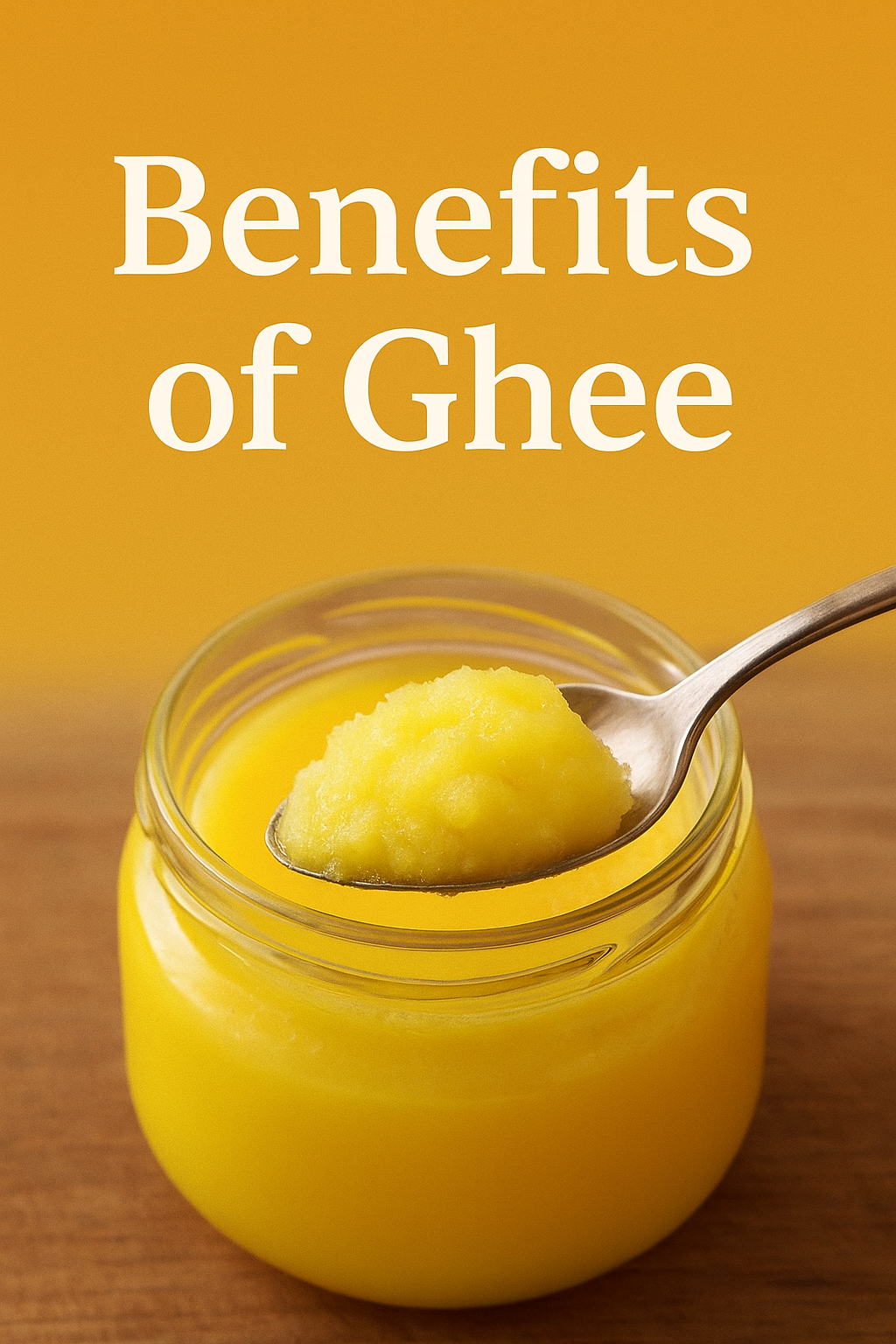
Ghee – the golden, aromatic clarified butter from Indian kitchens – has been celebrated for centuries in both traditional Ayurvedic medicine and modern wellness circles. But is it truly worth the hype? Let’s dive deep into the science 🔬, Ayurveda ⚕️, and everyday applications to uncover all the reasons why ghee deserves a spot in your diet — in moderation, of course!
📌Is Ghee for Children Good? An Evidence-Based Answer
🌊 General Health Benefits of Ghee
Ghee is a digestive superhero ✨ and a powerful ally for gut and immune health:
- 🥛 Aids digestion: Ghee stimulates digestive fire (agni) and helps absorb fat-soluble nutrients.
- 🌿 Gut healer: Rich in butyric acid, ghee supports the gut lining and helps reduce inflammation.
- ⚡️ Improves glycemic response: Ghee in meals may lower post-meal glucose spikes.
- ⛨️ Anti-inflammatory: Studies show ghee reduces prostaglandins and other inflammatory markers.
Ayurveda calls ghee ojovardhak — a booster of ojas, your body’s immunity and strength.
🌿 Ghee in Ayurveda: A Tridoshic Superfood
In Ayurveda, ghee is:
- ✔️ Tridoshic – balances Vata, Pitta, and Kapha
- ✨ Rasayana (rejuvenator) – enhances vitality, immunity, and longevity
- 🔬 Yogavahi – it carries herbs deep into tissues
Used in:
- 🌾 Panchakarma detox (snehapana)
- 🚫 Nasya therapy (ghee drops in nose)
- ☕️ Medicated formulations like Brahmi ghrita, Triphala ghrita
Ghee’s unique property “samskarasya anuvartanam” means it adapts to and enhances the qualities of herbs it is processed with.
📌Is A2 Ghee Really Better — or Just Clever Marketing?
💋 Ghee for Skin & Hair
Ghee is a natural beauty enhancer both inside and out:
- 🌟 Glowing skin: Hydrates and improves complexion
- ⚕️ Wound healing: Traditional ghee dressings help heal burns and ulcers
- 👉 Lip balm: Great for dry, cracked lips
- 🧵 Hair health: Adds shine, conditions hair, and soothes scalp
🧶 Shata Dhauta Ghrita (ghee washed 100 times) is used for cooling and skin regeneration.
⚡️ Ghee & Metabolism: Surprising Weight Benefits
Ghee is rich in good fats like:
- 🌱 Short and medium-chain fatty acids – easily digestible energy
- 📊 CLA (Conjugated Linoleic Acid) – shown to reduce body fat in studies
- 🥜 MCTs & antioxidants – support fat metabolism
Ayurveda sees ghee as agnivardhak — boosts metabolism & satiety. It can:
- ⬇️ Lower GI of carbs when eaten with rice
- 🍽️ Help curb overeating
Remember: moderation is key (1–2 tsp/day) – even good fats in excess can slow metabolism.
Worried your child is eating “too little” or too selectively?
👉 Book a child nutrition consult (FREE) (Singapore-friendly, practical, doable meal plans).
📌How Much Protein Children Need Actually? An Age-by-Age Guide
🍼 Ghee in Pregnancy & Postpartum
Pregnancy is a sacred time when ghee becomes a powerful ally:
- 🌟 Fetal development: Supplies cholesterol & fat-soluble vitamins (A, D, E, K)
- ✉️ Brain & eye development: Ayurveda recommends milk + ghee during pregnancy
- 💜 Lactation support: Ghee enriches breast milk and restores mother’s strength
- ✅ Soothes cracked nipples, boosts energy, and helps with recovery massages
🪬 Postpartum porridges & laddoos often feature ghee as a primary strengthener.
👶 Ghee for Kids: A Growth Superfood
Ghee is one of the first fats introduced to babies in India ✨
- 🥜 Supports bone growth: Rich in K2 & D
- 📚 Brain fuel: Provides cholesterol, DHA & omega-3s
- 💯 Improves memory & immunity: Ayurveda says ghee boosts medha (intellect)
- 🥺 Eases digestion & constipation: Safe and soothing in small doses
Ideal dose: ½ to 1 tsp/day for toddlers, increasing with age.
📌Ghee: The Superfood for Babies – An Ayurvedic and Scientific Perspective
🔹 Final Word
Ghee isn’t just a kitchen staple — it’s a holistic powerhouse with proven benefits across digestion, skin, metabolism, maternal health, and child growth.
📖 Backed by Ayurveda. Supported by science. Loved by generations.
Frequently Asked Questions
Is ghee better than butter for children?
Ghee has several advantages over butter for children: the removal of milk solids means it is better tolerated by lactose-intolerant and milk-protein-sensitive children; its higher smoke point makes it safer for cooking at typical Indian cooking temperatures where butter would oxidise and smoke; it contains somewhat higher concentrations of butyrate than butter; and its Vitamin A content is marginally higher. From a saturated fat perspective, ghee and butter are broadly similar; ghee is approximately 64% saturated fat, and butter is approximately 63%. For practical purposes in Indian cooking, ghee is the appropriate choice over butter; Western cooking applications are where butter makes more cultural sense.
Does ghee make children smarter?
This is one of the most persistent claims in Indian traditional medicine, and it requires an honest, nuanced answer. Fat is essential for brain development in young children. Ghee, as a fat source, contributes to the caloric density that supports overall nutrition, the fat-soluble vitamin absorption relevant to brain function, and the butyrate that supports gut health (which influences the gut-brain axis). However, there is no clinical trial evidence that ghee specifically improves cognitive outcomes above and beyond any other adequate dietary fat source. The broader claim that a specific food “makes children smarter” is almost always an oversimplification. The accurate statement: adequate dietary fat from quality sources, of which ghee is one, is necessary for optimal brain development.
My child is underweight. Should I add more ghee to their food?
Ghee is a high-calorie-density food and can be a useful tool for increasing caloric intake in underweight children who cannot eat large volumes, but it should not be the primary strategy. Increasing the caloric density of existing meals with ghee (adding a teaspoon to dal, khichdi, and roti) is appropriate and practical. However, investigate why the child is underweight: is it primarily low appetite, picky eating, inadequate feeding opportunities, a medical condition affecting absorption, or simply a small natural build tracking below average but along their own growth centile? Address the underlying cause alongside the dietary strategy. If growth is significantly below the 3rd centile or crossing centiles downward, paediatric assessment is warranted alongside nutritional intervention.
Which ghee is best for children — homemade or commercial?
The nutritional profile of ghee is primarily determined by the source cow’s diet. Grass-fed cow ghee contains higher concentrations of Vitamin K2, CLA, and omega-3 fatty acids than grain-fed cow ghee. Homemade ghee from grass-fed cow cream (traditionally prepared by fermenting milk to make dahi, churning into butter, and then clarifying) is likely nutritionally superior to commercially produced ghee from grain-fed cows. However, any pure ghee (checking that the label shows 100% ghee with no vegetable oil additions, a common adulteration in commercial Indian ghee) is nutritionally adequate. Reputable commercial brands include Amul (in India) and various imported grass-fed ghee brands available in Singapore at Indian grocery stores and health food retailers.
At what age can babies start having ghee?
Ghee can be introduced as complementary feeding begins at six months, as a cooking fat in dal khichdi and porridge, and as a spread on soft roti pieces. Half a teaspoon per day is appropriate initially. Ghee is not a common allergen (milk proteins are largely removed during clarification), though a very small number of children with severe milk protein allergy may react to trace residual proteins. Introduce carefully and watch for any reaction, as with any new food. Current IAP and WHO complementary feeding guidelines support the introduction of all appropriate fats, including ghee, from six months of age.
The Bottom Line
Ghee for children is neither the miracle food of traditional Indian enthusiasm nor the cardiovascular villain of low-fat dietary fear. It is a nutritionally genuine food with specific benefits, butyrate for gut health, fat-soluble vitamins, caloric density for small stomachs, and cultural and culinary value that cannot be separated from its role in Indian food identity, and specific limits, primarily around caloric contribution in the context of the overall dietary fat load.
One to two teaspoons per day over dal and roti, in khichdi, or in porridge, as part of a nutritionally complete and varied diet, is appropriate and beneficial for most Indian children. It does not need to be eliminated, and it does not need to be given by the tablespoon. The middle path, which is where the evidence actually sits, is usually less exciting than the extremes, but it is almost always more useful.
💛 Want structured guidance? 📩 Click here to book a FREE consultation with Dr Akanksha Sharma
👉 Explore my programs:
-
Little Legends: The Doctor-Designed Growth & Strength Plan for Kids
- Teen Fuel: Doctor-Guided Nutrition & Routine Reset for Teenagers (Ages 12–19)
🔗 You May Also Find These Readings Helpful:
- [Fueling Little Minds: Best School Tiffin Ideas for Singaporean Kids!]
- [The Growth-Smart School Tiffin Recipes Guide]
-
[Children Are Not Mini Adults: Stop “Healthy” Food Trends From Harming Your Child]
- [Positive Reinforcement Tips to Encourage Good Behaviour in Your Child]
Disclaimer: This article is for educational purposes only. Dietary recommendations for children should be individualised based on the child’s growth, health status, and overall dietary pattern. Consult your paediatrician if you have concerns about your child’s growth or diet.
References:
- Canani RB et al. Potential beneficial effects of butyrate in intestinal and extraintestinal diseases. World J Gastroenterol. 2011;17(12):1519-1528. PMC
- Siri-Tarino PW et al. Meta-analysis of prospective cohort studies evaluating the association of saturated fat with cardiovascular disease. Am J Clin Nutr. 2010;91(3):535-546. PubMed
- Dinicolantonio JJ, O’Keefe J. The importance of marine omega-3s for brain development and the prevention and treatment of behaviour, mood, and other brain disorders. Nutrients. 2020;12(8):2333. PMC
- ICMR-NIN Expert Group. Recommended Dietary Allowances for Indians. 2020. nin.res.in
- Indian Academy of Paediatrics. Feeding the Normal Child 2019. iapindia.org

Akanksha Sharma
Dr Akanksha Sharma (MBBS, MD) is a physician and women’s health nutrition specialist, and the founder of IYSA Nutrition. She provides evidence-based, doctor-led nutrition guidance for pregnancy, postpartum recovery, PCOS, child nutrition, and family health, helping women make calm, informed decisions about their health and their children’s well-being.