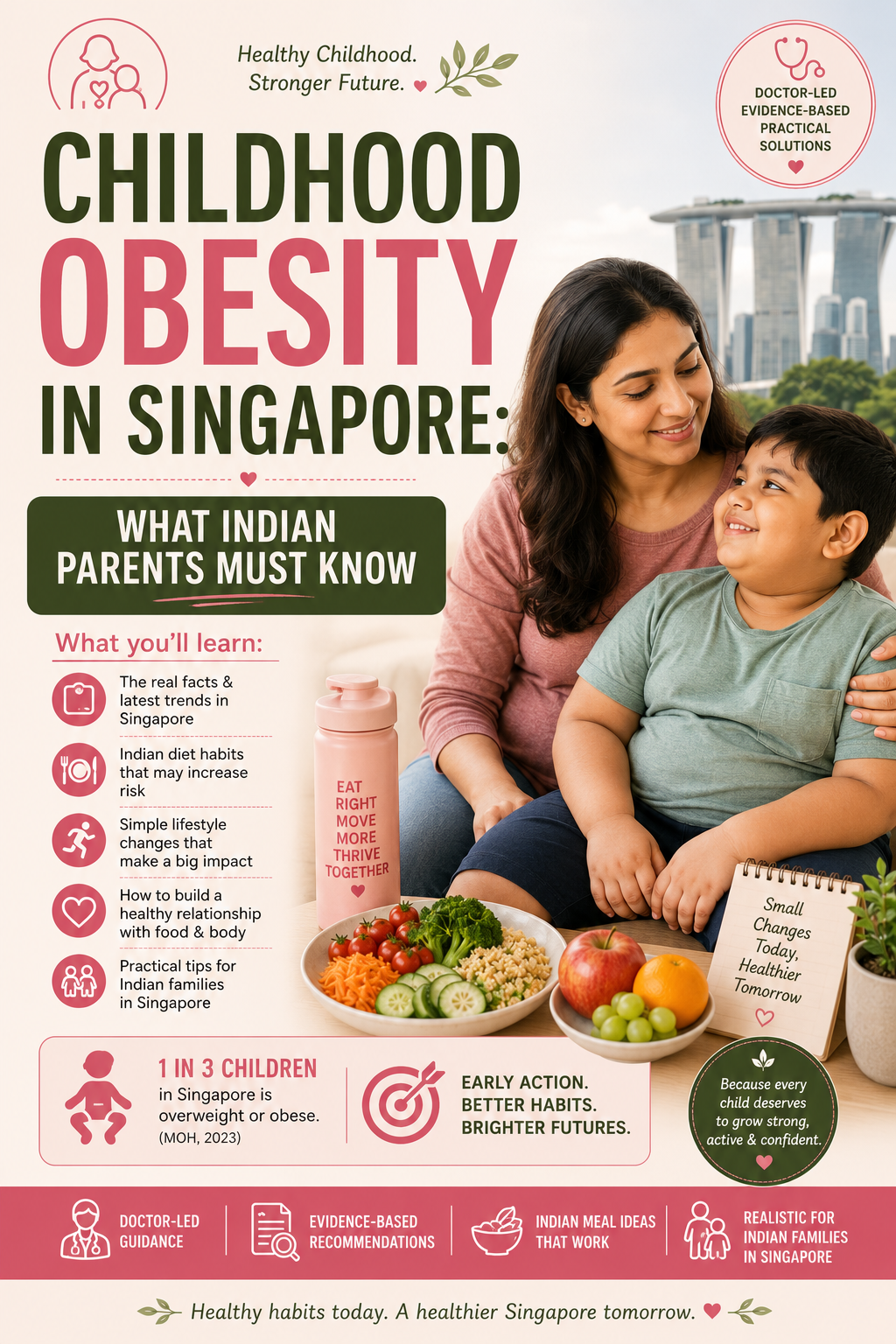
- MOH Singapore. Obesity Trend and Programmes. moh.gov.sg
- MOH Singapore. Annual Prevalence of Obesity for Children. moh.gov.sg
- KKH LIFE Centre. Integrating Community LITE Programme — Childhood Obesity Singapore. ClinicalTrials.gov NCT05281016
👉Nutri-Grade Singapore — the complete A/B/C/D explanation for beverages and the 2027 extension
Why Singapore Indian Children Face Higher Metabolic Risk
The Thin-Fat Indian Phenotype in Children
Research on South Asian body composition, including studies from Singapore and the Indian subcontinent, consistently shows that Indian children accumulate more visceral and intramuscular fat at lower BMIs than Chinese or Malay children. This means that an Indian child with a BMI at the 80th percentile may have the metabolic risk profile of a Chinese child at the 90th percentile. Standard BMI-for-age classifications, derived from largely Western reference populations, may systematically underestimate metabolic risk in Indian children.
The consequences of this excess visceral fat accumulation, even at apparently acceptable BMIs, include earlier onset of insulin resistance, worse lipid profiles, and higher risk of progressing to type 2 diabetes in adulthood. The India-Singapore Connection is bidirectional: Indian children who were overweight in childhood in India are at additional risk if they migrate to Singapore’s food environment, where ultra-processed food is hyperavailable, physical activity is often restricted by academic pressure, and air-conditioned environments reduce incidental activity.
Singapore’s Indian Children: Specific Risk Factors
- Ultra-processed snack consumption: Singapore has one of the highest densities of convenience stores, food courts, and packaged snack availability in Asia. Indian children in Singapore are heavily exposed to the same UPF environment as all Singapore children: biscuits, flavoured chips, sweetened Milo, instant noodles, on top of traditional Indian sweet snacks
- Reduced physical activity from tuition load: Singapore’s academic culture means many Indian children attend multiple enrichment classes and tuition sessions after school, leaving minimal time for the 60 minutes of daily physical activity that HPB recommends. A child with 5 tuition sessions per week may be spending 3–4 hours seated every afternoon
- Screen time displacement: Average screen time for Singapore school-age children significantly exceeds MOH’s recommended limits, particularly for educational screen use during and after the COVID-19 period. Screen time reduces physical activity, disrupts sleep, and increases snack intake simultaneously
- Family food culture: Traditional Indian celebration food like fried snacks, mithai, and ghee-heavy preparations is consumed more frequently in Singapore’s festival-dense multicultural environment than it might be for equivalent Indian families in India, because every cultural celebration (Deepavali, Hari Raya, Chinese New Year, Christmas) brings a food event
📌Hidden Sugar in Indian Kids’ Snacks (And Healthier Swaps)
📌Healthy Snacks for Kids Without Cooking
📌Screen Time and Sleep: How Your Child’s Diet Affects Both
What Drives Childhood Obesity: The Evidence
A mini review specifically examining public health approaches to combating childhood obesity in India, published in the European Journal of Clinical Nutrition (Challa et al., 2026), identified the primary drivers: excess consumption of high-fat, high-sugar, high-sodium ultra-processed foods; reduced physical activity; increased screen time; and insufficient fruits, vegetables, and whole grains, with national surveys and meta-analyses indicating that 9–12% of Indian children and adolescents are already overweight or obese. These are identical in Singapore’s Indian child population; the specific food products differ (Singapore adds bubble tea, salty snacks from 7-Eleven, and hawker fried options to the Indian UPF mix), but the mechanism is the same.
The Singapore-specific data from the PEDAL (Promoting hEalthy Diet and Active Lifestyle) study found that the prevalence of overweight among children and adolescents aged 5–19 in Singapore stands at 22%, ranking third highest in the ASEAN region. The study emphasised that multicomponent interventions, addressing diet, physical activity, and screen time simultaneously rather than any single factor, produce the best outcomes in Singapore school-age children.
What Does NOT Work: Common Parental Mistakes
Before discussing what to do, it is worth being explicit about what the evidence consistently shows does not work, because several common parental responses to childhood overweight actively make things worse:
- Putting a child on a “diet” or restricting calories: Caloric restriction in growing children consistently produces worse long-term outcomes; it can stunt growth, impair nutrient adequacy, create a disordered relationship with food that persists into adulthood, and often rebounds with accelerated weight gain when the restriction ends. Children are not adults; adult weight loss strategies do not translate to children.
- Commenting on the child’s weight or body: Children who hear negative comments about their weight from parents, even well-intentioned ones, have higher rates of eating disorders, lower self-esteem, and worse weight outcomes in adolescence. The conversation should be about food quality and activity, never about the child’s body.
- Forbidding specific foods categorically: Research on restrained eating in children consistently shows that forbidden foods become disproportionately desirable; children who are told they cannot have chocolate eat more of it when given unchaperoned access than children for whom it is an ordinary, occasional food. The goal is a positive relationship with a wide variety of foods, not prohibition of specific items.
- Using food as reward or punishment: “Finish your vegetables, and you can have dessert” consistently makes children like vegetables less and dessert more. Rewarding children for eating healthy foods with screen time, stickers, or other rewards also reduces intrinsic motivation for the healthy food over time. Let meals be meals.
📌Children Are Not Mini Adults: Stop “Healthy” Food Trends From Harming Your Child
What the Evidence Supports: Family-Based Strategies That Work
1. Improve the Home Food Environment, Not the Child’s Behaviour
The most effective lever for children’s eating is what food is available in the home. Children eat what is accessible and visible. If roasted chana, plain makhana, fruit, and dahi are what is on the kitchen counter when your child comes home hungry, that is what gets eaten. If biscuits, instant noodles, and flavoured drinks are what are there, those get eaten instead. This is not about willpower; it is about the food environment, which parents control completely.
Practical Singapore implementation:
- Stock up on roasted chana, mixed nuts, plain makhana at Mustafa or NTUC’s health section weekly; make these the visible, accessible snack
- Keep fruit on the counter (not in the refrigerator, where it is out of sight): guava, banana, apple, grapes, cut and ready
- Remove sweetened drinks from the home, replace with a water filter jug in the refrigerator with cucumber or lime slices for appeal
- Cook dal for dinner that can be reheated as a warm after-school snack: protein, fibre, and genuinely filling, unlike biscuits
2. Family Meals Together — the Single Strongest Predictor of Children’s Dietary Quality
Research consistently shows that eating dinner as a family, without screens, is one of the most protective factors against childhood overweight and disordered eating. Children who eat regular family meals consume more fruits and vegetables, fewer fried foods and sweetened drinks, and have better dietary variety than children who eat alone or in front of screens. In Singapore’s busy dual-income Indian family context, a minimum of three family dinners per week is a realistic and high-impact target.
3. Structured Physical Activity — 60 Minutes Daily
HPB’s recommendation of 60 minutes of moderate-to-vigorous physical activity daily for school-age children is backed by strong evidence. For Singapore Indian children whose schedules are dense with tuition and enrichment, this requires deliberate protection of activity time, not as one more scheduled class, but as unstructured outdoor play or a single sport they enjoy. Swimming (Singapore’s public pool network is extensive and affordable; check ActiveSG pools near your home), cycling in the park, playground time, or a martial arts or dance class are all effective. The key is consistency and enjoyment, not intensity.
4. Adequate Sleep — Often the Most Neglected Factor
Sleep deprivation in children directly raises ghrelin (hunger hormone) and lowers leptin (satiety hormone), increasing appetite and specifically increasing preference for high-calorie foods the next day. Singapore school-age children frequently sleep fewer than the recommended 9–11 hours due to homework demands and evening tuition schedules. A consistent, early bedtime (8:30–9 pm for primary school children) is one of the most impactful family health decisions available; it directly affects appetite regulation, academic performance, and emotional regulation simultaneously.
5. Reduce Screen Time Specifically Before Meals and at Night
Screen use immediately before meals reduces meal satiety; children eat more when distracted by screens during eating. Screen use in the evening delays sleep onset by suppressing melatonin. Both effects directly worsen childhood weight outcomes. A simple household rule, no screens during meals and screens off one hour before bedtime, addresses both mechanisms without requiring complex dietary changes.
📌Screen Time, Tuition & Hormones: A Singapore Parenting Reality
📌Screen-Free Meals: How Ditching Distractions Can Help Your Child Overcome Fussy Eating
👩⚕️ Concerned about your child’s weight or metabolic health in Singapore?
I work with Indian families to build sustainable, evidence-based approaches to children’s nutrition, without restriction, fear, or food conflict.
Explore my programmes:
👉 Not Sure Which Programme? Book a FREE 20-Minute Call
Dr Akanksha Sharma · MBBS MD · Preventive Medicine Physician · Singapore
The Singapore Resources Available to You
- HPB Lifestyle Coaching Programme: Free six-month structured lifestyle programme for overweight children referred through school health screening or polyclinics. 64% of participants achieved BMI reduction or reached acceptable weight. Access through referral from your school health nurse, polyclinic, or paediatrician.
- KKH LIFE Centre: KK Women’s and Children’s Hospital’s dedicated paediatric obesity management programme, a multidisciplinary service for children with significant obesity. Referral through your paediatrician or polyclinic.
- ActiveSG pools, gyms, and programmes: Singapore’s public sports infrastructure is extraordinarily accessible and affordable; ActiveSG membership allows access to 27 swimming complexes and 30+ sport centres islandwide at subsidised rates. Use it.
- Healthy 365 app (HPB): Includes family features, healthy recipes, physical activity tracking, and challenges specifically designed for Singapore families. Free download on iOS and Android.
- Healthhub.sg: MOH’s health information portal includes specific nutrition guidance for children, HPB’s My Healthy Plate model, and links to the Grow Well SG resources.
Frequently Asked Questions
My child’s school nurse told me my child is overweight, but my child looks fine to me. Who is right?
Both perspectives contain truth. The school nurse is applying Singapore’s standardised BMI-for-age classification, which is a population-level screening tool. The fact that your child “looks fine” to you may reflect visual normalisation: when overweight is common among a child’s peers, it looks normal. It may also reflect that your child carries excess fat in ways that are not immediately visible (visceral fat, for example, is not visible externally). The appropriate response is not to dismiss the screening result but to discuss it with your paediatrician or polyclinic doctor, who can assess your child’s full health picture including waist circumference, activity level, and diet quality in context.
My child is Indian and thin by Singapore standards but has a family history of diabetes. Should I still be concerned?
Yes, this is precisely the thin-fat phenotype scenario where BMI is misleading. A thin Indian child with a strong family history of type 2 diabetes warrants attention to diet quality (specifically reducing refined carbohydrates and sugar, increasing protein and vegetable intake) and physical activity even in the absence of overweight on school screening. Ask your paediatrician to check fasting glucose and ideally fasting insulin if there is significant family history; these provide a much earlier picture of metabolic trajectory than BMI alone.
My child is overweight but is very resistant to any food changes. Where do I start?
Start with the food environment, not the child’s behaviour. Change what is available in the home without announcing a “diet” or making the child’s weight the topic. Swap biscuits for chana in the snack drawer. Replace sweetened drinks with water. Add one more vegetable to dinner. These changes to the environment shift what gets eaten without requiring willpower or conflict. If resistance to food change is severe and causing significant family conflict, a paediatric dietitian referral through KKH or NUH can provide structured family-based intervention.
📌Picky Eating Solutions: A Doctor-Backed Nutrition Guide
The Bottom Line
Childhood obesity in Singapore is a documented, significant, and worsening public health concern, affecting 22% of children aged 5–19 and rising. For Indian children, metabolic risk at any given BMI is higher than Singapore’s standardised thresholds fully capture, making the prevention strategies discussed in this post not just relevant but urgent. The evidence-based family approach, improving the home food environment, protecting family mealtimes, ensuring 60 minutes of daily physical activity, prioritising sleep, and reducing screen time, is more effective and more sustainable than dietary restriction, food prohibition, or making a child’s weight a point of discussion. Start with the food environment. The child’s behaviour will follow.
👩⚕️ You Don’t Have to Navigate This Alone
As a Preventive Medicine physician based in Singapore, I help Indian families build evidence-based, culturally grounded approaches to children’s nutrition and metabolic health, with practical strategies for Singapore’s food environment and academic culture.
🌿 Explore My Programmes:
|
||
|
||
|
Not sure which programme fits your child or family? Let’s talk, 20 minutes, no pressure, clear next step.
👉 Book a FREE 20-Minute Children’s Nutrition Discovery Call
Dr Akanksha Sharma · MBBS MD · Preventive Medicine Physician ·
Singapore & worldwide via Zoom
Disclaimer: This article is for educational purposes only. If your child is overweight or obese, please seek medical assessment and management through your paediatrician, polyclinic, or KKH/NUH.
References:
- MOH Singapore. Obesity Trend and Programmes. moh.gov.sg
- MOH Singapore. Annual Prevalence of Obesity for Children. moh.gov.sg
- PEDAL Study. Promoting hEalthy Diet and Active Lifestyle in Singapore Primary Schools. PMC. PMC Full Text
- KKH LIFE Centre — Childhood Obesity Programme, Singapore. ClinicalTrials.gov NCT05281016
- Public health approaches to combating childhood obesity in India. Eur J Clin Nutr. 2026. Full Text

Akanksha Sharma
Dr Akanksha Sharma (MBBS, MD) is a physician and women’s health nutrition specialist, and the founder of IYSA Nutrition. She provides evidence-based, doctor-led nutrition guidance for pregnancy, postpartum recovery, PCOS, child nutrition, and family health, helping women make calm, informed decisions about their health and their children’s well-being.