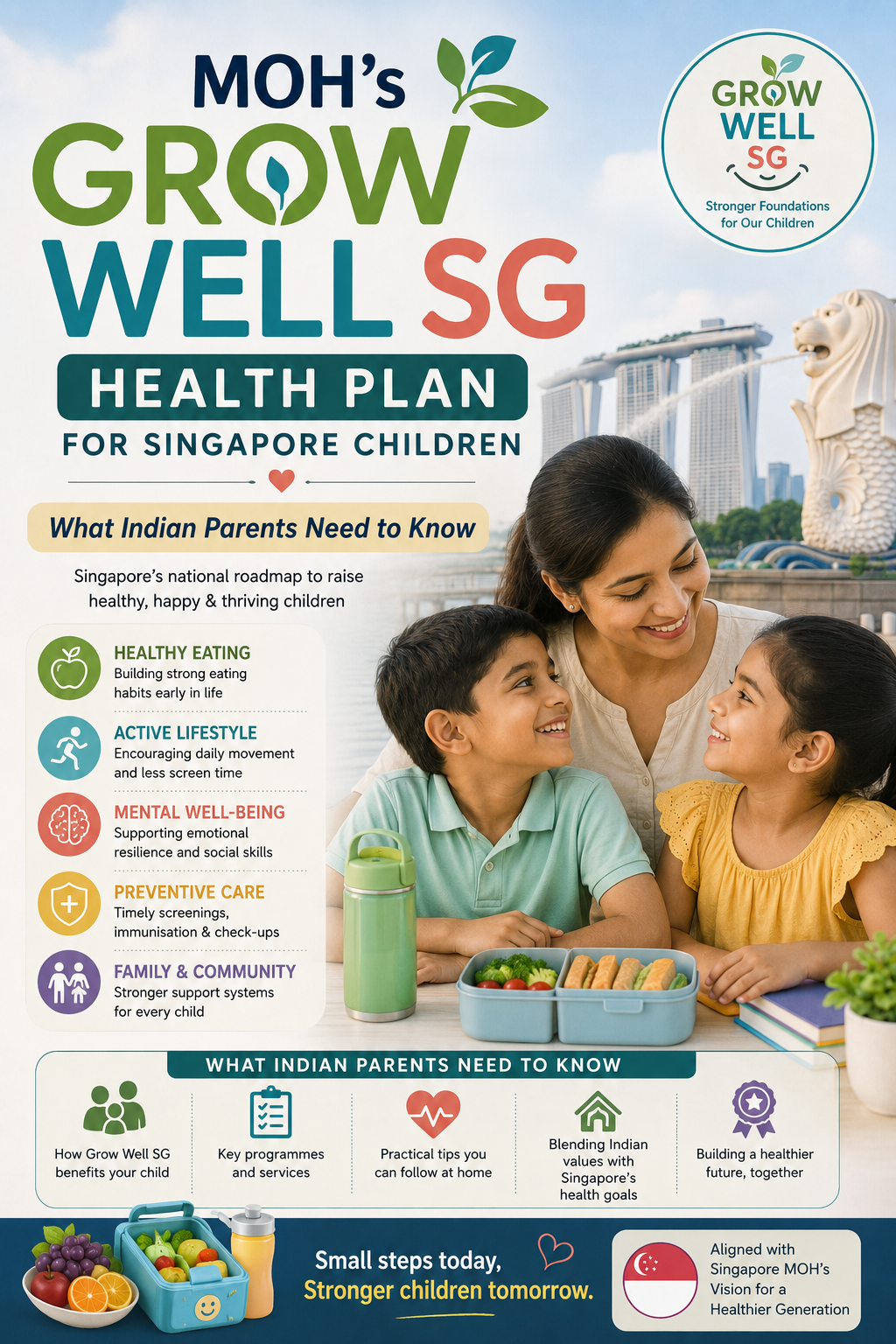
What Is the Grow Well SG Health Plan?
Every child in Primary 1 to Primary 3 receives a personalised Health Plan through HPB’s annual School Health Screening programme, starting from January 2025. Approximately 114,000 Primary 1 to Primary 3 students received their Health Plans in 2025. From January 2026, the programme has expanded to all K1 and K2 children in preschools across Singapore.
The Health Plan includes:
- A Lifestyle Questionnaire completed by parents at the beginning of the school year, covering your child’s current habits across nutrition, physical activity, sleep, and screen time
- School Health Screening results: height, weight, BMI-for-age, vision, dental, and other health assessments conducted annually
- A Lifestyle Prescription: personalised recommendations based on the questionnaire and screening results, generated for each child individually
- Vaccination records and any relevant referrals to public healthcare institutions if screening results indicate a need
- Digital access through HealthHub: parents can view their child’s Health Plan and lifestyle prescription via the HealthHub app or website, and through HPB’s Healthy 365 app
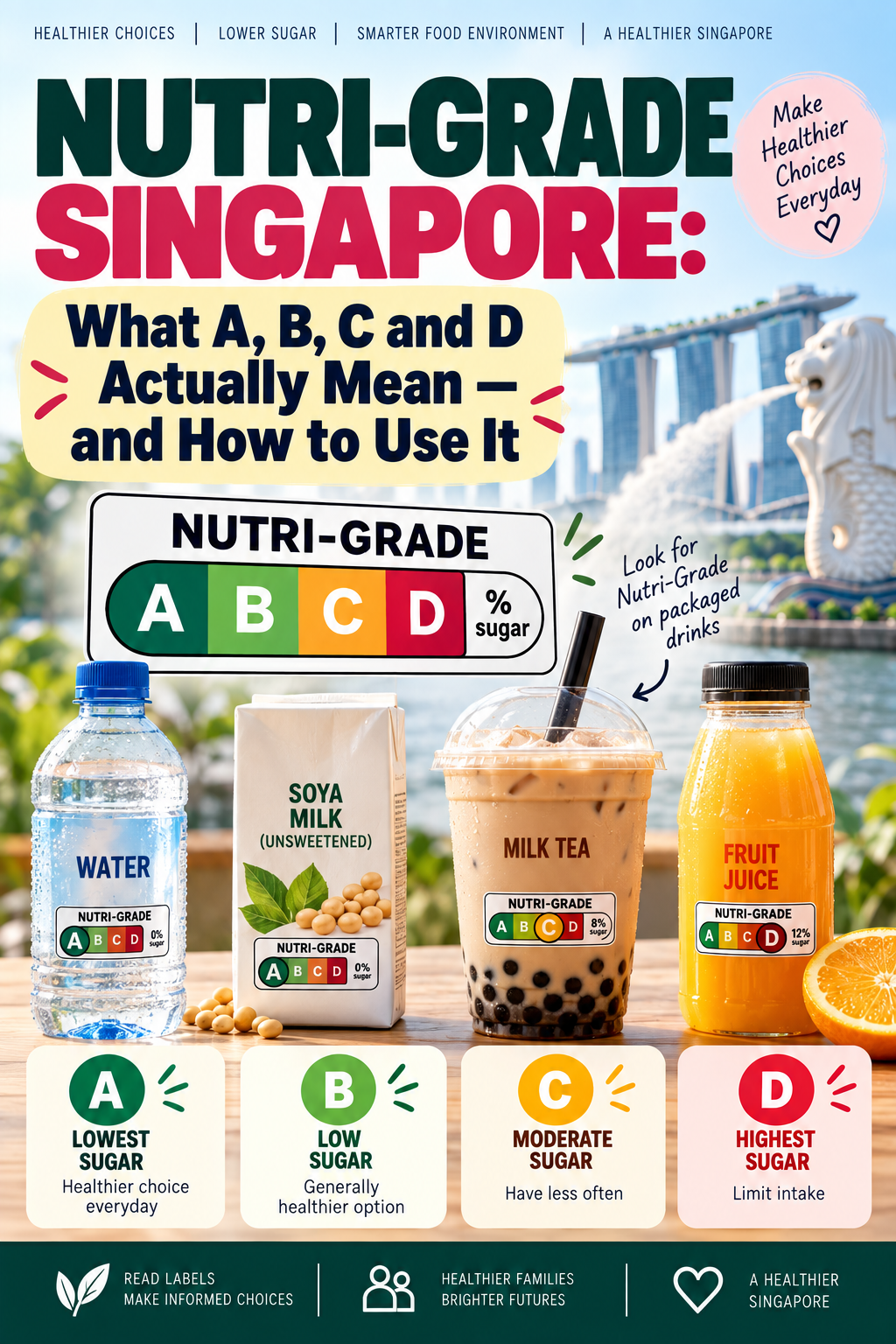
👉Nutri-Grade Singapore — the complete A/B/C/D explanation for beverages and the 2027 extension
References:
- MOH. Grow Well SG — Supporting families in building healthy habits in children. January 2025. moh.gov.sg
- MOH. Health Plan Expanded to More Children. January 2026. moh.gov.sg
- MOH. Start Early for Better Health — Grow Well SG. moh.gov.sg/staying-healthy/growwellsg
The Childhood Health Behaviours Checklist (CHBC): What It Covers
Alongside the school Health Plan, MOH introduced the Childhood Health Behaviours Checklist (CHBC) from 2 May 2025, used during Childhood Developmental Screening visits at all polyclinics, GP clinics, and paediatric clinics for children up to 6 years of age.
The CHBC covers four lifestyle domains:
1. Nutrition
The checklist asks about daily fruit and vegetable intake, frequency of sugar-sweetened beverage consumption, breakfast habits, and whether the child eats a variety of food groups. For Indian parents, the key questions will likely highlight whether your child is eating enough vegetables and fruit alongside the dal-roti pattern, and whether sugar-sweetened drinks (including sweetened Milo, flavoured milk, and packaged fruit drinks) are part of the daily routine.
2. Physical Activity
HPB recommends that children aged 6–17 years accumulate at least 60 minutes of moderate-to-vigorous physical activity daily. The checklist assesses whether your child meets this target. In Singapore’s high-academic-pressure environment, many children, particularly those attending multiple enrichment classes, have severely restricted physical activity time, which directly worsens metabolic risk.
3. Screen Time
MOH’s updated Guidance on Screen Use in Children aged 0–12 provides specific recommendations: zero screen time for children under 18 months (except video calls), less than 1 hour daily for children aged 2–5, and for school-age children, screen time should not displace sleep, physical activity, or family interaction. Singapore’s 2025 update has added more nuanced guidance on educational screen use versus passive consumption.
4. Sleep
Recommended sleep for primary school children (6–12 years) is 9–11 hours per night. Sleep deficiency is one of the most impactful and most underaddressed children’s health issues in Singapore, and it has direct consequences for weight, metabolic health, mood, and cognitive performance.
📌Childhood Obesity in Singapore: What Indian Parents Must Know
📌Healthy School Tiffin for Indian Kids in Singapore (HPB-Aligned)
Understanding the BMI Result in Your Child’s Health Plan
The BMI-for-age result is typically the finding that generates the most parental concern. Here is what the Singapore classification means:
| BMI-for-Age Percentile | Singapore Classification | What This Means |
|---|---|---|
| Below 5th percentile | Underweight | May need nutritional assessment; discuss with paediatrician |
| 5th to <90th percentile | Acceptable weight | Continue healthy habits |
| 90th to <97th percentile | Overweight | Lifestyle intervention recommended; HPB lifestyle coaching available |
| ≥97th percentile | Obese | Medical referral likely; KKH LIFE Centre or NUH paediatric services |
Important note for Indian parents: The BMI-for-age thresholds used in Singapore’s school health programme are based on the WHO reference population. Research suggests that South Asian children may face metabolic risk at lower BMI-for-age percentiles than these thresholds suggest — meaning a child classified as “acceptable weight” may still warrant attention to diet quality and physical activity if their waist circumference is high relative to height or if there is a strong family history of metabolic disease.
If your child is in the overweight or obese category, they may be referred to HPB’s lifestyle coaching programme. Singapore’s 2021 data shows that 64% of participants in this programme achieved BMI reduction of more than 0.5 points or reached an acceptable weight by the end of the six-month programme — demonstrating that the intervention works when engaged with.
What Indian Parents Should Do With the Health Plan Results
If Your Child’s Nutrition Score Is Flagged
The most common nutrition findings for Indian children in Singapore are:
- Insufficient vegetable intake: Indian cooking is vegetable-rich in theory, but many Indian children in Singapore eat selectively, accepting sabzi in limited variety and often preferring plain rice or roti without accompaniments. The Grow Well SG target is at least 2 servings of vegetables daily for school-age children. A “serving” is approximately half a cup of cooked vegetable or one cup of raw leafy greens.
- Excessive sugar-sweetened beverage consumption: Sweetened Milo, Horlicks in milk, packaged fruit drinks, and sweetened lassi are common daily items in Indian children’s diets in Singapore.
- Inadequate fruit intake: HPB recommends 2 servings of fruit daily. Indian families in Singapore often focus heavily on the main meal nutritional content and underserve fruit as a regular snack.
- High ultra-processed snack intake: Biscuits, flavoured chips, and instant noodles as daily after-school snacks are extremely common, and their connection to childhood overweight in Singapore is documented in published Singapore cohort data.
If Your Child’s BMI Is in the Overweight Range
Do not restrict food dramatically or put your child on a formal diet; this approach in children consistently worsens outcomes, creating anxiety around food, disordered eating patterns, and often accelerating weight gain due to metabolic adaptation. The appropriate approach is:
- Improve food quality, not just quantity: Replace ultra-processed snacks with whole foods; add protein to every meal and snack; ensure vegetables are present at lunch and dinner
- Increase physical activity deliberately: 60 minutes of moderate-to-vigorous activity daily; this means active outdoor play, not just PE class twice a week. Swimming lessons, playground time, cycling in the park, or a sport are the most practical Singapore options
- Reduce screen time and protect sleep: Both independently affect appetite hormones (ghrelin and leptin) and metabolic rate; improving these directly supports healthy weight without dietary restriction
- Engage with HPB’s lifestyle coaching programme if referred; it has documented effectiveness in Singapore children
Practical Nutrition for Indian Children in Singapore: Aligned With Grow Well SG
School Tiffin (Lunchbox)
Singapore’s HPB Healthier Choice Symbol programme sets nutritional criteria for lower-sugar, lower-sodium, higher-whole-grain products sold in school canteens. But the most nutritious school tiffin for Indian children is often a home-packed one:
- High protein: Moong dal chilla or masoor dal stuffed into a jowar roti, egg-based preparation, or paneer cubes alongside
- Vegetable: At least one cooked or raw vegetable, cucumber sticks, carrot sticks, roasted cherry tomatoes, or a small portion of a sabzi
- Whole grain carbohydrate: Whole wheat roti, rice, sushi-style rice rolls, or wholegrain bread (with minimum ingredients & no additives)
- Fruit: One whole fruit, guava, banana, grapes, or lychee in season
- Drink: Plain water or plain milk in a reusable bottle, not juice, not sweetened Milo, not flavoured milk
📌The Growth-Smart School Tiffin Recipes Guide
📌Fueling Little Minds: Best School Tiffin Ideas for Singaporean Kids!
After-School Snack (Most Critical Meal to Improve)
The after-school snack is where most Indian children in Singapore consume their highest-sugar, highest-UPF load of the day, biscuits, instant noodles, and sweetened drinks while doing homework. Replace with:
- Roasted chana (available at Mustafa and NTUC) + a guava or banana
- Plain dahi with a drizzle of honey and some almonds
- A small bowl of plain makhana (lotus seeds), available at Mustafa, Phoon Huat, and increasingly NTUC
- Warm moong dal soup (leftover from lunch), protein, fibre, and genuinely filling
📌5 High-Protein & Delicious Snacks for Kids’ Lunch
Doctor-Led Children’s Nutrition · Singapore
Your Child’s Health Plan Has Flagged a Concern, Here’s What to Do Next
MOH’s Health Plan tells you what to improve. I help you figure out how, with personalised, Indian-food-friendly strategies that
actually work for Singapore families. Not generic advice. A plan built around your child’s specific result, age, and eating habits.
|
21-day growth, bone strength & immunity plan |
21 days to a fearless eater |
👉 Not Sure Which Programme? Book a FREE 20-Minute Call
Dr Akanksha Sharma · MBBS MD · Preventive Medicine Physician · Singapore
Frequently Asked Questions
My child received their Health Plan, but I don’t know how to access it. Where do I look?
Log in to the HealthHub app (available on iOS and Android) using your SingPass account. Your child’s Health Plan should be visible in the Family section if they have been screened. You can also access it via the HPB Healthy 365 app once a child profile has been created for your child. If you cannot find it, contact your child’s school or the HPB School Health Service; the school nurse or administrative team can direct you to the right access point.
My child’s BMI is in the “acceptable weight” range, but they look quite chubby. Should I be concerned?
BMI-for-age is a population-level screening tool, not a precise individual measure of body composition. A child with a high proportion of body fat but also significant height may fall within the “acceptable” BMI range while having metabolically unfavourable body composition. For Indian children specifically, body composition (fat versus muscle ratio) is a more sensitive indicator of metabolic risk than BMI alone. If you have concerns about your child’s body composition, physical activity level, or energy levels despite a “normal” BMI result, discuss this with your paediatrician or polyclinic doctor — and consider a dietary review to ensure the pattern supports muscle development alongside appropriate body fat.
The Health Plan recommended my child eat more vegetables. How do I get an Indian child to eat vegetables when they refuse?
This is the most practical challenge for most Indian parents in Singapore, and it has evidence-based answers. The key principles: repeated low-pressure exposure (offer a small amount of the vegetable alongside accepted foods without pressure to eat it, children typically accept a new food after 10–15 exposures), including the child in vegetable preparation (children who help prepare food are more likely to eat it), naturally sweet vegetables as entry points (sweet potato, pumpkin, sweet corn, which appeal to children’s innate sweet preference), and disguising vegetables in dal or paratha filling as a transitional strategy while building broader acceptance. See our picky eater post for the full evidence-based framework.
My child drinks two glasses of Milo every day. Is this really a problem?
Yes, and this is a specific Singapore Indian parenting challenge worth addressing directly. Two glasses of Milo daily (assuming standard preparation with 3 teaspoons of Milo powder each) adds approximately 14–18g of added sugar from the Milo powder alone, before accounting for the child’s food intake. This represents 50–60% of the WHO’s recommended daily free sugar limit for a school-age child, from a single drink type. The Singapore NPHS data confirms that sugar-sweetened beverages are among the top contributors to excess calorie intake in Singapore children. Transitioning to plain warm milk (or plain milk with a banana blended in for natural sweetness) over 2–4 weeks is the most practical replacement strategy.
📌Picky Eater Solutions — evidence-based strategies for getting Indian children to eat vegetables
📌Is Protein Deficiency Common in Singapore Children? (A Doctor’s Reality Check)
The Bottom Line
Grow Well SG’s personalised Health Plans and Childhood Health Behaviours Checklist are Singapore’s most comprehensive and most systematic attempt yet to catch childhood health concerns early, before they become the adult diabetes, hypertension, and metabolic disease that MOH is trying to prevent. For Indian parents, the programme is an opportunity: a free, professionally developed assessment of your child’s health behaviours, with personalised prescriptions available digitally via HealthHub. The nutritional actions it calls for- more vegetables, less sugar, more physical activity, better sleep- are the same ones this series has documented with evidence across 60 posts. The Health Plan gives you an individual starting point. Act on it specifically for your child, with the Indian food strategies above as the practical how.
Doctor-Led Children’s & Family Nutrition · Singapore
Grow Well SG Tells You the Goal. We Help Your Family Get There.
Whether your child needs to grow stronger, your teen needs focus and energy for school, or your whole family needs a reset that works from one kitchen, choose the programme that fits right now:
|
||
|
||
|
Not sure which programme fits your child or family? Let’s talk, 20 minutes, no pressure, clear next step.
👉 Book a FREE 20-Minute Children’s Nutrition Discovery Call
Dr Akanksha Sharma · MBBS MD · Preventive Medicine Physician ·
Singapore & worldwide via Zoom
Disclaimer: This article is for educational purposes only. If your child’s Health Plan indicates a concern that requires medical follow-up, please engage with your polyclinic, paediatrician, or the HPB lifestyle coaching programme as recommended.
References:
- MOH. Grow Well SG — Supporting families in building healthy habits. January 2025. moh.gov.sg
- MOH. Health Plan Expanded to More Children. January 2026. moh.gov.sg
- MOH. Supporting Health and Well-Being Across Every Life Stage. 2025. moh.gov.sg
- MOH. Obesity Trend and Programmes — Singapore. moh.gov.sg
- SingHealth Polyclinics. Grow Well, Live Well: The Rollout of the CHBC. 2025. singhealth.com.sg

Akanksha Sharma
Dr Akanksha Sharma (MBBS, MD) is a physician and women’s health nutrition specialist, and the founder of IYSA Nutrition. She provides evidence-based, doctor-led nutrition guidance for pregnancy, postpartum recovery, PCOS, child nutrition, and family health, helping women make calm, informed decisions about their health and their children’s well-being.