Written & reviewed by Dr Akanksha Sharma, MBBS, MD (Preventive & Community Medicine) | Founder, IYSA Nutrition, Singapore
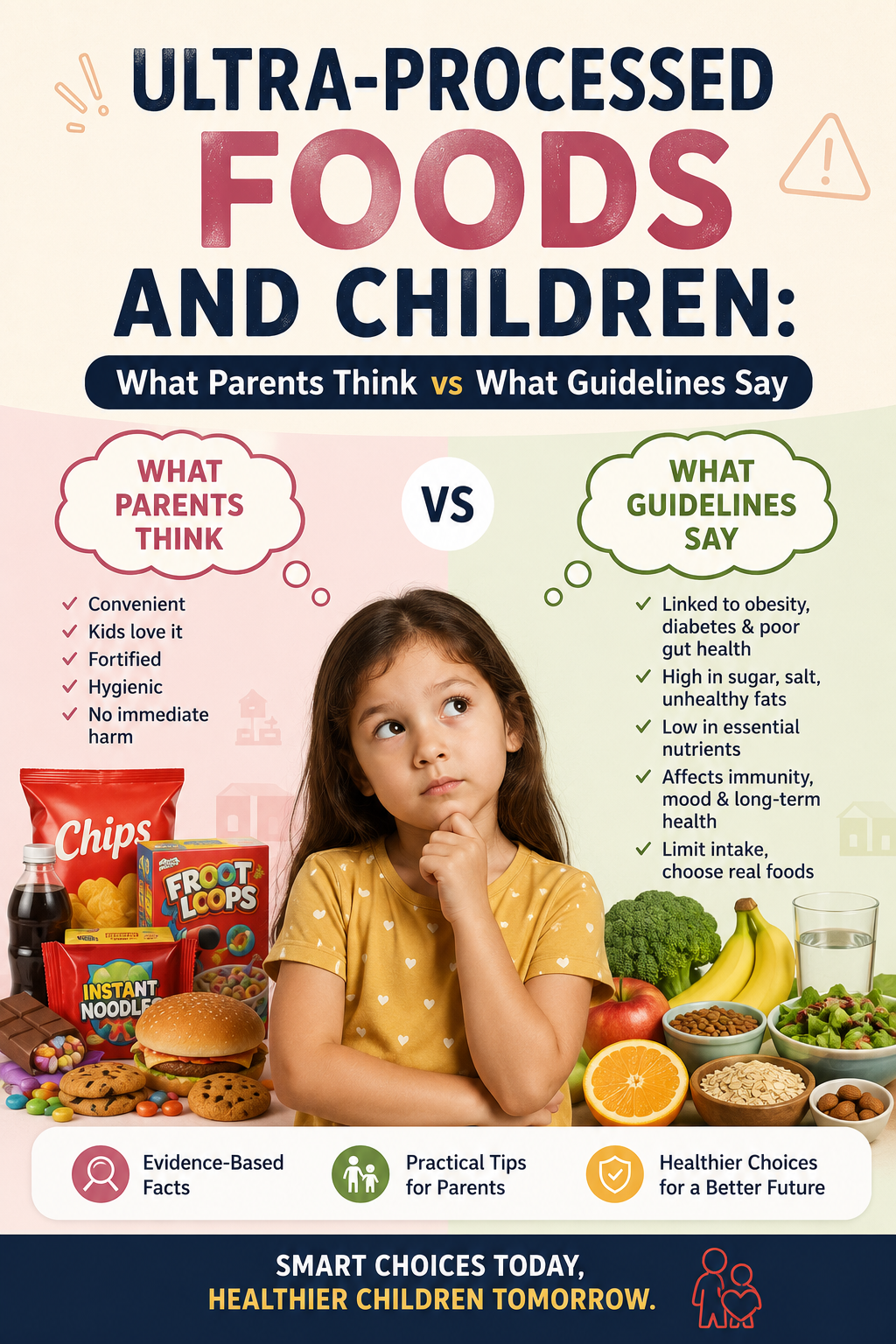
If you ask most Indian parents whether their children eat junk food, most will say no. They will point to the dal and roti at lunch, the dahi at dinner, the fruit in the lunchbox. What they may not fully account for are the biscuits eaten between meals, the packaged fruit drink in the lunchbox, the flavoured milk powder stirred into the bedtime glass, the instant noodles on the weekend, the packaged namkeen in front of the TV, and the cereal at breakfast. None of these feels like “junk food”, and yet the World Health Organisation’s analysis of ultra-processed food trends in India specifically includes all of them.
This post is about the gap between what parents think their children are eating and what the evidence shows they are actually eating, and about the specific foods that the science most clearly links to harm in children, which you can begin reducing immediately.
📌MOH’s Grow Well SG Health Plan for Singapore Children: What Indian Parents Need to Know
📌Hidden Sugar in Indian Kids’ Snacks (And Healthier Swaps)
📌Healthy Snacks for Kids Without Cooking
What Is Ultra-Processed Food? The NOVA Classification
The NOVA food classification system, developed by researchers at the University of São Paulo, Brazil, and adopted by the WHO and multiple national health bodies globally, classifies foods into four groups based not on their nutritional content alone but on the degree and purpose of industrial processing:
- Group 1 — Unprocessed or minimally processed foods: Fresh, frozen, or dried whole foods with no additives. Whole fruits, vegetables, legumes, whole grains, fresh meat, milk, plain yoghurt, eggs. This is where children’s diets should be centred.
- Group 2 — Processed culinary ingredients: Oils, butter, ghee, flour, salt, sugar. Used in cooking and preparation; not eaten alone; typically consumed in small amounts as part of Group 1 foods.
- Group 3 — Processed foods: Foods made from Group 1 or Group 2 ingredients with simple processing, canning, fermenting, salting. Canned tomatoes, salted nuts, canned fish, homemade cheese, traditionally fermented foods. Generally acceptable and nutritionally reasonable.
- Group 4 — Ultra-processed foods (UPFs): Industrial formulations containing multiple ingredients not used in home cooking, emulsifiers, stabilisers, artificial flavours, colours, sweeteners, hydrogenated oils, modified starches, designed for hyper-palatability, long shelf life, and to be eaten without cooking. This is the category of concern.
Ultra-processed foods are not simply “food with added ingredients.” They are foods in which whole food ingredients have been substantially replaced by industrially processed components, and in which additives serve primarily commercial functions, extending shelf life, intensifying flavour beyond what natural ingredients can achieve, or preventing separation. A dal cooked at home with oil and salt is not ultra-processed. An instant noodle packet is.
📌Picky Eating Solutions: A Doctor-Backed Nutrition Guide
📌Screen Time and Sleep: How Your Child’s Diet Affects Both
How Common Are Ultra-Processed Foods in Indian Children’s Diets?
The WHO Country Office for India published a report in 2023, The Growth of Ultra-Processed Foods in India: An Analysis of Trends, Issues and Policy Recommendations, that documents the rapid expansion of UPF consumption across India, particularly among children and young people in urban populations.
A cross-sectional study of maternal and child ultra-processed food and sugar-sweetened beverage (UPF/SSB) consumption in Mumbai’s informal settlements found that approximately 60% of children consumed sweet snacks and chips or biscuits daily. The study documented that children’s daily consumption of UPF and SSBs was approximately four times higher than their mothers’ consumption, reflecting both the specific targeting of children by UPF marketing and the normalisation of packaged snacks in children’s diets.
The Food Safety and Standards Authority of India (FSSAI) has responded with an “Eat Right Movement” that bans UPFs and pre-packaged foods inside schools and within 50 metres of school campuses, a regulatory acknowledgement that UPF exposure is a significant enough public health concern in Indian children to warrant specific protective measures at the school environment level.
👉ADHD in Children: Causes, Prevalence & Management Guide
👉Cancer-Causing Substances Recently Banned in Food by the FDA: A Step Toward Safer Consumption
What Parents Think vs What Is Actually Happening
The disconnect between parental perception and children’s actual UPF intake is well-documented. Research on parental perceptions of UPF specifically finds that parents consistently underestimate their children’s UPF consumption because:
- Marketing works: Products positioned as “healthy,” “fortified,” “natural,” or “whole grain” are not intuitively recognised as ultra-processed by parents, even when they contain emulsifiers, artificial flavours, and multiple additives that classify them as Group 4 by NOVA. Many “health” snack bars, fortified cereals, flavoured dairy products, and “multigrain” packaged products are ultra-processed by NOVA classification despite their health-positive packaging.
- Incremental exposure is invisible: No individual serving of biscuits, flavoured milk, or instant noodles feels like a meal, so parents do not count them the way they count proper meals. But three servings of biscuits across the day, a packaged fruit drink at lunch, and a flavoured yoghurt as an afternoon snack represent substantial UPF exposure that accumulates without being perceived as problematic.
- Cultural normalisation: Some ultra-processed products have been part of Indian children’s food culture for long enough that they feel like normal, safe foods. Bournvita and Horlicks have been present in Indian households for generations. Parle-G biscuits are culturally iconic. Familiarity is confused with safety.
- Limited label literacy: Most parents read labels for sugar and fat content, not for NOVA classification markers like emulsifiers (E numbers), artificial flavours, or modified starches that classify a product as ultra-processed regardless of its macronutrient profile.
📌Why Are So Many Kids Becoming Fussy Eaters?
📌How to Know If Your Child Is Getting Enough Protein!
What the Research Shows About UPF and Children’s Health
A systematic review and meta-analysis examining the association between ultra-processed food consumption and obesity and adiposity in children and adolescents confirmed a positive association between UPF consumption and adiposity parameters in children — consistent with findings in adults. Ultra-processed foods contribute to childhood obesity through multiple mechanisms: they are hyperpalatable (designed to override satiety signals), energy-dense, low in fibre and protein (the nutrients that promote satiety), and high in additives that may directly disrupt metabolic and gut health.
A comprehensive review of the impact of UPFs on paediatric health (2025) synthesised evidence across epidemiological data, mechanistic studies, and policy perspectives, finding that UPF consumption in children is associated with increased risk of obesity, cardiovascular risk factors, dental caries, poor diet quality, and, in emerging evidence, adverse mental health outcomes including depression and anxiety.
The WHO’s Nutrient Profile Model (2023) assessment of products marketed to children found that the vast majority of products in the packaged food market that are specifically targeted at children would not meet WHO criteria for appropriate marketing to children, because most are ultra-processed and nutritionally inadequate.
📌Healthy Baking: Don’t Deprive Your Kids & Don’t Compromise on Health
📌10 things that compromise child immunity & ways to fight them
What to Completely Avoid for Children: The Priority List
I want to be practical and specific here, because a list of “foods to avoid” that is too broad becomes paralysing. The following are the categories most clearly linked to harm in children, ranked by the strength of evidence and the degree to which they should be restricted:
Tier 1: Eliminate or Near-Eliminate
These have the strongest evidence for harm and the lowest nutritional value. There is no meaningful nutritional argument for their regular inclusion in children’s diets:
- Sugar-sweetened beverages (SSBs): Cola, Fanta, Sprite, Frooti, Maaza, Appy, Tropicana and similar packaged fruit drinks, Rasna-type drink powders, flavoured electrolyte drinks, energy drinks. These are the highest-evidence category for harm, associated with childhood obesity, type 2 diabetes risk, dental caries, and displacement of nutritionally valuable drinks. There is no minimum safe intake for children. Zero is appropriate as the default.
- Packaged savoury snacks with artificial flavours and MSG: Flavoured potato chips, puffed corn snacks (Cheetos-type), instant noodles (Maggi and similar), flavoured extruded snacks. High in sodium, artificial flavours, hydrogenated fat in many formulations, and very low in any nutritional value. They are specifically engineered to be hyperpalatable, to override satiety and drive continued consumption.
- Confectionery and heavily processed sweets: Commercially produced toffees, lollipops, packaged chocolate products with long ingredient lists, commercial candy. Not the same as traditional Indian mithai made from real dairy, jaggery, and nuts, which, while high in sugar, at least have nutritional ingredients.
Tier 2: Significantly Restrict (Occasional, Not Daily)
These are widely consumed daily by Indian children but should be reduced to occasional treats rather than daily staples:
- Commercial biscuits of all types: Including “digestive” biscuits, glucose biscuits, cream biscuits, and especially chocolate-coated varieties. All are ultra-processed regardless of packaging claims. Replace with roasted chana, plain makhana, whole fruit, or homemade snacks as daily staples.
- Flavoured health drinks added to milk (Bournvita, Horlicks, Complan, Boost): Sugar-containing additives to milk that add 7–10g of sugar per serving and are ultra-processed formulations. Plain milk provides the nutrition; the powder adds sugar and palatability primarily. Reduce gradually and replace with plain milk.
- Packaged breakfast cereals: Particularly sweetened, coloured, cartoon-branded varieties. Replace with plain rolled oats, ragi porridge, or egg-based breakfasts.
- Flavoured yoghurt and packaged dahi: Commercial flavoured fruit yoghurts are ultra-processed; plain dahi is Group 3 (processed but acceptable). Replace flavoured with plain dahi plus fresh fruit.
- Instant noodles: High sodium, ultra-processed, low nutritional value. Should be occasional at most, not a regular meal.
- Packaged fruit juice (all types, including “100% natural”): replace with whole fruit.
Tier 3: Be Selective and Label-Check
Some products exist on a spectrum from minimally processed to ultra-processed depending on formulation:
- Bread and packaged rotis: Commercially produced bread typically contains emulsifiers, dough conditioners, and preservatives, ultra-processed by NOVA. Homemade roti from whole wheat or millet flour is Group 1–2. If buying bread, choose versions with the shortest ingredient list and no E-number additives.
- Frozen vegetables and plain canned legumes: These are Group 3, processed but acceptable. Canned rajma, frozen peas, and frozen spinach (without sauces or additives) are fine choices for convenience.
- Ready-to-eat Indian snack mixes: Bhujia, chevdo, and chivda from reputable producers using minimal additives may be Group 3; heavily flavoured commercial versions with MSG and artificial flavours are Group 4. Read the ingredients.
📌How to Pack A Nutritious and Fun Lunch Box for Your Kids
📌5 High-Protein & Delicious Snacks for Kids’ Lunch
📌Childhood Obesity in Singapore: What Indian Parents Must Know
How to Read Labels for Ultra-Processing
The NOVA classification is not printed on food labels; you have to assess it from the ingredients list. These are the red flags that identify a product as ultra-processed regardless of its nutritional claims:
- Emulsifiers: soy lecithin, mono- and diglycerides, polysorbate 80, carrageenan
- Artificial flavours: “natural flavour,” “artificial flavour,” or any named synthetic flavour compound
- Artificial colours: tartrazine (E102), sunset yellow (E110), brilliant blue (E133), and other E-number colours
- Hydrogenated or partially hydrogenated vegetable oil (trans fats)
- Modified starches: modified corn starch, tapioca starch, hydroxypropyl starch
- Artificial sweeteners: aspartame, acesulfame K, sucralose, saccharin (particularly in “sugar-free” or “diet” children’s products)
- Preservatives: sodium benzoate, potassium sorbate, BHA, BHT
- High-fructose corn syrup, glucose-fructose syrup, or maltodextrin high in the ingredients list
A simple rule: if the ingredients list has more than 5–6 items and contains any of the above, the product is ultra-processed. If your child cannot pronounce most of the ingredients, it is almost certainly ultra-processed.
Worried your child is eating “too little” or too selectively?
👉 Book a child nutrition consult (FREE) (Singapore-friendly, practical, doable meal plans).
What to Replace UPFs With: A Practical Indian Guide
| Ultra-Processed Food | Practical Indian Replacement |
|---|---|
| Packaged fruit juice | Whole fruit + plain water |
| Commercial biscuits | Roasted chana, plain makhana, homemade ragi laddoo |
| Flavoured health drink powder in milk | Plain warm milk (with a teaspoon of jaggery if sweetness is needed) |
| Sweetened breakfast cereal | Plain rolled oats or ragi porridge with banana and a teaspoon of jaggery |
| Instant noodles | Homemade poha, upma with vegetables, or khichdi |
| Packaged chips and extruded snacks | Homemade roasted chana, plain makhana, cucumber with homemade chutney |
| Flavoured dahi | Plain dahi + fresh mango, banana, or a few raisins added at home |
| Packaged namkeen with MSG | Homemade murmura (puffed rice) with lime, coriander and minimal spice |
| Cola and flavoured drinks | Coconut water, plain water with lime, plain chaas |
📌Why Zinc Deficiency is common in Indian Kids (And How to Fix It)
Frequently Asked Questions
Is Maggi (instant noodles) really so harmful? My child has it once a week.
Once a week as an occasional food in an otherwise varied, whole-food-based diet is meaningfully different from daily or frequent consumption. The concern with instant noodles is high sodium content, refined flour as the primary ingredient, very low protein and fibre, and the flavouring sachet containing MSG, artificial flavours, and high sodium. One serving per week for a child eating well otherwise is unlikely to cause measurable harm. The problem is that for many Indian urban children, instant noodles are a regular rather than occasional food, and the combination of this with daily biscuits, packaged juice, and flavoured milk creates a diet where UPFs form a very large proportion of total intake.
My child refuses to eat anything except packaged snacks. How do I transition?
The most effective approach is gradual replacement rather than sudden elimination, for two reasons. First, abrupt removal of all familiar foods creates conflict and anxiety that entrenches the preference further. Second, taste preferences can and do shift when sweet and ultra-palatable foods are gradually reduced; the hyperpalatability of UPFs literally dulls the palate’s ability to appreciate less intensely flavoured whole foods, and this recalibrates over 2–4 weeks of reduction. Start by replacing one UPF item per week with a whole food alternative. See Day 25 (Picky Eater Solutions) for the full evidence-based framework on managing food selectivity in children.
What about Indian commercial snack brands positioning themselves as “healthier”? Multigrain chips, millet-based puffs, etc.?
Many of these products are clever marketing rather than meaningful nutritional improvement. A millet-based puffed snack with artificial flavouring, high sodium, and a list of additives remains ultra-processed by NOVA classification despite the millet front-of-pack claim. Read the ingredients list, not the marketing claims. If the ingredient list is long and contains the additives listed above, it is ultra-processed, regardless of whether the lead ingredient is millet, ragi, or quinoa. A short, recognisable ingredient list (roasted makhana with salt and turmeric, for example) is what indicates a genuinely less processed product.
Are school canteen foods in Singapore better regulated?
Singapore’s Health Promotion Board (HPB) has implemented the Healthier Choice Symbol (HCS) programme, which sets criteria for lower sugar, lower sodium, and higher whole grain content for products sold in school canteens. Singapore schools are also required to have at least one healthier food option at each food stall. While these measures meaningfully improve the nutritional standard of what is sold in school canteens compared to unregulated settings, they do not eliminate ultra-processed options and do not apply to foods brought from home. HPB’s programmes represent a meaningful regulatory effort, but parental choices about home food environment remain the primary determinant of a child’s overall diet quality.
The Bottom Line
Ultra-processed foods are far more prevalent in Indian children’s diets than most parents recognise, because the marketing of these products is sophisticated, their cultural embedding is deep, and the definition of “junk food” in most parents’ minds is narrower than the evidence warrants. The NOVA classification provides the clearest available framework for identifying them: if it has a long list of industrial additives designed for hyperpalatability and shelf life rather than nutrition, it is ultra-processed, and its regular consumption by children is associated with measurable health harm.
The practical response is not perfection; it is consistent direction of travel: more whole foods, fewer packages; more cooking, less opening; more plain water, fewer sweet drinks; more roasted chana and whole fruit, fewer biscuits and flavoured yoghurts. These changes do not require a complete dietary overhaul. They require one substitution at a time, sustained over weeks and months, until the child’s food environment is more whole food than ultra-processed by default.
💛 Want structured guidance? 📩 Click here to book a FREE consultation with Dr Akanksha Sharma
👉 Explore my programs:
-
Little Legends: The Doctor-Designed Growth & Strength Plan for Kids (ideal for malnourished kids and picky-eaters)
- Teen Fuel: Doctor-Guided Nutrition & Routine Reset for Teenagers (Ages 12–19)
Disclaimer: This article is for educational purposes only. Individual children’s dietary needs vary — consult your paediatrician or a qualified nutrition specialist for personalised guidance.
References:
- Kumar A et al. Maternal–child consumption of ultra-processed foods in Mumbai, India. J Health Popul Nutr. 2023. PMC Full Text
- WHO. The Growth of Ultra-Processed Foods in India: An Analysis of Trends, Issues and Policy Recommendations. 2023. who.int/india
- Ultra-processed foods and obesity and adiposity parameters among children and adolescents: a systematic review. Nutr Metab Cardiovasc Dis. 2022. PMC Full Text
- The impact of ultra-processed foods on pediatric health. ScienceDirect. 2025. Full Text
- High sugar content in baby food: an Indian perspective. Lancet Diabetes Endocrinol. 2019. Lancet

Akanksha Sharma
Dr Akanksha Sharma (MBBS, MD) is a physician and women’s health nutrition specialist, and the founder of IYSA Nutrition. She provides evidence-based, doctor-led nutrition guidance for pregnancy, postpartum recovery, PCOS, child nutrition, and family health, helping women make calm, informed decisions about their health and their children’s well-being.