Written & reviewed by Dr Akanksha Sharma, MBBS, MD (Preventive & Community Medicine) | Founder, IYSA Nutrition, Singapore
Turmeric (haldi) is one of the most recognisable spices in Indian cooking, woven into everything from daily dal to ceremonial milk. In recent years, it has also become one of the most heavily marketed “superfoods” globally, with curcumin supplements promising to fight inflammation, ease joint pain, and protect against chronic disease.
As someone who cooks with turmeric daily and is regularly asked about it in clinic, I want to give you a genuinely honest answer about what the research shows, not the inflated claims of supplement marketing, and not a dismissal of a spice with real pharmacological activity. The actual picture, once you look closely at the meta-analyses, is more nuanced than either extreme.
👉Flax Seeds: Nutritional Powerhouse for Heart, Gut, & Metabolism
👉Chia Seeds 101: How to Eat, How Much & Their Benefits
What Curcumin Is and Why It Has Attracted Research Interest
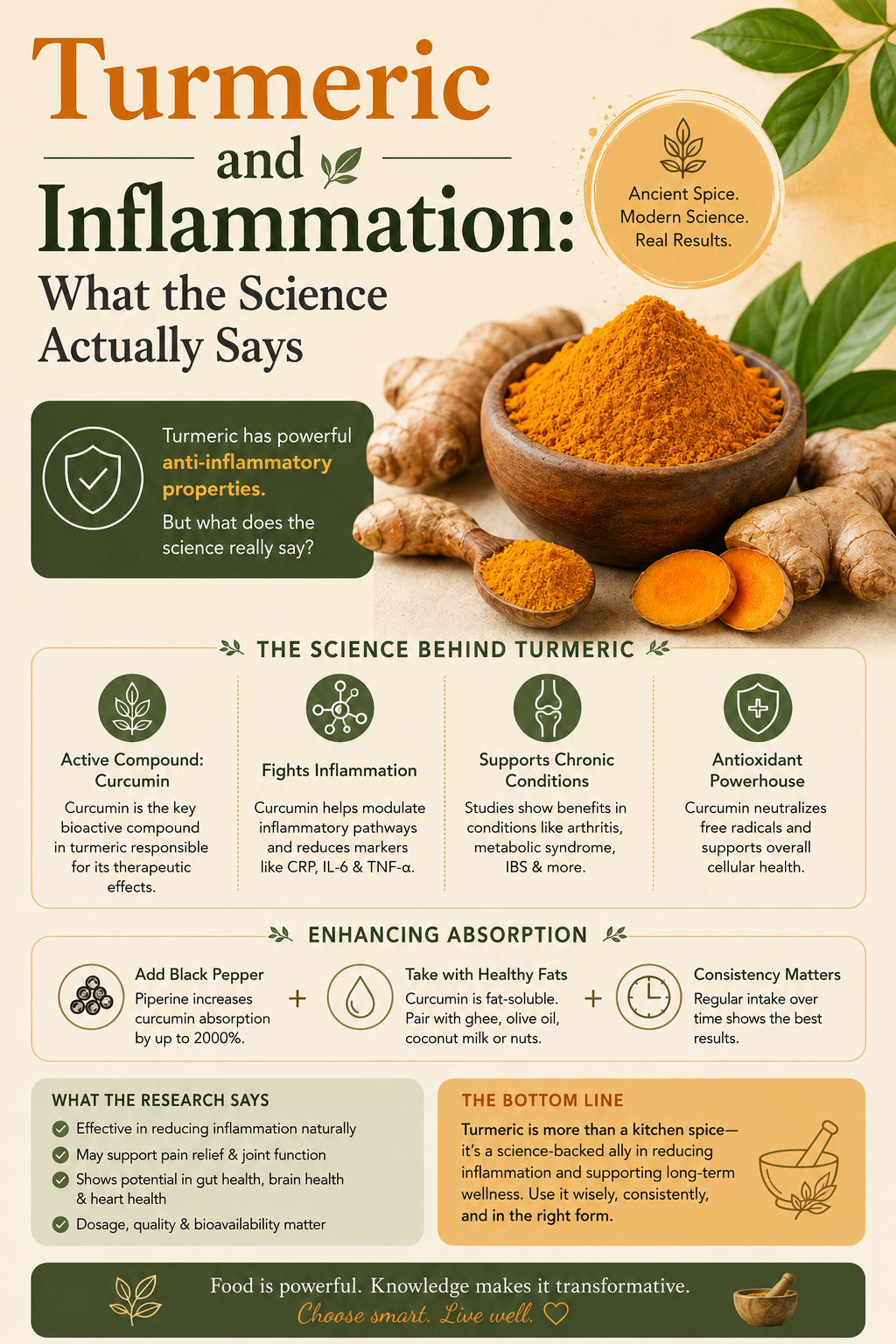
Curcumin is the primary bioactive polyphenol in turmeric, and it has well-documented anti-inflammatory and antioxidant properties at the cellular and molecular level, this part is genuinely well-established laboratory science, demonstrated across hundreds of in-vitro and animal studies. The translation from laboratory findings to clinically meaningful effects in human trials, however, is where the evidence becomes considerably more mixed, and this is the gap that matters most for anyone deciding how much weight to put on turmeric for a specific health concern.
👉IBS in Women: Managing Irritable Bowel Syndrome Through Diet
What the Meta-Analyses Actually Show
Because curcumin has now been studied across many human conditions, we have a useful body of systematic reviews and meta-analyses to draw on, rather than relying on any single trial. The picture across them is mixed, and that mix is itself the most honest answer.
General Inflammatory Markers: Inconsistent Results
A systematic review and meta-analysis of 19 randomised controlled trials, examining turmeric or curcumin’s effect on inflammatory markers in people with chronic inflammatory conditions including rheumatic disease, chronic kidney disease on haemodialysis, metabolic syndrome, and cardiovascular disease, found that turmeric or curcumin did not significantly decrease levels of CRP, high-sensitivity CRP, IL-1 beta, IL-6, or TNF-alpha compared to controls. The authors specifically noted high heterogeneity of effects across studies.
Reference: Oral turmeric/curcumin effects on inflammatory markers in chronic inflammatory diseases: A systematic review and meta-analysis of randomized controlled trials. PubMed PMID 31121255
This is an important finding, and one that does not typically make it into popular wellness content. It does not mean curcumin has zero biological effect, but it does mean that, across this set of well-conducted trials in real chronic disease populations, the effect on standard inflammatory blood markers was not statistically reliable.
Other Meta-Analyses: More Favourable, Different Populations
Other systematic reviews and meta-analyses, examining different combinations of studies, populations, and outcome markers, have found more favourable results for curcumin on inflammatory and oxidative stress markers, including reviews specifically in people with prediabetes and type 2 diabetes, and reviews focused on antioxidant markers such as total antioxidant capacity and malondialdehyde. A meta-analysis specific to knee osteoarthritis also found beneficial effects of curcumin on inflammatory biomarkers in that condition.
This pattern- some meta-analyses finding benefit, others finding none, depending on the population, the specific curcumin formulation and dose, the outcome measured, and the studies included- is a hallmark of an active but still-maturing area of research, rather than settled, consistent evidence either for or against curcumin’s effects on inflammation.
Why the Results Vary So Much
Several factors plausibly explain the inconsistency across studies, beyond simple chance:
- Bioavailability: Curcumin is poorly absorbed in its natural form; studies using standard turmeric or unformulated curcumin may show smaller effects than studies using bioavailability-enhanced formulations (such as those combined with piperine from black pepper, or specially processed curcumin complexes)
- Dose and duration: Trials vary considerably in dose and length of follow-up, typically ranging from 4 to 16 weeks, which may be too short to detect effects on some chronic disease markers
- Population and baseline inflammation: Effects may be more detectable in populations with higher baseline inflammation (such as those with active disease) than in healthier populations
- Outcome measured: Curcumin may affect some inflammatory pathways or markers more than others, and studies do not consistently measure the same panel of markers
👉Top Fat-Burning Foods & Ayurvedic Herbs That Actually Work
Where the Evidence Is More Consistently Positive
Despite the mixed picture on general inflammatory blood markers, certain specific clinical applications of curcumin have somewhat more consistent supportive evidence across multiple trials and reviews:
Knee Osteoarthritis
Multiple systematic reviews and meta-analyses, including a 2021 review on turmeric extracts for knee osteoarthritis and more recent analyses, have found that turmeric/curcumin supplementation, often in bioavailability-enhanced forms, can meaningfully reduce pain and inflammatory markers in people with knee osteoarthritis, with at least one trial showing non-inferiority compared to paracetamol for pain relief. This is one of the better-supported specific applications of curcumin in the clinical literature.
Mood Support
As referenced in Day 18 of this series, curcumin has shown promising results in trials for depressive symptoms, and a 2022 review specifically explored curcumin’s potential role in major depressive disorder, summarising a body of evidence that, while still developing, is more consistent than the general inflammatory marker literature.
👉A 10-Day Liver Support Diet: Thank Us Later!
The Bioavailability Problem — and Black Pepper
Whatever curcumin’s true effects turn out to be in any given condition, they depend heavily on the body actually absorbing enough of it. Curcumin is poorly water-soluble and is rapidly metabolised, meaning a large proportion of an oral dose is not absorbed into the bloodstream in its active form. This is part of why studies using standardised, bioavailability-enhanced formulations sometimes show different results from studies using plain turmeric powder.
Piperine, the active compound in black pepper, is well-documented to inhibit some of the metabolic pathways that break curcumin down, increasing its bioavailability substantially when the two are consumed together. This is precisely the traditional Indian cooking practice of combining turmeric with black pepper, and it remains a sound, low-cost, low-risk habit regardless of how the broader inflammatory marker debate eventually settles, simply because it improves the absorption of whatever beneficial compounds turmeric does contain.
👉10 Healing Ayurvedic Herbs Every Woman Should Know About
Safety
At typical culinary doses used in Indian cooking, turmeric is widely regarded as safe, with an extensive history of use as both a food and traditional medicine. At higher supplemental doses, curcumin is generally well tolerated in clinical trials, though mild gastrointestinal effects have occasionally been reported, and people on blood-thinning medication or with gallbladder disease should discuss higher-dose curcumin supplementation with their doctor, as curcumin can affect platelet function and bile flow at higher doses.
👉 Struggling with weight or energy despite “doing everything right”?
A structured, hormone-aware approach can make the difference. Click here to book a FREE 20-minute consultation call.
What This Means Practically
Bringing this together honestly: turmeric and curcumin have clear, well-established anti-inflammatory and antioxidant activity at the laboratory level, and some specific clinical applications, knee osteoarthritis and, to a developing extent, mood support, have reasonably consistent positive trial evidence. The broader claim that turmeric reliably “reduces inflammation,” measured by standard inflammatory blood markers across general or chronic disease populations, is not consistently supported across the available meta-analyses; some show benefit, a substantial one shows none.
This does not mean turmeric should be removed from your cooking. It is a nutritious spice with a strong safety profile at culinary doses, genuine bioactive compounds, and at minimum some evidence of benefit in specific contexts. What it does mean is that turmeric should not be oversold as a guaranteed anti-inflammatory solution for general health, and that anyone considering high-dose curcumin supplementation for a specific medical condition should discuss realistic expectations, appropriate formulation, and safety with their doctor, rather than assuming uniform, well-established benefit.
Frequently Asked Questions
Should I take a curcumin supplement instead of just cooking with turmeric?
This depends on your goal. For general dietary inclusion and the modest, accumulated benefit of a nutritious spice used regularly, cooking with turmeric (paired with black pepper for better absorption) is reasonable and low-risk. For a specific condition such as joint pain where the evidence is somewhat stronger, a standardised, bioavailability-enhanced curcumin supplement, used at the doses studied in trials and discussed with your doctor, is more likely to approach the effects seen in research than culinary use alone, given the bioavailability limitations described above.
Why do some studies show curcumin works and others do not?
As discussed above, this largely reflects differences between studies in the formulation and bioavailability of the curcumin used, the dose and duration of treatment, the specific population studied (and their baseline level of inflammation), and which inflammatory markers were measured. This is a normal feature of an active, still-developing area of nutritional science, and it is more honest to describe the evidence as mixed and population/context-dependent than to claim it is uniformly settled in either direction.
Is it worth adding black pepper to turmeric in my cooking?
Yes, this is a low-cost, well-supported practice. Piperine in black pepper measurably increases curcumin absorption, and traditional Indian cooking already combines the two extensively. Regardless of the unresolved questions about curcumin’s clinical effects on inflammatory markers, improving absorption of whatever beneficial compounds are present is a sound, evidence-consistent habit.
Can turmeric replace my prescribed anti-inflammatory medication?
No. Turmeric and curcumin should not be used as a substitute for prescribed medication for any diagnosed inflammatory or autoimmune condition without explicit guidance from your treating doctor. Some evidence, such as the osteoarthritis trials discussed above, suggests curcumin may be a reasonable complementary or adjunctive approach in specific contexts, but this is a decision to make with your physician, particularly if you are on other medications, given potential interactions with blood thinners.
The Bottom Line
Turmeric is a nutritious, safe, well-studied spice with genuine laboratory-demonstrated anti-inflammatory and antioxidant properties, and it deserves its place in Indian cooking on that basis alone. The claim that it reliably reduces inflammation in humans, however, is supported inconsistently across clinical trial meta-analyses, with some showing clear benefit and at least one well-conducted review of 19 RCTs across multiple chronic disease populations finding no significant effect on standard inflammatory markers. The more specific and currently better-supported applications are for knee osteoarthritis and, to a developing extent, mood support. Continue cooking with turmeric and black pepper as part of a varied, nutritious diet — but hold the broader “cures inflammation” claim with appropriate scepticism, and discuss any high-dose supplementation for a specific medical condition with your doctor.
📩 Click here to book a FREE consultation with Dr Akanksha Sharma — personalised metabolic nutrition consultations for women and kids in Singapore and India.
Disclaimer: This article is for educational purposes only and does not constitute personalised medical advice. Please consult your doctor before starting high-dose curcumin supplementation, particularly if you take blood-thinning medication or have gallbladder disease.
References:
- Oral turmeric/curcumin effects on inflammatory markers in chronic inflammatory diseases: A systematic review and meta-analysis of randomized controlled trials. PubMed PMID 31121255
- The effects of curcumin-containing supplements on biomarkers of inflammation and oxidative stress: A systematic review and meta-analysis of randomized controlled trials. PubMed PMID 30402990
- Antioxidant and anti-inflammatory effects of curcumin/turmeric supplementation in adults: A GRADE-assessed systematic review and dose-response meta-analysis of randomized controlled trials. ScienceDirect
- Efficacy of curcumin/turmeric on inflammation and oxidative stress in prediabetes and type 2 diabetes: a systematic review and dose-response meta-analysis. PubMed PMID 41240262
- Effects of curcumin on serum inflammatory biomarkers in patients with knee osteoarthritis: a systematic review and meta-analysis of randomized controlled trials. BMC Complementary Medicine and Therapies
- Lopresti AL. Potential Role of Curcumin for the Treatment of Major Depressive Disorder. CNS Drugs. 2022;36(2):123-141. Referenced via PubMed

Akanksha Sharma
Dr Akanksha Sharma (MBBS, MD) is a physician and women’s health nutrition specialist, and the founder of IYSA Nutrition. She provides evidence-based, doctor-led nutrition guidance for pregnancy, postpartum recovery, PCOS, child nutrition, and family health, helping women make calm, informed decisions about their health and their children’s well-being.