✍️ Written & reviewed by Dr Akanksha Sharma, MBBS MD (Preventive & Community Medicine) | Updated Dec 2025
If you’re here because you noticed breast development earlier than expected, sudden height spurts, body odour, or emotional changes in your daughter — take a breath first. 🌸 Early puberty is common, confusing, and often misunderstood. It does not automatically mean something is wrong, and it definitely does not mean panic, food fear, or drastic lifestyle changes are needed.
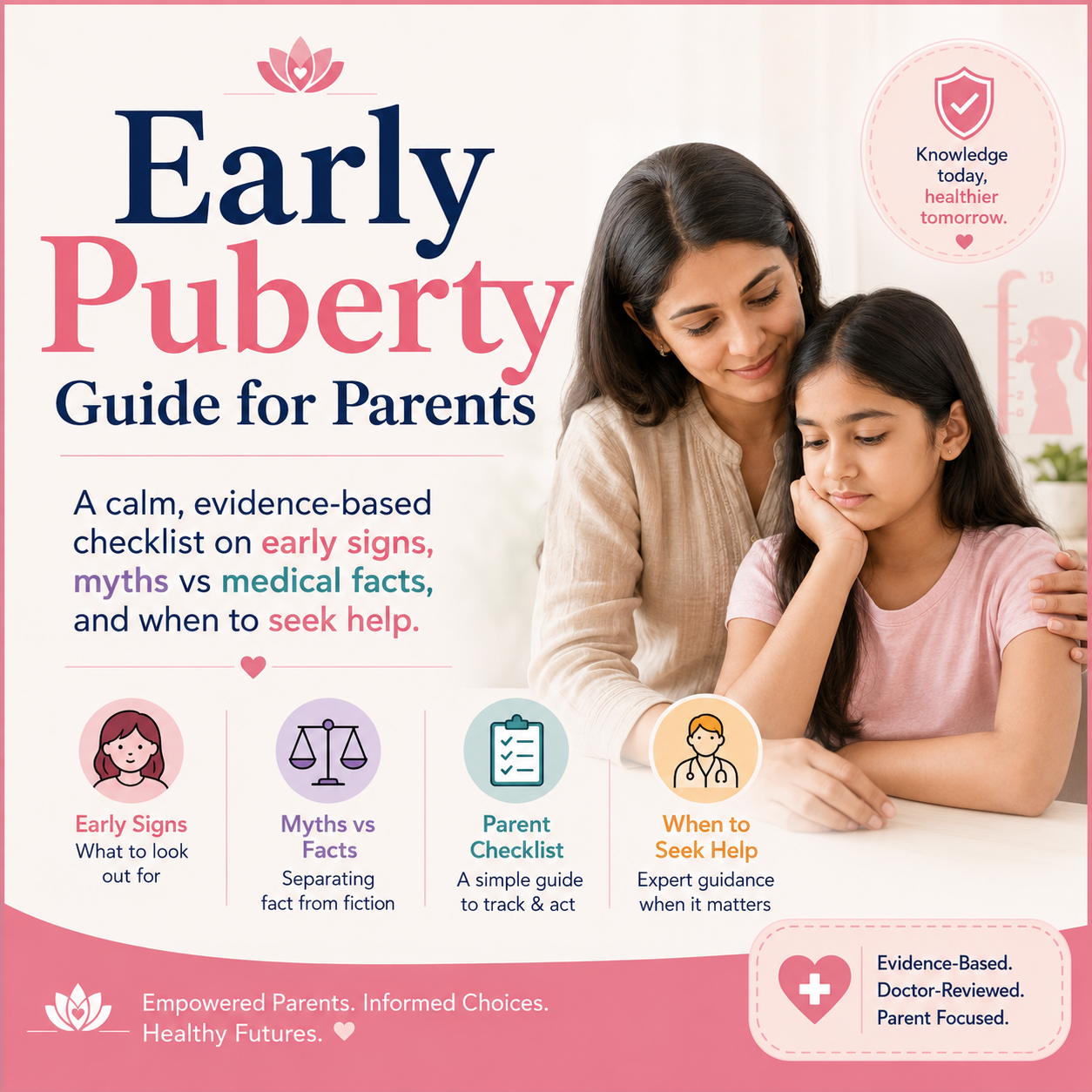
As a doctor working closely with children and families, I created this resource to help parents understand early puberty in a step-by-step, non-alarmist way. This guide does not replace a doctor’s visit, but it will help you approach one informed, prepared, and calm.

✅ This guide will help you:
- Understand normal vs early puberty by age
- Identify early signs parents often miss
- Know when to observe and when to act
- Learn simple nutrition & lifestyle support tips
- Decide when to consult a paediatrician or endocrinologist
📘 Want this as a printable PDF?
Download the Free Doctor-Reviewed Guide →🔎 What is considered “early puberty” in girls?
In girls, puberty is considered early (precocious) if:
- Breast development starts before age 8, or
- Menstruation occurs before age 9
However, this definition is a clinical guideline, not a diagnosis by itself. Many girls show early physical signs but progress slowly and normally over the years — this is called early but non-progressive puberty and often requires observation, not treatment.
👀 The first signs parents usually notice
Early puberty rarely announces itself dramatically. Parents often notice subtle changes such as:
- Small breast buds (often on one side first)
- Body odour earlier than peers
- Rapid height gain over a short time
- Mild acne
- Emotional sensitivity or mood changes
- Curiosity about body changes
💡 One sign alone does not confirm early puberty. The pattern and pace matter far more than a single change.
👉 Early Puberty in Singapore Girls: Lifestyle Triggers Parents Should Know
👉 Worried About Early Puberty in Girls? A Doctor Explains What Food Can Do
🤔 Why does early puberty seem more common today?
This is one of the most common questions parents ask — and the answer is multifactorial.
1️⃣ Improved nutrition & growth
Children grow faster and reach critical body fat thresholds earlier — fat tissue plays a role in estrogen signalling, which can influence puberty timing.
2️⃣ Higher childhood obesity rates
Excess adipose tissue increases peripheral estrogen production and insulin resistance — though thin children can enter puberty early too.
3️⃣ Environmental exposures
Endocrine-disrupting chemicals and repeated exposure to cosmetics/fragrances are an area of active research, not social media speculation.
4️⃣ Genetics (often overlooked)
If mum or close female relatives matured early, this may simply be familial, not pathological.
👉 10 Reasons for Early Puberty in Girls
👉 The Rise of Early Puberty in Girls — What Every Parent Should Know
🚫 What early puberty does not automatically mean
Let’s address common fears directly:
❌ Your child has a serious disease
❌ Hormone injections are inevitable
❌ Fertility will be affected
❌ You must ban multiple foods
❌ Your parenting caused this
Early puberty is a timing issue, not a moral or parenting failure. 💛
👉 Does Soy Affect Puberty in Girls? Let’s Find Out
😌 Observe calmly if:
- Breast development is mild
- Growth is steady, not rapid
- No pubic hair or periods yet
- Bone age close to actual age
- Emotional & academic function normal
🚩 Seek evaluation if:
- Very rapid breast enlargement
- Pubic/underarm hair very early
- Vaginal bleeding
- Sudden height acceleration
- Headaches, vision, or neuro symptoms
- Signs before age 6
✅ Download the Early Puberty Checklist — many parents use this to discuss observations calmly with their paediatrician.

🥗 The role of nutrition & lifestyle (without extremes)
Nutrition and lifestyle support healthy progression, but they do not “reverse puberty.”
✔️ Helpful principles:
- Balanced meals with adequate protein
- Whole foods over ultra-processed foods
- Adequate sleep (often underestimated)
- Regular physical activity
- Reducing excessive screen time
⚠️ What to avoid:
- Extreme elimination diets
- Cutting all dairy/soy without indication
- Fear-based food restrictions
- Unverified detoxes or supplements
Puberty requires nourishment, not restriction. 💚
💗 The emotional side of early puberty
Children who mature earlier may feel “different” from peers, self-conscious, or confused. Parents can help by:
- Using correct anatomical terms calmly
- Normalising body changes
- Avoiding secrecy or shame
- Keeping communication open
A calm parent response significantly protects a child’s emotional health. 🌷
💊 Do all children with early puberty need treatment?
No.
Medical treatment is considered only when puberty is clearly progressive, adult height may be compromised, psychological distress is significant, or underlying pathology is identified. Many children never require medication and progress normally with monitoring.
🤍 A gentle word for worried parents
Puberty timing varies widely. Most cases are benign. Observation is often the first and best step. You are not “missing something” by staying calm — the goal is support, not suppression.
Not sure what applies to your child? 🌼
I work with parents to assess growth patterns, nutrition, lifestyle factors, and red flags using a structured, evidence-based approach.
Book a Free 15-Min Child Health Consultation →(Educational guidance only; not a substitute for paediatric care.)
❓ Frequently Asked Questions
1. What age is considered early puberty in girls?
Before 8 years for breast development, or before 9 years for menstruation. Many children show early signs without rapid progression and may not need treatment.
2. Can early puberty stop on its own?
Yes — many cases are slow and non-progressive, requiring monitoring rather than treatment.
3. Does early puberty affect final adult height?
Only rapidly progressive puberty may reduce adult height. Slow progression usually reaches a normal genetic-potential height.
4. Is early puberty caused by diet alone?
No — genetics, growth patterns, body fat, environment, and overall health all play a role.
5. Should dairy, soy, or eggs be stopped?
Routine elimination isn’t recommended unless medically indicated — it can impair growth and nutrition. See: 8 Foods to Help Prevent Early Puberty in Girls Naturally
6. When should I consult a doctor?
If signs appear before age 6, progress rapidly, or come with bleeding, pubic hair, neurological symptoms, or significant distress.
7. Does early puberty affect mental health?
Early-maturing girls may feel self-conscious. Calm parental communication plays a major protective role.
8. Can lifestyle changes reverse early puberty?
No — but they support healthy progression, balanced growth, and emotional wellbeing.
Many parents notice changes earlier than expected. What questions are coming up for you? Comment below. 💬
📚 References (PubMed)
- Kaplowitz P. Link between body fat and the timing of puberty. Pediatrics. 2008.
- Biro FM et al. Pubertal correlates in girls. Pediatrics. 2012.
- Aksglaede L et al. Recent decline in age at breast development. Pediatrics. 2009.
- Parent AS et al. The timing of normal puberty and the age limits of sexual precocity. Endocr Rev. 2003.

Akanksha Sharma
Dr Akanksha Sharma (MBBS, MD) is a physician and women’s health nutrition specialist, and the founder of IYSA Nutrition. She provides evidence-based, doctor-led nutrition guidance for pregnancy, postpartum recovery, PCOS, child nutrition, and family health, helping women make calm, informed decisions about their health and their children’s well-being.