Written & reviewed by Dr Akanksha Sharma, MBBS, MD (Preventive & Community Medicine) | Founder, IYSA Nutrition, Singapore
Singapore sits just one degree north of the equator. The sun is intense year-round. UV index regularly reaches 10 or above, classified as “extreme” by the WHO. By any reasonable expectation, Vitamin D deficiency should be virtually non-existent here.
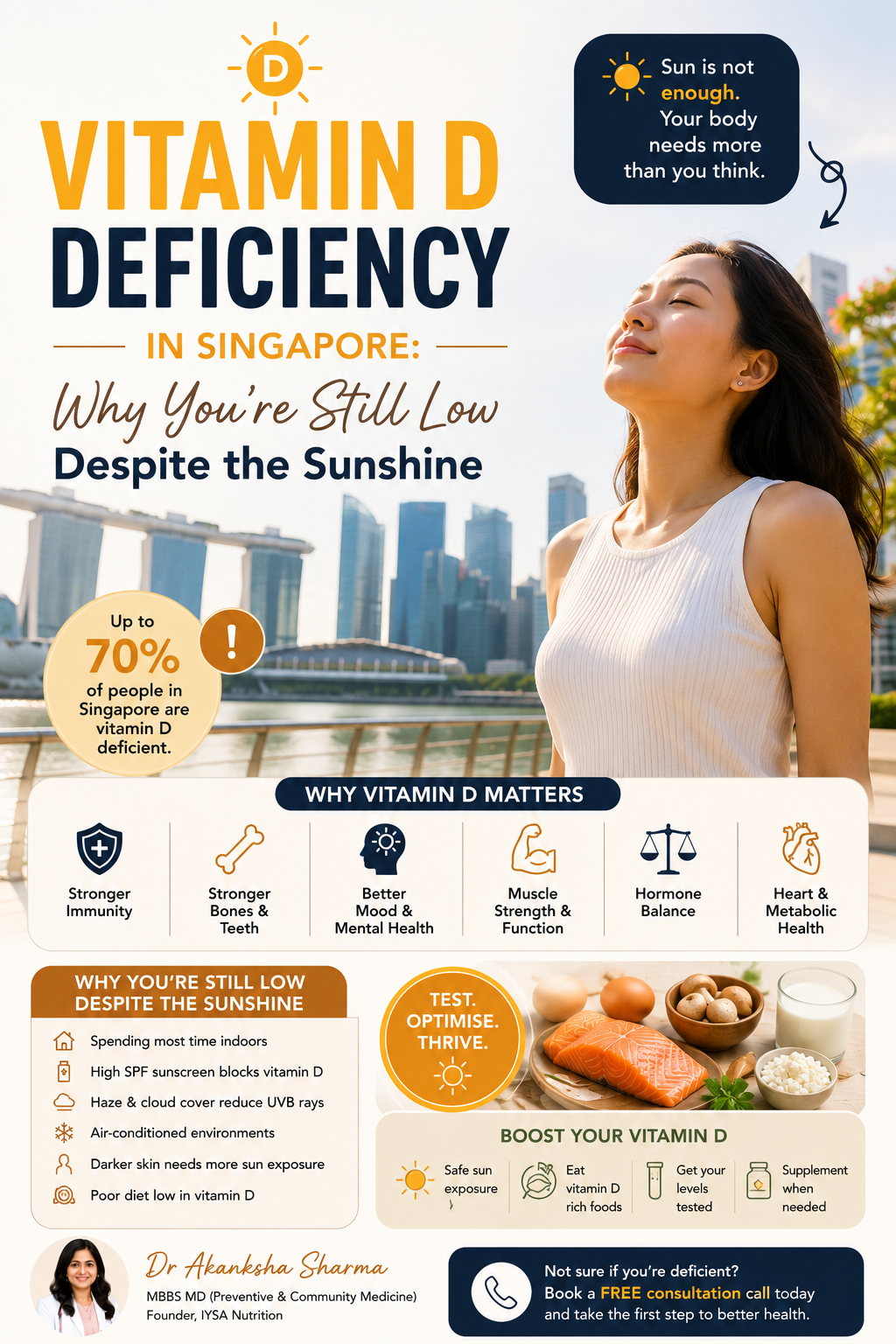
And yet, study after study tells a different story. The Singapore Health Study, the HELIOS cohort, and multiple clinical surveys consistently find that Vitamin D insufficiency affects a significant proportion of the Singapore population, with prevalence estimates ranging from 30% to over 60% depending on the population studied and the threshold used. Among Indian and South Asian women specifically, rates of deficiency are among the highest in Singapore, a finding that is simultaneously counterintuitive and, once you understand the biology, entirely predictable.
I want to explain this paradox clearly, because I see its consequences daily in my practice: women with unexplained fatigue, recurrent infections, bone pain, mood disorders, hormonal disruption, autoimmune thyroid disease, and metabolic dysfunction, who, when tested, are severely Vitamin D deficient despite living their entire lives in one of the sunniest cities on earth.
Understanding why this happens and what to do about it is one of the most impactful things you can do for your long-term health in Singapore.
👉Bone Health for Indian Women: Preventing Osteoporosis Before It’s Too Late
What Vitamin D Actually Does: Far More Than Bone Health
Vitamin D is frequently discussed in the context of calcium absorption and bone health, and this is indeed one of its most important functions. But the discovery of Vitamin D receptors in virtually every cell of the human body has fundamentally changed our understanding of what this nutrient does. It is now recognised as a pleiotropic hormone, a signalling molecule with effects across virtually every physiological system.
Immune System Regulation
Vitamin D is one of the most potent modulators of immune function available. It activates innate immune defences (the first-line, non-specific response to pathogens) and modulates adaptive immunity (the targeted antibody and T-cell response). Vitamin D deficiency is consistently associated with increased susceptibility to respiratory infections, impaired wound healing, and, critically for South Asian women, higher rates of autoimmune diseases, including Hashimoto’s thyroiditis, type 1 diabetes, rheumatoid arthritis, and lupus.
Hormonal Health
Vitamin D directly influences the ovarian production of oestrogen and progesterone. Women with Vitamin D deficiency show higher rates of PCOS, irregular menstrual cycles, ovulatory dysfunction, and reduced fertility. The correlation between low Vitamin D and PCOS is particularly strong. Vitamin D receptors are present in ovarian granulosa cells, and Vitamin D regulates the enzymes involved in ovarian steroidogenesis. Multiple small RCTs have found that Vitamin D supplementation improves menstrual regularity and hormonal parameters in PCOS.
Mental Health
Vitamin D regulates the synthesis of serotonin and dopamine, modulates the HPA axis (the stress-cortisol system), and has direct neuroprotective effects. Low Vitamin D is consistently associated with higher rates of depression, anxiety, and cognitive impairment in multiple large population studies. Among postpartum women, Vitamin D deficiency is an independent risk factor for postpartum depression.
Metabolic Health
Vitamin D improves insulin sensitivity, modulates adipokine production from fat tissue, and reduces systemic inflammation, all of which are directly relevant to insulin resistance, metabolic syndrome, and type 2 diabetes risk. South Asian women, who already carry an elevated genetic risk for these conditions, are particularly impacted by the metabolic consequences of Vitamin D deficiency.
Cardiovascular Health
Vitamin D deficiency is associated with higher blood pressure, increased arterial stiffness, higher rates of heart failure, and elevated cardiovascular mortality risk. Singapore’s Indian population carries an elevated cardiovascular risk profile, and Vitamin D deficiency adds meaningfully to this burden.
Cancer Prevention
Higher Vitamin D levels are associated with reduced risk of colorectal, breast, ovarian, and other cancers in epidemiological studies. The mechanisms involve Vitamin D’s role in regulating cell proliferation, differentiation, and apoptosis. While causality has not been definitively established for all cancer types, the association is consistent and biologically plausible.
The Singapore Sunshine Paradox: Why You Are Deficient Despite Living Here
The mechanism of cutaneous Vitamin D synthesis is more nuanced than most people realise, and several factors specific to Singapore, to Indian ancestry, and to modern urban lifestyles converge to make deficiency almost inevitable without deliberate intervention.
1. Skin Pigmentation
This is the most significant factor for Indian and South Asian women in Singapore. Melanin, the pigment that gives skin its colour, is a natural UV filter. Darker skin pigmentation requires significantly longer sun exposure to produce the same amount of Vitamin D as lighter skin. Studies have found that individuals with deeply pigmented skin (Fitzpatrick skin types V-VI, common among South Indians) require 3–5 times longer sun exposure than fair-skinned individuals to synthesise equivalent Vitamin D.
This means that even if an Indian woman in Singapore spends the same amount of time in the sun as a fair-skinned person, she synthesises far less Vitamin D from that exposure. The equatorial sun that is “enough” for lighter-skinned people is genuinely insufficient for darker-skinned people in the same environment, particularly when compounded by the other factors below.
2. Indoor Lifestyle
Singapore’s extreme heat, humidity, and UV intensity create a strong incentive to stay indoors during daylight hours. Air-conditioned offices, malls, homes, schools, and cars mean that most Singapore residents, regardless of ethnicity, spend the majority of their waking hours shielded from direct sunlight. When they do go outside, it is typically early morning or evening, when UV-B radiation (the wavelength responsible for Vitamin D synthesis) is at its lowest intensity.
UV-B radiation sufficient for Vitamin D synthesis in Singapore is available between approximately 10 am and 3 pm. This is precisely the window when most working adults and schoolchildren are indoors. The theoretical abundance of Singapore sunshine is largely irrelevant to people who never expose their skin to it during the productive UV-B hours.
3. Sunscreen and Sun Avoidance
Sunscreen with SPF 30 reduces UV-B penetration to the skin by approximately 95–97%. SPF 50 reduces it by 98%. While sunscreen is absolutely appropriate for skin cancer prevention and anti-ageing, its widespread daily use, particularly on the face, neck, and arms, the skin surfaces most commonly exposed during brief outdoor time, virtually eliminates cutaneous Vitamin D synthesis during that exposure.
The cultural pressure on Indian and South Asian women to maintain lighter skin (fair skin preference is deeply culturally embedded across the subcontinent) creates additional motivation to avoid sun exposure, use high-SPF products consistently, and cover exposed skin — all of which compound Vitamin D deficiency risk.
4. Clothing Coverage
Cultural and religious practices that involve covering most of the body (salwar kameez with dupatta, sarees with covered blouses, and, for some women, more complete coverage) reduce the skin surface area available for Vitamin D synthesis, even during outdoor exposure.
5. Obesity and Fat Sequestration
Vitamin D is a fat-soluble vitamin that is sequestered in adipose tissue. Individuals with higher body fat have larger fat stores that “trap” circulating Vitamin D, reducing its bioavailability in the bloodstream. This means that women with higher body fat percentages, disproportionately common in the South Asian population due to the thin-fat Indian phenotype, may test as Vitamin D deficient even with adequate synthesis and intake, because the Vitamin D is being stored in fat rather than circulating.
6. Dietary Insufficiency
Food sources of Vitamin D are very limited, and the Indian vegetarian diet is particularly poor in this nutrient. The richest food sources, fatty fish (salmon, mackerel, sardines), egg yolk, and liver, are either not consumed by vegetarians or not eaten daily by most people. Fortified foods (fortified milk, fortified cereals) provide modest amounts. Without fish or deliberate fortification, dietary Vitamin D is entirely inadequate to maintain sufficiency in the absence of sun exposure.
7. Ageing and Reduced Skin Synthesis Capacity
The capacity of skin to synthesise Vitamin D declines significantly with age, by approximately 75% between the ages of 20 and 70. Women in their 40s and 50s synthesise significantly less Vitamin D from the same sun exposure as younger women, increasing deficiency risk at exactly the life stage when Vitamin D’s effects on bone density, hormonal health, and cardiovascular protection are most critical.
Understanding Your Vitamin D Test Results
Vitamin D status is measured as serum 25-hydroxyvitamin D (25-OH Vitamin D). This is the most reliable marker of overall Vitamin D status. Not all laboratories in Singapore and India use the same reference ranges, and there is ongoing debate in the medical literature about the optimal level. Here is a practical clinical guide:
| 25-OH Vitamin D Level | Status | Clinical Implications |
|---|---|---|
| Below 25 nmol/L (10 ng/mL) | Severe deficiency | High risk of osteomalacia, immune dysfunction, significant hormonal disruption; urgent treatment required |
| 25–50 nmol/L (10–20 ng/mL) | Deficiency | Impaired calcium absorption, increased fracture risk, immune compromise, mood effects; treatment required |
| 50–75 nmol/L (20–30 ng/mL) | Insufficiency | Below optimal for full physiological benefit; supplementation advisable especially in pregnancy, autoimmune disease, PCOS |
| 75–150 nmol/L (30–60 ng/mL) | Sufficient / Optimal | Full physiological benefit across immune, hormonal, metabolic, and mood functions; target range for most adults |
| Above 250 nmol/L (100 ng/mL) | Potential toxicity | Risk of hypercalcaemia with sustained levels above this threshold; monitor if on high-dose supplementation |
Doctor’s Note: Many Singapore laboratories set their “normal” lower limit at 50 nmol/L (20 ng/mL), meaning your test result may say “normal” when your level is 52 nmol/L. In my clinical practice, I consider the optimal range for women to be 75–125 nmol/L for full physiological benefit, particularly regarding immune function, hormonal health, and mood. A level of 52 nmol/L that is technically “within range” is not optimal for a woman with PCOS, Hashimoto’s, recurrent infections, or mood difficulties. Always ask your doctor what your actual number is, not just whether it is “normal.”
How Much Vitamin D Do You Need?
Official recommendations vary by country and body, and are widely considered conservative by many endocrinologists and nutrition researchers. Here is a practical guide:
- ICMR-NIN 2020 (India): 600 IU/day for adults; 600–800 IU/day for pregnant and breastfeeding women
- MOH Singapore: 600–800 IU/day for adults under 70
- Endocrine Society (US): For treatment of deficiency, 50,000 IU weekly for 8 weeks OR 6,000 IU daily, followed by maintenance at 1,500–2,000 IU/day
- Clinical practice in Singapore: Many physicians prescribe 60,000 IU monthly (approximately 2,000 IU/day average) for maintenance in deficient patients; correction of severe deficiency often uses higher loading doses
The important practical points:
- The official daily recommendations (600–800 IU/day) are often insufficient to correct a deficiency or maintain optimal levels in dark-skinned individuals with limited sun exposure. Most clinical endocrinologists and nutrition specialists consider 1,500–2,000 IU/day as a more appropriate maintenance dose for Indian women in Singapore
- Vitamin D3 (cholecalciferol) is more effective than Vitamin D2 (ergocalciferol) for raising and sustaining serum levels. Choose D3 when selecting a supplement
- Vitamin D is fat-soluble; take it with your largest meal of the day (containing fat) for optimal absorption
- Vitamin D and Vitamin K2 work synergistically. K2 (particularly MK-7 form) helps direct calcium to bones and teeth rather than soft tissues; consider a combined D3+K2 supplement, particularly at higher D3 doses
How to Get Tested in Singapore
Vitamin D testing in Singapore is straightforward. You can:
- Request the test from your GP, polyclinic doctor, or specialist (endocrinologist, gynaecologist, or internal medicine physician)
- Access self-funded testing at most private diagnostic laboratories without a referral. Raffles Medical, Mount Elizabeth, Parkway Laboratories, and most private hospitals offer Vitamin D testing at approximately SGD 30–60 for a serum 25-OH Vitamin D test
- Under Healthier SG, Vitamin D testing may be recommended as part of a health assessment, depending on your GP’s clinical judgement and your risk profile
Testing is particularly important for Indian and South Asian women, women who spend most of their time indoors, women who cover most of their skin when outdoors, women with PCOS, thyroid disease, autoimmune conditions, recurrent infections, depression, or metabolic syndrome, and all pregnant and breastfeeding women.
Food Sources of Vitamin D: The Honest Picture
Food provides very little Vitamin D relative to what the body needs, but maximising dietary sources is still worthwhile as part of a comprehensive strategy.
| Food | Serving | Vitamin D (IU) | Notes |
|---|---|---|---|
| Salmon (cooked) | 100g | 447–600 IU | Best single food source: wild salmon is higher than farmed |
| Sardines (canned in oil) | 100g | 270–300 IU | Excellent and affordable; widely available in Singapore |
| Mackerel (cooked) | 100g | 360 IU | Good source; available fresh in Singapore wet markets |
| Egg yolk | 1 yolk | 37–44 IU | Modest but useful daily contributor; pasture-raised eggs higher |
| Fortified cow’s milk | 250ml | 100–130 IU | Check label — fortification varies by brand in Singapore/India |
| Fortified plant milk | 250ml | 100–130 IU | Check label; Oatly, Vitasoy, and most Singapore brands fortify |
| Mushrooms (UV-exposed) | 100g | Up to 400 IU | Only UV-exposed varieties; Portobello placed gill-side up in the sun for 1 hour dramatically increases D2 content |
| Fortified breakfast cereal | 30–40g serving | 40–100 IU | Check label; varies significantly by brand |
| Liver (chicken/beef) | 100g | 42–50 IU | Modest D but rich in many other nutrients |
As this table shows, even an optimal diet, eating salmon, sardines, or mackerel three times per week plus eggs daily plus fortified milk, delivers perhaps 600–900 IU of Vitamin D per day. Against a deficiency background requiring correction doses of 2,000–6,000 IU/day, food alone cannot close the gap. Supplementation is not optional for most Indian women in Singapore, it is medically necessary.
The UV-B Sun Strategy: How to Get Sunshine That Actually Works
For women who prefer to maximise natural synthesis before relying entirely on supplements, here is a practical guide to UV-B exposure in Singapore:
- Timing: UV-B radiation sufficient for Vitamin D synthesis in Singapore is available from approximately 10am to 3pm. Before 10am and after 4pm, UV-B is insufficient regardless of how bright the sun appears.
- Duration: For an Indian woman (medium-dark skin), approximately 20–30 minutes of direct sun exposure on arms, legs, or back during the 10 am–3 pm window is needed for meaningful Vitamin D synthesis. This is difficult to achieve daily in a working adult’s schedule.
- Skin surface: Expose as much skin as practically feasible, arms and lower legs are the most accessible areas. Face and hands alone are insufficient surface area for significant synthesis.
- No sunscreen on exposed areas during this window: For the specific 20–30 minutes of Vitamin D synthesis sun exposure, avoid sunscreen on the target skin areas. Apply sunscreen for any additional sun exposure beyond this window to protect against UV-A-mediated skin damage and skin cancer risk.
- Practical suggestion: A lunchtime walk (11 am–1 pm) in direct sunlight for 20–30 minutes with arms exposed is the most practical way to incorporate UV-B exposure into a Singapore working day. This also provides significant benefits for mood, circadian rhythm, and metabolic health independently of Vitamin D.
For most Indian women in Singapore, however, this level of consistent deliberate sun exposure is difficult to maintain reliably, making supplementation the more practical and reliable primary strategy.
Vitamin D and Specific Health Conditions: What the Evidence Shows
PCOS
Multiple studies have found Vitamin D deficiency in 67–85% of women with PCOS. Vitamin D supplementation in deficient women with PCOS improves insulin sensitivity, menstrual regularity, and AMH levels, and reduces androgen levels and ovarian volume in some studies. Correcting Vitamin D deficiency is a standard first-line intervention in PCOS management at IYSA Nutrition.
Hashimoto’s Thyroiditis
Low Vitamin D is consistently and strongly associated with higher anti-TPO antibody levels and more severe Hashimoto’s disease activity. Multiple RCTs have found that Vitamin D supplementation reduces anti-TPO antibodies in Vitamin D-deficient women with Hashimoto’s. Among Indian women, who have high rates of both Vitamin D deficiency and Hashimoto’s, testing and correcting Vitamin D is one of the highest-yield single interventions available.
Pregnancy
Vitamin D deficiency in pregnancy is associated with gestational diabetes, pre-eclampsia, preterm birth, low birth weight, and impaired foetal immune development. It is also associated with Vitamin D deficiency in the newborn, since breast milk contains very little Vitamin D, and deficient mothers produce deficient milk. The AAP recommends 400 IU/day of Vitamin D drops for all breastfed infants. For pregnant Indian women in Singapore, Vitamin D testing and supplementation (typically 1000–2000 IU/day or higher under medical guidance) should be standard of care.
Postpartum Depression
As discussed in my post Postpartum Depression and Nutrition: The Missing Link, low Vitamin D at delivery is an independent risk factor for postpartum depression. Correcting Vitamin D postpartum is part of the comprehensive nutritional approach to mood recovery discussed in that post.
Bone Health and Osteoporosis Prevention
Indian women have a genetically lower peak bone mass than Western women and are at elevated osteoporosis risk. Adequate Vitamin D throughout the reproductive years and perimenopause, combined with adequate calcium, resistance training, and oestrogen maintenance, is the most effective long-term strategy for osteoporosis prevention. Correcting Vitamin D deficiency now, not waiting until bones become fragile, is the appropriate preventive approach.
Frequently Asked Questions
How long does it take to correct Vitamin D deficiency?
With a loading dose protocol (for example, 60,000 IU weekly for 8 weeks as commonly prescribed in Singapore and India), serum Vitamin D levels typically rise to sufficient levels within 8–12 weeks. With daily supplementation at 2000 IU/day, levels rise more slowly, and meaningful improvement is typically seen at 12–16 weeks, with optimal levels reached at 3–6 months. Retest at 3 months after starting supplementation to confirm response and adjust dose. Maintenance supplementation is required indefinitely in the absence of consistent, adequate sun exposure.
Can you overdose on Vitamin D?
Yes, Vitamin D toxicity (hypervitaminosis D) is a real but uncommon condition caused by very high supplemental doses over sustained periods. It does not occur from sun exposure (the skin has a self-limiting mechanism that prevents overproduction) and is unlikely at maintenance doses below 4,000 IU/day in adults. Toxicity typically requires sustained doses above 10,000–40,000 IU/day for extended periods. Symptoms of toxicity include nausea, weakness, frequent urination, kidney stones, and, in severe cases, hypercalcaemia. If you are taking doses above 4,000 IU/day, regular monitoring of serum 25-OH Vitamin D and serum calcium is advisable.
Should I take Vitamin D with Vitamin K2?
This is an area of active interest in the nutrition and cardiology research community. The concern is that high-dose Vitamin D supplementation, by improving calcium absorption, could theoretically direct calcium to arterial walls and soft tissues rather than bones, and Vitamin K2 (particularly MK-7 form) activates osteocalcin and matrix GLA protein, which direct calcium to bones and away from arteries. The evidence for routine K2 co-supplementation with D3 is not yet definitive, but the biological rationale is sound, and the risk of adding K2 at standard doses is minimal. If you are supplementing with more than 2000 IU of D3 daily on an ongoing basis, I typically recommend a combined D3+K2 product (100 mcg MK-7 per day) as a prudent precaution.
My child’s paediatrician has not mentioned Vitamin D testing. Should I ask?
Yes, particularly if your child is Indian or South Asian, spends most of the day at school indoors, has recurrent infections, poor bone density concerns, or a family history of autoimmune disease. Vitamin D deficiency in children is common in Singapore and is associated with impaired immune function, reduced bone density, and, in growing evidence, poorer mood and cognitive outcomes. The AAP recommends 400 IU/day of Vitamin D for all breastfed infants from birth; 600 IU/day for children above 1 year who do not obtain adequate sun exposure. Ask your paediatrician specifically for a serum 25-OH Vitamin D test if you are concerned.
I take a multivitamin that contains Vitamin D. Is that enough?
Almost certainly not for a deficient Indian woman in Singapore. Most standard multivitamins contain 200–400 IU of Vitamin D, a dose that may prevent rickets but is insufficient to correct deficiency or maintain optimal levels in a dark-skinned woman with limited sun exposure. Check your multivitamin label for the specific IU of D3 (not D2) included. If it contains less than 1000 IU of D3, consider adding a separate Vitamin D3 supplement to reach a total maintenance dose of 1500–2000 IU/day, or the higher corrective dose your doctor recommends based on your tested level.
The Bottom Line
Vitamin D deficiency in Singapore is not an anomaly; it is the expected outcome of a set of converging factors: darker skin pigmentation requiring longer sun exposure for synthesis, indoor lifestyles that minimise the UV-B window, cultural and aesthetic sun avoidance, age-related decline in skin synthesis capacity, and a diet that provides negligible Vitamin D without deliberate fortification or supplementation.
For Indian and South Asian women in Singapore, Vitamin D testing is not a luxury or a screening test that can wait; it is foundational clinical information. The downstream consequences of sustained deficiency, on immunity, hormonal health, metabolic function, mood, bone density, and cancer risk, are significant, cumulative, and largely preventable.
Get tested. Know your number. Correct the deficiency with appropriate supplementation. Retest. Maintain. This simple four-step sequence is one of the most impactful things you can do for your long-term health in Singapore, and it costs less than a single day’s worth of vitamins at most pharmacies.
📩 Click here to book a FREE consultation with Dr Akanksha Sharma — personalised metabolic nutrition consultations for Indian women in Singapore and India.
OR Explore this FREE Guide:
👉 The Insulin Reset: A Women’s Guide
Disclaimer: This article is for educational purposes only. Vitamin D supplementation at therapeutic doses should be undertaken with medical guidance and monitoring.
Related reading:
👉Thyroid Support in Hypothyroidism: Diet, Lifestyle & Ayurveda
👉Perimenopause in Singapore Women: Symptoms Doctors Miss
👉PCOS in Singapore: Why It’s Rising Even in Lean Women
👉Gut Problems Common in Singapore Women (and What to Do About Them)
✅ References
- Chin CJ et al. High prevalence of vitamin D insufficiency in Singapore. Singapore Med J. 2008;49(7):538-546. PubMed
- Holick MF et al. Evaluation, treatment, and prevention of vitamin D deficiency. J Clin Endocrinol Metab. 2011;96(7):1911-1930. PubMed
- Lerchbaum E, Obermayer-Pietsch B. Vitamin D and fertility: a systematic review. Eur J Endocrinol. 2012;166(5):765-778. PubMed
- Kivity S et al. Vitamin D and autoimmune thyroid diseases. Cell Mol Immunol. 2011;8(3):243-247. PubMed
- ICMR-NIN Expert Group. Recommended Dietary Allowances for Indians. 2020. nin.res.in

Akanksha Sharma
Dr Akanksha Sharma (MBBS, MD) is a physician and women’s health nutrition specialist, and the founder of IYSA Nutrition. She provides evidence-based, doctor-led nutrition guidance for pregnancy, postpartum recovery, PCOS, child nutrition, and family health, helping women make calm, informed decisions about their health and their children’s well-being.