Written & reviewed by Dr Akanksha Sharma, MBBS, MD (Preventive & Community Medicine) | Founder, IYSA Nutrition, Singapore
It is one of the first questions many new mothers quietly ask, often before they feel it is socially acceptable to ask it out loud: When can I start losing this weight? And how do I do it without losing my milk?
This question deserves an honest, evidence-based answer, not the cultural shame that surrounds it (“you just had a baby, how can you think about weight?”) nor the equally unhelpful pressure from the other direction (the celebrity “bounce back” narrative that sets completely unrealistic timelines for postpartum body changes).
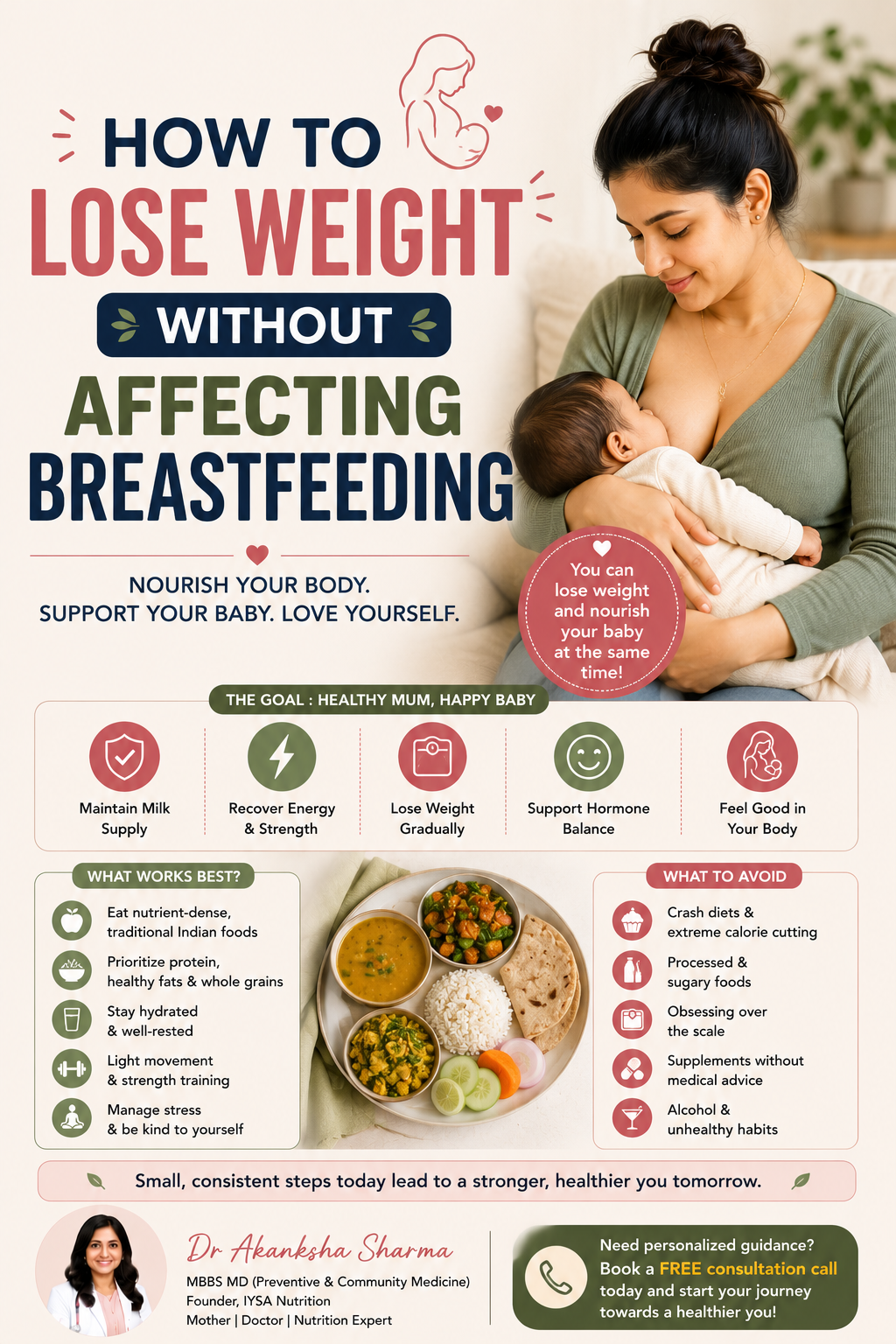
The reality: losing weight while breastfeeding is possible, safe, and for many women, happens naturally with the right nutritional approach. Breastfeeding itself burns approximately 400–500 extra calories per day, the equivalent of a moderate cardio session. But there are clear nutritional boundaries that, if crossed, will impair milk supply, worsen postpartum depletion, and slow rather than speed recovery. Understanding those boundaries is what this post is about.
👉 Download my Fourth Trimester Survival Guide – includes recovery meals, red flags & checklists.
👉Fourth Trimester Care in Singapore: What Hospitals Don’t Cover (and What It Really Costs)
Understanding Postpartum Weight: What Is It and Where Did It Come From?
The weight gained during pregnancy is not all fat. A typical pregnancy weight gain of 11–16 kg (for a normal pre-pregnancy BMI) breaks down approximately as follows:
- Baby: 3–4 kg
- Placenta: 0.5–1 kg
- Amniotic fluid: 1 kg
- Increased blood volume: 1.5–2 kg
- Uterine enlargement: 1 kg
- Breast tissue growth: 1–1.5 kg
- Increased fluid and tissue: 1.5–2 kg
- Maternal fat stores: 2–4 kg (the body deliberately stores fat in preparation for breastfeeding)
Most of the non-fat weight, baby, placenta, amniotic fluid, and blood volume is lost at or immediately after delivery and in the first week postpartum. The average woman loses 5–6 kg immediately at delivery, and another 2–3 kg in the first week through fluid loss and uterine involution.
What remains is the maternal fat stored during pregnancy, 2–4 kg, sometimes more, plus any additional weight gained from excess caloric intake during pregnancy. This is the weight that most new mothers are referring to when they ask about “losing baby weight.” And this is where nutrition strategy matters.
Related reading:
👉Starter Guide to Getting Your Body Back After Having a Baby
👉Postnatal Depletion Syndrome: The Reason Mums Feel Exhausted
The Breastfeeding Caloric Equation
Breastfeeding creates a significant daily caloric deficit relative to the energy cost of milk production:
- Producing 750–800 ml of breast milk daily requires approximately 500 kcal
- The body derives approximately 100–150 kcal from the maternal fat stores that were specifically laid down during pregnancy for this purpose
- The remaining 350–400 kcal need to come from the diet
This means that a breastfeeding woman who eats at her pre-pregnancy maintenance level is already in a modest caloric deficit, which is why many women lose weight gradually and naturally during exclusive breastfeeding without any specific dietary restriction. The pregnancy fat stores are being burned to fuel milk production, exactly as they were designed to be.
The critical implication: aggressive caloric restriction while breastfeeding is both unnecessary and counterproductive. The body’s fat-burning for milk production is already happening. Severe restriction adds physiological stress, depletes nutritional stores faster, and can reduce milk supply, while providing little additional benefit over the natural fat-utilisation process that breastfeeding already activates.
Related reading:
👉Post-partum Depression and the Baby Blues: Causes and Management
👉Postpartum Hair Loss: The Nutritional Truth Nobody Tells You
The Calorie Deficit: How Low Is Too Low?
This is the most important number in this entire post. Research consistently shows that milk supply begins to decrease when total caloric intake falls below approximately 1500–1800 kcal per day in breastfeeding women. For most Indian women, the safe lower limit for maintaining milk supply while supporting gradual weight loss is 1800 kcal/day.
Below this threshold:
- Milk volume decreases as the body prioritises its own survival over milk production
- Breast milk fat content may decrease, reducing the caloric density and satiety of feeds for the baby
- Maternal nutrient stores deplete more rapidly, worsening hair loss, bone density loss, fatigue, and mood
- Cortisol rises in response to caloric restriction stress, promoting fat storage rather than fat loss (the metabolic paradox of severe dieting)
- Thyroid function may be suppressed, further slowing metabolism
The practical target: Aim for 1800–2000 kcal/day of high-quality, nutrient-dense food. This creates a modest deficit relative to the 2200–2500 kcal/day recommended for exclusive breastfeeding, producing a sustainable, milk-supply-safe weight loss of approximately 0.5 kg per week.
Doctor’s Note: Women who are significantly overweight postpartum (pre-pregnancy BMI above 30) may safely lose weight at a slightly faster rate, up to 1 kg per week, without affecting milk supply, as their larger fat stores provide more available energy for milk production. Women who are at or near their pre-pregnancy weight should not restrict calories at all during breastfeeding. The appropriate strategy varies significantly by individual, this is one of the best reasons to work with a nutrition specialist rather than following generic postpartum weight loss advice.
👉 Related readings:
-
Breastfeeding vs Formula: Making Informed Decisions Without Guilt
- How Much Weight Gain During Pregnancy is Normal According to Singapore Guidelines?
Timing: When Is It Safe to Start?
Timing matters enormously. The postpartum body needs a recovery window before any weight loss effort begins:
0–6 Weeks: Do Not Diet
The first six weeks postpartum are a period of acute physiological recovery. The uterus is involuting. Perineal or abdominal wounds (from episiotomy or caesarean section) are healing. Hormones are in dramatic flux. The gut microbiome is recovering. Iron stores are being depleted by postpartum blood loss. Sleep deprivation is at its most severe. This is absolutely not the time to restrict calories. Eat adequately. Recover. Nourish yourself and your milk supply.
6–12 Weeks: Gentle Nutritional Optimisation
From six weeks, if your postnatal check has confirmed good recovery, you can begin focusing on food quality, replacing empty-calorie foods with nutrient-dense alternatives, reducing packaged snacks, establishing regular meal timing, and beginning gentle movement (walking, postnatal yoga). This is not caloric restriction; it is nutritional quality improvement. Weight loss in this period, if it happens, is a side effect of better nutrition rather than the goal.
3–6 Months: Sustainable, Modest Deficit
From three months postpartum, milk supply is typically well established, and the body has had a meaningful recovery time. A modest caloric deficit (200–300 kcal below the breastfeeding maintenance level, so approximately 1900–2100 kcal/day for most Indian women) combined with increasing physical activity is safe and sustainable. Expected weight loss: 0.5–1 kg per month.
After 6 Months or Weaning
Once complementary foods are introduced at six months, breast milk production typically decreases, reducing the caloric cost of feeding. At this stage or after weaning, a more structured approach to weight management, still respecting the nutritional recovery needs of the postpartum period, is appropriate.
Related reading:
👉Returning to Work After Maternity: How to Keep Up Nutrition
👉10 Healthy Snack Ideas to Boost Energy and Aid Recovery for New Moms
Explore my NURTURE: Mother & Baby Fourth Trimester Program
A doctor-led, evidence-based program supporting healing, feeding, and emotional recovery.
What to Eat: The Postpartum Weight Loss Nutrition Strategy
The most effective postpartum weight loss nutrition strategy is not a diet; it is a food quality framework. The goal is to maximise nutritional density per calorie, which supports milk quality, maternal recovery, and satiety while creating a modest energy deficit.
Protein at Every Meal — The Satiety Foundation
Protein is the most satiating macronutrient; it reduces appetite, preserves muscle mass during weight loss, and has the highest thermic effect of food (your body burns more calories digesting protein than carbohydrates or fat). Adequate protein during postpartum weight loss is particularly critical because any caloric deficit creates some risk of muscle loss, and muscle is the metabolically active tissue that determines your resting metabolic rate.
Target: 1.2–1.5 g of protein per kg of body weight per day, which for a 60 kg woman means 72–90g daily. This is non-negotiable regardless of caloric restriction.
High-protein Indian foods for postpartum weight management:
- Two eggs at breakfast — 12g protein, extremely satiating, takes 3 minutes
- A generous cup of thick dal at lunch and dinner — 8–10g per meal
- Plain dahi (200g) as a snack — 8–10g protein, probiotic benefit
- Paneer (80g) in a sabzi — 14g protein
- Grilled or steamed fish — 20–25g per 100g
- Roasted chana as a snack — 10g per 30g; portable and satisfying
Fibre — The Volume and Satiety Hack
High-fibre foods provide large food volumes with relatively few calories, creating physical stomach fullness and slowing gastric emptying, which reduces hunger between meals. For postpartum weight management, fibre is the most effective tool for reducing caloric intake without creating the physiological stress of caloric deprivation.
Target: 30–35g of dietary fibre per day, significantly above what most Indian urban women currently consume.
- All dal and legumes — rajma, chana, moong, masoor; eat at least one cup daily
- Jowar and bajra roti instead of white rice — higher fibre, lower GI
- At least 4–5 portions of non-starchy vegetables daily — sabzi at every meal
- Isabgol (psyllium husk) — one teaspoon in water before lunch significantly reduces caloric intake at that meal
- Whole fruit instead of juice — fibre intact, more satiating
Reduce — Don’t Eliminate — Carbohydrates
Carbohydrates are not the enemy of postpartum weight loss, but refined, low-fibre, high-GI carbohydrates eaten in large quantities are the primary driver of excess caloric intake in most Indian women’s diets. The strategy is not elimination but intelligent reduction and substitution:
- Reduce white rice portions from one cup to half a cup, and fill the plate with more dal and sabzi
- Replace maida rotis and naan with jowar, bajra, or whole wheat rotis
- Reduce sweet chai from 3 cups to 1 cup daily, each cup with 2 teaspoons of sugar represents 32 kcal of empty calories, 96 kcal per day from chai sugar alone
- Replace packaged biscuits and namkeen with nuts, seeds, and dahi
- Reduce mithai and commercial sweets to occasional treats rather than daily habits
Healthy Fats — Do Not Eliminate
Fat is essential for breast milk quality; the fat content of breast milk is directly influenced by maternal fat intake, and low-fat diets produce breast milk with lower fat content, reducing the caloric density and satiety of feeds for the baby. Additionally, fat-soluble vitamins (A, D, E, K) require dietary fat for absorption, and eliminating fat impairs vitamin status at a time when nutritional status is already compromised.
The postpartum weight loss approach to fat is quality-focused reduction, not elimination:
- Use ghee in moderation (1–2 teaspoons per day) rather than eliminating it. Ghee provides butyrate for gut health and fat-soluble vitamins
- Include a small handful of mixed nuts daily. Despite their caloric density, nut consumption is consistently associated with better weight management outcomes in research, likely due to their protein and fibre content and incomplete caloric absorption
- Limit deep-fried foods. These are the most calorie-dense and nutritionally poorest fat sources in the Indian diet
- Choose fatty fish over fried snacks. The omega-3s support milk quality and mood
Physical Activity: When and What Is Safe
Exercise is the other half of the postpartum weight management equation, and it offers benefits well beyond caloric expenditure, including improved mood (critical for postpartum mental health), bone density preservation, muscle maintenance, and cardiovascular recovery.
0–6 Weeks: Rest and Gentle Movement Only
Walking, slow, comfortable, short duration, is appropriate from the first week postpartum for most women with uncomplicated vaginal deliveries. Caesarean section recovery requires more caution; avoid anything that strains the abdominal wall for at least 6–8 weeks. No structured exercise before the 6-week postnatal clearance appointment.
6–12 Weeks: Rebuilding Foundation
After postnatal clearance: daily walking (20–30 minutes, gradually increasing), postnatal yoga, and pelvic floor rehabilitation (with a women’s health physiotherapist if available; pelvic floor dysfunction is extremely common postpartum and should be addressed before any high-impact activity). Swimming is gentle on joints and safe from 6 weeks after incisions have healed. HIIT and other rigorous exercises are still not advised (in case of C-section). One mom consulted me after doing burpees at 6 weeks and opening up her C-section scar. She needed to go back to the gynaecologist for a procedure.
3+ Months: Structured Exercise
After three months, most women can begin more structured exercise, postnatal Pilates, light resistance training, and gradually increasing cardio. Resistance training is particularly valuable postpartum because it preserves and rebuilds muscle mass, maintaining the metabolic rate that supports long-term weight management. Begin with bodyweight exercises (squats, lunges, modified push-ups) before adding external resistance.
Important: High-impact exercise (running, jumping) should be avoided until the pelvic floor has been properly rehabilitated, ideally assessed and cleared by a women’s health physiotherapist. The widespread cultural pressure to “run it off” after having a baby, without pelvic floor rehabilitation, contributes significantly to long-term incontinence and pelvic organ prolapse in Indian women.
Related reading:
👉5 Effective Exercises to Flatten Your Mommy Pooch and Strengthen Your Core
👉10 Yoga Asanas to Strengthen Deep Core Muscles and Combat Mommy Pooch
If you’re unsure whether what you’re feeling is normal, structured postpartum support can make a huge difference.
👉New mom? Book a complimentary 20-minute support call
Common Postpartum Weight Loss Mistakes to Avoid
Mistake 1: Cutting Calories Too Severely Too Soon
As discussed, below 1500–1800 kcal/day, milk supply suffers, cortisol rises, thyroid function suppresses, and the body enters a metabolic conservation mode that actually reduces fat loss. The severe restriction approach is self-defeating for breastfeeding women.
Mistake 2: Eliminating Entire Food Groups
No-carb, no-fat, or no-dairy approaches during breastfeeding risk specific nutritional deficiencies that directly impact milk quality and maternal health. Dairy elimination risks calcium and iodine deficiency. Fat elimination reduces milk fat content and fat-soluble vitamin absorption. Extreme carbohydrate elimination can reduce milk supply (the brain and the lactating mammary gland are highly glucose-dependent). Restriction of specific foods is appropriate only when medically indicated.
Mistake 3: Skipping Meals
Skipping meals, particularly breakfast, in the belief that eating less means losing more, is counterproductive postpartum. Meal skipping raises cortisol, destabilises blood glucose, increases hunger and carbohydrate cravings later in the day, and can reduce milk supply. Eat regularly, every 3–4 hours, in moderate portions.
Mistake 4: Relying on “Diet” or “Slimming” Products
Weight loss teas, detox products, meal replacement shakes, and slimming supplements are contraindicated during breastfeeding. Many contain herbal compounds with unknown effects on breast milk. Some contain caffeine, diuretics, or laxative compounds that affect the baby through breast milk. None has evidence for safe use in breastfeeding women. Avoid entirely.
Mistake 5: Comparing to Pre-Pregnancy Weight at 6 Weeks
The postpartum body at 6 weeks is not the same body it was before pregnancy, and expecting it to be is a source of enormous unnecessary distress. The uterus has not fully involuted. Hormones are still fluctuating. Breast tissue remains enlarged. The relaxin hormone (which loosens ligaments for delivery) remains elevated in breastfeeding women for months, affecting body shape. Many women’s bodies do not reach a stable post-baby weight and shape until 12–18 months postpartum. This is a biological reality, not failure.
💛To Download the 7-Day C-Section Recovery Meal Plan (Doctor-Designed), CLICK HERE!
A Sample One-Day Postpartum Weight Management Meal Plan (Indian)
Target: approximately 1900–2000 kcal, 80–90g protein, high fibre, supporting gradual weight loss while maintaining milk supply.
- Breakfast (7:30 am): Two scrambled eggs with palak and tomato + one jowar roti + a cup of plain dahi. One cup of chai with minimal sugar or green tea. ~420 kcal, 28g protein.
- Mid-morning (10:30 am): One small handful of mixed nuts (almonds, walnuts) + one small guava or apple. ~180 kcal, 5g protein.
- Lunch (1:00 pm): One generous cup of masoor dal + one cup of sabzi (any non-starchy vegetable) + one jowar or whole wheat roti + a large salad with cucumber, tomato, carrot, lime. No second roti — replace with more dal and sabzi. ~480 kcal, 22g protein.
- Afternoon snack (4:00 pm): A bowl of plain dahi (200g) with one tablespoon of ground flaxseed (omega-3 for milk quality) + one piece of fruit. ~200 kcal, 10g protein.
- Dinner (7:00 pm): Grilled fish or paneer sabzi + half cup brown rice + a generous vegetable sabzi ~420 kcal, 18g protein.
- Bedtime (9:00 pm): A small glass of warm milk with a pinch of haldi. ~120 kcal, 6g protein.
- Daily total: ~1880 kcal | ~96g protein | ~32g fibre
Related reading:
👉Confinement Food vs Medical Nutrition: What’s Best for Singapore Moms?
👉Postpartum Nutrition: Doctor’s Insights for Optimal Recovery
👉7-Day Meal Plan for Postpartum Recovery: Traditional Indian Diet
👉Pregnancy & Postpartum Nutrition: A Doctor-Reviewed Guide
Frequently Asked Questions
Will breastfeeding automatically make me lose weight?
For many women, yes, breastfeeding creates a caloric deficit that promotes gradual fat loss, particularly of the pregnancy fat stores specifically laid down for this purpose. However, the response varies significantly between individuals. Some women lose weight readily while breastfeeding; others find that the hunger driven by milk production leads them to eat more than the caloric cost of feeding, resulting in no net weight loss. The key variables are dietary quality, portion sizes, and activity level, not breastfeeding alone. Breastfeeding creates the conditions for weight loss; dietary quality determines whether it happens.
How quickly can I expect to lose the baby weight?
A realistic, evidence-based timeline for returning to pre-pregnancy weight while breastfeeding is 9–12 months for most women. At a safe rate of 0.5 kg per week from three months postpartum, this represents approximately 6–9 months of gradual loss after the initial recovery period. Women who gain more than the recommended amount during pregnancy may take longer. Women who exclusively breastfeed typically lose weight faster in the first six months than partially breastfeeding or formula-feeding women. The 6-week “bounce back” expectation seen in social media and celebrity culture is not representative of normal postpartum physiology for most women.
I am not breastfeeding. Does my postpartum weight loss approach change?
Yes, without the caloric cost of milk production, the energy balance equation changes significantly. Non-breastfeeding postpartum women do not have the additional 400–500 kcal/day expenditure of lactation, and the natural fat-utilisation mechanism that breastfeeding activates is not present. A more structured caloric deficit (typically 300–500 kcal below maintenance) combined with progressive exercise is appropriate from 6–8 weeks postpartum after medical clearance. The nutritional quality principles, high protein, high fibre, and adequate healthy fats, remain the same. The timeline for safe weight loss remains gradual, 0.5–1 kg per week, as the body is still in postpartum recovery regardless of feeding method.
My weight loss has completely stalled despite breastfeeding. What is happening?
Several factors can cause a weight loss plateau during breastfeeding: the hunger-driven overconsumption that lactation provokes (many women unconsciously eat back all the calories burned by feeding, and then some); elevated prolactin levels during breastfeeding, which promote fat storage in some women as a protective mechanism for milk production; inadequate sleep (which raises cortisol, promotes fat storage, and drives carbohydrate cravings); and thyroid dysfunction, postpartum thyroiditis is common and causes weight resistance. If weight has been completely static for more than 2–3 months despite good dietary quality and regular exercise, it is worth getting a thyroid panel and a full hormonal assessment to rule out underlying causes.
Can I do intermittent fasting while breastfeeding?
Intermittent fasting, particularly extended fasts of 16 or more hours, is generally not recommended while breastfeeding. Extended fasting can reduce milk supply in some women, raise cortisol (which can impair milk let-down), and risk hypoglycaemia in the early morning hours when cortisol is already elevated. A 12-hour overnight fast (finishing dinner by 7:30–8 pm and eating breakfast at 7:30–8 am) is physiologically appropriate and produces many of the metabolic benefits of time-restricted eating without the risks to milk supply associated with longer fasting windows. This is a reasonable and achievable approach for most breastfeeding women.
The Bottom Line
Losing weight while breastfeeding is not about deprivation; it is about working with your body’s extraordinary postpartum biology rather than against it. Breastfeeding is already burning your pregnancy fat stores. Your job is to eat enough to sustain milk production and maternal recovery (never below 1800 kcal/day), focus on nutritional quality over caloric restriction, move your body gradually and appropriately for your recovery stage, and give yourself the 9–12 months that normal postpartum weight loss actually takes.
The pressure to “bounce back” quickly is cultural noise, not clinical reality. Your body grew and birthed a human being. It deserves nourishment, patience, and respect, not aggressive dieting at six weeks postpartum.
👉 Need guided support through the fourth trimester?
Explore the NURTURE: Mother & Baby Fourth Trimester Program
A doctor-led, evidence-based program supporting healing, feeding, and emotional recovery.
🌸Or start by booking your 20-minute complimentary support call. CLICK HERE!
Disclaimer: This article is for educational purposes only. Postpartum weight management should be approached with medical guidance, particularly for women with obstetric complications, gestational diabetes history, or significant obesity.
References:
- Dewey KG. Energy and protein requirements during lactation. Annu Rev Nutr. 1997;17:19-36. PubMed
- Lovelady CA et al. The effect of weight loss in overweight, lactating women on the growth of their infants. N Engl J Med. 2000;342(7):449-453. PubMed
- Brewer MM et al. Postpartum changes in maternal weight and body fat depots in lactating vs nonlactating women. Am J Clin Nutr. 1989;49(2):259-265. PubMed
- ICMR-NIN Expert Group. Recommended Dietary Allowances for Indians. 2020. nin.res.in

Akanksha Sharma
Dr Akanksha Sharma (MBBS, MD) is a physician and women’s health nutrition specialist, and the founder of IYSA Nutrition. She provides evidence-based, doctor-led nutrition guidance for pregnancy, postpartum recovery, PCOS, child nutrition, and family health, helping women make calm, informed decisions about their health and their children’s well-being.