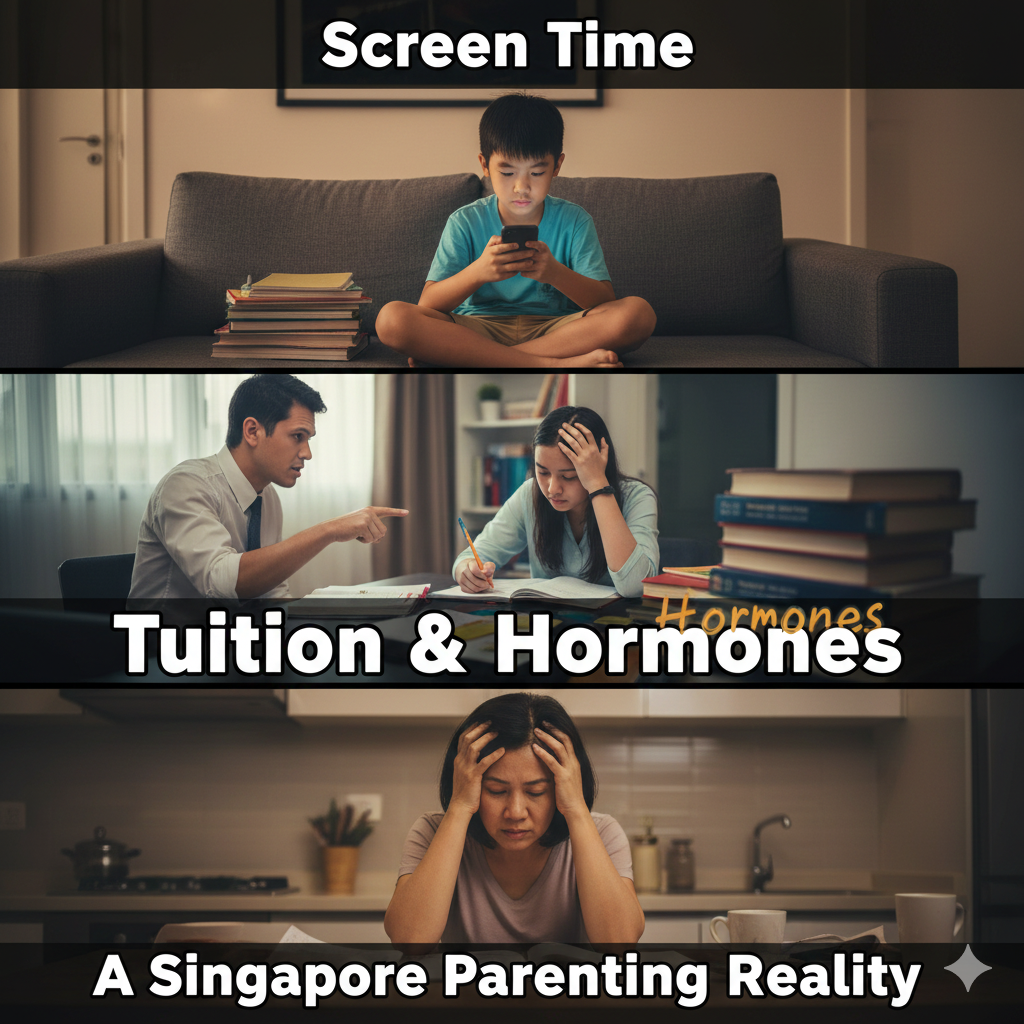
If you’re parenting in Singapore, you’ve probably felt it: the quiet pressure to keep up. School, enrichment, tuition, screens (for learning and “just to unwind”), late bedtimes, early mornings… and somehow your child’s mood, sleep, appetite, and even growth can start to feel “off”.
This isn’t about blaming screens or tuition. It’s about understanding what they can displace: sleep, movement, outdoor light, unstructured play, family connection and how that can ripple into the body’s hormone systems (melatonin, cortisol, appetite hormones, and the puberty pathway). 🌙⚡
Why does this topic hit so hard in Singapore
Singapore is academically intense, and tuition is a real part of many families’ lives. National data has shown Singapore households spent S$1.8 billion on private tuition in 2023, and average monthly tuition spending rose compared to previous years.
At the same time, digital devices are everywhere—learning platforms, messaging groups, YouTube “study with me”, and quick gaming breaks. Evidence reviews note that during the pandemic period, average screen time in children was reported around 2.77 hours/day, with a substantial proportion exceeding 2 hours/day.
The hormone link in simple terms (no jargon)
Think of your child’s body like a highly sensitive orchestra. Hormones are the conductors:
-
Melatonin helps sleep and circadian rhythm 🌙
-
Cortisol helps the body respond to stress, but constant stress can dysregulate it ⚡
-
Leptin/ghrelin/insulin influence appetite, cravings, and energy regulation 🍽️
-
Puberty hormones respond to growth signals, sleep, body composition, and overall environment 🌱
When life gets packed with tuition + screens + late nights, the biggest “domino” is usually sleep.
👉Early Puberty in Singapore Girls: Triggers Parents Should Know
📌Does Milk Cause Early Puberty in Girls? A Doctor’s Evidence-Based Answer
Screen time and sleep: the most consistent evidence
Research repeatedly shows that more screen media use is linked with later bedtimes and shorter sleep duration.
And Singapore’s Ministry of Health (MOH) guidance is very direct about this pattern, especially avoiding screens during meals and one hour before bedtime, and keeping daily recreational screen time age-appropriate.
Why sleep matters hormonally
-
Less sleep → higher stress reactivity and harder emotional regulation
-
Less sleep → more cravings and snack-seeking (because the brain wants quick energy)
-
Less sleep → poorer attention and learning (ironically making more tuition feel necessary)
So the “tuition + screen time” loop can accidentally create the exact issues we’re trying to solve.
👉10 Screen-Free Activities That Boost Your Child’s Brain Development
👉Screen-Free Meals: How Ditching Distractions Can Help Your Child Overcome Fussy Eating
Tuition stress and cortisol: when “busy” becomes biologically heavy
Stress isn’t always bad, some stress helps performance. But when children feel they’re always being evaluated, always behind, always preparing… cortisol can become “on” too often.
Cortisol is closely tied to stress and anxiety biology in adolescents, and chronic dysregulation is linked with mental health risks over time.
What parents commonly notice when cortisol load is high:
-
Irritability or “snapping” easily 😣
-
Trouble falling asleep even when tired
-
Tummy symptoms before school or tuition
-
Emotional eating or picky eating
-
Headaches, fatigue, “I don’t want to go” resistance
Screen time, sedentary behaviour, and early puberty concerns
Parents sometimes ask: “Is screen time affecting puberty?”
The research is evolving, but newer reviews suggest associations between screen time and pubertal timing, though causality is not always clear.
Separately, research also highlights sedentary behaviour (often linked to long sitting/screen habits) as a factor associated with early puberty risk in some analyses, especially in girls.
A practical takeaway:
Instead of obsessing over “screens cause puberty,” focus on the controllables that protect hormonal health:
-
consistent sleep timing
-
daily movement
-
outdoor light exposure
-
balanced meals and stable energy
-
lower stress load where possible
👉 Read my Early Puberty Parent Guide (symptom checklist + prevention strategies).
📌Screen Time and Sleep: How Your Child’s Diet Affects Both
The Singapore parent’s “3-switch reset” (realistic + doable) ✅
Here’s a plan that works even in busy households.
1) The Sleep Anchor (non-negotiable) 🛏️
Pick ONE anchor point:
-
Same bedtime window on school nights (e.g., within 30–45 minutes)
-
Screens off 60 minutes before bed (MOH guidance supports this)
Tiny upgrade: charge devices outside bedrooms.
2) The Screen Plan (not “screen ban”) 📱
Use a simple rule your child can understand:
-
Schoolwork screens: allowed, with breaks
-
Fun screens: a clear daily limit + a clear “stop time”
Parenting win: don’t only measure time—measure timing (late-night is the most disruptive).
3) The Tuition Load Check (reduce invisible pressure) 📚
Ask 3 questions:
-
Is my child sleeping enough most nights?
-
Do they have at least 60 minutes/day of movement or outdoor play (can be broken up)?
-
Do they have unstructured time at least a few times a week?
If the answer is “no,” the issue may not be “more tuition.” It may be too little recovery.
💡 Feeling overwhelmed by screens, school pressure, or sleep issues at home?
As a doctor working closely with Singapore families, I help parents create realistic routines that protect children’s growth, hormones, and emotional wellbeing, without extremes.
👉 Explore my child & teen nutrition and lifestyle guidance here.
Food and hormones: what helps (without perfection) 🍲
When kids are stressed + tired, blood sugar swings can worsen mood and cravings.
Try these small, high-impact habits:
-
Protein at breakfast (eggs / Greek yogurt / tofu / dal)
-
A proper after-school snack before tuition (fruit + nuts / yogurt / sandwich + milk)
-
Hydration + early dinner when possible
-
Keep ultra-processed “study snacks” from becoming daily defaults
This isn’t about dieting—this is about stabilising energy so hormones don’t get pushed around.
When to worry (and when to seek help) 🚩
Consider a professional check-in if you notice:
-
persistent sleep issues for weeks
-
significant anxiety symptoms (school refusal, panic-like symptoms)
-
rapid weight change, disordered eating patterns, frequent tummy pain
-
signs of very early puberty that concern you
-
mood changes that affect daily functioning
👉 Download the Weekly Family Screen Plan (Singapore Edition)
💬 Concerned about your child’s growth or behaviour?
👉 Book a pediatric nutrition & lifestyle consultation (FREE 20 minutes call) tailored to Singapore families.
FAQs
1) What’s a “safe” screen time limit for children in Singapore?
MOH guidance recommends age-based limits and emphasizes quality, co-viewing for younger kids, and avoiding screens during meals and in the hour before bedtime.
2) If my child uses screens for homework, does that count?
Most guidance separates schoolwork screen use from recreational use. The bigger concern is what screens replace sleep, movement, and family interaction.
3) Does screen time affect sleep even if my child “falls asleep fast”?
Yes, research links screen media use with delayed bedtimes and shorter sleep in many studies, even if the child seems to knock out quickly.
4) Is tuition harmful?
Not automatically. Tuition becomes hormonally “heavy” when it crowds out sleep and recovery, or when a child feels constant pressure. Stress biology (including cortisol patterns) can be affected by sustained stress/anxiety.
5) Can a busy lifestyle contribute to early puberty?
Puberty timing is multi-factorial. Evidence is still developing, but newer research explores links between screen time/sedentary patterns and pubertal timing or early puberty risk, so focusing on sleep, movement, and stress buffering is a smart approach.
💛 Want structured guidance? 📩 Click here to book a FREE consultation with Dr Akanksha Sharma
👉 Explore my programs:
-
Little Legends: The Doctor-Designed Growth & Strength Plan for Kids
- Teen Fuel: Doctor-Guided Nutrition & Routine Reset for Teenagers (Ages 12–19)
🔗 You May Also Find These Readings Helpful:
- [10 Science Backed Ways to Prevent Early Puberty in Girls]
-
[The Rise of Early Puberty in Girls — What Every Parent Should Know]
- [How to Know If Your Child Is Getting Enough Protein!]

Akanksha Sharma
Dr Akanksha Sharma (MBBS, MD) is a physician and women’s health nutrition specialist, and the founder of IYSA Nutrition. She provides evidence-based, doctor-led nutrition guidance for pregnancy, postpartum recovery, PCOS, child nutrition, and family health, helping women make calm, informed decisions about their health and their children’s well-being.