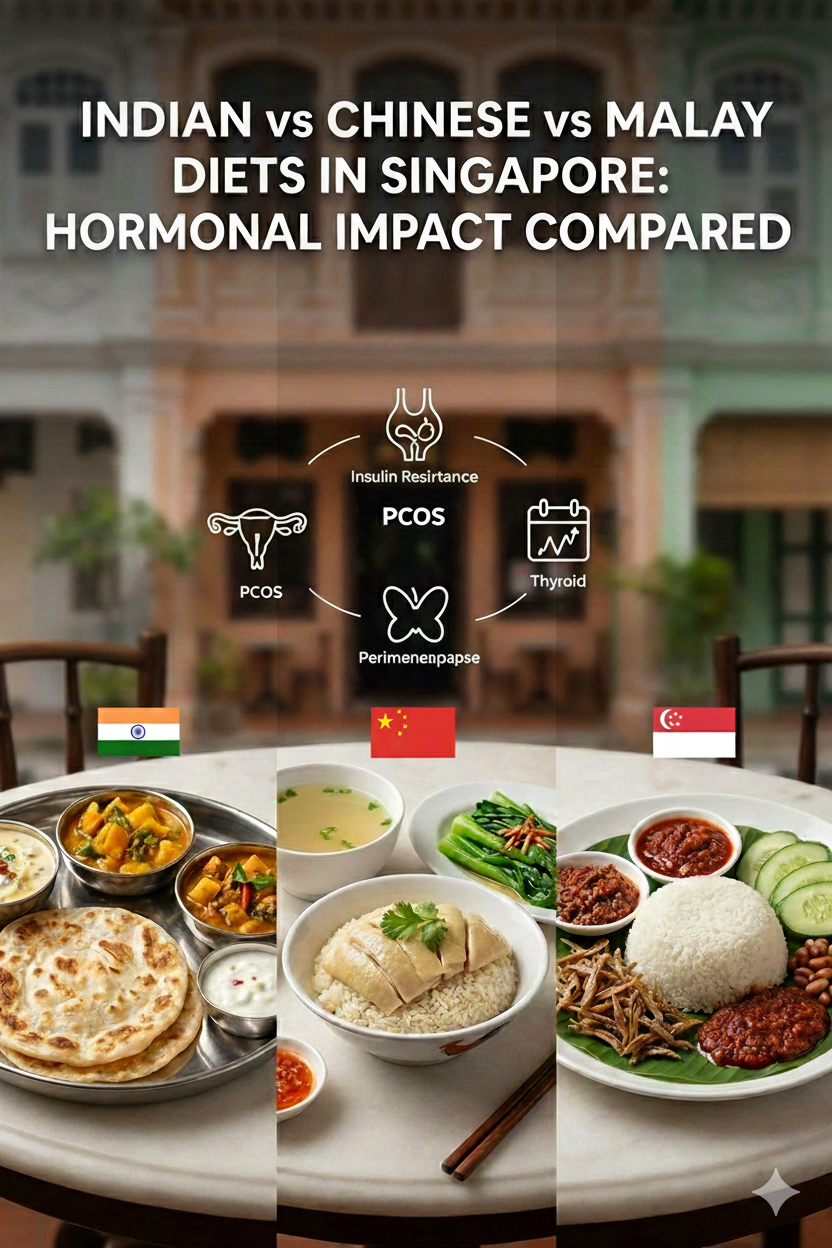
Singapore is a food paradise—and a fascinating “real-world nutrition lab.” Chinese, Malay, and Indian cuisines share the same city environment (work stress, sleep debt, heat, eating-out culture), yet each has distinct staples, cooking fats, and flavour bases that can influence insulin, cortisol, thyroid function, and reproductive hormones over time.
This guide compares the typical patterns (not stereotypes), explains the hormone pathways, and shows how to eat any cuisine in a more hormone-friendly way—without giving up cultural foods. 😊
Why this matters in Singapore (recent local data)
Two Singapore-wide surveys help frame the problem:
-
The National Nutrition Health Survey 2022 (Health Promotion Board, Singapore) reported that wholegrain intake remained low—<5% of staples consumed, and overall dietary quality remained a concern.
-
Singaporeans had “acquired a palate for increasingly rich & salty foods,” with higher total fat and excessive saturated fat, and many exceeding sodium recommendations. Health Promotion Board
-
National health survey data (2021–2022) reported diabetes prevalence around 8.5% among residents aged 18–74 (with additional undiagnosed cases).
These patterns matter because highly refined carbs + low fibre + high saturated fat + high sodium often push the body toward insulin resistance and inflammation—two major hormone disruptors.
The hormone pathways affected by diet (simple & useful)
Here’s what we’re really comparing:
1) Insulin (PCOS, acne, belly fat, fertility)
Refined carbs (white rice, noodles, sweet drinks, pastries) can raise glycaemic load, driving higher insulin—especially when paired with low fibre and low protein. High rice/noodle intake has been associated with greater insulin resistance in population studies.
Low-GI dietary approaches improve insulin-related outcomes in women with PCOS in trials/meta-analyses.
2) Stress hormones (cortisol) + sleep hormones
Skipping meals, under-eating protein, or relying on sweet caffeine drinks can worsen energy crashes → more caffeine/sugar → poorer sleep → higher stress response (a common Singapore cycle 😅). This indirectly worsens insulin and can affect menstrual symptoms.
3) Sex hormones (estrogen/testosterone balance, SHBG)
Dietary fat quality can influence reproductive hormone concentrations (e.g., changes in free and total androgens in some studies).
Inflammation and metabolic health also influence SHBG (a key hormone “carrier” affecting free hormone levels).
4) Menopause/perimenopause symptom experience
Soy foods (more common in many Chinese diets) contain isoflavones, which may help some menopausal symptoms in certain analyses, though findings vary by study design and dose.
Related reading:
👉Perimenopause & Hormone Support Guide
👉A Doctor-Reviewed Guide to Understanding PCOS
Typical patterns in Singapore (Chinese vs Malay vs Indian)
A) Chinese dietary pattern (common Singapore style)
Typical staples & features
-
Rice, noodles, congee, dim sum, stir-fries, soups
-
Frequent soy foods (tofu, tau kwa, soy milk)
-
Sauces can be salty (soy sauce, oyster sauce), and hawker meals may be oil-heavy
Potential hormonal upsides ✅
-
Soy intake may offer phytoestrogens (isoflavones) that can be helpful for some women around menopause (not a replacement for medical therapy, but a useful tool).
-
Seafood and soup-based meals can be protein-friendly if chosen well.
Common hormonal pitfalls ⚠️
-
High reliance on refined rice/noodles → higher glycaemic load → insulin strain (especially if protein/veg are small).
-
High sodium sauces/soups → water retention, BP risk (and overall cardiometabolic stress).
Singapore upgrade (easy swaps)
-
Choose ½ rice/noodles + double veg + palm-sized protein
-
Swap congee + youtiao → congee + egg/tofu + veg side
-
Pick unsweetened soy milk; treat bubble tea as dessert (not hydration) 🧋
B) Malay dietary pattern (common Singapore style)
Typical staples & features
-
Rice + coconut-based gravies (nasi lemak, rendang, lodeh)
-
Fried items are common (goreng)
-
Sweet beverages and kuih can add extra sugar
Potential hormonal upsides ✅
-
Many dishes include herbs/spices and can be very nutrient-dense.
-
Can be high-protein if you prioritise fish/chicken/egg/tempeh.
Common hormonal pitfalls ⚠️
-
Coconut milk + fried foods → higher saturated fat load; when combined with refined carbs, this can push insulin resistance in susceptible people.
-
Sweet drinks/kuih, frequently → insulin spikes → PMS/PCOS symptoms may feel worse.
Singapore upgrade
-
Nasi lemak: less rice, add egg/ikan, ask for less gravy; balance with veg side
-
Rendang/lodeh: keep coconut-based dish but pair with veg + protein, not extra carbs
-
Limit “combo hits” (fried + sweet drink + dessert) to occasional treats 🍰
C) Indian dietary pattern (common Singapore style)
Typical staples & features
-
Roti/rice + dal + sabzi (best-case pattern)
-
Also: briyani, prata, sweets, fried snacks, chai/coffee with sugar
-
Ghee/oil use varies; vegetarian diets may be carb-heavy if protein isn’t planned
Potential hormonal upsides ✅
-
When built around dal/legumes, curd, vegetables, and spices, it becomes a naturally hormone-friendly template (fibre + protein + micronutrients).
-
Fermented foods (idli/dosa) can be gentler for digestion in some.
Common hormonal pitfalls ⚠️
-
“Vegetarian but low-protein” → high refined carbs (white rice, refined flour) + low protein → insulin resistance risk rises
-
Sweets/snacks + sugary chai regularly → frequent insulin spikes
-
Restaurant Indian foods can be high in oil, and portions are large
Singapore upgrade
-
Aim for protein per meal: dal + paneer/tofu/eggs/Greek yoghurt
-
Switch some meals to millets/whole wheat/atta or mix (even 50/50 helps)
-
Keep prata/naan as “sometimes” and add protein (egg/prata + curry + veg) 🥚
The “big picture” comparison (what affects hormones most)
Across all cuisines, the strongest hormone drivers are usually:
-
Refined carbs + sugary drinks → insulin resistance (PCOS, acne, belly fat)
-
Low fibre / low whole grains → poorer metabolic health (Singapore data shows wholegrain staples are very low overall)
-
High saturated fat + high sodium eating-out pattern → inflammation + cardiometabolic load
-
Low protein (common in poorly planned vegetarian diets) → cravings, muscle loss, slower metabolism (especially 35+)
💛 Confused whether your symptoms are PCOS/insulin resistance/perimenopause? Take the guesswork out—book a FREE consultation (doctor-led, Singapore-friendly plans).
How to eat any cuisine for better hormones (the “Singapore Plate Method”) 🍽️
Use this for Chinese, Malay, and Indian meals:
-
½ plate non-starchy veg (or 2 veg sides if hawker portions are small)
-
¼ plate protein (fish/chicken/eggs/tofu/tempeh/paneer/dal)
-
¼ plate carbs (rice/noodles/roti)—not half the plate
-
Choose water / unsweetened drinks most days
-
If dessert happens: share, eat slowly, enjoy it—then move on 😄
Related reading:
👉Fitness After 40: Why It Feels Different (And What To Do)
👉The Insulin Reset: A Women’s Guide
FAQs
1) Which Singapore cuisine is “best” for hormones?
None is automatically best. The most hormone-friendly diet is the one that keeps insulin stable, fibre high, protein adequate, and ultra-processed foods low—within your culture.
2) I eat rice daily—do I need to stop?
No. But adjust the portion and pairing: a smaller rice portion + more protein + more vegetables reduces the glycaemic impact. High rice/noodle intake has been linked to insulin resistance in studies, so portions matter.
3) Does soy “mess up” hormones?
For most women, moderate soy foods (tofu, tempeh, soy milk) are safe. Some analyses suggest soy isoflavones may help with menopausal symptoms, though results vary.
4) I’m a vegetarian (Indian style). How do I make it hormone-friendly?
Prioritise protein at every meal (dal + paneer/tofu/Greek yoghurt/eggs), increase vegetables, and reduce refined flour/sugar frequency.
5) I have PCOS—what matters most across cuisines?
Carb quality and glycaemic load. Low-GI strategies improve insulin-related outcomes in women with PCOS in trials/meta-analyses.
PubMed references
-
Rice/noodle intake & insulin resistance: https://pubmed.ncbi.nlm.nih.gov/24229726/ PubMed
-
Glycaemic index/load in PCOS (systematic review/meta-analysis): https://pubmed.ncbi.nlm.nih.gov/32805007/ PubMed
-
Dietary fat & reproductive hormones: https://pmc.ncbi.nlm.nih.gov/articles/PMC4763493/ PMC
-
Soy isoflavones & menopausal symptoms (meta-analysis): https://pubmed.ncbi.nlm.nih.gov/40718787/ PubMed
-
Singapore multi-ethnic differences in diabetes risk (context for metabolic-hormonal risk): https://pmc.ncbi.nlm.nih.gov/articles/PMC10387644/ PMC

Akanksha Sharma
Dr Akanksha Sharma (MBBS, MD) is a physician and women’s health nutrition specialist, and the founder of IYSA Nutrition. She provides evidence-based, doctor-led nutrition guidance for pregnancy, postpartum recovery, PCOS, child nutrition, and family health, helping women make calm, informed decisions about their health and their children’s well-being.