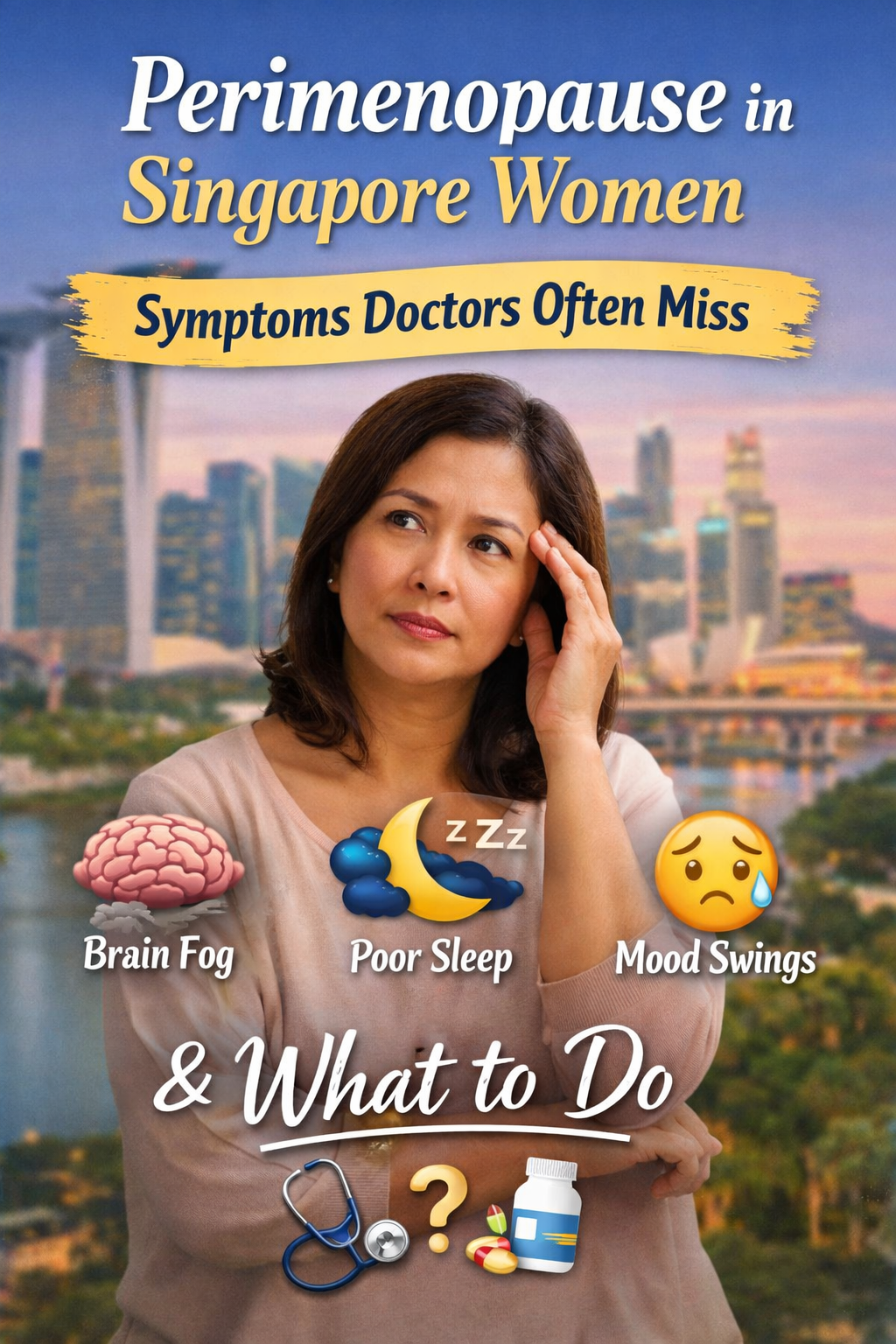
If you’re in your late 30s to early 50s and thinking, “Something feels off… but my reports are normal,” you’re not imagining it. Perimenopause (the menopause transition) can start years before periods stop completely—and the symptoms are often subtle, fluctuating, and easy to mislabel as “stress,” “thyroid,” or “just aging.”
Singapore adds its own mix: long work hours, high mental load, heat/humidity impacting sleep, and a culture of powering through discomfort. So let’s decode what perimenopause can look like—especially the signs doctors may miss.
👉Perimenopause Nutrition in Singapore: Why You’re Tired, Gaining Weight and How to Fix It
What Exactly Is Perimenopause?
Perimenopause is the transition phase leading up to menopause, when ovarian hormones fluctuate and menstrual cycles become less predictable. It’s not one fixed “test result”—it’s typically identified by symptoms + cycle changes over time.
The STRAW + 10 framework serves as the gold standard for defining the seven stages of reproductive aging, providing a clear roadmap from early perimenopause through postmenopause. This universal system uses menstrual patterns and hormonal markers to help doctors provide more accurate, personalized care for women regardless of age, ethnicity, or body size.
The STRAW + 10 criteria divide “perimenopause” into two distinct phases: the Early Transition and the Late Transition. Understanding these helps women identify where they are in the process and what to expect next.
Early vs. Late Menopausal Transition
| Feature | Early Transition (Stage -2) | Late Transition (Stage -1) |
| Menstrual Cycle | Increased Variability: Cycles differ by 7+ days from your normal (e.g., a 21-day cycle followed by a 35-day cycle). | Skipped Cycles: Periods of 60+ days of amenorrhea (no bleeding). Often called “skipping” cycles. |
| Hormones (FSH) | Variable: FSH levels begin to rise but fluctuate significantly day to day. | Elevated: FSH levels are consistently higher (often > 25 IU/L) as the body works harder to trigger ovulation. |
| Symptoms | Subtle: You may notice mood shifts or sleep changes, but they are often inconsistent. | Likely: Vasomotor symptoms (hot flashes and night sweats) typically peak or become more frequent. |
| Duration | Variable: Can last for several years. | Predictable: Usually lasts between 1 to 3 years before the final period. |
- You can be in perimenopause even if you still get periods (sometimes very regularly).
- The “60-Day” Rule: The most helpful takeaway for your readers is that skipping two months of periods is the official gateway into the “Late” stage, meaning the final menstrual period is likely within 1–3 years.
- Hormone Testing: Because hormones fluctuate so wildly in the Early Transition, a single blood test often doesn’t give the full picture. The menstrual calendar is actually a more reliable tool for staging during this time.
Key Takeaway: If your cycles are just “wonky” by a week or so, you’re likely in the Early Transition. If you’re starting to skip months at a time, you’ve moved into the Late Transition.
Related reading:
👉Perimenopause & Hormone Support Guide
👉A Doctor-Reviewed Guide to Understanding PCOS
Symptoms Doctors Often Miss (Common in Singapore Women)
1) “Brain Fog” and Memory Slips 🧠
You may notice:
-
Forgetting names/words mid-sentence
-
Reduced focus at work
-
Feeling mentally “slower,” especially on poor-sleep days
This is increasingly recognised as part of the menopause transition, often linked with sleep disruption, mood changes, and vasomotor symptoms.
2) Sleep Problems That Don’t Fit the Usual Pattern 😴
Not just “insomnia”—but:
-
Waking at 2–4 AM (wide awake)
-
Feeling unrefreshed even after 7–8 hours
-
Light, fragmented sleep (often worse pre-period)
Sleep issues can both trigger and worsen mood and fatigue symptoms during the transition.
3) Mood Shifts: Irritability, Anxiety, “Low Mood” (Without a Clear Trigger) 💛
Some women feel:
-
More sensitive or snappy
-
Uncharacteristic anxiety
-
Tearfulness or low motivation
Research shows the menopause transition can be a time of increased vulnerability to depressive symptoms, especially when combined with poor sleep, life stress, and hot flashes.
4) “Mini Hot Flushes,” Night Sweats, or Heat Intolerance 🔥
In Singapore’s climate, vasomotor symptoms can be missed because it’s easy to blame the weather:
-
Sudden waves of heat
-
Sweat episodes at night
-
Palpitations with warmth
Hormone therapy remains the most effective option for significant vasomotor symptoms (when appropriate for you medically).
5) PMS That Becomes “PMDD-like” (Premenstrual Dysphoric Disorder)
A classic pattern:
-
PMS suddenly gets much worse than before
-
Mood symptoms and cravings intensify
-
Cycles may shorten/lengthen unpredictably
This can happen because hormones fluctuate more dramatically during perimenopause.
6) Body Changes Despite “Same Diet” 🧍♀️
Many women report:
-
Reduced muscle tone
-
Slower recovery after workouts
This isn’t purely willpower—sleep disruption, stress hormones, and changing estrogen levels can influence appetite, energy, and body composition. (It’s fixable, but the strategy needs updating.)
Related reading:
👉Fitness After 40: Why It Feels Different (And What To Do)
👉The Insulin Reset: A Women’s Guide
7) Vaginal Dryness, Recurrent UTIs, Low Libido (Often Not Asked About) 🌸
These symptoms are extremely common, but many women don’t bring them up—and many clinics don’t routinely ask. Hormone therapy can help genitourinary symptoms as well, depending on what’s suitable (local vs systemic).
Why It’s Missed So Often (Even With “Normal” Blood Tests)
-
Symptoms fluctuate week to week
-
One-time hormone tests don’t reliably “prove” perimenopause
-
Symptoms overlap with thyroid issues, iron deficiency, depression, burnout, and sleep disorders
-
Many women present with non-classic symptoms first (sleep, mood, brain fog)
What You Can Do Now (Practical, Singapore-Friendly)
Track for 2–4 weeks initially (symptoms & patterns) 📝…and continue cycle tracking over 2–3 months.
During the first 2–4 weeks, track daily symptoms such as:
-
Sleep quality (especially 2–4 AM waking)
-
Mood changes (irritability, anxiety, low mood)
-
Brain fog or poor concentration
-
Hot flushes, night sweats, heat intolerance
-
Energy levels and exercise tolerance
Over the next 2–3 months, track menstrual patterns including:
-
Date of each period
-
Cycle length (days between periods)
-
Flow changes (lighter, heavier, spotting)
-
PMS severity and duration
📌 Why this matters:
In early perimenopause, symptoms often appear months before clear cycle irregularity. Symptom tracking gives early clues, while longer-term cycle tracking confirms the pattern.
Ask your doctor targeted questions 🩺
Instead of “I feel off,” try:
-
“Could this be perimenopause? My cycles/sleep/mood have changed.”
-
“Can we rule out thyroid/iron/B12/Vit D and also discuss menopause transition?”
-
“What are my options for vasomotor symptoms /sleep /mood support?”
Evidence-based treatment options (individualised)
-
Lifestyle: strength training + protein, stress regulation, sleep optimisation
-
Non-hormonal options (as indicated) for sleep/mood/VMS
-
Menopausal hormone therapy (MHT) for suitable candidates—benefits/risks depend on your profile and timing
Important: If you have heavy bleeding, bleeding after sex, bleeding between periods, or new severe symptoms—seek medical evaluation promptly.
🔗 You May Also Find These Readings Helpful:
- [A Doctor’s Natural Approaches for Perimenopause Symptom Relief]
-
[Menopause-Friendly Gut & Bone Health Diet and Lifestyle Plan]
- [Beyond the Hot Flashes: Exploring Testosterone Therapy for Women]
FAQ (Singapore Women Ask This a Lot)
1) At what age does perimenopause start in Singaporean women?
It can start in the late 30s or early 40s for some, but it varies widely. The key is symptoms + changing cycle patterns rather than a single age cut-off.
2) Can I be in perimenopause if my periods are regular?
Yes. Early perimenopause can present with mood, sleep, and cognitive symptoms even before cycles become clearly irregular.
3) Which symptoms are most commonly missed by doctors?
Brain fog, sleep fragmentation, anxiety/irritability, worsening PMS, and genitourinary symptoms (dryness, recurrent UTIs) are frequently under-recognised or not discussed proactively.
4) Should I test hormones to confirm perimenopause?
Hormone levels can fluctuate a lot during this transition, so one-time tests may not confirm or exclude it. Tracking symptoms and cycles is often more useful.
5) Is hormone therapy safe?
It depends on your age, time since menopause, medical history, and the type/route/dose used. For many symptomatic women, MHT can be appropriate after a proper risk assessment.
6) I feel low and anxious—how do I know if it’s perimenopause or depression?
Both can overlap. The menopause transition can increase vulnerability to depressive symptoms, especially with sleep issues and stress. A clinician can assess both in parallel—mood support is valid and treatable.
🌿 You don’t have to “push through” this phase.
Explore our doctor-designed resources for women navigating hormones, weight, and midlife transitions:
👉 Explore Our All Women’s Health Programs
👉 OR Book a FREE Consultation call

Akanksha Sharma
Dr Akanksha Sharma (MBBS, MD) is a physician and women’s health nutrition specialist, and the founder of IYSA Nutrition. She provides evidence-based, doctor-led nutrition guidance for pregnancy, postpartum recovery, PCOS, child nutrition, and family health, helping women make calm, informed decisions about their health and their children’s well-being.