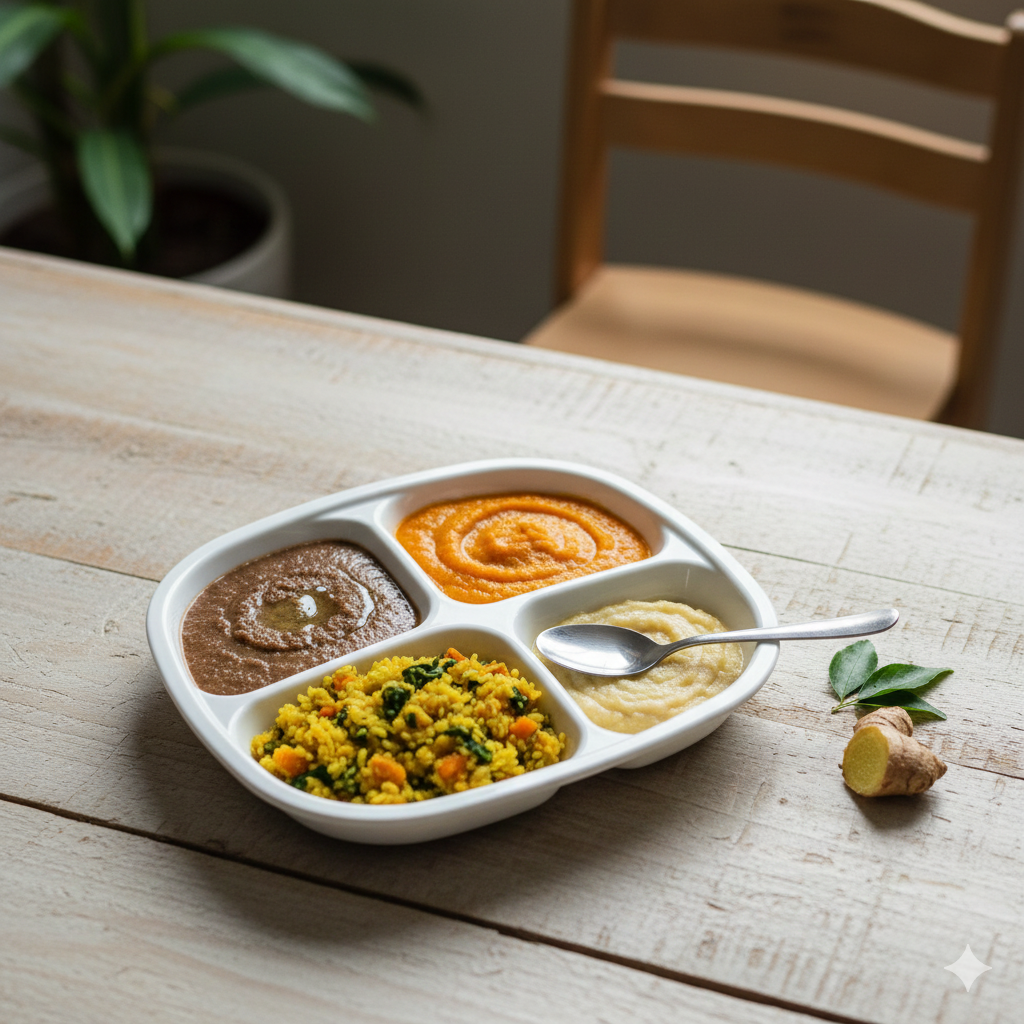
Complementary feeding is the “bridge” from exclusive breastfeeding to family meals. In India, we often call this the Annaprashan phase—but it’s more than a ceremony; it’s a critical window for brain and body growth. 🧠💪
The “When” and “How”: Readiness Cues 🚦
Don’t just watch the calendar; watch your baby.
-
The 180-Day Rule: WHO and IAP strictly recommend starting at 6 completed months (180 days).
-
Signs of Readiness: Baby sits with minimal support, has good head control, and shows “hand-to-mouth” coordination (trying to grab your plate!).
-
The Tongue-Thrust Reflex: If the baby pushes everything out with their tongue, they may need another week or two.
👉Weaning Your Baby: First Foods by Age and How to Introduce Them
👉Childhood Food Allergy: What Parents Must Know
The Indian “Four-Star” Meal Framework ⭐
To ensure a Minimum Acceptable Diet (MAD), every meal should aim to include these four stars:
-
Grains/Tubers: Rice, Ragi, Suji, Bajra, or Potato (Energy).
-
Legumes/Nuts: Dal, Roasted Chana powder, Groundnut paste (Protein).
-
Dairy/Animal Source: Curd, Paneer, or Egg/Meat (B12 & Iron).
-
Fruits/Vegetables: Pumpkin, Spinach, Papaya, or Carrot (Micronutrients).
Read ‘The First Food of Your Baby: A Doctor’s Guide‘ to know when to introduce which food item!
Fats for Babies 🧈
In the world of pediatric nutrition, fats are not “optional”—they are a biological necessity. During the transition to solids (6–24 months), a baby’s brain is growing at an incredible rate, and nearly 60% of the brain is composed of fat.
According to WHO and IAP (Indian Academy of Pediatrics) guidelines, fats are the most efficient way to increase the caloric density of a small stomach.
🧈 Ghee vs. Oil: The Clinical Breakdown
1. Desi Ghee (Clarified Butter)
Ghee is a staple in Indian households for a reason. It is culturally accepted and nutritionally dense.
-
High Smoke Point: Unlike butter, ghee doesn’t burn easily, making it safer for cooking.
-
Rich in Fat-Soluble Vitamins: It helps the baby’s body absorb Vitamins A, D, E, and K from the vegetables you are serving.
-
Butyric Acid: Ghee contains butyrate, which supports gut health and helps keep the baby’s bowel movements regular (constipation is common when starting solids).
-
Energy Density: One teaspoon of ghee adds roughly 45 calories to a meal without adding volume—perfect for babies who eat very small amounts.
📌Is Ghee for Children Good? An Evidence-Based Answer
2. Cold-Pressed Oils
While ghee is excellent, rotating it with high-quality oils provides a broader range of fatty acids.
-
Coconut Oil (Cold-pressed): Excellent for quick energy and contains Lauric Acid (also found in breast milk), which has antimicrobial properties. Great for babies in coastal regions.
-
Olive Oil (Extra Virgin): Rich in Omega-9 and antioxidants. It is heart-healthy and very gentle on the digestive tract.
-
Mustard Oil: Common in North/East India; ensure it is well-heated to remove the pungency. It provides a good balance of fats but should be used in rotation with others.
⚖️ Practical Guidelines for Parents
How much to add?
-
6–8 Months: Start with 1/2 teaspoon per meal.
-
9–12 Months: Increase to 1 teaspoon per meal.
-
1–2 Years: 1 to 1.5 teaspoons per meal.
The “Why” (The Science)
Babies have tiny stomachs (about the size of their fist). If you give them plain boiled rice or watery dal, they get “full” before they get enough calories. Adding ghee or oil ensures that every spoonful is “nutrient-dense,” helping them stay energetic and hit their weight gain milestones.
Medical Precautions 🩺
-
Avoid Refined Oils: Stay away from highly processed vegetable oils (soybean, cottonseed, or “vanaspati” dalda). Stick to Ghee, Extra-virgin olive oil, or Cold-pressed (Kachi Ghani) oils.
-
Balance: While fats are good, do not exceed the recommended amounts, as excessive fat can sometimes lead to loose stools or make the baby feel too full to eat their proteins and fibres.
🌟 The “Absorption Rule”
“Many parents serve carrots for Vitamin A and spinach for Iron. However, without a source of fat like Ghee, the Vitamin A (which is fat-soluble) cannot be absorbed by the baby’s body effectively. Adding fat is literally the key that ‘unlocks’ the nutrition in the vegetables.”
Worried your child is eating “too little” or too selectively or not sure what to start first?
👉 Book a child nutrition consult (FREE) (Singapore-friendly, practical, doable meal plans).
Practical Takeaways: Consistency & Frequency 📈
-
6 Months: Thick, smooth puree (should stay on a spoon): 2 times/day: Quantity 2–3 tablespoons
-
7–8 Months: Mashed/Crushed (lumpy but soft): 3 times/day: Quantity 1/2 cup (125ml)
- 9–11 Months: Finely chopped or “Finger foods”: 3-4 times/day + 1 snack: Quantity 3/4 cup
-
12–24 Months: Family pot (chopped/mashed): 3-4 times/day + 2 snacks: Quantity 1 full cup (250ml)
Unique Indian Recipes (Nutrient-Dense) 👩🍳
A. The “Iron-Boost” Ragi-Banana Mash (6+ Months)
-
Ingredients: 2 tbsp Ragi flour, 1/2 ripe Banana, 1 tsp Ghee.
-
Method: Cook Ragi in water until thick. Mash the banana separately and fold it in. Add ghee for healthy fats.
-
Why it’s unique: Ragi is an Indian superfood with 10x the calcium of rice/wheat.
B. Savoury “Paushtik” Khichdi (8+ Months)
-
Ingredients: Rice, Moong Dal, Spinach, Carrot, Pinch of spices like Turmeric, Cumin & Asafoetida, 1/2 tsp Ghee.
-
Method: Pressure cook all until mushy. Mash with a fork (don’t blend!).
-
Pro-Tip: Add a drop of lemon juice at the end—the Vitamin C helps absorb the iron from the spinach and dal! 🍋
C. Egg-Appam or Paneer Bhurji (9+ Months)
-
Ingredients: 1 Egg or 30g Crumbled Paneer, finely grated Lauki (Bottle gourd), and ghee.
-
Method: Scramble lightly with ghee.
-
Why it’s unique: High-quality protein is vital. WHO 2023 guidelines emphasise animal-source foods (eggs/dairy) daily if possible.
D. Homemade Cerelac: Superfood for babies
-
Ingredients: cereals (ragi, dalia, poha, oats, etc), nuts & seeds, makhana & roasted bengal gram flour
-
Method: Lightly roast everything in 2-3 tsp ghee and grind. Keep in an airtight container. Prepare a paste by heating 1-2 tablespoons of this in water or milk. Serve with a pinch of cardomom.
-
Why it’s unique: High nutrient density, easy to cook and a readymade nutritious meal always at hand for the baby’s hunger.
👉Is Your Child Getting Enough Calcium? (Without Dairy Supplements)
📌Why Zinc Deficiency is common in Indian Kids (And How to Fix It)
Common Pitfalls to Avoid (The “No” List) 🚫
-
No Salt/Sugar: Until 1 year. High salt damages kidneys; sugar creates a lifelong preference for sweets. 🧂🍭
-
No Honey: Risk of infant botulism (a serious type of food poisoning).
-
No Cow’s Milk as a Drink: Can be used in cooking (like Kheer), but not as a replacement for breastmilk/formula until age 1.
-
Avoid “Watery” Dal: The “Dal Ka Pani” myth is dangerous. It fills the stomach with water but provides zero calories. Give thick mashed dal instead.
- No Refined Oil: Mentioning again for reinforcement.
Related reading:
👉Why Cow’s Milk May Not Be the Best Choice for Toddlers Under Two
👉Refined Oil: The Poison That Reached Our Kitchens Somehow!
🗓️ The First 30 Days: Indian Complementary Feeding Schedule
Goals for Month 1: * Introduce the spoon and the concept of swallowing.
-
Focus on single-ingredient purees.
-
Keep consistency thick but smooth (like Greek yoghurt).
Week 1: The Gentle Introduction (Cereals & Tubers)
Focus on easily digestible, low-allergy foods.
| Day | Meal (Once a Day – Late Morning) | Practical Tip |
| 1-3 | Single Grain: Steamed Rice Mash | Use well-cooked, mashed rice with a drop of Ghee. |
| 4-5 | Yellow Moong Dal (Thick) | Not the water! The actual cooked, mashed dal. |
| 6-7 | Mashed Potato or Sweet Potato | Steam until very soft. Adds healthy carbohydrates. |
Week 2: Adding Colours (Vegetables)
Expanding the palate with earthier flavours.
| Day | Meal (Once a Day) | Practical Tip |
| 8-10 | Steamed Pumpkin Puree | Naturally sweet and rich in Vitamin A. |
| 11-12 | Carrot Mash | Steam thoroughly to avoid choking hazards. |
| 13-14 | Lauki (Bottle Gourd) Mash | Very hydrating and easy on the stomach. |
Week 3: The Fruit & Iron Phase
Introducing natural sweetness and local superfoods.
| Day | Meal (Once a Day) | Practical Tip |
| 15-17 | Banana Mash | Use a ripe “Elaichi” or “Robusta” banana. |
| 18-20 | Ragi Porridge (Nachni) | Cook with water/expressed breastmilk. High in Iron. |
| 21 | Papaya Mash | Great for digestion and preventing constipation. |
Week 4: Textures & Combinations
Moving toward twice-a-day feedings (Morning & Evening).
| Day | Meal 1 (Morning) | Meal 2 (Evening) |
| 22-24 | Rice & Dal Mash | Stewed Apple (Peeled/Steamed) |
| 25-27 | Sujee (Semolina) Halwa (No sugar) | Mashed Avocado or Banana |
| 28-30 | Ragi & Banana Mix | Khichdi (Rice + Dal + Carrot) |
💡 The “Doctor’s Secret” Tips for Month 1
-
Breastfeed FIRST: At 6 months, solids are “complementary.” Nurse the baby first, then offer solids 30–60 minutes later, so they aren’t too frustrated by hunger to learn.
-
The “Ghee” Rule: Always add 1/2 tsp of desi ghee to savoury meals. Babies need concentrated calories and healthy fats for brain development.
-
No Distraction Feeding: Avoid screens or “chasing the baby.” Let them sit in a high chair or on your lap to build a healthy relationship with food.
-
Iron-Rich Focus: By 6 months, a baby’s birth stores of iron are depleted. Prioritise Ragi and Green Leafy Vegetable purees twice a week.
FAQs: Parents’ Top Concerns ❓
Q1: My baby gags on lumpy food. Should I go back to purees?
Gagging is a normal safety reflex, not choking. Keep offering soft lumps. If you delay textures past 9 months, your baby may become a “fussy eater” later.
Q2: Should I give water?
Yes. Once solids start, offer 2–3 sips of boiled, cooled water after meals to keep stools soft.
Q3: Can I use “Store-bought” cereals?
Homemade is better. Store-bought often contains hidden sugars and preservatives. Use “Homemade Cerelac”.
Q4: How do I manage allergies?
Introduce common allergens (Egg, Wheat, Nuts) one at a time. Research shows early introduction (around 6 months) actually reduces the risk of allergies!
💛 Want structured guidance? 📩 Click here to book a FREE consultation with Dr Akanksha Sharma
👉 Explore my programs:
🔗 You May Also Find These Readings Helpful:
- [Fueling Little Minds: Best School Tiffin Ideas for Singaporean Kids!]
- [The Growth-Smart School Tiffin Recipes Guide]
-
[Children Are Not Mini Adults: Stop “Healthy” Food Trends From Harming Your Child]
- [Positive Reinforcement Tips to Encourage Good Behaviour in Your Child]
📚 References & Evidence
-
WHO (2023): Guideline for complementary feeding of infants and young children 6–23 months.
-
IAP (2024): Indian Academy of Pediatrics Guidelines for Parent Education.
-
Determinants of complementary feeding in India (Pune Study). PubMed
-
Systematic review on timing of introduction of solids. PubMed
-
UNICEF India: Infant and Young Child Feeding (IYCF) Training Module.
-
National Family Health Survey (NFHS-5): India-specific data on stunting and feeding gaps.
-
MAA (Mothers’ Absolute Affection) Program: National Health Mission, India.
-
ESPGHAN: Complementary Feeding position paper (Global standard).

Akanksha Sharma
Dr Akanksha Sharma (MBBS, MD) is a physician and women’s health nutrition specialist, and the founder of IYSA Nutrition. She provides evidence-based, doctor-led nutrition guidance for pregnancy, postpartum recovery, PCOS, child nutrition, and family health, helping women make calm, informed decisions about their health and their children’s well-being.