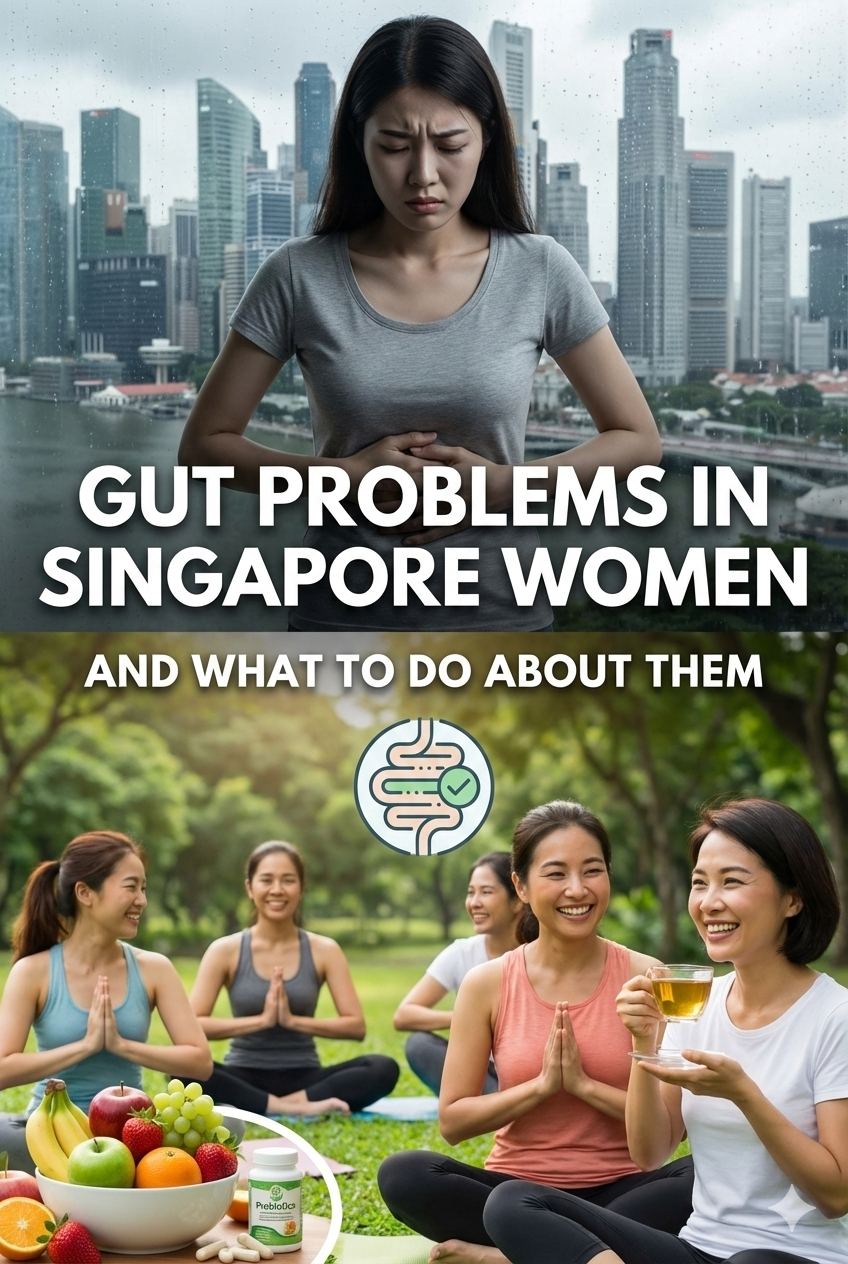
Bloating that “looks like pregnancy” by evening, constipation that won’t budge, acid reflux after hawker meals, or a tummy that reacts to everything—gut complaints are extremely common in Singapore women, especially during high-stress seasons of life (career pressure, postpartum, perimenopause).
The good news: most gut issues improve significantly with the right combination of food strategy + stress/sleep support + targeted medical checks when needed. 😊
The most common gut problems seen in Singapore women
1) IBS (Irritable Bowel Syndrome): “sensitive gut”
IBS typically includes bloating, abdominal discomfort, and changing stools (constipation/diarrhoea or both). In Singapore, IBS is often quoted around ~1 in 10 people, and it tends to affect women more than men.
A Singapore community study also reported that IBS and constipation are present in adults (constipation is notably common).
2) Chronic constipation (very common in women)
Constipation can worsen with:
-
low fibre (common in “rice/noodles + little veg” patterns)
-
low water intake (air-con + coffee/tea habits)
-
sedentary workdays
-
iron supplements (pregnancy/postpartum)
3) Acid reflux / “gastritis-like” symptoms
Spicy/oily foods, late dinners, stress, and caffeine can trigger reflux-like symptoms. In Singapore, reflux-type symptoms were reported to vary across ethnic groups in population research.
4) Postpartum gut issues
After delivery, many women experience constipation, haemorrhoids, bloating, appetite changes, and gut sensitivity (especially after C-section/antibiotics).
5) Perimenopause-related digestive shifts
Hormonal fluctuations can worsen bloating and bowel irregularity for some women (often alongside sleep disturbance and stress).
Related reading:
👉Perimenopause in Singapore Women: Symptoms Doctors Miss
👉Perimenopause & Hormone Support Guide
Why Singapore women are vulnerable (the lifestyle + food pattern)
This isn’t about blame—it’s about context.
Low wholegrains and fibre intake 🌾
Singapore’s National Nutrition Survey 2022 found wholegrains were only ~4% of staples, far below the recommended 30% of staples.
Low fibre can worsen constipation, bloating, and gut microbiome diversity.
Hawker/eating-out patterns 🍜
Convenient meals can be:
-
carb-heavy (rice/noodles dominate)
-
low vegetable volume
-
high oil + sodium
This combo tends to worsen bloating and reflux in sensitive individuals.
Stress + sleep debt 🧠
IBS is strongly linked with the gut–brain axis; female sex is a known risk factor, and stress often amplifies symptoms.
Related reading:
👉Burnout in High-Achieving Singapore Mothers: A Practical Recovery Plan
👉How Healthy Is Singapore Hawker Food? A Doctor’s Breakdown
Actionable: your 7-step “Singapore-friendly” gut reset ✅
1) Do a 14-day symptom tracker (quick and powerful)
Track:
-
meals (especially lactose, wheat, onions/garlic, spicy/oily foods)
-
stool pattern (constipation/loose stools)
-
stress, sleep, cycle phase
This helps identify whether it’s IBS patterns vs reflux vs food intolerance.
2) Fix the “fibre gap” gradually (don’t jump overnight)
Aim for a slow increase:
-
Add 1 fibre-serving/day for 3–4 days, then increase
-
Pair fibre with water
Easy adds in Singapore:
-
oats, chia, fruits, cooked veg
-
dal/beans in small portions
-
brown rice mix (start 50/50)
3) Trial a guided low-FODMAP approach (if bloating is severe)
Low-FODMAP can reduce IBS symptoms in controlled trials.
Best done short-term (2–6 weeks), ideally with a structured reintroduction—otherwise it becomes overly restrictive.
4) Upgrade hawker meals without “dieting”
Use the Gut-Friendly Hawker Plate:
-
½ veg, ¼ protein, ¼ carbs
Choose: fish soup + rice (small), yong tau foo (less fried), cai fan (2 veg + 1 protein + ½ rice).
👉 Download my Healthy Hawker Food Cheat Sheet (simple swaps that lower sugar & bloating triggers).
5) Reduce reflux triggers strategically (not forever)
Try for 2 weeks:
-
earlier dinner
-
reduce fried + very spicy meals
-
limit caffeine after 2 pm
-
smaller portions at night
6) Add a daily “gut walk” 🚶♀️
10–15 minutes post-meal helps motility and reduces bloating for many.
7) Consider probiotics selectively
Probiotics can help some IBS patterns, but strains matter, and response is individual. Diet quality remains the foundation.
💬 If you’re stuck in a cycle of bloating/constipation and fear of food:
👉 Book a consultation for a personalised gut plan (Indian/Chinese/Singapore-friendly).
When to see a doctor urgently 🚩
Seek medical evaluation if you have:
-
blood in stool, black stools
-
persistent vomiting
-
unexplained weight loss
-
fever, severe pain
-
anaemia, persistent fatigue
-
Symptoms waking you from sleep
These are not “just IBS.”
FAQs
1) Is bloating always a “gut problem”?
Not always—constipation, food triggers, hormonal shifts, and stress can all cause bloating. Tracking patterns helps.
2) Should I cut dairy/gluten immediately?
Not automatically. First, track symptoms and trial targeted changes. Over-restriction often backfires.
3) Does low-FODMAP work for everyone?
No, but it has strong evidence for IBS symptom reduction in many people when done correctly.
4) What’s the simplest first step?
Add vegetables + protein to meals, reduce sugary drinks, walk 10 minutes after meals, and increase fibre gradually.
PubMed references
-
Mayer EA, et al. Irritable bowel syndrome. Nat Rev Dis Primers. 2016.
https://pubmed.ncbi.nlm.nih.gov/27159638/ -
Halmos EP, et al. A diet low in FODMAPs reduces symptoms of IBS. Gastroenterology. 2014.
https://pubmed.ncbi.nlm.nih.gov/24076059/ -
Valdes AM, et al. Role of the gut microbiota in nutrition and health. BMJ. 2018.
https://pubmed.ncbi.nlm.nih.gov/29899036/ -
Siddiqui R, et al. The Gut Microbiome and Female Health. 2022.
https://pubmed.ncbi.nlm.nih.gov/36421397/ -
Chen LY, et al. Functional bowel disorders in Singapore adults (community study). Singapore Med J. 2000.
https://pubmed.ncbi.nlm.nih.gov/10843299/

Akanksha Sharma
Dr Akanksha Sharma (MBBS, MD) is a physician and women’s health nutrition specialist, and the founder of IYSA Nutrition. She provides evidence-based, doctor-led nutrition guidance for pregnancy, postpartum recovery, PCOS, child nutrition, and family health, helping women make calm, informed decisions about their health and their children’s well-being.