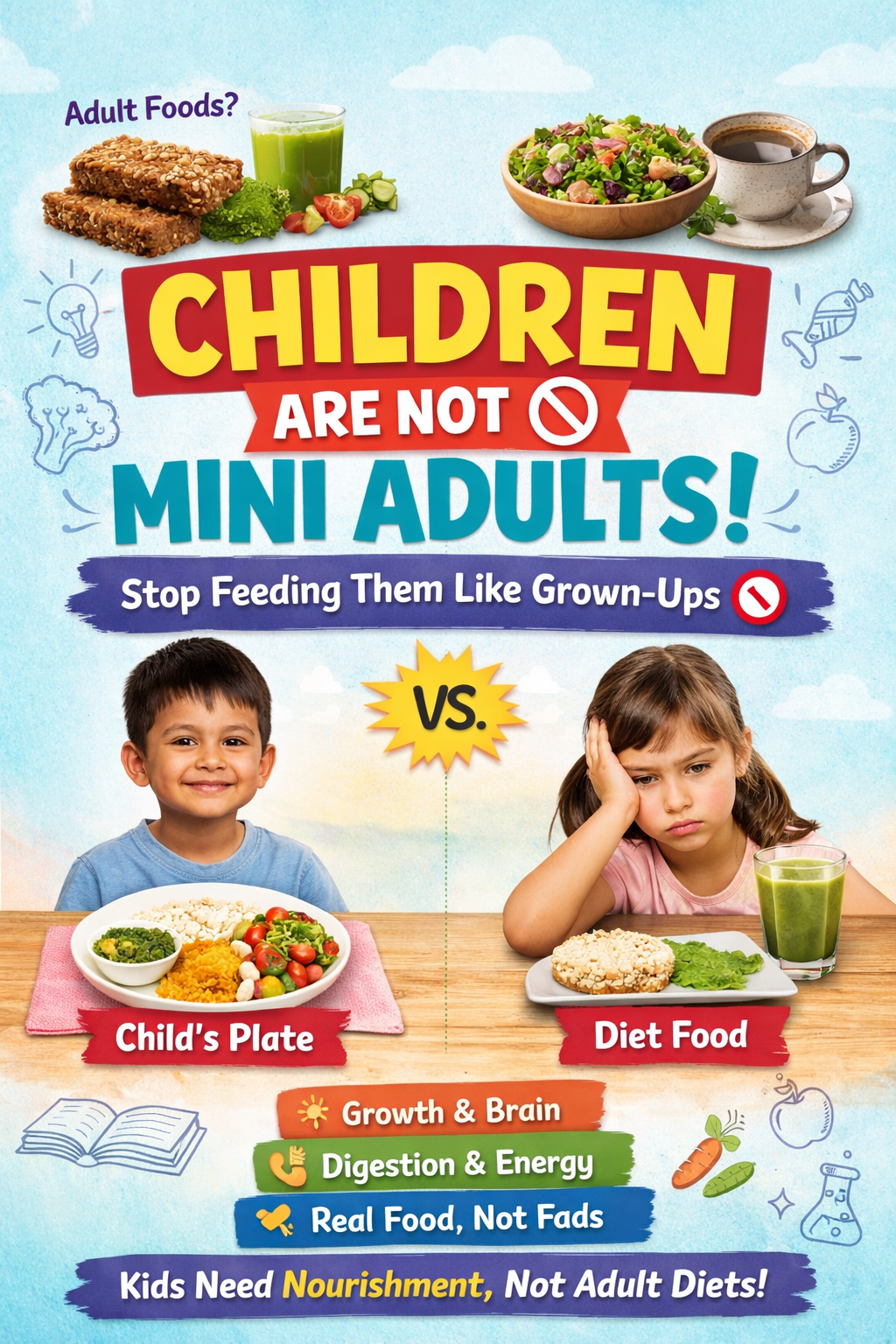
As adults, we often chase health trends—low sugar, low carb, “clean eating,” protein everything.
But children are growing humans with different biology, different needs, and a much smaller “nutrition margin for error.”
A child’s plate is not about fat loss or “optimizing.”
It’s about growth, brain development, gut maturity, hormones, sleep, and immunity—all happening at once.
This guide will help you spot the most common “adult health foods” that can backfire in kids (even when your intention is love ❤️).
Why kids aren’t mini adults (the science in simple words)
1) Kids have smaller stomachs but higher nutrient needs per kg
They can’t “make up later” easily. Skipping meals, low-calorie swaps, or bulky fiber-heavy diets can leave them under-fueled.
2) Their gut and taste learning are still developing
Kids need repeated exposures to learn foods. Extreme sweetness (even “sugar-free”) can train preference for sweet tastes.
3) Their brains run heavily on glucose
Carbohydrates aren’t “bad” for kids. In growing years, carbs support energy, learning, mood, and physical activity.
4) Growth is hormonally expensive
Kids need adequate calories, protein, calcium, iron, zinc, vitamin D—consistently.
If you want a done-for-you plan that fits your child’s age, schedule, and food culture:
✅ Book a FREE 30-minutes Consultation Call with Dr Akanksha.
or explore Child Nutrition Programs.
The “healthy” adult foods to limit in kids (and what to give instead)
1) Protein bars / protein laddoos / protein powders
Why to limit: often ultra-processed, very dense, can replace real meals.
Better swaps: paneer cubes, egg/omelette, dal chilla, curd + fruit, homemade sandwiches.
2) Green smoothies + raw veggie juices
Why to limit: raw loads can trigger bloating/constipation, and liquid calories can reduce appetite for meals.
Better swaps: cooked sabzi, veg dal, khichdi, soups, veg parathas.
3) “Diet foods” (sugar-free biscuits, stevia sweets, “keto” desserts)
Why to limit: may disrupt appetite cues and reinforce sweetness-seeking.
The interesting science on stevia (and similar sweeteners) in kids
Non-nutritive sweeteners (NNS) are actively studied because children are consuming them more (often without parents realizing). Major pediatric bodies have flagged the evidence as incomplete and emphasized caution and better labeling.
Reviews of early-life exposure discuss possible links (mostly from observational data) with later adiposity/metabolic outcomes, though causality is not settled.
Mechanism-wise, research explores how sweeteners might affect taste preference, appetite regulation, and gut microbiota—and why the “sweet taste without calories” pattern could matter over time.
Practical parent rule: If a child doesn’t need sugar-free products medically, don’t make them a daily habit. Use them occasionally, not as a default.
Better swaps: fruits, dates-laddoo, homemade muffins with less sugar, roasted makhana, peanut chikki.
4) Excess nuts & seeds (trail mixes, seed powders, daily nut butters)
Why to limit: too much fat + fibre can overload small guts → tummy aches/constipation.
Better swaps: age-appropriate portions (see charts below), nuts in meals (not as “all-day grazing”), peanuts/til chikki.
5) Low-carb / keto style meals
Why to limit: kids need carbs for energy, mood, learning, sports, and growth.
Better swaps: rice/roti + dal + sabzi + ghee; idli/dosa + chutney; poha/upma with veggies + curd.
Age-wise swap charts ✅
Ages 2–4: “Small stomach, fast growth”
Limit: raw salads/juices, seed powders, protein bars, diet biscuits
Swap to: khichdi + ghee, dal + rice, curd + fruit, paneer, egg, soft-cooked veggies
Portion guide: nuts/seeds in tiny amounts (think “sprinkle,” not “bowl”).
Ages 5–8: “Learning, immunity, height building”
Limit: green tea/coffee, salad-only meals, plant milks as “milk replacement,” daily oats-only breakfasts
Swap to: idli/dosa/poha/paratha rotation, dal/rajma/chole + rice/roti, milk/curd/paneer, fruit + nuts in small portions
Ages 9–13: “Pre-teen growth spurt”
Limit: low-carb rules, meal skipping, “fat loss” food swaps, sugar-free daily treats
Swap to: balanced meals with carbs + protein + fats; school snacks like paneer sandwiches, sweet corn chaat with veggies, sprouts chaat, curd bowls; millets 2–3×/week
📥Download My Guide on Age-wise Protein Needs for Children
5 Golden Rules of Child Nutrition ⭐
-
Children need fuel for growth, not restriction.
-
Home food beats packaged “health” food.
-
Variety matters more than superfoods.
-
Digestion matters more than trends.
-
Consistency matters more than perfection. 😊
Related reading:
👉Why Cow’s Milk May Not Be the Best Choice for Toddlers Under Two
👉The Ultimate Indian Complementary Feeding Guide (6–24 Months)
What this looks like on a plate (simple framework)
For most kids, aim for:
-
½ plate: cooked vegetables + fruit
-
¼ plate: carbs (rice/roti/idli/dosa/poha)
-
¼ plate: protein (dal/beans/eggs/paneer/curd)
-
+ fats: ghee/olive oil/nut paste in small amounts
👉How to Know If Your Child Is Getting Enough Protein!
FAQ (parent questions I get daily)
1) “Is stevia safe for kids?”
Safety approvals exist for certain sweeteners, but daily use in children isn’t recommended as a habit because long-term effects on appetite, taste preference, and metabolic outcomes are still being studied. Pediatric guidance highlights uncertainty and the need for clearer labeling and better evidence.
2) “Isn’t sugar-free better than sugar?”
Not automatically. “Sugar-free” can keep the child’s palate trained toward intense sweetness, and it can crowd out real foods. The goal is less sweet dependence overall, not swapping one sweet system for another.
3) “My child is picky—should I use smoothies daily?”
Smoothies can help occasionally, but daily smoothies can reduce chewing practice and appetite for meals. Prefer whole fruits + curd or cooked veg in meals most days.
4) “Are plant milks okay?”
They’re fine sometimes, but most are not nutritionally equivalent to milk (especially protein/fat) unless specifically formulated—and even then, they’re not always ideal for growth as a replacement. Use only when medically needed or planned carefully.
5) “How do I reduce sugar without sweeteners?”
Use: fruit, cinnamon, vanilla, nut pastes, yoghurt, and slowly reduce sweetness over weeks (kids adapt!).
If you want a done-for-you plan that fits your child’s age, schedule, and food culture:
✅ Book a FREE 15-minutes Consultation Call with Dr Akanksha.
or explore Child Nutrition Programs.
References (PubMed / PMC links)
-
AAP Policy Statement: The Use of Nonnutritive Sweeteners in Children
-
Review: Early-life exposure to NNS and cardiometabolic health
-
Review: Nonnutritive sweeteners—physiology & metabolic effects
-
Systematic review: Artificial sweeteners and metabolic outcomes incl. children

Akanksha Sharma
Dr Akanksha Sharma (MBBS, MD) is a physician and women’s health nutrition specialist, and the founder of IYSA Nutrition. She provides evidence-based, doctor-led nutrition guidance for pregnancy, postpartum recovery, PCOS, child nutrition, and family health, helping women make calm, informed decisions about their health and their children’s well-being.