Choosing the right cooking oil isn’t just about taste — it’s about your health, digestion, and even long-term disease prevention. In today’s blog, we explore the best oils for cooking, explain why refined oils might not be the healthiest option, and dive into the benefits of traditional choices like cold-pressed oils, ghee, and extra virgin olive oil.
🧪 Why Refined Oils May Not Be the Best Choice
Refined oils are highly processed using heat, chemicals (like hexane), and deodorizers to make them look and smell neutral. This strips the oil of its natural nutrients and introduces potential toxins.
🔍 What Research Says:
- A study in BMC Public Health found that repeated consumption of refined and reused oils may lead to inflammation, oxidative stress, and atherosclerosis (Kumar et al., 2020).
- Research has linked excessive consumption of omega-6 rich refined vegetable oils (like sunflower and soybean oil) with increased risk of chronic diseases like heart disease and obesity (Simopoulos, 2008).
⚠️ Potential Risks of Refined Oils:
- Loss of natural antioxidants and vitamins
- Higher trans fats and free radicals due to high-heat processing
- Increased risk of heart disease, diabetes, and inflammation
🌾 The Case for Cold-Pressed Oils
Cold-pressed oils are extracted without the use of heat or chemicals, preserving their nutrient profile and natural flavor.
✅ Benefits:
- Rich in antioxidants, vitamins (like E), and polyphenols
- No chemical residues
- Better for heart health and digestion
🥥 Best Cold-Pressed Oils for Kitchens:
- Mustard oil: Rich in omega-3 and anti-microbial properties
- Groundnut oil: Balanced PUFA and MUFA content
- Coconut oil: Great for medium-heat cooking, antimicrobial and easy to digest
- Sesame oil: Warming, suitable for temperate climates and good for Vata balancing in Ayurveda
📖 A 2017 study in the Journal of Food Science and Technology concluded that cold-pressed oils retain significantly higher levels of tocopherols and phytosterols, contributing to improved lipid profiles and reduced inflammation (Sharma et al., 2017).
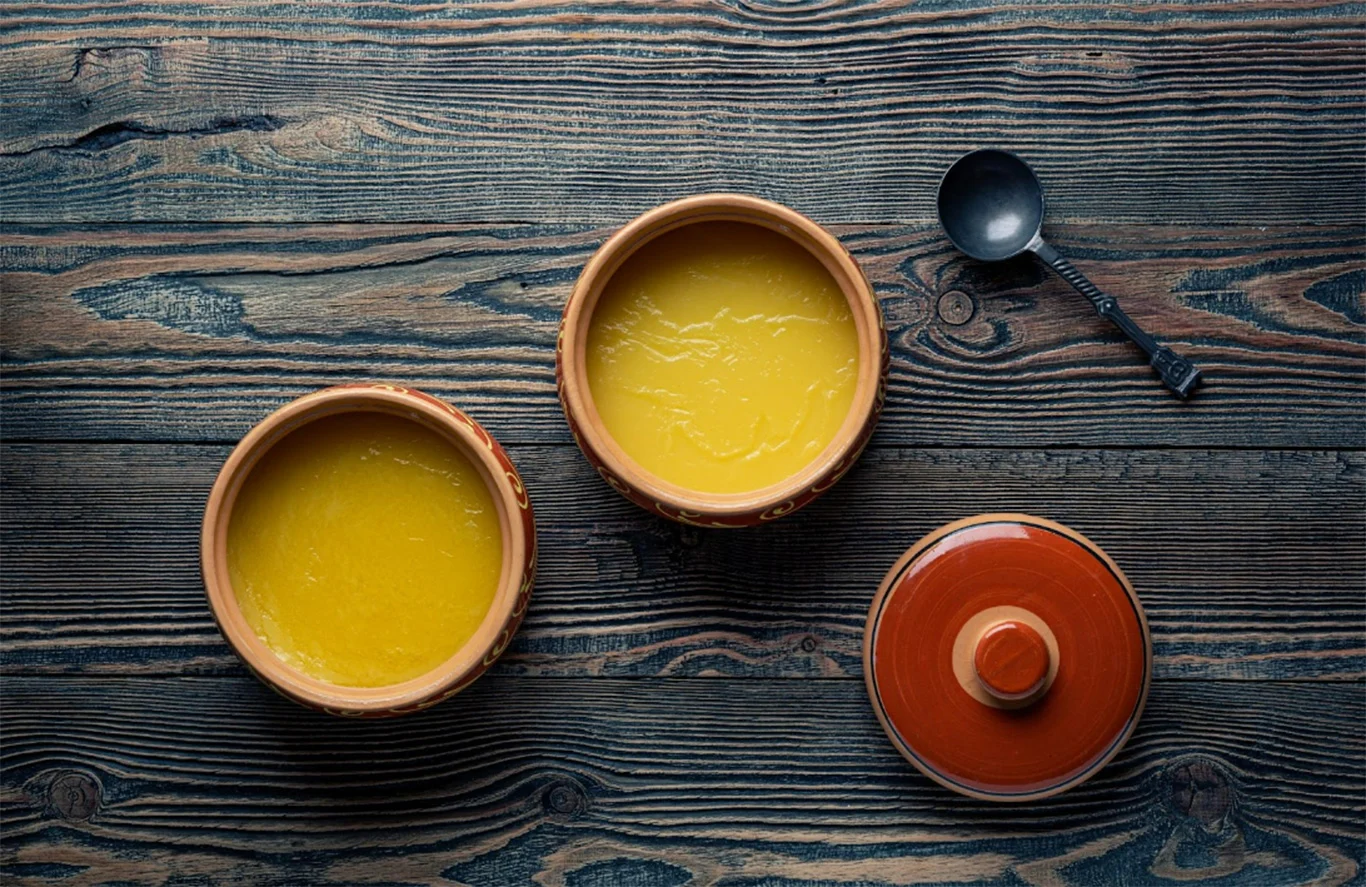
🥄 Why Ghee Still Reigns Supreme in Indian Households
Ghee is clarified butter rich in fat-soluble vitamins (A, D, E, K), and butyric acid which supports gut health.
🔥 High smoke point (~250°C) makes it suitable for most Indian cooking methods like tadka, roasting, and sautéing.
🌱 In Ayurveda, ghee is considered sattvic, nourishing for the body and mind. It’s also known to improve absorption of herbs and nutrients.
📚 Studies show that ghee, when consumed in moderation, may reduce cholesterol and improve lipid metabolism (Rani et al., 2016, Ayu Journal).
🍈 Extra Virgin Olive Oil (EVOO): Not Just for Salads
EVOO is unrefined and rich in heart-healthy monounsaturated fats, vitamin E, and polyphenols.
✅ Can it be used for cooking? Yes — but with care.
- Smoke point: Around 190–210°C (suitable for light sautéing, not deep frying)
- Best uses: Dressings, dips, low to medium-heat cooking
🔬 A 2018 study published in the journal Nutrients found that extra virgin olive oil retains much of its antioxidant capacity even when heated moderately, making it safe for everyday cooking (Martínez-González et al., 2018).
🎯 Final Thoughts: Choose Wisely, Eat Mindfully
👉 Avoid heavily refined, ultra-processed oils
👉 Prefer traditional cold-pressed oils suited to your region and cooking style
👉 Rotate oils based on your cooking method and season
👉 Include ghee and EVOO for their medicinal and culinary benefits
🥗 Remember: Your cooking oil is not just a medium — it’s medicine, tradition, and nourishment in one spoonful.
🔗 For personalized dietary guidance and traditional nutrition plans, Click here 💛
🔗 You May Also Find These Readings Helpful:
- [The Best Oils for Cooking: What Science (and Tradition) Say]
-
[Coconut Oil for Babies: A Natural Wonder for Skin, Hair & More]
-
[Refined Oil: The Poison That Reached Our Kitchens Somehow!]
📚 References:
- Perumalla Venkata, R., & Subramanyam, R. (2016). Evaluation of the deleterious health effects of consumption of repeatedly heated vegetable oil. Toxicology Reports, 3, 636–643. LINK
- Ambreen, G., Mirbahar, A., Memon, A., & Memon, S. Q. (2020). Association of long-term consumption of repeatedly heated mix vegetable oils with hyperlipidemia and hepatic enzyme derangement. Lipids in Health and Disease, 19, 215. LINK
- Simopoulos, A. P. (2004). Omega-6/omega-3 essential fatty acid ratio and chronic diseases. Food Reviews International, 20(1), 77–90. PubMed
- Simopoulos, A. P. (2002). The importance of the ratio of omega-6/omega-3 essential fatty acids. Biomedicine & Pharmacotherapy, 56(8), 365–379. PubMed
- ashempour-Baltork, F., Farshi, P., Alizadeh, A. M., Azadmard-Damirchi, S., & Torbati, M. (2022). Nutritional aspects of vegetable oils: Refined or unrefined? European Journal of Lipid Science and Technology, 124(12), 2100149. LINK
- Voon, P. T., Ng, C. M., Ng, Y. T., et al. (2024). Health effects of various edible vegetable oils: An umbrella review. Advances in Nutrition, 100276. LINK
- Kataria, D., et al. (2024). Health benefits of ghee: Review of Ayurveda and modern science perspectives. Journal of Ayurveda and Integrative Medicine, 15(1), 100819. PubMed
- Hosseinabadi, S. M., Nasrollahzadeh, J., et al. (2022). Effects of diets rich in ghee or olive oil on cardiometabolic risk factors in healthy adults: A two-period, crossover, randomised trial. British Journal of Nutrition, 128(9), 1720–1729. PubMed
- Martínez-González, M. A., Sayón-Orea, C., Bullón-Vela, V., Bes-Rastrollo, M., Rodríguez-Artalejo, F., Yusta-Boyo, M. J., & García-Solano, M. (2022). Effect of olive oil consumption on cardiovascular disease, cancer, type 2 diabetes, and all-cause mortality: A systematic review and meta-analysis. Clinical Nutrition, 41(12), 2659–2682. PubMed
- Guasch-Ferré, M., Li, Y., Willett, W. C., Sun, Q., Sampson, L., Salas-Salvadó, J., Martínez-González, M. A., Stampfer, M. J., & Hu, F. B. (2022). Consumption of olive oil and risk of total and cause-specific mortality among U.S. adults. Journal of the American College of Cardiology, 79(2), 101–112.PubMed

Akanksha Sharma
Dr Akanksha Sharma (MBBS, MD) is a physician and women’s health nutrition specialist, and the founder of IYSA Nutrition. She provides evidence-based, doctor-led nutrition guidance for pregnancy, postpartum recovery, PCOS, child nutrition, and family health, helping women make calm, informed decisions about their health and their children’s well-being.