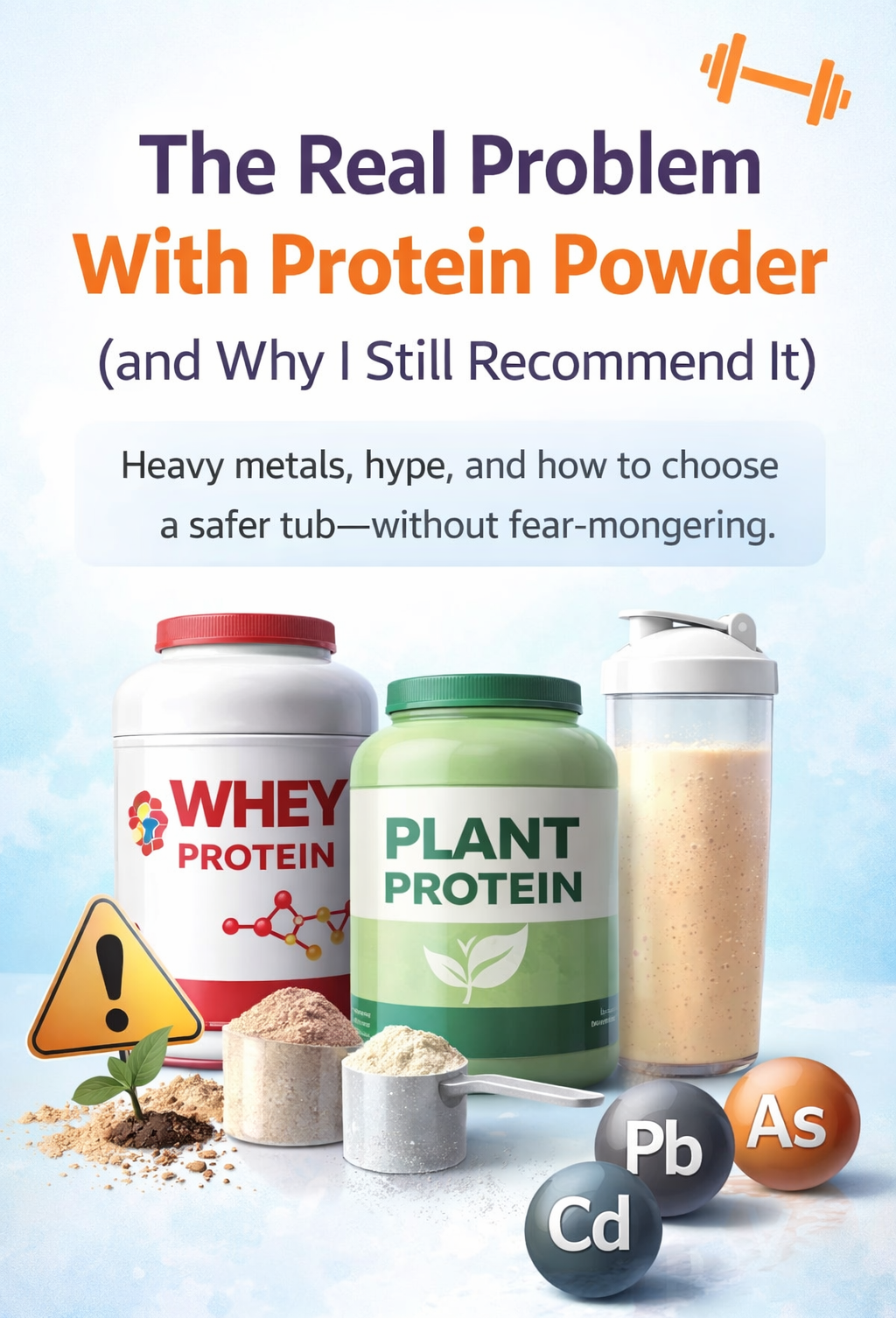
Heavy metals, hype, and how to choose a safer protein powder —without fear-mongering.
Protein powders have become the internet’s favourite “health villain.” One week they’re a muscle-building miracle; the next week they’re “toxic” and “full of metals.” 🙃
The truth is more balanced—and honestly, more helpful:
✅ Protein powders can be extremely useful for busy adults, vegetarians, peri-menopausal women, older adults, and anyone struggling to hit protein targets.
⚠️ Some protein powders (especially some plant-based powders) can contain higher levels of heavy metals than people expect.
✅ This doesn’t mean “all powders are unsafe.” It means you should buy smarter.
Let’s break it down in a way that keeps the tone sane—and your protein intake strong.
Why Protein Powder Exists (And Why It’s Not “Cheating”) 🧠
Protein powder isn’t meant to replace real food. It’s designed to solve a very real modern problem:
-
You have protein needs (muscle, hormones, recovery, satiety).
-
You have time constraints (work, parenting, travel).
-
Your appetite is limited (especially in peri-menopause, stress, or calorie deficit).
-
Your diet pattern may be vegetarian or lower in high-protein foods.
A scoop of protein is simply a concentrated, measured source of protein, like how iodised salt is a practical way to prevent iodine deficiency. It’s not morally “good” or “bad.” It’s a tool.
And the tool works: research consistently shows that protein supplementation can enhance gains in strength and lean mass when combined with resistance training.
So What’s the “Problem” With Protein Powder? 🚨
The biggest legitimate concern is not “protein damages kidneys” (that’s mostly misinformation for healthy people), nor is it that “powder is processed.” The real concern is:
1) Heavy metals in some products
Several scientific analyses have found detectable levels of metals like lead (Pb), cadmium (Cd), arsenic (As), and sometimes others in protein powders.
And importantly:
Plant-based powders often show a higher metal burden than animal-based powders
This is not a “plant foods are bad” statement—it’s about agriculture and soil.
Plants can absorb metals from:
-
soil (natural mineral content, industrial contamination, fertiliser residues),
-
water,
-
air pollution.
A published risk assessment reported that plant-based protein powders tended to have a higher heavy metal burden than animal-based powders.
More recent work also flags plant-based supplements as potential sources of potentially toxic elements depending on sourcing and product type.
Key nuance (important):
Finding “detectable” metals does not automatically equal “danger.” Dose and frequency matter. Some studies evaluating exposure conclude that typical consumption patterns may not raise non-carcinogenic risk for most consumers—yet this depends on the product, serving size, and long-term use.
Why Plant Proteins Can Test Higher (And Why That Still Doesn’t Make Them “Bad”) 🌱
Plant proteins—like pea, rice, hemp, and mixed blends—can be fantastic options for people who don’t tolerate dairy.
But plant powders may test higher because:
-
plants reflect their growing environment,
-
and “clean/organic” labels don’t automatically guarantee lower metals (soil can still contain them).
Also, some ingredients (like cacao used in chocolate-flavoured powders) can contribute to higher cadmium/lead in foods in general—so the flavour sometimes matters too. (This varies by brand and sourcing—so don’t assume, verify.)
Bottom line: plant protein is not the enemy.
The issue is quality control + sourcing + testing transparency.
The Part People Forget: Protein Powders Have Real Benefits ✅
If protein powders were only “marketing,” we wouldn’t see consistent performance and body composition advantages in controlled research.
Here’s what the evidence supports:
Protein + resistance training = better results
-
A large meta-analysis found protein supplementation increases in muscle size and strength during resistance training.
-
Studies and reviews also show whey protein can improve body composition outcomes, especially alongside training and appropriate energy intake.
Useful beyond gym culture
Protein powders can help people who:
-
can’t eat large meals,
-
are vegetarian and fall short on protein,
-
are peri-menopausal and trying to preserve lean mass,
-
are older adults working on strength and function (often best combined with exercise).
So yes—protein powders can be a smart, science-aligned tool.
How to Choose a Safer Protein Powder (Without Overthinking) 🛒✅
Use this checklist like a clinician would:
1) Look for third-party testing or transparent Certificates of Analysis (COA)
Words to look for:
-
NSF Certified for Sport
-
Informed Choice
-
USP Verified
-
“Third-party tested” (best if they show COA/lot testing)
If a brand won’t share testing details at all, that’s a yellow flag.
2) Prefer simpler ingredient lists
More ingredients = more variables (thickeners, gums, flavours, sweeteners).
A short list doesn’t guarantee safety—but it reduces common gut triggers.
3) Choose the type based on your gut
If you’re sensitive to lactose:
-
Whey isolate or hydrolyzed whey isolate usually has very low lactose
-
Many people tolerate it better than whey concentrate
If dairy triggers you:
-
choose a plant blend from a brand with strong testing transparency
4) Rotate protein sources (and don’t mega-dose daily forever) 🔁
This is a practical “risk reduction” habit:
-
Rotate between whey isolate / egg white protein / plant blend
-
Don’t take 2–3 giant scoops daily unless there’s a specific need
5) Keep perspective on exposure
Heavy metals are not unique to protein powders; they exist in small amounts across the food chain. The aim is not “zero exposure” (impossible), but lower exposure over time by choosing better products and not over-consuming.
The “Best” Way to Use Protein Powder (So It Actually Helps) 🥛✨
Protein powder works best when it supports real-life eating:
Use it to:
-
“top up” a low-protein breakfast
-
hit targets during travel/busy clinics/school runs
-
support strength training days
-
make a balanced snack (protein + fibre + healthy fat)
Not ideal to:
-
replace meals all day
-
use as a license to skip real protein foods
-
depend on it as your only protein source
If you want a practical framework, you can read:
-
Internal link idea: “How Much Protein Do You Actually Need?”
-
Internal link idea: “Lactose Intolerance in Adults: Smarter Protein Choices”
-
Internal link idea: “Peri-menopause & Protein: Protecting Muscle, Mood, Metabolism”
(Links are included at the end so you can plug them into your site.)
My Clinical Take (In One Line) 🩺
Protein powder is good.
But like any supplement, it’s only as good as the brand’s quality control—and your dosing.
If you’re a vegetarian, a busy mom, peri-menopausal, training for strength, or simply not meeting protein needs through food: protein powders can be a game-changer 💛—as long as you choose wisely.
CTA 📣
If you want me to help you choose the right powder based on your gut tolerance (lactose sensitivity), dietary pattern, goals (fat loss vs muscle), and your current meals, I do this inside my personalized plans.
✅ Comment “PROTEIN” (or message me) and I’ll share:
-
a quick brand-check checklist,
-
plus how to fit 1 scoop into your day without bloating.
🔗 You May Also Find These Readings Helpful:
-
[Is Protein Deficiency Common in Singapore Children? (A Doctor’s Reality Check)]
- [How Much Protein Do You Really Need? And Is Too Much Harmful?]
🔗 References:

Akanksha Sharma
Dr Akanksha Sharma (MBBS, MD) is a physician and women’s health nutrition specialist, and the founder of IYSA Nutrition. She provides evidence-based, doctor-led nutrition guidance for pregnancy, postpartum recovery, PCOS, child nutrition, and family health, helping women make calm, informed decisions about their health and their children’s well-being.