
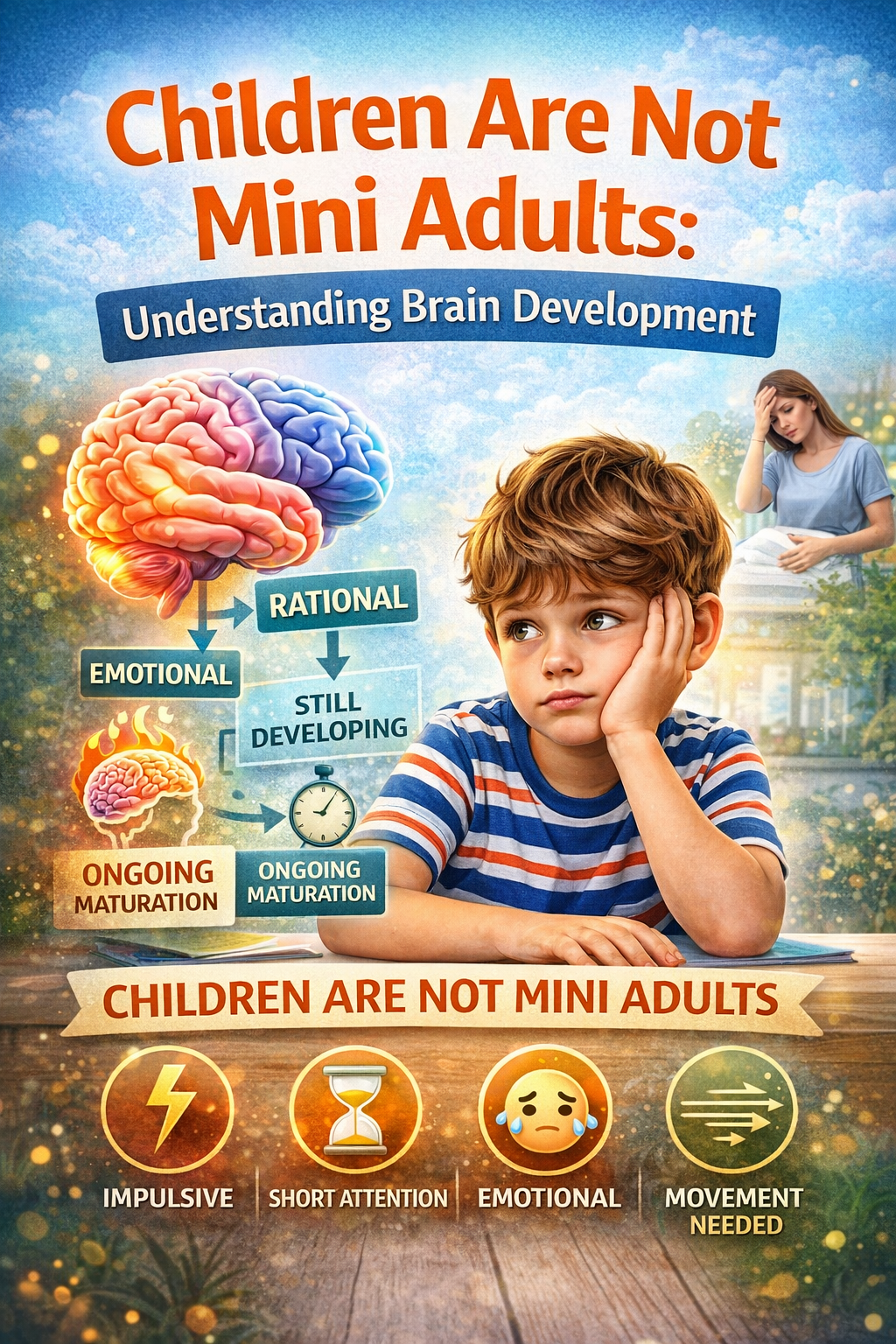
Why treating children like “small adults” can harm their growth, behaviour, and learning.
Brain development in children, child brain vs adult brain, pediatric development, executive function in children.
Introduction
One of the most common mistakes parents make, often unknowingly, is expecting children to think, behave, and regulate emotions like adults.
You may hear:
- “Why can’t he sit still?”
- “She knows better. Why is she still doing this?”
- “He is just being difficult.”
But here’s the truth:
👉 Children are not mini adults: their brains are structurally and functionally different.
Understanding this is not just philosophical; it is neuroscience-backed and critical for parenting, education, and child health.
How a Child’s Brain Is Different from an Adult’s
The human brain undergoes prolonged development well into the mid-20s.
1. The Prefrontal Cortex Is Still Developing
The prefrontal cortex controls:
- Decision-making
- Impulse control
- Planning
- Attention
In children, this region is immature.
A landmark neuroimaging study showed that brain maturation, especially in the prefrontal cortex, continues into adolescence and early adulthood.
👉 This explains why children:
- Act impulsively
- Struggle with focus
- Have difficulty regulating emotions
Not because they “don’t want to”, but because they can’t yet.
2. Emotional Brain Develops Earlier Than Rational Brain
The limbic system (emotional brain) develops earlier than the prefrontal cortex.
👉 Result:
- Strong emotions
- Limited control over those emotions
This mismatch is why:
- Tantrums happen
- Reactions seem exaggerated
- Logic doesn’t work in emotional moments
3. Synaptic Pruning & Brain Plasticity
Children’s brains have excess neural connections, which are refined over time.
- Early childhood = high plasticity
- Experiences shape brain wiring
Research shows that early experiences significantly influence brain architecture.
👉 This is why:
- Environment matters deeply
- Parenting style shapes behaviour
- Early intervention is powerful
Why “Mini Adult Expectations” Harm Children
When we expect children to behave like adults, we create:
1. Unrealistic Expectations
- Expecting long attention spans
- Expecting emotional control
- Expecting perfect behaviour
👉 Leads to frustration (for both parent and child)
2. Mislabeling Normal Behaviour
- Active child → “hyperactive”
- Emotional child → “dramatic”
- Curious child → “disobedient”
👉 This can lead to overdiagnosis or unnecessary punishment
3. Emotional Disconnect
When children are repeatedly told:
- “Stop crying”
- “Be mature”
They may:
- Suppress emotions
- Develop anxiety
- Struggle with self-regulation later
Brain Development Explains Common Child Behaviours
Let’s decode everyday behaviours using neuroscience:
“My child doesn’t listen”
👉 Executive function is still developing
“My child is impulsive”
👉 Inhibitory control is immature
“My child gets overwhelmed easily”
👉 Emotional regulation circuits are not fully developed
“My child can’t sit still”
👉 Movement is part of normal neurological development
ADHD, Behaviour & Brain Development
Understanding brain development is crucial in conditions like ADHD.
ADHD is linked to:
- Delayed cortical maturation
- Differences in dopamine signaling
A study showed delayed maturation of the cortex in children with ADHD.
👉 This reinforces an important message:
Children with ADHD are not “misbehaving”; they have neurodevelopmental differences.
What Shapes a Child’s Brain?
Brain development is influenced by both biology and environment.
1. Genetics
- Determines baseline brain structure and function
2. Nutrition
- Essential for brain growth (iron, DHA, protein)
👉 (Top 10 Brain-Boosting Foods for Baby’s Cognitive Development)
3. Sleep
- Critical for memory consolidation and learning
4. Environment
- Responsive parenting
- Emotional security
- Learning stimulation
5. Stress & Adversity
Chronic stress can negatively affect brain development.
Research shows early adversity can impact brain structure and function.
What Parents Should Do Instead
Instead of expecting adult-like behavior, align expectations with brain development.
1. Adjust Expectations
- Short attention spans are normal
- Emotional reactions are expected
- Repetition is necessary
2. Co-Regulation Before Self-Regulation
Children first learn to regulate emotions through parents.
- Stay calm during tantrums
- Validate feelings
- Guide behavior
3. Create Structure
Children thrive on:
- Routine
- Predictability
- Clear instructions
4. Use Positive Reinforcement
- Praise effort, not just outcome
- Reinforce desired behavior
(👉Positive Reinforcement Tips to Encourage Good Behavior in Your Child)
5. Prioritize Play
Play is not “extra” — it is essential for:
- Cognitive development
- Emotional regulation
- Social skills
You may also like:
- 👉 ADHD in Children: Causes, Prevalence & Management
- 👉 The Growth-Smart School Tiffin Recipes Guide
- 👉 Top 10 Brain-Boosting Foods for Baby’s Cognitive Development
- 👉 Positive Reinforcement Tips to Encourage Good Behaviour in Your Child
FAQs
1. At what age does a child’s brain fully develop?
Brain development continues into the mid-20s, especially the prefrontal cortex.
2. Why do children struggle with impulse control?
Because the brain area responsible for control is not fully developed yet.
3. Are tantrums normal?
Yes. They reflect immature emotional regulation, not bad behavior.
4. Can early parenting influence brain development?
Yes. Early experiences significantly shape brain wiring.
5. Is ADHD due to poor parenting?
No. ADHD is a neurodevelopmental condition, not a parenting issue.
Final Takeaway
Children are not mini adults; they are developing brains in progress.
When we shift from:
❌ Expecting control
To
✔ Supporting development
We create:
- Better behavior
- Stronger emotional health
- Healthier adult outcomes
If you want to understand your child’s behavior through a science-based, doctor-led approach:
👉 I offer personalized child development and nutrition guidance
✔ Behavior + brain development integration
✔ Practical routines for real families
✔ Evidence-based strategies
📩 CLICK HERE to get started OR BOOK A FREE CONSULTATION CALL WITH DR AKANKSHA.

Akanksha Sharma
Dr Akanksha Sharma (MBBS, MD) is a physician and women’s health nutrition specialist, and the founder of IYSA Nutrition. She provides evidence-based, doctor-led nutrition guidance for pregnancy, postpartum recovery, PCOS, child nutrition, and family health, helping women make calm, informed decisions about their health and their children’s well-being.



Leave a Reply