
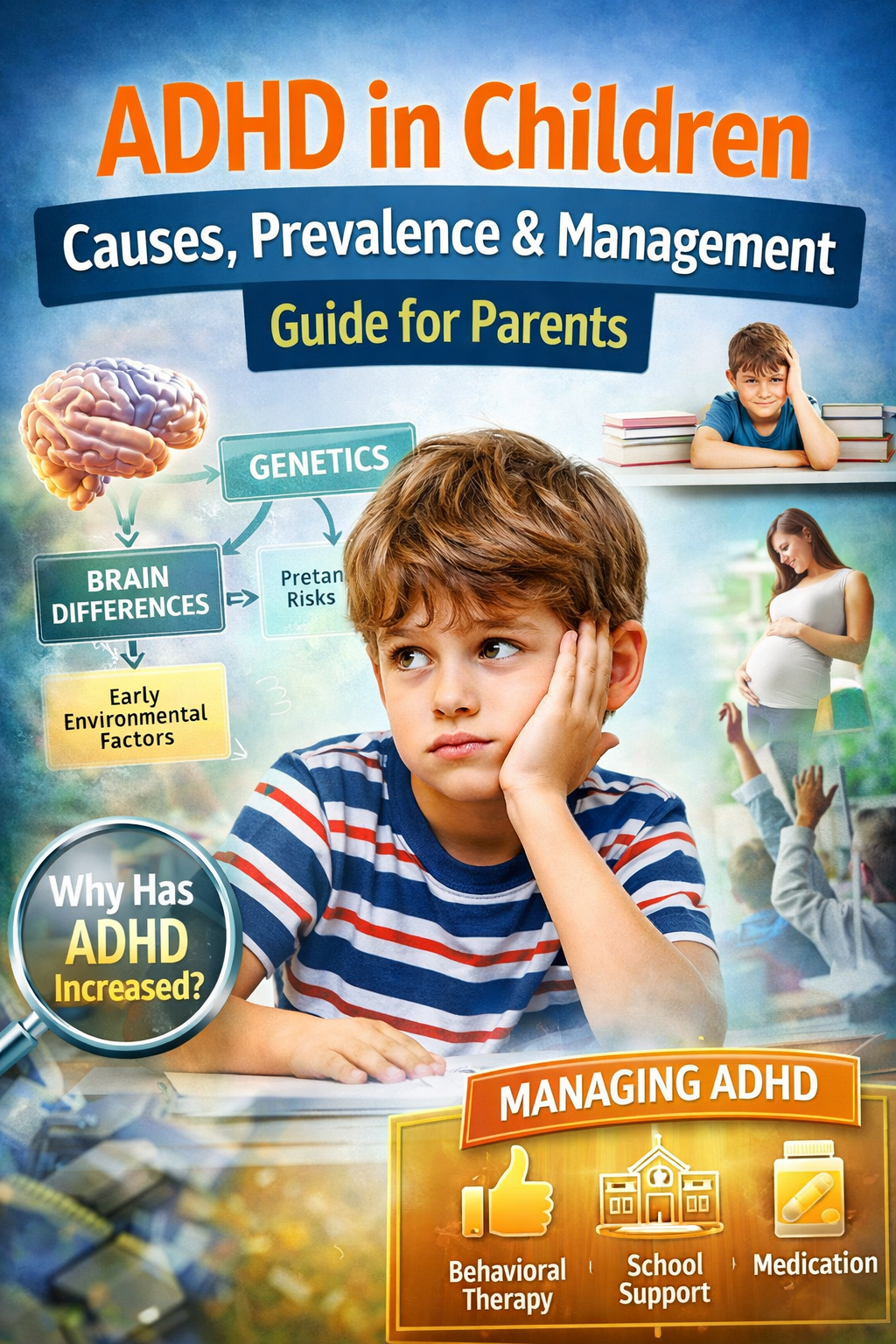
Attention-Deficit/Hyperactivity Disorder (ADHD) is one of the most common neurodevelopmental conditions seen in children today. Parents often ask:
-
Why is my child unable to focus?
-
Is ADHD increasing in children?
-
Can it be managed without medication?
The truth is — ADHD is not a result of bad parenting, screen time alone, or diet alone. It is a complex interaction of genetic, neurological, and environmental factors.
In this article, we break down:
✔ What causes ADHD
✔ How prevalence has changed over the last 20 years
✔ What actually works to manage ADHD in children
What is ADHD?
ADHD is a neurodevelopmental disorder characterized by:
-
Inattention
-
Hyperactivity
-
Impulsivity
Symptoms must:
-
Be present in multiple settings (home + school)
-
Persist over time
-
Affect functioning (learning, behavior, relationships)
What Causes ADHD in Children?
ADHD does not have a single cause. It develops through a multi-factorial pathway.
1. Strong Genetic Component
Research consistently shows ADHD runs in families.
-
Children with a parent who has ADHD are at significantly higher risk
-
Brain imaging studies show differences in attention and executive control networks
👉 This means ADHD is biological, not behavioural failure
2. Brain Development Differences
Children with ADHD may have:
-
Altered dopamine signalling
-
Differences in prefrontal cortex function
-
Delayed maturation of attention circuits
These differences affect:
-
Focus
-
Impulse control
-
Planning ability
3. Prenatal & Early-Life Risk Factors
Certain exposures during pregnancy and early life can increase risk:
A systematic review found that maternal substance exposure is associated with increased ADHD risk in children
4. Environmental Factors
-
Early toxin exposure
-
Psychosocial stress
These factors do not directly cause ADHD alone, but can increase vulnerability.
5. What Does NOT Cause ADHD (Important for Parents)
❌ Sugar alone
❌ Screen time alone
❌ “Bad parenting”
❌ Lack of discipline
These may worsen symptoms — but do not cause ADHD
Has ADHD Increased Over the Last 20 Years?
This is where things get interesting.
1. Diagnosed ADHD Has Increased
A large population-based study showed:
-
ADHD diagnosis increased from 6.1% (1997–1998)
-
To 10.2% (2015–2016)
Recent data suggests:
-
About 1 in 9 children (~11.4%) have been diagnosed with ADHD
2. But True Prevalence May Not Have Increased
Meta-analyses show:
-
No clear increase in true biological prevalence over decades
-
Variations are largely due to:
-
Better awareness
-
Broader diagnostic criteria
-
Increased screening
-
3. Global Prevalence
👉 Key insight for your audience:
ADHD is not “new”, but diagnosis and recognition have increased significantly
Why More Children Are Being Diagnosed Today
-
Increased awareness among parents and teachers
-
Better screening tools
-
Academic pressure highlighting symptoms
-
Reduced tolerance for behavioural variability
-
Expanded diagnostic criteria over time
How to Recognize ADHD in Your Child
Common signs include:
Inattention
-
Easily distracted
-
Difficulty finishing tasks
-
Forgetfulness
Hyperactivity
-
Constant movement
-
Difficulty sitting still
Impulsivity
-
Interrupting
-
Acting without thinking
👉 Key point:
Symptoms must be persistent and impair functioning
Evidence-Based Management of ADHD in Children
Management is multi-layered — not just medication.
1. Parent Training & Behavioral Therapy (First-Line)
Especially in younger children:
-
Structured routines
-
Positive reinforcement
-
Clear expectations
-
Consistency
This is one of the most effective non-drug interventions
2. School-Based Support
Children perform better when schools are aligned:
-
Sitting away from distractions
-
Task breakdown
-
Extra time for assignments
-
Movement breaks
3. Lifestyle Interventions
Sleep
-
Fixed sleep schedule
-
Screen-free bedtime routine
Physical Activity
-
Improves attention and executive function
Nutrition
-
Balanced meals (avoid extremes, not restrictive diets)
4. Identify Comorbid Conditions
Up to 70–80% of children with ADHD have another condition
Common ones:
-
Anxiety
-
Learning disorders
-
Sleep problems
-
Autism spectrum traits
👉 Treating these often improves ADHD symptoms
5. Medication (When Needed)
Medication is considered when:
-
Symptoms are severe
-
Functional impairment persists
-
Behavioral strategies are insufficient
Common options:
-
Stimulants (methylphenidate, amphetamines)
-
Non-stimulants (atomoxetine, guanfacine)
Evidence shows these are effective for symptom control, but must be:
✔ Individualized
✔ Closely monitored
6. Combination Approach Works Best
The most effective management includes:
✔ Parent training
✔ School support
✔ Lifestyle optimization
✔ Medication (if needed)
What Parents Should Focus On Daily
Simple, practical framework:
Structure
-
Same routine daily
Clarity
-
One instruction at a time
Reinforcement
-
Praise desired behaviour immediately
Movement
-
Regular breaks and physical activity
Connection
-
Strong emotional bonding improves outcomes
Common Mistakes Parents Make
Avoid these:
❌ Labeling child as “lazy”
❌ Constant scolding
❌ Comparing with other children
❌ Over-reliance on medication alone
❌ Ignoring school involvement
ADHD is Manageable — Not a Limitation
Children with ADHD can:
-
Excel academically
-
Be highly creative
-
Develop strong problem-solving skills
With the right environment, ADHD can become a strength, not just a diagnosis
FAQs
1. Can ADHD be cured?
No, but it can be effectively managed, and many children improve significantly over time.
2. Does screen time cause ADHD?
No. It may worsen symptoms but is not a primary cause.
3. Should all children with ADHD take medication?
No. Treatment should be individualized.
4. Will my child outgrow ADHD?
Some symptoms improve, but many children continue to have traits into adulthood.
5. Is ADHD overdiagnosed?
Diagnosis has increased, but true prevalence appears relatively stable when measured carefully.
You may also like:
-
👉 “Children Are Not Mini Adults: Understanding Brain Development”
-
👉 “10 Screen-Free Activities That Boost Your Child’s Brain Development”
-
👉 “Top 10 Brain-Boosting Foods for Baby’s Cognitive Development”
Final Takeaway
ADHD is not a parenting failure; it is a neurodevelopmental condition shaped by biology and environment.
Early recognition + structured support can transform outcomes for the child.
If you’re a parent struggling with focus, behaviour, or learning issues in your child:
👉 I offer doctor-led, evidence-based child development and nutrition programs tailored to your child’s needs
✔ Personalised routines
✔ Diet + behavior integration
✔ School support guidance
📩 CLICK HERE to get started.

Akanksha Sharma
Dr Akanksha Sharma (MBBS, MD) is a physician and women’s health nutrition specialist, and the founder of IYSA Nutrition. She provides evidence-based, doctor-led nutrition guidance for pregnancy, postpartum recovery, PCOS, child nutrition, and family health, helping women make calm, informed decisions about their health and their children’s well-being.



Leave a Reply