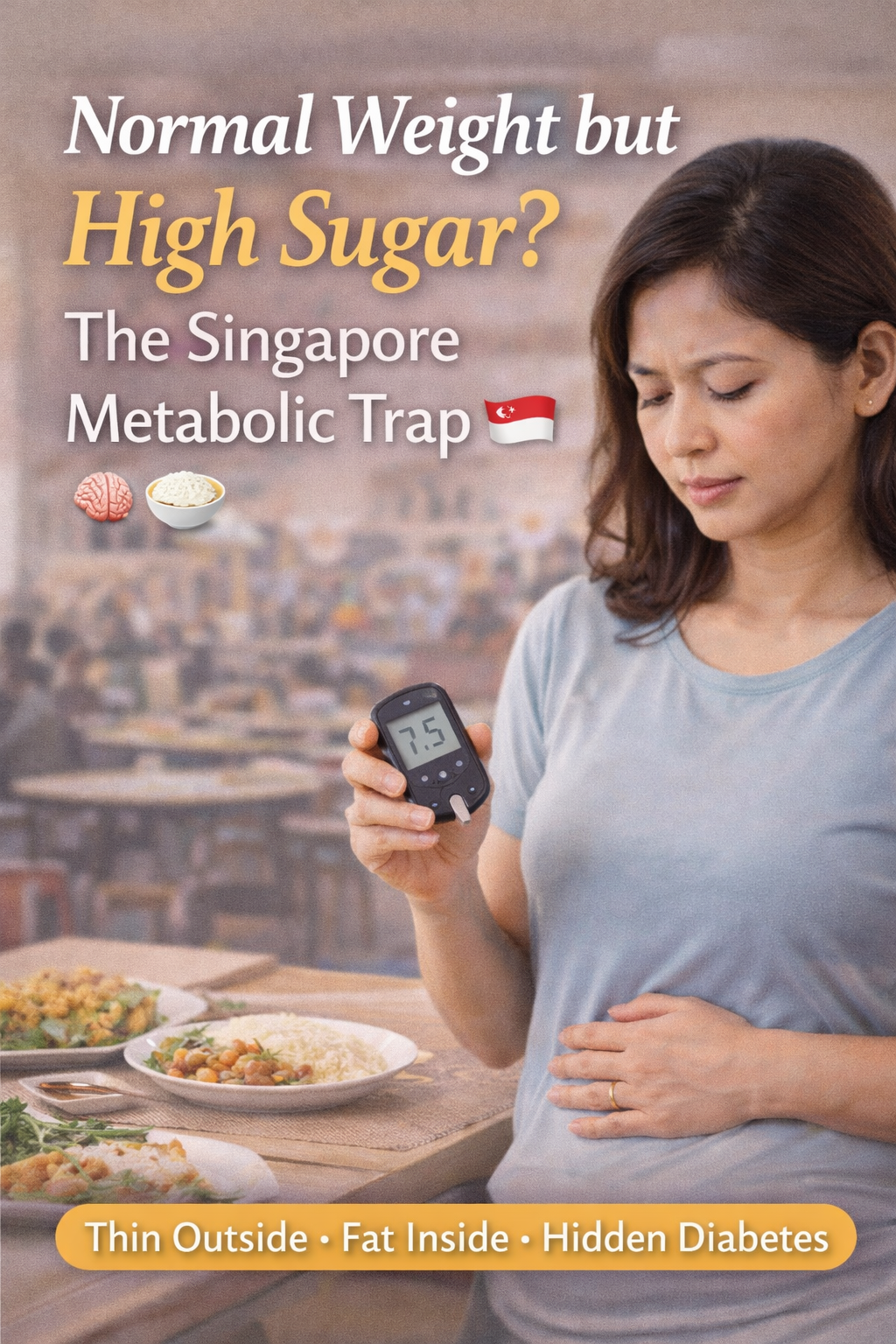
“I’m not overweight, so my blood sugar should be fine… right?”
In Singapore, this is a very common misconception—and it’s why many people get surprised by prediabetes, high HbA1c, or fatty liver despite looking “slim”.
This phenomenon is often described as being “thin outside, fat inside” (more visceral fat, less muscle), or normal-weight obesity / metabolically obese normal weight—and it can happen at a normal BMI, especially in Asian populations.
What the recent Singapore reports show (why this matters now)
Singapore’s National Population Health Survey (NPHS) 2022 reported that:
-
Diabetes prevalence among residents aged 18–74 was ~8.5% in 2021–2022 (down from 9.5% in 2019–2020).
-
Hypertension remained high at ~37% in 2021–2022.
-
Obesity prevalence (BMI-defined) was ~11.6% in 2021–2022—meaning many people with metabolic issues may still sit outside the “obese” category.
And from the National Nutrition Survey (NNS) 2022:
-
Wholegrains made up only ~4% of staples (recommended is much higher).
-
MOH also highlighted that 9 in 10 Singapore residents exceeded the recommended sodium limit (a marker of an overall “processed / hawker-heavy” pattern).
Bottom line: The environment makes it easy to have “normal weight” but still drift into insulin resistance.
Why “normal weight” can still mean “high sugar”
BMI is a rough screening tool—it does not tell you:
-
how much visceral fat (belly/organ fat) you carry
-
how much muscle you have (your glucose “storage tank”)
-
your liver fat risk (fatty liver)
Asian populations tend to have higher body fat % and more visceral fat at lower BMI compared with Western cohorts—so metabolic risk can show up earlier.
The Singapore metabolic trap: 6 everyday drivers 🍜🧋
1) “Staples-first” meals (high refined carbs)
Rice/noodles/bread make up most of the plate, while protein and vegetables are small. That pushes higher post-meal glucose, especially if repeated daily.
2) Hidden liquid sugar 🧋
Kopi/teh with condensed milk, bubble tea, canned drinks—even “juice”—can spike glucose without making you feel full.
3) Low wholegrains + low fibre 🌾
4) “Sedentary-but-busy” lifestyle 🪑
Even if you’re active sometimes, long sitting hours reduce glucose uptake by muscles.
5) Low protein (especially in busy vegetarian patterns)
Not enough protein → more cravings, less muscle maintenance, higher glycaemic load per meal.
6) Sleep debt + stress 🧠
Poor sleep and chronic stress increase appetite signals and worsen insulin sensitivity over time.
👉Indian vs Chinese vs Malay Diets in Singapore: Hormonal Impact Compared
Signs you may be “metabolically unhealthy” despite normal weight 🚩
You don’t need all of these:
-
Waistline creeping up (even if weight stable)
-
Post-meal sleepiness, cravings within 2–3 hours
-
Triglycerides high / HDL low
-
Fatty liver on scan
-
Acanthosis nigricans (dark neck folds)
-
HbA1c in the prediabetes range
A simple practical screen: track waist circumference + metabolic labs, not weight alone.
👉 Insulin Reset in Women Guide
👉Perimenopause & Hormone Support Guide (especially for women 35+).
What to do (Singapore-friendly, realistic) ✅
1) Upgrade your plate (without giving up hawker food)
The rule: Protein first → Veg second → Carbs last
-
½ plate veg (or 2 veg portions at cai fan)
-
¼ protein (egg/tofu/fish/chicken/dal/paneer)
-
¼ carbs (rice/noodles/roti)
👉How Healthy Is Hawker Food Really? A Doctor’s Breakdown
2) Make drinks “boring” most days 💧
Switch your default to:
-
water / unsweetened tea
-
kopi/teh siew dai or with no condensed milk
3) Add 10–15 minutes of walking after meals 🚶♀️
This is one of the most practical glucose-lowering habits (especially after carb-heavy meals). It cuts post-meal glucose spike by >50%.
4) Build muscle 2–3x/week 🏋️
Muscle acts like a glucose sink—more muscle = better sugar handling.
5) If you snack, snack with protein
Examples:
-
Greek yoghurt + nuts
-
Boiled eggs
-
Tofu/edamame
-
Roasted chana
📥 Download the Healthy Hawker Food Cheat Sheet (Doctor-Approved)
💬 If you’re normal-weight but your HbA1c is rising, you need a metabolic reset plan, not “eat less.”
👉 Book a consultation for a Singapore-friendly Indian/Chinese meal strategy.
FAQs 🙋♀️🙋♂️
1) Can I have diabetes or prediabetes if I’m slim?
Yes. Normal BMI doesn’t rule out insulin resistance—especially in Asians, where visceral fat risk can be higher at lower BMI. SAGE Journals+1
2) What’s a better indicator than weight?
Waist circumference, blood pressure, triglycerides/HDL, fasting glucose/HbA1c, and (where appropriate) fatty liver risk.
3) Is rice the main culprit?
It’s usually the pattern: large refined-carb portions + low veg/protein + sweet drinks.
4) What’s the fastest “first change” I can make?
Change drinks (remove daily sugar) + add a 10-minute post-meal walk.
PubMed references
-
Astrup A, et al. Dietary fat and obesity: still an important issue. Am J Clin Nutr. 2000
-
Yoon KH, et al. Epidemic obesity and type 2 diabetes in Asia. Lancet. 2006

Akanksha Sharma
Dr Akanksha Sharma (MBBS, MD) is a physician and women’s health nutrition specialist, and the founder of IYSA Nutrition. She provides evidence-based, doctor-led nutrition guidance for pregnancy, postpartum recovery, PCOS, child nutrition, and family health, helping women make calm, informed decisions about their health and their children’s well-being.