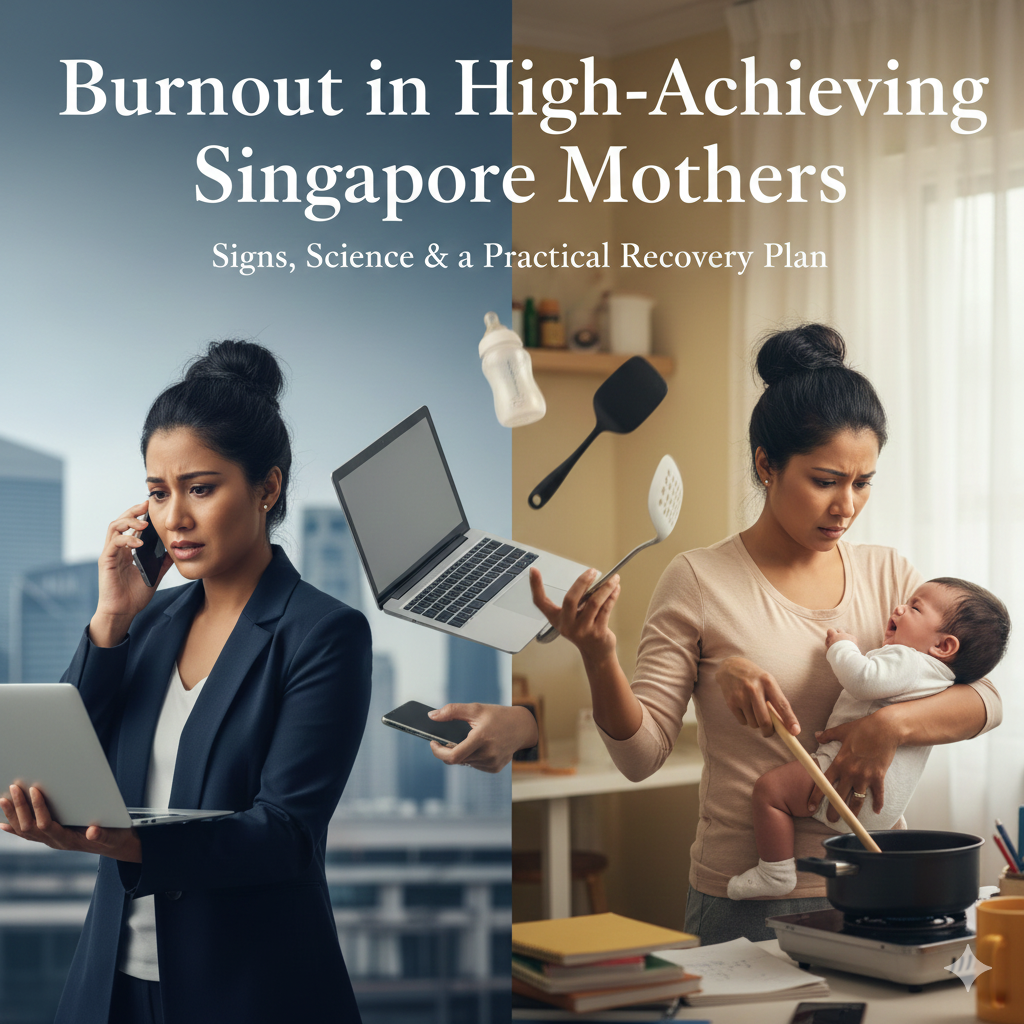
You’re the mum who “has it together.”
The calendar is colour-coded. The kids’ enrichment classes are booked. Work targets get met. Meals get planned. Family WhatsApp gets answered. And somehow—everyone still expects you to be pleasant about it. 🙂
If you’ve been feeling tired but wired, snappy, emotionally flat, forgetful, or like your brain has 27 tabs open… you’re not “weak.” You may be running on chronic overload—and that can look like burnout.
In Singapore’s high-performance culture, many mothers quietly function at 80–90% for months, until the body forces a stop.
Why “high-achieving mums” burn out more (even when life looks fine) 💼🏠✨
High-achieving mothers often carry a unique mix of:
-
High internal standards (“If I don’t do it, it won’t be done properly.”)
-
Invisible labour (planning, remembering, anticipating everyone’s needs)
-
Dual load (career + caregiving + household management)
-
Emotional labour (keeping the home calm, supporting kids’ emotions, smoothing family dynamics)
-
Performance parenting pressure (milestones, tuition culture, enrichment schedules)
Singapore-specific reality: workplace strain is real, and population mental-health indicators show a meaningful burden, especially in younger and mid-life groups. For example, Singapore’s National Population Health Survey 2024 reports poor mental health prevalence across adults, with women having higher rates than men overall.
And MOM-linked reporting based on an assessment tool has suggested that 1 in 3 workers report stress/burnout signals.
Even when we can’t label this “mother burnout statistics” specifically (Singapore-wide mother-only burnout prevalence is limited publicly), the context is clear: many women are operating under sustained stress load.
👉The CBD Survival Guide: Managing High Cortisol & Insulin Resistance in SG Work Culture
Burnout vs “normal tiredness” (a helpful distinction) 🔍
Normal tiredness: improves with one good rest day, better sleep, or a lighter week.
Burnout: doesn’t fully improve even after rest, because the demands restart immediately.
Common burnout signs in mothers
Body
-
Exhaustion that sleep doesn’t fix
-
Headaches, gut issues, muscle tension
-
Frequent infections / low immunity
Mind
-
Brain fog, forgetfulness, decision fatigue
-
Feeling “overwhelmed by small things”
-
Racing thoughts at night
Emotions
-
Irritability, numbness, guilt, resentment
-
Crying spells or feeling “emotionally flat”
-
Loss of joy in parenting
Behaviour
-
Procrastination, doom scrolling
-
More caffeine/sugar just to function
-
Withdrawal from friends, avoiding calls/messages
The science: why stress hijacks energy, appetite and mood 🧪
Burnout isn’t just “mental.” It’s whole-body physiology.
1) Stress + poor sleep → metabolic and mood disruption 😴
Sleep and stress interact with metabolism through neuroendocrine pathways (HPA axis). Chronic stress and sleep loss are associated with changes that can affect glucose regulation, appetite hormones and inflammation.
Translation: when you’re constantly stressed and sleeping poorly, it’s harder to feel calm, make good food choices, and sustain energy.
2) “Parental burnout” is a recognised syndrome
Research describes parental burnout as intense exhaustion related to parenting demands, emotional distancing, and a reduced sense of efficacy/fulfilment. It is distinct from job burnout and has specific outcomes.
3) It’s not only “busy mums”—it’s the mismatch of demands vs resources
A major framework explains burnout as a chronic imbalance: demands exceed resources (time, support, health, money, sleep, emotional bandwidth).
“High-achiever burnout” patterns I see often (relatable, not diagnostic) 💛
If any of these sound like you, you’re not alone:
-
The Over-Functioner: You do everything early, “so nothing goes wrong.”
-
The Good-Girl Mum: You feel guilty saying no, even to unreasonable demands.
-
The Hyper-Responsible Partner: You carry 80% of the mental load because it’s “faster.”
-
The Identity Squeeze: You’re excellent at work + home, but you’ve lost yourself.
The Action Plan: 7-Day “Stabilise First” Reset (realistic for Singapore mums) ✅🌿
Not a full life overhaul. Just stabilise your nervous system, reduce overload, and rebuild capacity.
Day 1–2: Do a “load audit” (10 minutes) 📝
Write 3 lists:
-
Must-do (health/safety essentials only)
-
Can-delegate (someone else can do 70% okay)
-
Can-drop (not needed this month)
Rule: if it doesn’t protect health, income, or key relationships, it may not be urgent.
Micro-script (use it today)
-
“I can’t take that on this week.”
-
“I’ll get back to you by Friday.”
-
“Let’s keep it simple for now.”
Day 3: Fix sleep before fixing everything else 😴
Choose two:
-
10–15 min morning sunlight exposure ☀️
-
No caffeine after 2 pm ☕
-
30–60 min “screen dim” rule before bed 📵
-
5-minute brain-dump journal (write the to-dos)
Sleep is a keystone habit—and it influences stress and metabolic regulation.
👉Perimenopause & Hormone Changes Guide
Day 4: Food that lowers stress load (not perfect diet) 🍲
Aim for:
-
Protein at breakfast (eggs/Greek yogurt/tofu/paneer)
-
One fruit + one fibre food daily (guava/berries + dal/veg/beans)
-
A “calm dinner”: soup + protein + vegetables (less heavy late-night digestion)
When stressed, extreme restriction often backfires. Think steady blood sugar + steady energy.
👉Gut Problems Common in Singapore Women (and What to Do About Them)
Day 5: The 10-minute nervous system reset (daily) 🧘♀️
Pick one:
-
4-7-8 breathing (2–3 rounds): Inhale through your nose for 4 seconds, hold the breath for 7 seconds, then exhale slowly through your mouth for 8 seconds. This activates the parasympathetic nervous system and helps calm anxiety and racing thoughts.
-
Box breathing (4-4-4-4): Inhale for 4 seconds, hold for 4 seconds, exhale for 4 seconds, and hold again for 4 seconds before the next breath. This steadies breathing, improves focus, and reduces stress by regulating the nervous system.
-
10-min slow walk after dinner 🚶♀️
You’re training the body out of “alarm mode.”
Day 6: Reduce decision fatigue with 2 templates 🍱
-
Breakfast template: Protein + fibre + fat
-
Lunch template: ½ veg + ¼ protein + ¼ carbs
-
Repeat meals for 3–4 days. High achievers burn out partly from constant decisions.
👉Best Morning Drinks for Singapore Weather (Doctor-Approved)
👉5 Science-Backed Morning Drinks to Balance Blood Sugar
Day 7: The “Support Upgrade” conversation 🤝
Pick one support point:
-
Partner: “I need you to own X completely (not help).”
-
Parent/helper: “Can you cover pickups twice a week?”
-
Work: “I can deliver A and B; C will need a later deadline.”
Burnout improves faster when resources rise—not only when you “try harder.”
Long-term: 4 boundaries that protect high-achieving mums 🛡️
-
One non-negotiable recovery block/week (even 45 min)
-
A “good enough” standard at home (70% is fine)
-
One low-effort meal plan system (repeat + swap list)
-
A monthly mental-load review with your partner (what you carry invisibly)
When to get professional help (a simple guide) 🧑⚕️
Consider support if you have:
-
Persistent low mood/anxiety, panic symptoms
-
Sleep disruption most nights
-
Inability to function at work/home
-
Frequent physical symptoms linked to stress
Singapore also has an increasing focus on mental health literacy and stigma reduction, which is encouraging.
Getting help is not “drama”—it’s maintenance.
Feeling burnt out but still “functioning”? You don’t need more motivation—you need a system.
👉 Book a doctor-led consultation with Dr Akanksha (MBBS, MD) to build your personalised burnout recovery plan: sleep + stress + nutrition + realistic routines for Singapore life.
Bonus: You’ll get a simple weekly template (meals + energy plan) you can actually follow.
PubMed references 📚
-
Parental burnout conceptual overview. PubMed
-
Parental burnout outcomes and comparison to job burnout. PubMed
-
Maternal burnout syndrome (contextual + psychological factors). PMC
-
Sleep, stress and metabolism (mechanisms). PMC
-
Systematic review on parental burnout and related factors. PMC

Akanksha Sharma
Dr Akanksha Sharma (MBBS, MD) is a physician and women’s health nutrition specialist, and the founder of IYSA Nutrition. She provides evidence-based, doctor-led nutrition guidance for pregnancy, postpartum recovery, PCOS, child nutrition, and family health, helping women make calm, informed decisions about their health and their children’s well-being.